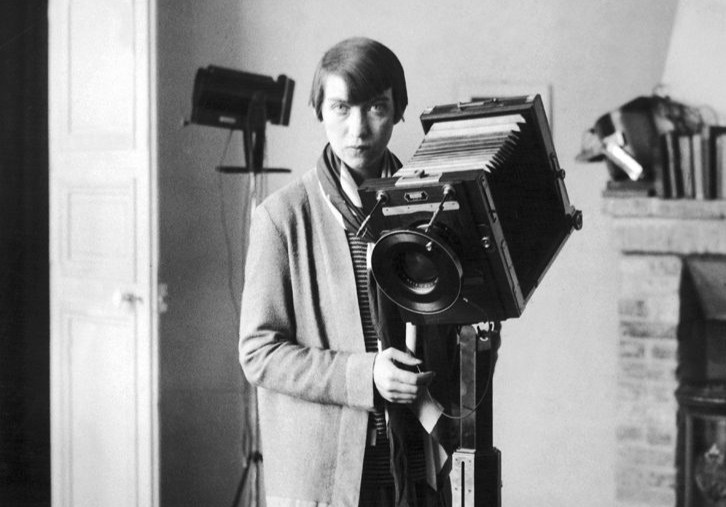
A major practitioner in the 20th century, Berenice Abbott–well known for her images of New York City in the 30s and 40s–looks at the first one hundred years of the development photography as an art from.
‘Photographer as Artist’ by Berenice Abbott from Art Front. Vol. 2 No. 9. September-October, 1936.
More than a hundred years have passed since Nicephore Niepce and Louis J.M. Daguerre made the discoveries from which modern photography has evolved. In that century of experimentation and technical development, the machinery of photography has been tremendously improved, with the invention and perfection of lenses, shutters, cameras and sensitive materials making possible photographic achievements undreamed of in the medium’s early days. Faster lenses with better optical correction have resulted in ever greater speed, as have faster plates and films. Here in the compact neat box of the camera and in the precise scientific procedure of the darkroom is the real 20th century medium. Speed—that is the characteristic which differentiates the 20th century from preceding centuries. Speed of transportation, speed of communications, speed of technological evolution, speed of manufacturing processes, these tangible applied scientific expressions of speed have as their intangible psychical counterpart the speed with which history in our time has accelerated its tempo. Speed is, therefore, the first quality that the art of the 20th century must possess. Practically, photography with its present ultimate of the f. 1.5 lens is able to catch the tangible and physical aspects of speed, by which the intangible and psychical aspects may be suggested. No other medium has this capacity for instantaneous observation, this all-seeing eye which (in comparison with the painter or draftsman) seems to function with the speed of light.
It is a cliche that 19th century painting had to turn away from representationalism because the emerging technic of photography could do the representational thing far better than could the brush or pencil. In art (by which was meant the plastic and pictorial arts, but not the photographic) there was no place left for the artist to go but toward abstract and experimental manners. Today having for the time being exhausted the exploration of these abstruse and cerebral areas, art must turn again to realism for the sustenance of solid subject matter. The trend away from romanticism, of whatever sort, whether of the emotions or of the intellect, creates the need for a medium which can deal adequately and faithfully with the complexity of 20th century life, which can convey with fervor and completeness the present’s social and documentary emphasis.
Yet, although photography is technically equipped for its 20th century role, there is no general acceptance of the medium, certainly not by the lay public and regrettably often not by practitioners of the older art mediums. If anything would make an honest woman of photography, one would think it would have been the unquestioned esthetic achievements of pioneers like Nadar, David Octavius Hill, Brady and Atget. The work of these early photographers attained a high degree of excellence, not only in a documentary sense but also in a formal sense. Their prints show, whatever the limitations of early photographic equipment, a profound concern for composition, Organization of forms, and textures. By virtue of the simplicity and directness enforced on them because of the limits of 19th century photographic apparatus, i.e., slowness of lenses and plates, they preserve in their work the qualities of the great pictorial tradition, arrangement within an area, occupation of two-dimensional space, etc. If photography never went beyond Atget, it would still have left enduring monuments of art.
As implied above, photography today has far greater technical capacities than it had during its first century of life. The anastigmatic lens, the compound shutter, the bellows camera, the color-sensitive film, all collaborate to widen the photographer’s horizon. This self-evident truth is understood and accepted by some present-day photographers and critics. However, a wider public acceptance is necessary before photography can completely fulfil itself as the twentieth century medium.
In the evolution of photography as an art there is a clear and continuous tradition, The early daguerreotypes (the first latent images of a sensitive emulsion) often possess that intellectual and esthetic addition made by the artist to his subject which we say constitutes the difference between art and nature. The portraits of Nadar and of Hill, the latter originally a painter, the powerful Civil War scenes of Brady, the vast Parisian panorama of Atget, these are the sources of an authentic photographic tradition for contemporary workers in the medium. Here we have masterpieces of art equal in quality and merit to the oils, water colors and prints of the times in which these men lived and worked. Already it has been demonstrated that photography is an art. This is all the more notable because a century is an extremely brief period of time for a new invention to achieve a form and personality of its own. Now it remains for photographers to go forward from the point reached by their nineteenth century forebears,
In applying photography to the problems, historical and artistic, of the twentieth century, the photographer can, however, be greatly aided by a glance, even if but cursory, at the work of these pioneers who emancipated photography from its slavery to painting and thereby set the standards for it to function as an independent art. From the earliest announcements of the new chemico-physical process discovered by Daguerre and Niepce in 1830, there was an immediate appreciation of its potentialities for art. Daguerre was himself a painter and lithographer; Niepce had experimented with lithography. Thus when the scientists of Paris came to examine the new invention, it was but natural that we should find them saying as did the physicist, Dominique, and the chemist, Gay-Lussac, that the most significant contribution of the daguerreotype was its “usefulness for art” and the daguerreotype was a means of “representing still life with a perfection unattainable in the usual procedure of drawing and painting, a consummateness like Nature’s own.”
To the scientists’ enthusiasm was added that of the painter, Paul Delaroche. Photography, he said, would be “of infinite service to the arts,” “it so far realized certain essential requirements of art” that it would eventually “become an object of study and observation for even the most distinguished painters.” Today with Siqueiros painting in duco in photographic enlargements and with every other easel painter possessing himself of a miniature camera, these are certainly words of prophecy. Delaroche’s last word on the subject was: “From today, painting is dead.” A few years later, the Frenchman, Disderi, and the Englishman, Robinson, wrote treatises on “Photography as a plastic art” and sought to found an esthetics of photography.
The real fathers of photography as an art were not, however, the men who wrote critically or scientifically of its possibilities but the pioneers who utilized those possibilities, Daguerre, David Octavius Hill, Matthew Brady, Nadar (pseudonym for Gaspard Felix Tournachon) and Atget. The daguerreotypes often possess great beauty of form and quality as well as historical value. They were, nevertheless, limited, especially by the fact that but a single copy could be made. Almost simultaneously with Daguerre and Niepce, the Englishman, Fox Talbot was experimenting with the camera obscura, which he first used as an aid in drawing landscapes in Italy. Ultimately he invented the calotype, printed from paper negative on silver-chloride paper. And from this invention came a notable body of work, the portraits of Hill.
In Hill’s history we have an extraordinary example of how science saved a man from oblivion. A second or third rate painter, Hill become a master photographer. Starting his photographic career because he wanted to paint a large historical canvas of a Scottish religious assembly, an affair of some 57 square feet with 500 faces, he found himself carrying on, as it were by a miracle, the tradition of English portrait painting. His calotype portraits, ranging in tone from a delicate violet to sepia and dark brown, are a national gallery of the middle class of his time. They possess, besides their documentary significance, great formal and pictorial merit. Here we have, as we have later in Atget’s case, the spectacle of an artist who seemed determined to torture himself with the limitations of his machine; for Hill never took advantage of later discoveries in lenses and processes, but continued with his simple lens, which required that sitters would have to hold a pose from three to six minutes. Here again we have the sense that these physical limitations were welded into form by the will and conscious intention of the photographer.
With Nadar also photography proved itself as a medium for portraiture. In one year, 1859, a series of inspired portraits came from his studio, representing the whole intellectual life of Paris,—Berlioz, Ciceri, Daumier, Dore, Gautier, Guizot, Millet, Philippon and many others.
But it remained for other men to widen the field of photography, notably the American Brady, best known for his Civil War scenes. A boy of 16, he had begun his experiments in the same year that Niepce’s and Daguerre’s invention was announced. At 19 he set up a studio at the corner of Broadway and Fulton; and his portraits quickly won him fame, as well as blue ribbons at various world’s fairs. In 1850 he published “A Gallery of Illustrious Americans,” equally successful. In 1855 he took up the newly invented wet plate process and widened his business activities, opening a second studio in New York and one in Washington. It was the financial proceeds of this very American enterpreneuring which enabled Brady to make his really remarkable photographs of the Civil War. He bankrupted himself in this adventure. But the world is richer by the first great documentary photographic record, though unfortunately the archives of the War Department in Washington is scarcely the place for a national artistic monument.
Here photography had reached out to picture the world of action. There was no posing of dead men, no stage setting for battle scenes. It was reality he photographed, the objective world, a world which in this case happened to be a world of war and death. Here in a sense was the birth of the moving picture, the emerging mood which made it necessary for science to create ever faster and faster photographic apparatus with which to capture the accelerating tempo of history.
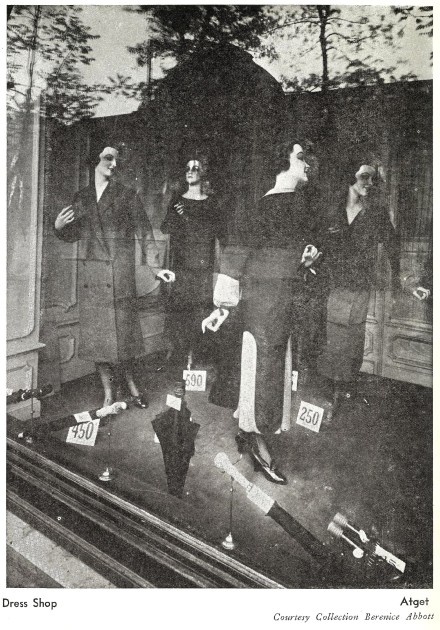
Atget, coming a quarter of a century later, did not find himself confronted with war as his theme: His theme was society, its facades and bourgeois interiors, its incredible contrasts and paradoxes. It was the vast scope of this world, the changing 19th century world, that Atget sought to imprison in his photographs. Because of the extreme sensitiveness and beauty of his conception, one cannot but state unequivocally that in the creation of the tradition for photography no one man has played a greater part.
Eugene Atget died in 1927, for all practical purposes unknown and unsung. Working for over 30 years with primitive equipment, critically handicapped by lack of funds, Atget nevertheless produced a vast bulk of work, the most beautiful photographs yet made. Armed with a crude dix-huit et vingt-quatre camera, heavier and less compact than the standard 8×10 of today, having only one lens, a rectilinear which gave depth of focus at the cost of loss of speed, Atget worked within the limits of his machinery, transmuting these very limitations into positive esthetic virtues, whether by intuition or by conscious intention we cannot dogmatically state. However, the internal evidence of his prints leaves no doubt that he was a great master.
A provincial actor till he was 40, Atget set himself up in Paris with a shingle which read “Documents pour artistes.” Since he was almost totally unrecognized in his lifetime, it is hard to speak with authority of his real motives and ideas; he did not speak, in his old age, of what he sought in his work; he only did the work and left it to speak for itself and him; and indeed, his work is the best source book for knowledge of his principles. One cannot say, therefore, whether this sign contained an ironic note as well as a utilitarian one. The fact remains that many well known Parisian artists did buy photographs from Atget, to include them as details in their canvasses, among their number being men as far apart in their styles as Utrillo and Braque.
The sale of documents for artists was, however, only an incidental occupation for Atget. His real business, after he belatedly found his metier, was to create an incomparable photographic portrait of Paris, its architectural monuments, its palaces, its fountains and grilles, its markets and street-vendors, its “boutiques” and brothels, its petit-bourgeois interiors and rag-pickers’ huts, trees in the parks of St. Cloud and Versailles, plows and peasants’ carts in the outskirts of the city. To carry on this work, Atget was compelled to sell his photographs for a few francs apiece—when he could—thereby securing funds to buy more plates and printing paper. But, from the fury and passion with which he devoted himself to his self-appointed task, it is clear he knew very well in the depths of his own heart that he was creating a body of work of great value and importance. In his old age he was a silent man, who did not expose either his work or his heart to the world. But he worked away unrelentlessly, producing thousands of photographs which except for a miracle would have been lost to the future.
One cannot say of Atget that his work has influenced contemporary photography to any great extent. His work was barely known when he died a decade ago; it is little known now, unfortunately. Yet the values that control his creative effort are standards which should be basic in that tradition for 20th century photography of which we are speaking. These values are a relentless fidelity to fact, a deep love of the subject for its own sake, a profound feeling for materials and surfaces and textures, a conscience intent on permitting the subject photographed to live by virtue of its own form and life, rather than by the false endowment of memory or sentimental association.
To carry these principles into effect, Atget used legitimate devices of the artist. Distortion, not in a self-conscious intellectual fashion, but in an intuitive and visual sense, was one of these devices. Plainly Atget deliberately makes use in some of his pictures of the distortion forced upon him by the inadequacy of his one lens, a rectilinear which (while it gave great sharpness of definition to his images) had many shortcomings, such as lack of coverage, curvature of the field and lack of speed. But aside from this rationalization of his handicaps, Atget had a strong esthetic awareness, manifested for example in the way in which his photographs express the very air of Paris, gray and moist. Here he presented a physical fact which had a wider significance than the mere visually observed object; only through selection of such significant facts can the artist create reality; and this reality Atget did indeed create in his work, which becomes thereby the demonstration of photography as art and the foundation of the tradition for photography.
Art Front was published by the Artists Union in New York between November 1934 and December 1937. Its roots were with the Artists Committee of Action formed to defend Diego Rivera’s Man at the Crossroads mural soon to be destroyed by Nelson Rockefeller. Herman Baron, director of the American Contemporary Art gallery, was managing editor in collaboration with the Artists Union in a project largely politically aligned with the Communist Party USA.. An editorial committee of sixteen with eight from each group serving. Those from the Artists Committee of Action were Hugo Gellert, Stuart Davis, Zoltan Hecht, Lionel S. Reiss, Hilda Abel, Harold Baumbach, Abraham Harriton, Rosa Pringle and Jennings Tofel, while those from the Artists Union were Boris Gorelick, Katherine Gridley, Ethel Olenikov, Robert Jonas, Kruckman, Michael Loew, C. Mactarian and Max Spivak.
PDF of full issue: https://www.marxists.org/history/usa/parties/cpusa/art-front/v2n09-sep-oct-1936-Art-Front.pdf

