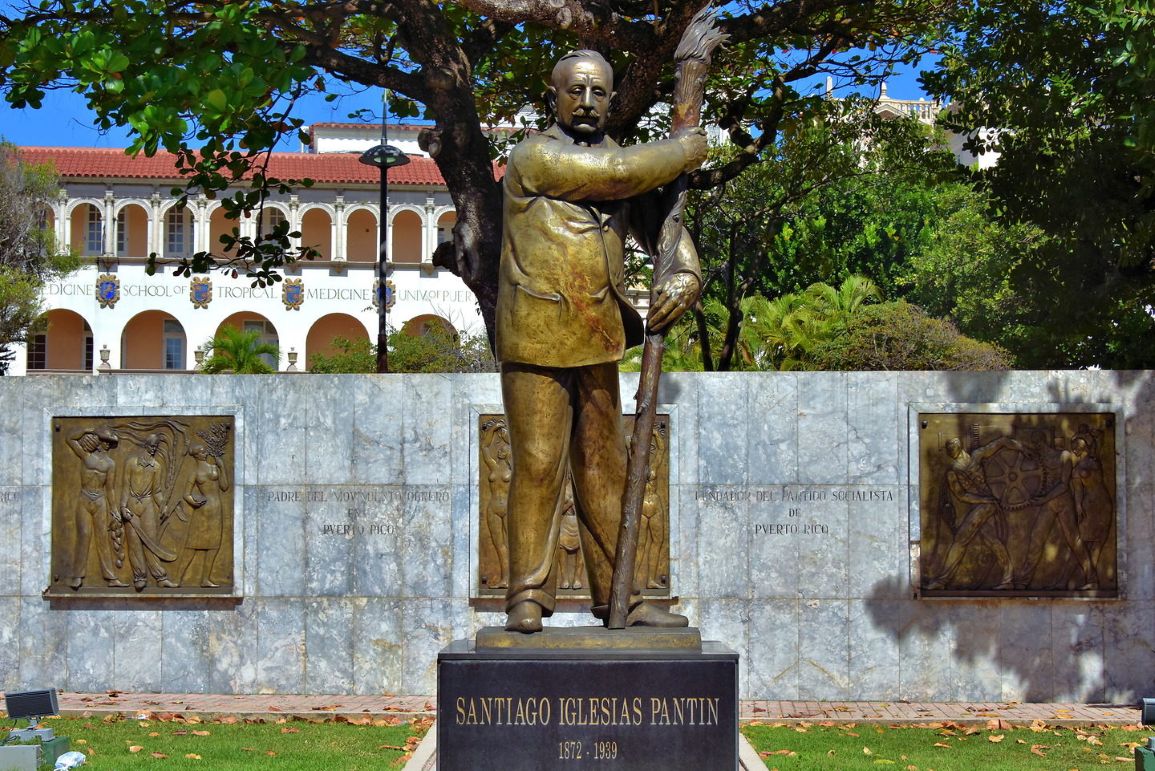
The woeful historic role of the ‘Socialist’ Santiago Iglesias, a Puerto Rican protege of Samuel Gompers.
‘Senator Iglesias of Porto Rico, Tool of American Imperialists’ by J. Nevarez from The Daily Worker. Vol. 4 No. 170. August 1, 1927.
Organizer, Communist League of Porto Rico.
Santiago Iglesias, honorable senator and leader of organized labor in Porto Rico, shares with Don Antonio Barcelo the political leadership of the island. In Porto Rico, Sena- tor Iglesias is hailed as Barcelo’s future rival for the office of governor should the colony be granted political autonomy (which the two above mentioned are jointly campaigning to secure from congress) or as the logical senator from Porto Rico, should the impossible happen and Porto Rico be admitted to statehood. In the convention of the Pan-American Federation of Labor, however, Iglesias presents a pitiable picture, a meek and most perfect flunkey of the leaders of the American labor bureaucracy, an interpreter for President Green to whom he bows with meek reverence at the slightest nod.
It was at the last convention of the Pan-American Federation of Labor that Iglesias was given the post of Spanish secretary to that body, a job which he deserves for his services to American imperialism in Porto Rico. Iglesias has proved his ability to stem the tide of anti- imperialism developing in the labor movement of Latin America.
Faker Betrays Latin Labor.
The island of Porto Rico, the first of the colonies secured in the war with Spain, to be completely subjugated to the will of Wall Street, served as a sort of experimental laboratory for the American imperialist. With Gompers’ aid, the scheme was conceived of bringing the labor movement of Latin America under the domination of Wall Street’s labor lieutenants. Santiago Iglesias is a by-product of this experiment staged in Porto Rico, and the organization in 1918 of the pan-A. F. of L. is the result.
Porto Rico, previous to the Yankee invasion, was a country of small, diversified agriculture, the land being, for the most part in the hands of small land owners, with large families and tenants depending on them. The semi-feudal social forms of old Spain prevailed there.
With the American invasion in 1898, the change from a colony of semi-feudal Spain to that of a modern highly developed imperialist power, effected an immediate economic revolution in the island. The immediate penetration of American finance, thru the National City Bank of New York and others, led to the hasty expropriation of thousands of landowners, estimated to date about 40,000 titleholders plus their dependents. Thousands of the island’s besa and most fertile acreage
At fell into the hands of American and other foreign corporations, who de- voted these lands to large agriculture, sugar, tobacco and coffee cultivation. The thousands expropriated were forced into wage slavery, to labor in the plantation sugar mills and tobacco factories. Porto Rico then became the scene of the most brutal exploitation of workers; hours, sunrise to sunset; wages 60 cents per day, together with the plundering of the wealth created, by the stockholders, coupon clippers, in the form of profit and “earned” dividends.
Exploited Workers Revolt.
Such conditions did not long prevail without creating a feeling of revolt among the masses of exploited, which gave birth to the desire for workers’ organization. This movement for workers’ organization came under the leadership of Santiago Iglesias, an anarchist emigre from Spain, who because of his experience in the anarchist movement in Spain, and wider experience in work of agitation among the masses, became outstanding in the workers’ movement in Porto Rico and was trusted by the workers to lead them.
American economic and political rule in Porto Rico is not entirely free from resistance on the part of the Spanish and native capitalist class. On the contrary, the resistance offered the Americans by the native bourgeoisie, primarily of a political nature, was one that worried the American authorities. Thus the outstanding political leader of the Porto Rican and Spanish bourgeois, Luis Munoz Rivera, fought the American political administration, demanding political independence for the island, until 1915, when he capitulated to American political rule. The American rulers sought means to overcome this resistance on the part of the bourgeoisie and prevent any mass movement coming to the support of the “independendistas” (at that time the unionist party) 1900-1915. And here is where Sam Gompers came to the assistance of American imperialism.
Gompers Bribed Iglesias.
The A. F. of L., through the good graces of Gompers, became interested in the workers’ movement led by the anarchist and militant Santiago Iglesias, who rallied workers and peasantry to organize and fight their exploiters, both foreign and native, and who therefore was constantly persecuted and jailed by the local authorities and his life threatened.
Gompers saw in the movement led by Iglesias an opportunity of winning mass support away from any independence movement led by native: bourgeoisie and bringing the workers to the support of American domination.
The Executive Council proceeded by extending offers of material and other practical assistance to Santiago Iglesias in his efforts to organize the workers, and creating a labor organization whose avowed aim would be to strive to eliminate the semi-feudal condition which oppressed the masses, and raise the standard of life of the Porto Rican masses to that of the American workers on the continent. The American authorities cooperated with the A. F. of L. in offering Iglesias protection in his mission, a thing of which Iglesias speaks with sentiments of almost childish grate- fulness and admiration.
Thus, by such methods of bribery the American rulers won over the leader of the workers’ movement and the masses of workers. Iglesias to this day is an ardent exponent of American “democratic” institutions, a preacher in Latin America of Gomperism and the good intentions of the Yankees. The following shows how Iglesias bows until his nose touches the tips of the Yankee boots; thus in upholding American administration he speaks to workers in Porto Rico:
“In office where questions affecting laborers are to be passed on, we need Americans who are accustomed to treat laborers like people, not caciques (native bourgeoisie) who believe laborers to be inferior beings.” (Union Obrero March 16, 1912.)
Hence followed the creation of the Free Federation of Workingmen of Porto Rico, affiliated to the A. F. of L., whose policies are dictated by the A. F. of L. executive council and administered by Iglesias and his gang of retainers.
The workers of Porto Rico, however, took the organization of the Federacion Libre seriously, considered it as a means by which they could organize and struggle for better conditions. Thus the workers rallied around the Federacion Libre, until its ranks in 1916-7 counted 80,000 members, and, during the war years, Porto Rico became the scene of great mass strikes in the sugar, tobacco, and all other industries on the island.
The Daily Worker began in 1924 and was published in New York City by the Communist Party US and its predecessor organizations. Among the most long-lasting and important left publications in US history, it had a circulation of 35,000 at its peak. The Daily Worker came from The Ohio Socialist, published by the Left Wing-dominated Socialist Party of Ohio in Cleveland from 1917 to November 1919, when it became became The Toiler, paper of the Communist Labor Party. In December 1921 the above-ground Workers Party of America merged the Toiler with the paper Workers Council to found The Worker, which became The Daily Worker beginning January 13, 1924. National and City (New York and environs) editions exist.
PDF of full issue: https://www.marxists.org/history/usa/pubs/dailyworker/1927/1927-ny/v04-n170-Nat-aug-01-1927-DW-LOC.pdf

