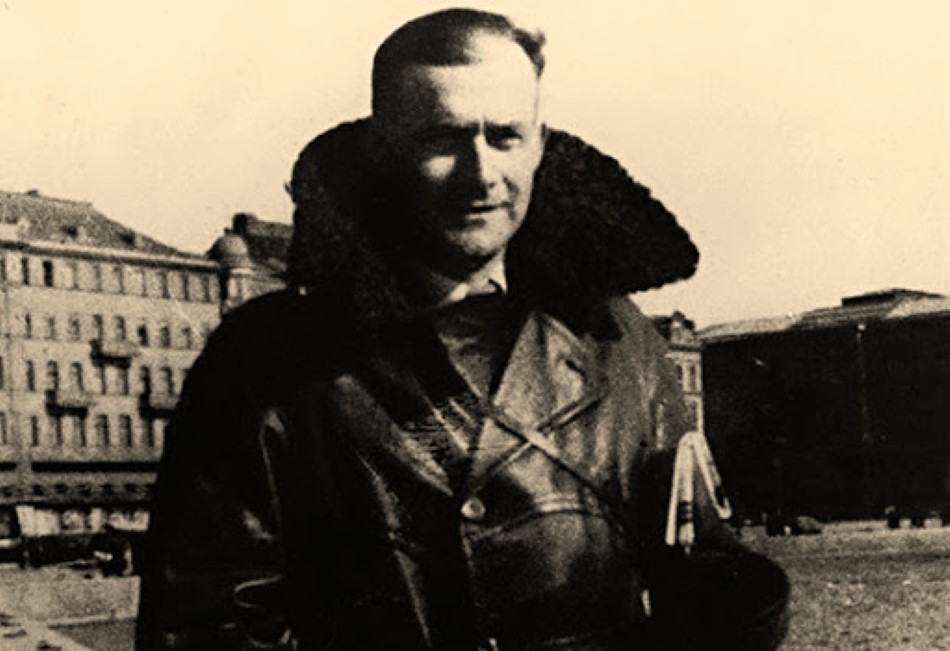
A figure of the the post-war radical German theater, best known as the author of Sailors of Cattaro, Wolf exiled by Nazi rule, surveys the changing impact of the First World War on written drama and their stage productions.
‘Western Drama of the Imperialist War’ by Friedrich Wolf from International Literature. No. 1. 1936.
A future historian writing on the imperialist war of 1914-18 would certainly begin by drawing attention to the struggle of the large financial groups for raw material and markets and for the re-division of the world. However, he can not disregard the important spiritual reflection of these complicated events: the drama of the imperialist war.
The World War as shown in the drama gives a true picture of man’s convictions at that time, it shows the state of consciousness existent in the masses in its most varied phases of development. In the first phase, the dramatist marched alongside the flag as nationalist drummer. The “meaning” of war is defense of the fatherland, the awakening of manly virtues, of courage and comradeship and of the “true unto death” feelings, all of which was greatly praised by the chaplains. It means the birth of the “heroic man,” which today, on the eve of new enterprises, should be revived in the “steely romantic poetry” of Goebbels. A typical war play of this phase is Hias. It depicted the Bavarian soldier in all his greatness, typical of the trench fighters, as a comrade, true to the core, gentle as a lamb with women, but when it is a question of the enemy, then forward with knife in hand and no mercy! Moreover, we witnessed classical war plays behind the front and in our own countries: The Persian of Aeschylus and the Prince of Homburg by Kleist. Besides Ladies’ Tears and Hussar Fever and the military farces by Blumenthal-Kadelburg, they also carried out their purpose during the imperialist war, that was, the justification of the noble yet happy-go-lucky character of the military profession.
Four years of trenches, filth, lice, starvation, gas and grenades; four years of imprisonment in gun turrets and steel casements on war vessels, shot to smithereens by an invisible foe, and at home the children growing up undernourished and rickety, and wives with yellow faces working in the munition factories. An atmosphere of disaster, of apocalypse, the war as a “catastrophe of actuality,” prevailed. The nihilistic phase in war drama began. It finds most audacious expression in Karl Kraus’ The Last Days of Mankind. It reflects the dismal and terrible hopelessness of the crushed masses, and at the same time it shows the anarchist intrigues of the Viennese court and of the press.
Escape from Reality
In those days, the international youth and the Spartakusbund of the west were still far too limited. At this time Stephen Zweig’s Jeremiah appeared, an analogous play dealing with the years 1914-18. In Jeremiah too, the principles are nihilistic, fogged over with a mist of pacifism. One summoned God, but he answered not; one wishes to show the people the way to peace, but the blinded people will not see; therefore they must perish…on the whole, a fatalistic and nihilistic outlook.
Then fronts were broken down. In spite of the bold revolt of the Kiel sailors, in spite of the heroic fighting of the workers at Marstall, in Berlin and in Munich, as yet there was no bolshevik party which could take the lead. The world war was not liquidated by the workers’ and soldiers’ soviets but by the “democratic” generals Lutzwitz, Merker, Epp and Mulier of the Ebert-scheidemann republic. The facts are well known. And how did the majority of the masses react at that time? War is at an end. Now we only demand one thing: No more shooting! Peace! This mood is reflected in the third phase of war drama, in the pacifist play. A Generation by Fritz V. Unruh typifies this phase. In this case, the war throws a flaring torch in the midst of a family; the brothers murder one another, and over the bodies of her dead son the mother points out the path to the future. This play with its ecstatic style, its many metaphors and its numerous individualistic outbursts, is one of the few successful “expressionalist” dramas. To this category also belong The Transformation by Toller and Das Bist Du by Wolf and Naval Battle by Goring. They all cussed the war furiously and burned their books; but they could not suggest any course to be followed. What we lacked then was every vestige of Marxist foundations. We wrote poetry according to our sense of feeling. About “brother man.” Means of production played no part in this “Oh Man’ drama. “Man” was everything. Man’s heart was the driving force of the world. Goring’s Naval Battle has merely brought to the stage the narrow gun turret of a canon on a cruiser which was bound for the Skagenak battle. The cast consists of five sailors, The theme: Is it possible for these five sailors to find a way of escape from this gun turret, hemmed in by death? And how? They think of a hundred ways, but find none. Their concluding words, said as the deadly gas grenade penetrates the turret, are: “It was good to have shot, it would have been better to have mutinied!” A helpless, leaderless meandering in the chaos of those days. Hasenlever and Werfel fled with their pacifist plays Antigone and The Trojans into the ancient. The Frenchman Reynald retired into the individualistic with his play Tomb of the Unknown Warrior.
Back to Life
After 1928 the impossibility of a genuine stabilization of world economy became obvious. The crisis also affected the “victorious countries,” a new arrangement for the interested parties was necessary in spite of all peace conferences, a monstrous armament race began. And now the dramatists also began to think much more calmly and concretely on the problem of the past and that meant also the future, war. The fourth phase in war plays, that is, the realistic phase began. These dramas asserted that they told the complete truth and reality of the war. War “as it really was.” But how was the war “really?” That question still remained unsettled. The question was asked much more directly, more to the point, and more calmly. Suddenly a whole series of trench plays appeared: headed by Journey’s End by Sheriff and Die endlose Strasse by Hintze and Graff, and lastly the play P G (Prisonnier de guerre) by Wanner which deals with an internment camp. These plays are fundamentally different from any preceding plays. They no longer described the war as a gigantic death dealing volley of shots, or as the apocalyptical millennium, or as “fratricide;” they concentrated more on depicting the dreary monotonous every-day routine of the trenches: lice, boredom, hunger, theft, alcohol, yes and even “nerves,” meaning cowardice; they described the parasitic life of the generals and (Etappenschweine) brass hats with soft jobs as compared with the soldiers, every detail was distressingly true, almost exaggeratedly realistic in an endeavor to reproduce the authenticity of trench life. Suddenly the order to “attack” is given, and then comes the great trench experience: the entire trench garrison, whether officer or soldier, manufacturer or worker, now form a single compact front against the common enemy. There are no class differences here in the trenches, here in the shame and filth and under the same fire they are all “class brothers,” all of them, whether rich or poor, are threatened! by the same death, they are all protecting their one country with their bodies. Elimination of class by means of “bloody” trench experience!
The New Drama
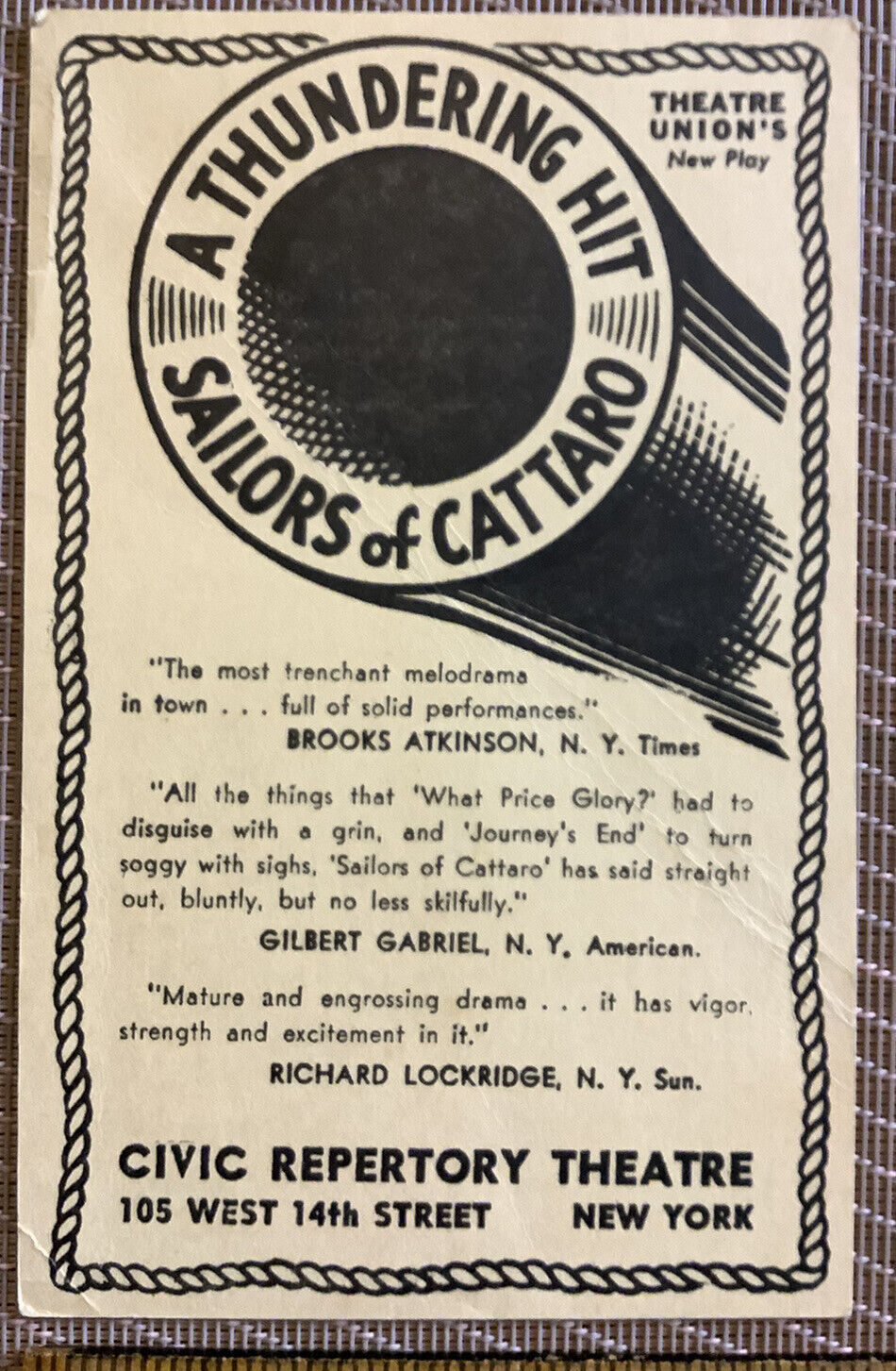
Here we already clearly see the phase of the social Volksgemeinschaft (People’s community), the most important left expression of the Hitler ideology. But all these plays forgot one small point: the hinterland they forgot the children dying of starvation and disease, the women with tallow colored faces working in the munition factories. They also forgot the patriot Stinnes, who during the war sold his railway lines both to the German and French military headquarters. A different result and outlook were attained by the three naval plays: The Kaiser’s Coolies by Plivier—Piscator, Fire from the Caldron by Toller and The Sailors of Cattaro by Wolf, which all appeared in Berlin in the winter of 1930-31. In this case experience of war does not result in a united Volksgemeinschaft, in any strong feeling of comradeship as between officer and soldier, on the contrary, here their mode of living, in such closeness with one another, in the narrowness of the armored ships, results in acute class struggles between lieutenant and sailor and leads to revolt. “The enemy is in your own country,” this slogan of Karl Liebknecht now rings in the crew’s quarters. England is not the enemy! The enemy is on our own ship! These plays for the first time consider the hinterland question. In Sailors of Catarro, one of the sailors called Rasch returns from leave and tells of the great strike. of the munition workers of Floridsdorf-Vienna. The sailors utilized some of the demands of the Viennese metal workers as their own slogans.
Rasputin and Sweik by Piscator went still a step further in showing up the hinterland and the intrigues. of the imperialist wire puller. Here we see the war, not merely as “war,” but above all, war as a speculation; as a method of “pressure,” as a business, as the last resort of the ruling classes.
At the time when fascism was in its earliest stages the Piscator productions showed the war in all its entirety. The productions were a great political and artistic revelation to the western. world…Tretyakov’s Roar China and the latest Piscator production of Wolf’s Tay Yang Awakens also belong to this type of play. Both plays describe the invasion of Japan and of the western world in China. Both plays endeavor to truly show the real background .of the imperialist war and the dawning defence of the proletarian masses.
After Hitler came into power the German stage was flooded with “steely romantic poetry.” The coming war was quite openly propagated as the “father of things,” as the creator of the new “heroic man.” Dusseldorf Passion by Paul Baier, Zerkaulen’s Langemark and U-boat 116 are all plays which exalt death on the battlefield (Schlageter-plays) and refer to such death as the highest happiness and greatest sacrifice of the new German youth. The “theorist” and specialist in oriental politics of the Third Empire, Alfred Rosenberg, said in his wireless talk on the subject: Concerning the myth of the twentieth century:
The two million Germans who gave their lives in the great war for the ideal of Germany, revealed suddenly that they could shake off the entire nineteen centuries, that the old mythological courage flared just as brightly in the hearts of these simple workers as it did in the hearts of those ancient Germans who crossed the Alps.

So we can conclude that the factory workers who were killed by gas grenades, cherished the same faith in Walhalla as did their ancient German forefathers! But The Marnes Battle by Hanns Johst and France on the Rhine by Josef Cremers are far more skilful and their influence more dangerous than the old minstrel songs of Rosenberg’s pen.
Again, as in 1914, it is a question of defending one’s country and the German nation. Again as in 1914, to the blare of trumpets the German proletariat was to be mobilized for the German cannon and munition kings. And now something very interesting took place. The entire pretence of the Third Kingdom was revealed by means of the stage. Last summer, when Hitler closed the doors of the Geneva conference behind him, when the strong leader’s brown cohorts were exulting, suddenly the “Schlageter” plays—the national drama of the new Germany—were banned. Cremer’s France on the Rhine suffered the same fate. Thus Hitler wished to prove his love of peace. While Germany was rearming apace, this hypocritical gesture shows just as plainly as the earlier demagogic left phrases in connection with the S.A., the precariousness and uncertainty of German fascism.
Even if the revolutionary dramas of the western stage are practically entirely prohibited; we are there to carry on the work. The excellent anti-imperialist play Peace on Earth by the Americans Sklar and Maltz, captivated the masses when it gave over one hundred performances on the New York professional stage. Neither are we proletarian dramatists of Germany idle. The danger which is ever growing, in both the west and east, will be marked out by us as examples of the west. It must not be so easy for the bards of the Rosenberg myth “to ride against the east.” This time, the proletariat of the west will heed our signal.
Moscow, USSR
FRIEDRICH WOLF (Author of Sailors of Catarro, the new play Floridsdorf and other successful plays.)
Literature of the World Revolution/International Literature was the journal of the International Union of Revolutionary Writers, founded in 1927, that began publishing in the aftermath of 1931’s international conference of revolutionary writers held in Kharkov, Ukraine. Produced in Moscow in Russian, German, English, and French, the name changed to International Literature in 1932. In 1935 and the Popular Front, the Writers for the Defense of Culture became the sponsoring organization. It published until 1945 and hosted the most important Communist writers and critics of the time.
PDF of full issue: https://www.marxists.org/subject/art/literature/international-literature/1935-n01-IL.pdf

