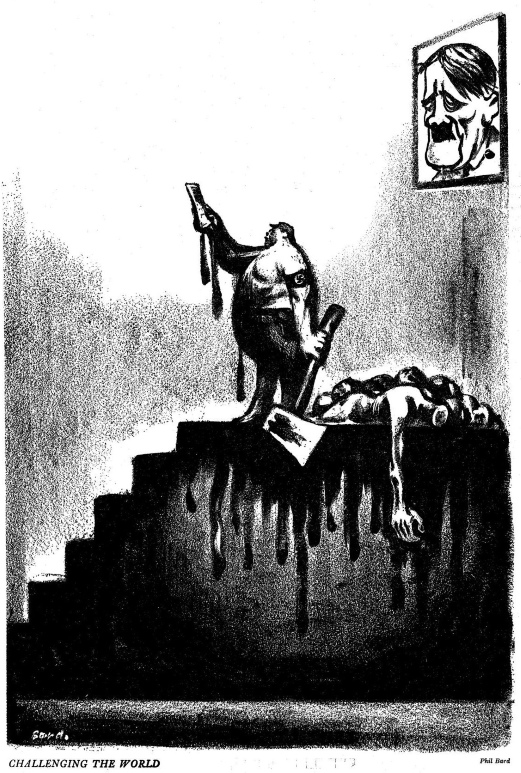
One year after the Nazi takeover in Germany, a survey of fascism’s ascendancy in many European countries.
‘Nazi Plague Spots of Europe’ by Albert Allen from New Masses. Vol. 10 No. 9. February 27, 1934.
(Only a few weeks ago an appeal for a united pan-Aryan front of kindred movements was issued by the Nazis from Berlin through the Welt Dienst, a propaganda service published in three languages for private circulation among Aryans throughout the world. Invited to the united front were the Iron Guard of Roumania, the Rozwoj of Poland, the National Association of Greece (E.E.E.), the Awakening Magyars of Hungary, the Lappos of Finland and the pro-Nazi organizations in Switzerland, Latvia and Lithuania. The following article deals with Nazi activities in these countries and others on the continent wherein Hitlerism has, either by direct propaganda, the power of example or alliance with native Fascists, kindled the fires of reaction–THE Editors.)
Czechoslovakia
IF AUSTRIA is secured for Germany the waves of National Socialism might easily engulf this land which juts more than half its distance into the Austro-German frontier like a sandbar in an angry ocean. Just what resistance Czechoslovakia can be expected to offer may, to some extent, be judged by the present laxity of its government in dealing with National Socialism within its borders.
Nazi propaganda has been directed chiefly at counteracting anti-Nazi propaganda emanating from Prague. This is being done through terrorism and espionage among the refugees. The killing of Dr. Theodor Lessing which attracted world attention, was only one of an organized series of kidnappings, beatings and murders by Nazi storm troops, both German and Czech, often with the connivance of the Czech police and frontier guards. A secondary purpose is to win the support of the almost 4,000,000 Germans living in Czechoslovakia to demand Anschluss with Germany. Appeals for loyalty to the Fatherland are coupled with economic pressure exerted chiefly upon border folk living in Bohemia, many of whom work or trade in Saxony. Support is put on a business basis. Join with us or lose your living in Saxony, say the Nazis.
Although the government has outlawed the National Socialists party and confiscated its property, the Nazis continue to operate from within sport clubs, notably the Volksport, and other German Societies. The government officially professes an attitude of impartiality striking out against the left as well as the right. Actually, however, by suppressing working class self-defense groups, it operates in the interests of Fascism.
This is further borne out by the fact that it has taken no strong action to put down the Fascist movement of General Gadja, the Nationale Fascisten Gemeinde, which enjoys the support of leading Czech industrialists. Nor for that matter has it taken pains to put down the pro-Hitler National League led by Stribrny.
Roumania
Nazi propaganda has made more headway in Roumania than anywhere else in the Balkans. It has culminated in the assassination of Premier Ion G. Duca by Iron Guardists. And in the opinion of every responsible foreign correspondent, there is no doubt that the greater part of the support of the Iron Guard has come from Germany. The Voelkischer Beobachter, Hitler’s mouthpiece, practically admits responsibility for Duca’s death by boasting that that event was intended “as a signal to the Jews and to the French who are manipulating to prevent Roumania from coming into close contact with modern Germany.” This admission taken together with the tone with which the Beobachter speaks of Iron Guard plans further implicates the Nazis. It is no wonder then that Zelea Cordreanu, Guardist leader, fleeing arrest, should have chosen Germany as a refuge. There he would be most certain to receive a cordial reception as did Stephan Tarterscu before him. Tarterscu had been received by Hitler himself, and had conferred with several Nazi leaders on a line of action to be pursued in Roumania. Nazi leaders are known to have expressed disapproval of the division of Fascist forces in Roumania. So that upon his return, Tarterscu set about to bring the Iron Guard and the Cuzists (he had been connected with both these organizations), and whatever other miscellaneous sympathetic elements there were, into the newly organized Nazi Christian Fascist Party. The unification was not achieved.
The Christian National League of Professor A.C. Cuza is still the largest group and was represented until the recent elections by eleven deputies in the Parliament. After the appointment of Duca, the Cuzists together with the Iron Guard were ordered dissolved and denied the right to participate in the coming elections, The Cuzists wear blue shirts, duplicate the National Socialist lack of program, and sing a national anthem closely resembling the Horst Wessel song. They maintain assault battalions which engage in terrorism.
In addition to the three major Fascist organizations there is a National Agrarian Party, headed by Octavian Gorga, who has recently returned from Berlin, and a Christian National Socialist Party known also as the Damians. Both are sympathetic to Hitler and anti-Semitic.
Greece
Nazis in Greece are constituted in the “E.E.E.” otherwise known as the National Association of Hellas. This organization is held responsible for the disastrous fire in the Jewish quarter of Saloniki a few years ago. It is said to number some 10,000 supporters, a substantial part of whom are storm troopers. Chicly uniformed, they wear brown shirts and steel helmets, a sort of fusion of the S.A. and Stahlhelm. Their symbol is the swastika which they brazenly paint on synagogue walls next to the initials “E.E.E.” The cross is a second symbol, generally carrying the accompanying legend: “This sign is our salvation.”
Too much reliance, however, is not placed in the efficacy of symbol number two. Force is required to hasten salvation and force is encouraged against Jews in the Jew-baiting sheet Makedonia published in Saloniki, During the past year the “E.E.E.”, fearing government action, reconstituted itself as a political party and is thus immune. Its chief propaganda organ is Adialaktos, edited by M. Fardis, former editor of Makedonia. Recently an exchange of visits took place between members of the “E.E.E.” and German Nazis.
Former Premier Venizelos, war-time dictator of Greece, and leader of the “liberal” party is one of the supporters of the “E.E.E.”
Poland
There are several Nazi and kindred organizations in Poland, and their membership runs into tens of thousands. There are Brown Shirts, Purple Shirts and Yellow Shirts. But there are more than one organization to a shirt. We find German National Socialists, Polish National Socialists, National Democrats, the Obwiapol, Rozwoj and other combinations of Hitlerites. The first named are out and out Hitlerites, usually German nationals. The Polish Nazi party enrolls Polish citizens who side with Hitler. It has been dissolved in Kattowice and was entirely outlawed in Polish Upper Silesia by Silesian authorities. It continues to function, nevertheless. Strong measures were also taken by the government against the National Democrats or as they are popularly called Endeks. Its party militia numbering 10,000 has been dissolved by the government. The official organ of the Endeks is the Gazetta Warsawska, which advocates the complete elimination of Jews from the professions. Of a similar character is Bliskowza, published by Nazis in Kattowice.
Authorities have closed down the central office of the anti-Semitic Democratic Mutual Aid Organization, the last of the legalized Endek organizations, which has been responsible for much of the rioting at the universities, The notorious anti-Jewish boycott organization Roswoj has been disbanded as well. A terroristic organization called the National Revolutionary Organization connected with the Obwiapol has been banned. In Eastern Galicia, Ukrainian White Guards have joined with Nazis in stirring up the peasantry against the Jews. The result has been a campaign of terror no less widespread or cruel than that prevailing in Germany.
Switzerland
The avowed purpose of Nazi propaganda in Switzerland is to “free the 2,800,000 Germans living under the Swiss yoke.” To that end storm troops have staged military demonstrations along the Swiss frontier and have gone so far as to cross the border and kidnap Swiss residents. The New York Herald Tribune of August 28 described Nazi violation of Swiss soil as a weekly occurrence.
Within Switzerland there is a multiplicity of Hitlerite groups, which fail to agree among themselves. There is the National Front led by Sonderegger, an ex-general in the Swiss army; the Bund Nationale Socialischer Eidgenosson, which does not conceal its admiration for Hitler yet denies receiving financial support from Germany. Its identity with the Nazi movement is conspicuously evident in its trappings as well as its ideology. It flies the swastika, calls upon Aryans to awake, sings its song to the tune of the Horst Wessel and maintains a storm troop division. There are also the Eidgenoessische Front which is outspokenly anti-labor, the Bund Fuer Volk and Heimat, which looks for agrarian support; the Vaterlaendische Front which is Germanophile and the Union Nationale which is Hitlerism in French.
Since the Swiss law permits all citizens of military age to keep arms in their homes for mobilization on an hour’s notice, Fascists have been able to arm themselves without difficulty.
Belgium
Nazis operate in Belgium through the so-called Dinasa movement (an abbreviated term denoting Germanic National Solidarity) and other anti-Semitic organizations. Co-operating with them is the Maximalist Flemish Party, which in contradistinction to the Minimalists, demand absolute Flemish independence from Belgium. The Verdinasos, as they are called, have a program strongly resembling Hitler’s. They regard the Dutch and Flemish peoples as of Germanic origin and for that reason are co-operating with Nazis in Holland for ultimate pan-Germanism. Their leader is a literary man named Van Severen, who has a wild hatred of France. He is popularly referred to as “Hitlerke.” The movement makes an especial appeal to enlist peasants. Its symbol is a ploughshare, a saw and a wheel, standing for the union of the peasantry, the proletariat and the army. The Verdinasos are particularly active in Eastern Flanders. Recently, to disguise their philo-Germanism, the Verdinasos had their Brown House in Gehnt repainted green.
Hungary
Although Premier Gomboes has assured American Hungarians that he will not tolerate Hitlerism in Hungary, he continues to wink at their activities. The basis for Gomboes’ friendship with Germany seems to be the desire for German help in revision of Hungary’s frontiers. The attitude of the Hungarian government is succinctly put in the statement by former Minister of Justice Magy, who once declared: “If necessary we shall ally ourselves with the devil to obtain our rights.”
Nazi activities in Hungary reached a head in widespread rioting in almost every university and high school in the country. In response to pressure, Premier Gomboes was compelled to take action against the Nazis. He ordered the confiscation of Nemzeti Szocialista, official organ of the Hungarian Nazi party. The Nazi leaders Ladislaus Lengyel, Boeszermenyi, and Olah were arrested. The leader of the party, Deputy Mesko, enjoys parliamentary immunity. Count Alexander Festetic, one of Gomboes wealthy supporters, resigned from the government party as a result of Gomboes’ anti-Nazi acts and announced his intention of devoting his wealth to building a Nazi party. Outstanding Hungarian Nazi leaders, in addition to those already mentioned, are Czillern, Boszermeny and Archduke Albrecht, a Hapsburg, who was at one time a candidate for the Hungarian throne.
Sweden
Notwithstanding their promise to refrain from propaganda in Sweden the Nazis have been working there ceaselessly. They are divided into two camps—Swedish and German Nazis. But despite the attempt to picture them as mutually antagonistic, there is no essential difference between them. According to Emil Lengyel, the split in the Nazi ranks occurred when Birger Furugaard, Swedish Nazi leader failed to reach an agreement with Premier Goering concerning the delivery of North Sweden to the German Nazis. Goering offered Furugaard subsidies if he would undertake to turn over provinces in North Sweden to German colonization when the Swedish Nazis took power at Stockholm. Furugaard refused and made public his conversation with Goering. The Nazis then divided, Furugaard leading one camp and Goering the other. The official organ of the Swedish Nazis is Our Struggle. Edited by Furugaard himself, it is violently anti-Semitic. Supporting him are ex-army men who are eager to shake their uniforms free of camphor balls and bark orders once more. Recently a foreign consultant was reported to have been engaged to put the party over. He is Major Ekstroem, a native of Sweden, until recently in Finland.
The spiritual father of the Nationalsocialistika, Arbeter Parteit, is Premier Goering, who having observed Sweden from a cell of a Stockholm lunatic asylum, considers himself competent to direct the Swedish appeal. Late in October he visited Stockholm to accelerate the pace of organization. The Nazis here have a fighting troop patterned after the German S.A. Their banner represents a golden swastika on a blue field with a red border line.
The Swedish government has taken only minimum precautions in the face of Nazi provocations. It has banned political uniforms, tightened somewhat the restrictions on the possession of firearms and just lately closed the Nazi headquarters in Stockholm.
Finland
The National Patriots work with the German Nazis in Finland toward establishing Fascism here. The Patriots succeeded the Lapua movement of 1929, which had been suspended by the Supreme Court after the abduction of ex-president Stahlberg. It is intimately connected with the church, has functioning nuclei in every parish, and is demanding greater emphasis on religion and nationalism in the schools. It would restrict citizenship only to those “belonging to the nation, racially, culturally and historically.” Lately, Nazi propaganda has been seriously impaired due to the trade war which has sprung up between Finland and Germany.
Norway
When Nazism reared its head in the Norse country, Norwegian “socialists” promptly met the situation by abandoning their “socialism.” Afraid of the fire of the Nazis under Major Vidquin Quisling, leader of the Norwegian Nazis, and at the same time wishing to steal their thunder, the “socialists” changed their color from Marxist pink to monarchial white.
The Nazis are organized into the National Union under the leadership of Quisling. At one time, the Defense Minister Quisling had an intimate knowledge of the Norwegian system of defense which should serve him in good stead in military manoeuvers against the government. The Quisling movement came into existence as early as 1931 and was called the “unified Nordic folk movement.” It is definitely anti-Marxist, anti-Semitic and outspokenly pro-German. Sometime ago it was reorganized into the present “Norwegian Samnaung,” issues a paper called the A B C, and has for its symbol a golden cross on a red field. It received as many as 30,000 votes in the last election.
Baltic States
In the Baltic States the Nazi movement was organized and founded by Alfred Rosenberg, former minister of the Nazi party, a native Esthonian and former Russian subject. There is no mistaking his purpose. He would use a consolidated Hitlerite Baltic bloc as a base of operations from which to attack Soviet Russia. Working toward such a combination is a Nazi organization called the Baltic Federation under the leadership of the German military. In addition there are separate Nazi organizations in these states seeking to gain control through “constitutional” means. In Danzig they have already been successful. The free city of Danzig bartered its freedom last June for the Hockenkreutz. Although ostensibly a ward of the League of Nations, Danzig is now ruled by a Nazi senate, Herman Rauchning, president of the senate, is virtual dictator. The High Commissioner, Dr. Rosting, is powerless, having no control over the forces of law and order. Danzig continues to be a point of dissension between Poland and Germany.
Latvia
Notwithstanding a decision by the Latvian parliament to suppress all Nazi organizations and newspapers throughout the country, the last few months have seen a rapid development of Nazi forces. Attacks on workers and Jews by the Latvian Nazis or Perkonkrustnieki occur almost daily. The boldest stroke the Nazis have attempted was to demand that the government deprive Latvian Jews of the right to vote, to own property, and to receive trade licenses. The Nazis in Riga are constituted into two organizations with but a single purpose. The Liberation League and the significantly named Blue Eagle. The former publish a paper called the Jaunakas Sinds, whose angel, Benjaminosh, has been active in White Guard intrigues against the Soviet Union.
Holland
On the surface the Dutch government is against the Nazis. It is aware that the Nazis have open designs on the coal mines in South Limburg and ultimately hope to swallow Holland whole. Following disorders in frontier towns by uniformed Nazis, the government forbade all Germans wearing brown shirts and other Nazi emblems to cross the border. A police order in the Heerlen mining district about this time prohibited foreigners living in this section to cross the Dutch frontier and take part in Nazi activities in Germany. Violators were subject to deportation. Konrad Tykfer, regional leader of the Nazis, was expelled from Limburg and now conducts his activities from Aachem on the other side of the border.
There is a hitch to Dutch opposition, however. Of the twenty-odd Fascist groups in Holland, the only one countenanced by the government is the organization led by A.A. Mussert. Ideologically the Mussert organization is close. to the Hitler movement and because it enjoys a monopoly of legal protection many Nazis find it more expedient to operate from within that group. There is strong evidence of complicity on the part of Mussert followers with Nazis in the apprehension and deportation of anti-Fascist workers in Holland. It is an open secret, also, that Mussert has tried to get financial subsidies from Berlin and has in all likelihood succeeded. For his paper, De Deitsche Gedachter, has recently been enlarged. Also operating in collusion with the Nazis in spying upon and terrorizing anti-Fascists are the Black Shirts led by the Englishman Haighton. The Black Shirts who joined hands with the Nazis at the Schlaegter memorial, are supported by German industrialists and function as a sort of auxiliary body to the Dutch National Socialists.
The central headquarters of the N.S.D.A.P. are in Amsterdam, administered by one Patzig, who also is in charge of an active espionage division. Assisting Patzig in putting Hitler across is Dr. Van Rappard, a Dutchman, who edits a magazine called the National Socialist, which advocates an enlarged German empire of which Holland would be a part. Dr. Van Rappard maintains close contact with the Central Propaganda Bureau of Dr. Goebbels and visits Berlin frequently.
The New Masses was the continuation of Workers Monthly which began publishing in 1924 as a merger of the ‘Liberator’, the Trade Union Educational League magazine ‘Labor Herald’, and Friends of Soviet Russia’s monthly ‘Soviet Russia Pictorial’ as an explicitly Communist Party publication, but drawing in a wide range of contributors and sympathizers. In 1927 Workers Monthly ceased and The New Masses began. A major left cultural magazine of the late 1920s and early 1940s, the early editors of The New Masses included Hugo Gellert, John F. Sloan, Max Eastman, Mike Gold, and Joseph Freeman. Writers included William Carlos Williams, Theodore Dreiser, John Dos Passos, Upton Sinclair, Richard Wright, Ralph Ellison, Dorothy Parker, Dorothy Day, John Breecher, Langston Hughes, Eugene O’Neill, Rex Stout and Ernest Hemingway. Artists included Hugo Gellert, Stuart Davis, Boardman Robinson, Wanda Gag, William Gropper and Otto Soglow. Over time, the New Masses became narrower politically and the articles more commentary than comment. However, particularly in it first years, New Masses was the epitome of the era’s finest revolutionary cultural and artistic traditions.
For PDF of full issue: https://www.marxists.org/history/usa/pubs/new-masses/1934/v10n09-feb-27-1934-NM.pdf

