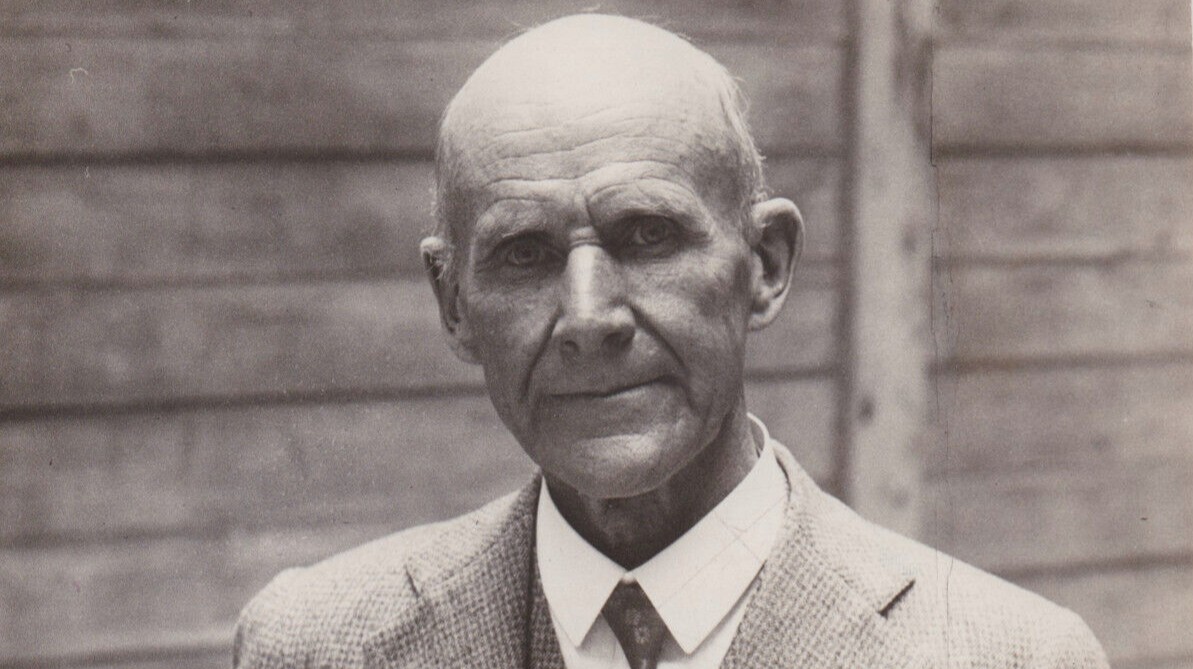
With his full and sincere conviction, Debs pronounces on the Good News of Socialism.
‘The Earth for All’ by Eugene V. Debs from Chicago Socialist. Vol. 6 No. 306. January 14, 1905.
The only worker who has an excuse to keep out of the social democratic movement is the unfortunate fellow who is ignorant and does not know better. He does not know what socialism is. That is his misfortune.
But that is not all, nor the worst of it. He thinks he knows what it is.
In his ignorance he has taken the word of another for it, whose interest it is to keep him in darkness. So he continues to march with the Republican Party or shout with the Democratic Party, and he no more knows why he is a Republican or a Democrat than he knows why he is not a Socialist. It is impossible for a workingman to contemplate the situation and the outlook and have any intelligent conception of the trend and meaning of things without becoming a socialist.
Consider for a moment the beastly debasement to which womanhood is subject in capitalist society. She is simply the property of man to be governed by him as may suit his convenience. She does not vote, she has no voice and must bear silent witness to her legally ordained “inferiority.”
She has to compete with men in the factories and workshops and store and her inferiority is taken advantage of to make her work at still lower wages than the male slave gets who works at her side. As an economic dependent, she is compelled to sacrifice the innate refinement, the inherent purity and nobility of her sex, and for a pallet of straw she marries the man she does not love.
The debauching effect of the capitalist system upon womanhood in accurately registered in the divorce court and the house of shame. In socialism women would stand forth the equal of man—all the avenues would be open to her and she would naturally find her fitting place and rise from the low plane of menial servility to the dignity of ideal womanhood. Breathing the air of economic freedom amply to provide for herself in socialist society, we may be certain that the cruel injustice that is now perpetrated upon her sex and the degradations that result from it will disappear forever.
Consider again the barren prospect of the average boy who faces the world today. If he is the son of a workingman his father is able to do little in the way of giving him a start. His father has no influence and can get no preferred employment for him at the expense of some other boy, so he thankfully accepts any kind of service that he may be allowed to perform.
How hard it is to find a place for that boy of ours!
“What shall we do with Johnnie and Nellie?“ is the question of the anxious mother long before they are ripe for the labor market.
“The child is weak, you know,” continues the nervous, loving little mother, “and can’t do hard work; and I feel dreadfully worried about him.”
What a picture! Yet so common that the multitude do not see it. This mother, numbered by the thousands many times over, instinctively understands the capitalist system, feels its cruelty, and dreads its approaching horrors which cast their shadows upon her tender, loving heart. Nothing can be sadder than to see the mother take the boy she bore by the hand and start to town with him to peddle him off as merchandise to someone who has use for a child-slave. To know just how that feels one must have had precisely that experience.
The mother looks down so fondly and caressingly upon her boy; and he looks up into her eyes so timidly and appealingly as she explains his good points to the businessman or factory boss, who in turn inspects the lad and interrogates him to verify his mother’s claim, and finally informs them that they may call again the following week, but that he does not think that he can use the boy.
Well, what finally becomes of the boy? He is now grown, his mother’s worry is long since ended, as the grass grows green where she sleeps—and he, the boy? Why he’s a factory hand—a hand, mind you, and he gets a dollar and a quarter a day when the factory is running.
He is an industrial life prisoner—no pardoning power for him in the capitalist system. No sweet home, no beautiful wife, no happy children, no books, no flowers, no comrades, no love, no joy for him.
Just a hand! A human factory hand! Think of a hand with a soul in it.
In the capitalist system the soul has no business. It can not produce profit by any process of capitalist calculation. The working hand is what is needed for the capitalist’s tool and so the human must be reduced to a hand.
No head, no heart, no soul—simply a hand. A thousand hands to one brain—the hands of the workingmen, the brain of the capitalist. A thousand dumb animals in human form, a thousand slaves in the fetters of ignorance, their heads having run to hands—all these owned and worked and fleeced by one stock-dealing, profit-mongering capitalist.
This is capitalism!
And this system is supported alternately by the Republican Party and the Democratic Party. These two capitalist parties relieve each other in support of the capitalist system, while the capitalist system relieves the working class of what they produce.
A thousand hands to one head is the abnormal development of the capitalist system. A thousand workingmen turned into hands to develop and gorge and decorate one capitalist paunch!
This brutal order of things must be overthrown. The human race was not born to degeneracy.
A thousand heads have grown for every thousand pairs of hands; a thousand hearts throb in testimony of the unity of heads and hands; and a thousand souls, though crushed and mangled, burn in protest and are pledged to redeem a thousand men.
Heads and hands, hearts and souls, are the heritage of all. Full opportunity for full development is the inalienable right of all.
He who denies it is a tyrant; he who does not demand it is a coward; he who is indifferent to it is a slave; he who does not desire it is dead.
The earth for all the people—that is the demand.
The collective ownership and control of industry and its democratic management in the interest of all the people—that is the demand.
The elimination of rent, interest, and profit and the production of wealth to satisfy the wants of all the people—that is the demand.
Cooperative industry in which all shall work together in harmony as the basis of a new social order, a higher civilization, a real republic—that is the demand.
The end of class struggles and class rule, of master and slave, of ignorance and vice, of poverty and shame, of cruelty and crime; the birth of freedom, the dawn of brotherhood, the beginning of man—that is the demand.
That is socialism!
The Chicago Socialist, sometimes daily sometimes weekly, was published from 1902 until 1912 as the paper of the Chicago Socialist Party. The roots of the paper lie with Workers Call, published from 1899 as a Socialist Labor Party publication, becoming a voice of the Springfield Social Democratic Party after splitting with De Leon in July, 1901. It became the Chicago Socialist Party paper with the SDP’s adherence and changed its name to the Chicago Socialist in March, 1902. In 1906 it became a daily and published until 1912 by Local Cook County of the Socialist Party and was edited by A.M. Simons if the International Socialist Review. A cornucopia of historical information on the Chicago workers movements lies within its pages.
PDF of full issue: https://www.marxists.org/history/usa/pubs/workers-call-chicago-socialist/050114-chicagosocialist-v06w306.pdf

