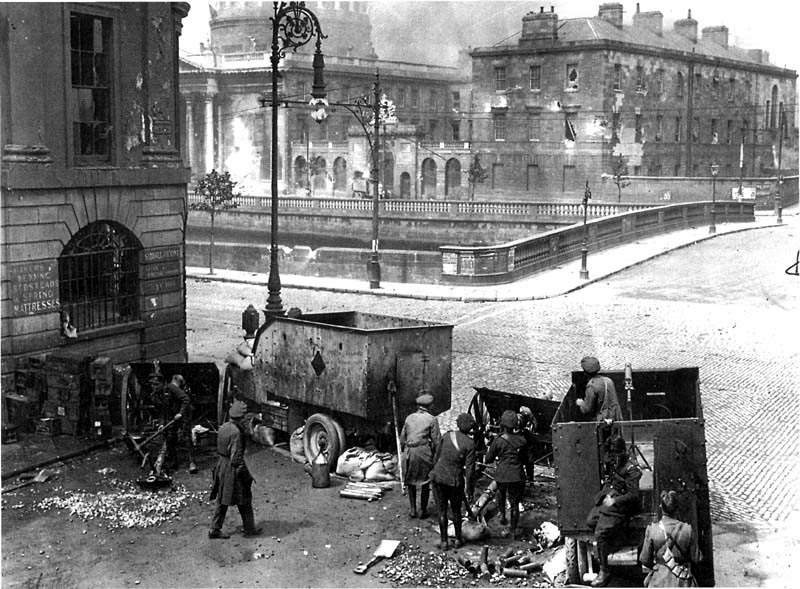
Postgate offers his analysis of Ireland’s Treaty and subsequent Civil War as it breaks out, with estimations of its two leading, and opposing figures, Eamon De Valera and Michael Collins. Collins would be killed in an ambush by the anti-Treaty I.R.A. within weeks of this publication.
‘Tragedy of Irish Labor’ by Raymond W. Postgate from The Worker. Vol. 5 No. 233. July 23, 1922.
Postgate Sees Dark Days Ahead for Irish Workers; Middle Class Backed by Britain
(Written especially for The Worker)
LONDON, July. The conflict between the Free Staters and the Republicans in Ireland is probably quite the most disastrous thing that has ever happened to the revolutionary movement in that country.
Yellow Leaders Betray Larkin
The revolutionary working-class elements in Ireland are not strong. The Communist Party is small in numbers and woefully inexperienced. The official labor movement led by Tom Johnson is reformist and reactionary. The timidity and irresolution of the trade union officials is partly concealed by their nationalism, but a very brief acquaintance with them shows that the spirit of the old Irish Transport Workers’ Union has disappeared.
No more striking instance of this has perhaps occurred than the quiet dropping of Jim Larkin’s name from the list, of labor candidates. There was no question but that Larkin’s return was ardently desired by the mass of the Irish workers. There was no question, either, but that the officials of the I.T.W.U. were most apprehensive of the effect that his presence would have upon their followers. His name, therefore, quietly disappeared.
Workers Divided
In the struggle between O’Connor and Collins the workers were thus found hopelessly divided. Behind Collins, no doubt, were all those of pronounced reformist tendency, but that does not mean that behind O’Connor and De Valera were all the revolutionists.
Many of the strongest and best of the revolutionary workers sided with Collins because they were sick to death of romantic flourishings and Republicanism which led nowhere. They believed that England would never grant the full Republican program of O’Connor and De Valera, and they knew that neither of these generals had the power to force her to.
They believed that the institution of the Free State had exorcised the spirit of nationalism sufficiently for them to begin their task. They wanted to get on with the social revolution and not be held up any longer by romantic idiots.
Middle Class Behind Collins
It was because there was some truth in that point of view that Collins’ success was ultimately assured. Collins could never have succeeded by British ammunition alone. He is an Irish revolutionary, and his power lies in that. If he had become a British policeman, he would have gone the way of the Black and Tans–as he may do yet. But, for the moment, he has a real and irresistible Irish power behind him. That power is the power of the Irish bourgeois. The Catholic hierarchy, the farmers, the trading community, the employers and merchant class as a whole, with a large section of the professional classes, are solidly for Collins. The nationalist demands of the Irish bourgeoisie which ultimately boil down to sufficient political independence to be quit of the economic subjection and tutelage in which England has carefully left Irish industry–was actually and in fact conceded by the treaty which Collins signed.
Pact Helped Irish Exploiters
The bourgeois class, when in its revolutionary stage as in Ireland, is singularly acute and quick-witted, and the generality of the middle-class revolutionaries quickly penetrated thru the disguise of oaths to the king and imperialist ceremony to the real fact of the concession of economic independence. It is for this reason that, so long as Collins maintains a sufficiently stiff demeanor to the London authorities, he will find his support continually growing and stabilizing.
De Valera Irish Mazzini
Compared with Collins’, the power of De Valera is small and evanescent. De Valera is the Mazzini of Ireland. In every revolution there are to be found leaders who take their program literally who will have nothing but the exact demands that they have written down. Honest, sincere and courageous, they are prevented by these very qualities from being of further use to the class they lead.
When the Italian middle classes achieved their aims–national unity and bourgeois liberty–underneath the House of Savoy, Mazzini would have nothing to do with it. He stood out for an Italian Republic. So, too, De Valera has stood out against compromise for an Irish Republic. So, too, just as Mazzini’s followers wavered, dwindled and disappeared, De Valera’s supporters in Ireland will gradually disperse, as the bonds of tradition and emotion which hold them are weakened by time.
Abhors Class Struggle
For–again like Mazzini–De Valera is forbidden by his principles to appeal to the only class which could shore up the ranks of his army–the revolutionary workers. All taint of Socialism, all Bolshevism, is abhorrent to him. He never was, never will be a leader of the workers. When the truce was first called, both De Valera and Collins sent round instructions forbidding all strikes and ordering the I.R.A. to disperse any strike pickets. When Rory O’Connor first issued his call for volunteers from the Four Courts he appealed simply for “plain men who were sick of politicians.”
Workers’ Instinct Correct
Nevertheless, although revolutionary Communism is probably no stronger in the councils of the rebels than with Collins, the class-conscious mass of the workers tended more and more to De Valera’s side. The few confessed Communists there were attempted to aid him, and the relics of the Citizen Army came out on his side.
It was more instinct than logic that led them there, for the old argument that the national question must be cleared utterly away by a Republic before the social revolution can be thought of has worn very thin by now: what they were impelled by was the sight of O’Connor and De Valera actually fighting the British Empire.
Collins as Defender of Empire
By whatever means, it was the case that Collins was actually defending British capitalist imperialism and De Valera and O’Connor actually combatting it. They felt–and their instinct was fundamentally correct–that they could not do wrong in joining the side which, for whatever reason, was fighting British capitalist imperialism.
The Tragedy of It All
But the tragedy of this has been that the question should ever have been presented to them in those terms, and as a choice between two such leaders. Worker has been shooting down worker, revolutionary killing revolutionary. The signing of the Treaty, which some thought was a sign of the defeat of the British Empire, has turned out to be Lloyd George’s master-stroke.
The Irish Republican threat, which was draining the whole power of the Empire, has been wiped out of existence. A combination of craft and force has made the ablest leader of the revolutionaries take up the task of crushing his fellows.
Setback for Revolution
Whatever happens, the Irish revolutionary movement has been put back for years. Had O’Connor and De Valera won, or if any of the other Republican revolts, that will break out soon, succeed only one result can follow. They will break up the Free State Government, maybe shoot Collins, dissolve the Free State troops–and then the British and Ulstermen will strike. De Valera will have to fight them as he had to fight before the truce–but this time the discipline and morale of the I.R.A. will have vanished, half of his old colleagues will be dead by his own act or on the enemy’s side, while throughout the Irish people will be fixed the expectation of defeat.
Collins’ Future Fate
If ever prophecy was fairly safe, it is to say that the Republicans could never stand up to the terrific machine Sir Henry Wilson left behind him. If Collins wins things will be little better. Faced with the necessity of holding down the Republicans, dependent upon British munitions, and unable any more to threaten to break the Treaty and rejoin the Republicans, he will be forced more and more into the position of Churchill’s policeman and his apparent independence will disappear.
Eventually, London will find in him a more efficient and respectable substitute for the Black and Tans.
Of the two solutions, the odds at the moment. I think, are on the second. But either is disastrous.
In December 1921 the above-ground Workers Party of America merged the Toiler with the paper Workers Council to found The Worker, which became The Daily Worker beginning January 13, 1924. National and City (New York and environs) editions exist. The Daily Worker began in 1924 and was published in New York City by the Communist Party US and its predecessor organizations. Among the most long-lasting and important left publications in US history, it had a circulation of 35,000 at its peak. The Daily Worker came from The Ohio Socialist, published by the Left Wing-dominated Socialist Party of Ohio in Cleveland from 1917 to November 1919, when it became became The Toiler, paper of the Communist Labor Party.

