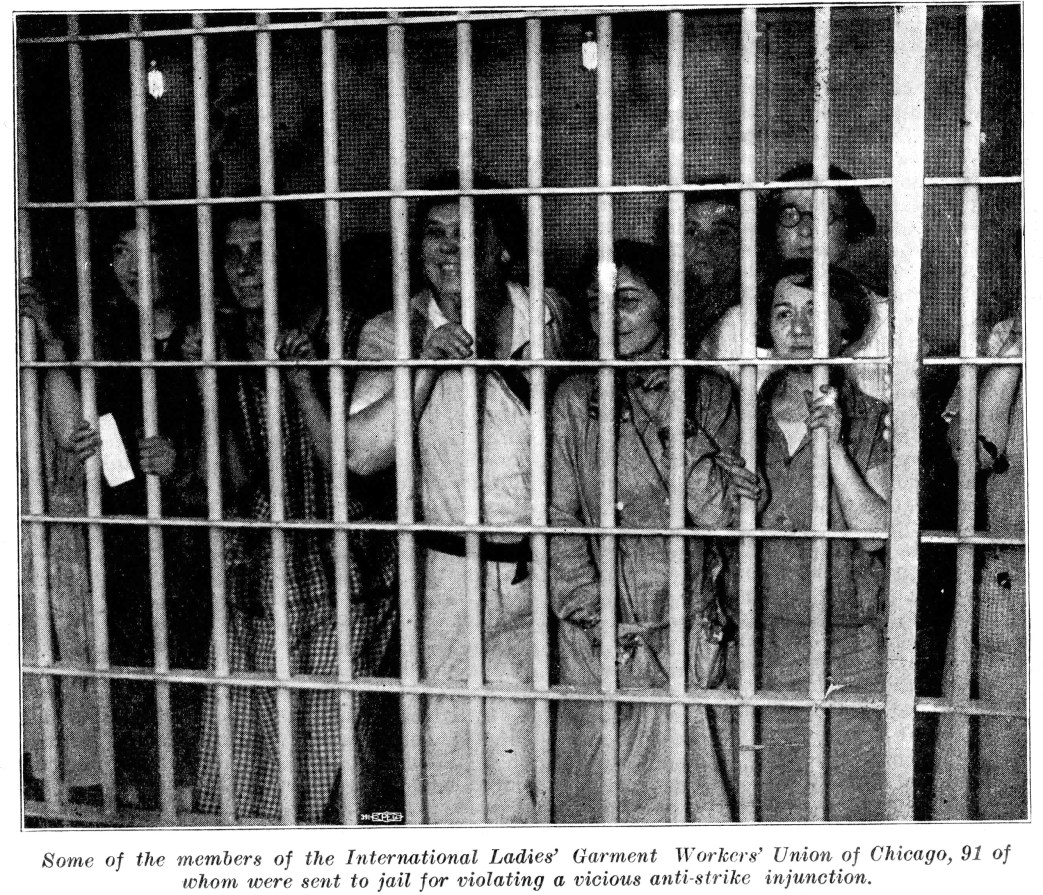
Imprisoned for the defiance of an anti-picketing injunction, dozens of heroic I.L.G.W.U. strikers are met by Morris Backall in Chicago’s notorious Cook County Jail, where many had been taken before.
‘A Visit to the Pickets at the Cook County Jail’ by Morris Backall from The Daily Worker. Vol. 3 No. 142. June 27, 1926.
THE heavens are heavily bedecked with clouds. A loneliness hovers about. One’s soul is oppressed.
I am about to see the heroic strike. pickets who so bravely fought against Judge Sullivan’s injunction during the dressmakers’ strike of 1924. Some of them are now behind the bars at the Cook county jail.
Seven-Story Building.
Haunted by various thoughts, I reach the county jail on Dearborn and Austin streets. A seven-story building of concrete and steel, blackened by the thick smoke belching from chimneys in the neighborhood.
Fifty-five years is the age of the oldest wing; thirty that of the newest. What hell people have endured there in the last six decades only the bricks can relate.
A small corridor leads to a heavy steel door, which has a very small window. Here I come to the piercing eyes of the guard.
“What do you want?” he fairly bellows out,
Upon producing my correspondent’s card he directs me to Warden Weideling. The latter was found in a newly-painted spacious room. He received me quite friendly and with a smile. took me over to the inner hall where the women pickets were conversing with visiting friends thru a heavy screen.
Pots of flowers stood on the table. The most beautiful bouquet was the one sent by Bob Minor–a token promised these heroic workers when they first resisted the injunction in 1924. Fruits and candies colored the too gloomy atmosphere pervading the jail. The holiday feeling of the new prisoners did not seem to harmonize with the stern rules of prison.
Deny Privileges.
The warden did not think that prisoners should be permitted to enjoy human privileges and ordered the matron not to allow any more flowers, etc.
Twenty-six women pickets were in jail. All of them surrounded me. They were all happy, merry.
Would Fight Injunction Again.
They said: “We don’t wish to be thought of as martyrs–but as rebels who know what they are doing and are conscious of their purpose. If we were freed today and the occasion called again to resist injunctions, we wouldn’t hesitate a moment, and would fight persistently, as we did in 1924.
“Each day here in prison stimulates a strong desire to fight for freedom–for a new order of society.”
These ejaculations did not seem to find the approval of the warden. He declared that only one may speak to me.
Comrade Freda Reicher, cell No. 761, stewardess chosen by the pickets, who came from a tubercular sanitarium in Colorado, is the one who is allowed to speak to me.
Comrade Reicher is a slim girl with smart, expressive eyes. On the whole, she leaves the expression of a capable and energetic woman.
Union Aids Prisoner.
“During the five hours of recreation,” she began, “we mingle with the other female inmates. We have succeeded in organizing our diet so that we may remain healthy. We order our food from the outside. The joint board of the union covers the expense. These arrangements were made through the co-operation of Comrades Davidson and Goldstein.
“Yesterday was house-cleaning. We showed the administration that we are not only good pickets but also good housewives.
“We suffer a great deal from the fact that no books are allowed us from, the outside. The books of the prison library, of which there are 3,000, do not interest us. We must feel content with what few newspapers the joint board can supply us. The articles are very often discussed with the other inmates.
Wall Newspapers.
“Correspondence with our comrades helps to kill the drab of the jail. We are told that the union headquarters made a ‘wall newspaper’ of our letters.”
Very interesting was our conversation regarding the other inmates. Our pickets seemed to be more interested in the fate of the other prisoners than of their own.
Dark Cells.
During our conversation we were shadowed by rows of steel cages devoid of light and air. Nineteen hours a day are spent in these cells, where the air is poison laden.
It took some time before I was allowed to see the three men pickets. This time I was accompanied by an assistant warden. Here I spoke to my old friend and comrade, Oscar Simons. We were permitted to talk through the bars with the guard on constant watch.
Comrade Simons drew a picture of life in this jail. Nine hundred men are incarcerated in the jail. The stench is such that it makes one feel faint. During recreation hours the men are crowded together. There is not enough room for all. Each one is in someone else’s way. The nerves of the prisoners are always on edge.
Treatment Unequal.
The treatment of the prisoners in the jail is not equal. Those who have politicians on the outside or who at one time were politicians have special privileges.
Here, too, I found that the pickets have greater interest in the other inmates that in themselves.
The pickets, through me, send their greetings to all of their fellow-workers who were on strike, and to all of the militant fighters in their union.
In December 1921 the above-ground Workers Party of America merged the Toiler with the paper Workers Council to found The Worker, which became The Daily Worker beginning January 13, 1924. National and City (New York and environs) editions exist. The Daily Worker began in 1924 and was published in New York City by the Communist Party US and its predecessor organizations. Among the most long-lasting and important left publications in US history, it had a circulation of 35,000 at its peak. The Daily Worker came from The Ohio Socialist, published by the Left Wing-dominated Socialist Party of Ohio in Cleveland from 1917 to November 1919, when it became became The Toiler, paper of the Communist Labor Party.
PDF of full issue: https://www.marxists.org/history/usa/pubs/dailyworker/1926/1926-ny/v03-n142-Chi-jun-27-1926-DW-LOC.pdf

