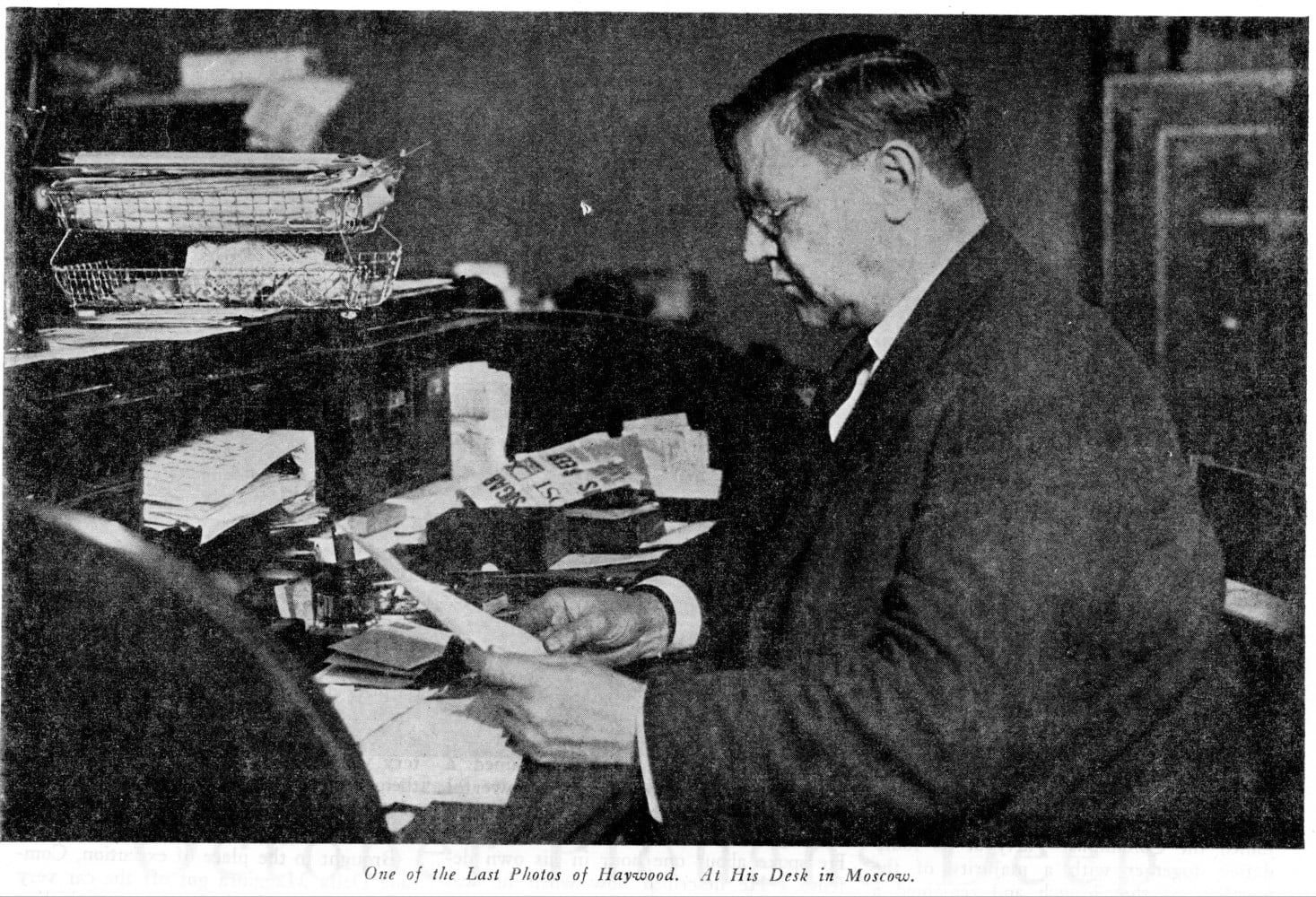
The veteran suffrage activist and, for several key years, Moscow correspondent for the International News Service, remembers William D. Haywood in his Soviet exile.
‘Haywood in Exile’ by Adele Parker from Industrial Worker. Vol. 10 No. 22. June 2, 1928.
The first American I saw in Moscow when I reached there in 1922 was “Big Bill” Haywood. In miner’s soft black hat and a rather dignified black suit he entered the lobby of the Hotel Lux as I was waiting rather anxiously to find a room in the over-crowded city. This fine hotel on the Tverskaya was his home during his several years’ residence in the capital. He had a large room facing the fashionable street with a window balcony from which he could view the May Day and November Seventh parades which always passed here to the Red Square. Nearly covering one wall of his well furnished room was a huge tapestry which had been a present from a Russian institution.
When I became acquainted with Haywood he had already severed his connection with the Kuzbas mining and manufacturing enterprise in western Siberia. Undoubtedly he was not fitted for the management of the enterprise and furthermore he had learned that the project of uniting American efficiency with Russian labor was more romantic than practical. As most Americans found out a labor force is a social growth and cannot be arbitrarily readjusted in a few weeks.
The weird tales of Haywood trying to get out of Russia and trudging through the Caucasus snows published some time ago in the American press could only cause smiles to these who knew Haywood in Moscow. His position there was always one of honor as the representative of a revolutionary working-class movement in America. Had he wished to leave the country he would have been furnished with a Russian passport and with transportation and travelling expense had he lacked these.
Haywood, however, never seemed to be without funds. As an American correspondent I had access to the commissary of the American Relief Administration and frequently purchased there for Haywood, Camels and coffee. He always dug up from the recesses of his room American banknotes with which to make payment.
Haywood told me that he came to Russia in a serious condition physically suffering from diabetes. His abstention from alcohol and his diet of black bread for two years, he said, had cured him. In 1924, however, he told me that the malady was reappearing and it finally caused his death.
Articles from Haywood’s pen in both prose and verse occasionally appeared in the Russian press and were paid for. It was popularly supposed that he was writing his memoirs in the great amount of idle time he had on his hands. He had access in the Comintern library to the press of the world and kept well-informed about world events.
Haywood’s hotel was the headquarters of all the foreign delegates to the Third International Congress and Haywood was an important factor in the entertainment of these foreign members when they arrived in Moscow. It was in his room that I attended a party for Tom Mann when that English labor leader was 68.
Haywood was undoubtedly lonely in Moscow. He knew that he had made a mistake in going there under the circumstances and his regret was no less bitter because he had misjudged the situation and had been misled by unauthorized representations. He knew that his act had injured the cause for which he had stood and had marred his own career.
When he returned one day from a trip o the Crimea where he had been speaking through an interpreter for the International Red Aid soliciting funds for political prisoners and meeting with hearty acclaim and success everywhere he told this tale.
He had been studying Russian with a Russian woman for whom he had formed a deep attachment. She spoke no English and he little Russian but a comradeship had sprung up between them which had meant much to him. Upon his return from the Crimea he had purchased a box of chocolates and gone to call on her only to find that she had been dead and buried for a week. He had received no intimation of this and it was undoubtedly a shock to him.
It was after this that Haywood considered the possibility of returning to America. When he found that this would mean death in prison and his health was already breaking he decided to remain in Russia. About two years later he married a Russian woman, a trained nurse of 36, who was devoted to him to the end.
The fact that Haywood was cared for in the Kremlin hospital during his illness is an indication of the high honor with which he was regarded. This is the hospital within the Kremlin walls, the hospital of the former palace with the very best medical talent in Russia in attendance.
Haywood’s residence in Russia illuminated his views of revolutionary history and while he remained loyal to the I.W.W. of which he was so vital a factor he saw many phases of revolutionary progress and development which would have remained a closed book to him had he not had his Russian experience. He had faith In the Russian people and in their experiment and it was to see his old comrades and to tell them what he had learned that, most of all, made him long to return to America.
Never shall I forget the night he spoke at the English Club in 1923 giving in his stirring style and finished English the inside history of the Western Federation of Miners. That audience, made up of all the English-speaking workingmen in Moscow, listened enthralled to the daring exploits of the American miners in the nineties. No other address made at the English Club while I was in Moscow made such a deep impression. The scenario writers begged him to undertake to aid in preparing a film on this theme for the Russian movies. I had heard Haywood speak several times in America but never so brilliantly as that night.
If Haywood could have sent a message to America it would have been one of affection for the comrades beside whom he fought so many battles and one of belief that a better social order is not far distant.
The Industrial Union Bulletin, and the Industrial Worker were newspapers published by the Industrial Workers of the World (IWW) from 1907 until 1913. First printed in Joliet, Illinois, IUB incorporated The Voice of Labor, the newspaper of the American Labor Union which had joined the IWW, and another IWW affiliate, International Metal Worker.The Trautmann-DeLeon faction issued its weekly from March 1907. Soon after, De Leon would be expelled and Trautmann would continue IUB until March 1909. It was edited by A. S. Edwards. 1909, production moved to Spokane, Washington and became The Industrial Worker, “the voice of revolutionary industrial unionism.” A victim of finances and internal disputes, the IW ceased publication in 1913, only to be revived in 1916 and surviving as a weekly, sometimes more, until 1931. Easily among the most important working class newspapers in U.S. history and an essential resource on the wobbly, and larger radical labor experience
Access to full issue: https://washingtondigitalnewspapers.org/?a=d&d=IWW19280602

