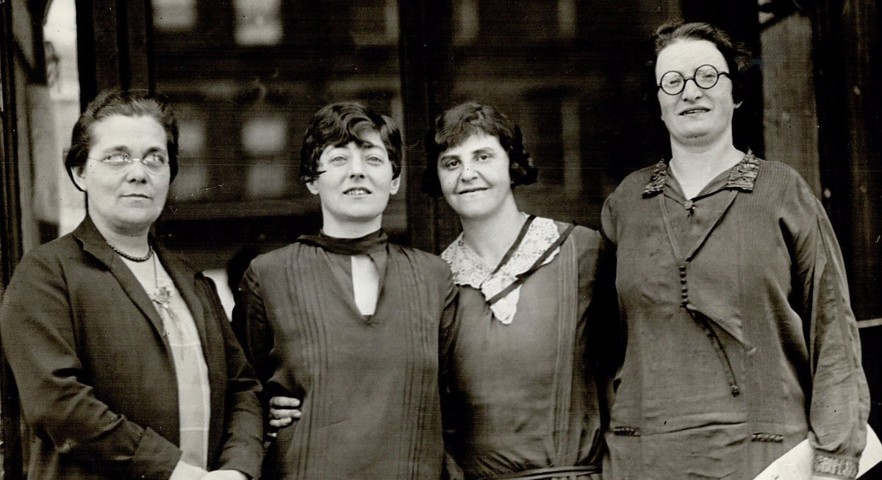
A report to the recent congress of the Canadian C.P. focuses on the work in the Women’s Labour League, the wellspring organization of working class women’s activism, which has been revitalized by militants after the war, with Communist Florence Custance becoming a leading force.
‘The Women’s Movement in Canada’ from International Press Correspondence. Vol. 4 No. 33. June 12, 1924.
Report delivered at the Third National Convention of the Workers’ Party of Canada.
The political status of the women in Canada is, nominally, one of sex equality. And it must be said that women’s position in the social sense is better than that of the women of Europe. But when judging the position of the working women from the economic viewpoint, the opposite is the case. The labour of the working women of Canada is relatively more exploited than that of her European sisters. In this country nearly 400,000 women are compelled to be wage earners. Of this number 25% are engaged in industry. As far as can be estimated only 1% of this large army of workers are organized. Judging from the reports of the minimum wage board of Ontario, the extent to which women were exploited in some branches of industry, at the time the board commenced investigations about two years ago, takes one back to the early days of capitalism in England. The Board, in fixing the minimum rate at $ 12, 50 per week for experienced women workers, can boast that it increased women’s wages in some cases nearly 100%.
The practical questions confronting us in Canada are: 1. How to attract the women to active participation in the every day struggles for better conditions of labour and higher wages. 2. How to combat the reactionary influences which hold the working women in their grip. And to take them forward to revolutionary class action and organization.
The methods adopted in Toronto by the Women’s Labour League will form a good illustration as to how these difficulties are being met in their first stages. The following report was given by the secretary at the Annual Meeting of the League April 8th of this year.
Progress of the Toronto Women’s League and the results of its activity for the year:
1. The no more war demonstration. The league helped largely in initiating this, going on record as being in favour of street demonstrations.
2. Our delegates to the Trades and Labour Council participated in the unemployed movement in the city, and endeavored to interest the wives of the unemployed workers in the movement.
3. The league made a struggle against the minimum wage rate of $12.50, with the conscious endeavour to use this to get the factory workers interested in organization. In this connection we have been instrumental in bringing the Trades and Labour Council into this work. The organizational committee of the council is now planning mass meetings for the unorganized women and girls who work in industry.
4. The League undertook a campaign to collect funds for the assistance of the women and children of the Steel workers, who were on strike last summer, in Nova Scotia. Later this activity was converted into Defense work on a broader scale by organized labour.
5. The League established a precedent in Canada by celebrating International Women’s Day and sending greetings to the working women of Germany.
These activities have increased the prestige of the league and provided the members with an incentive to work for the Labour movement generally.
Perhaps the most effective piece of work was accomplished by the league when it sent two resolutions to the Dominion Trades Congress in September of last year.
1. Calling for the endorsement of the Labour League movement in Canada.
2. Calling upon the Congress to take a stand upon the War question.
The outcome of this publicity was the formation of leagues in Sydney, Drumheller and Hamilton, and closer connections with other leagues in the country.
Following upon the discussion of the Labour League movement by the Congress, a call was sent to working women’s organizations to take part in a conference which the Toronto league is initiating. This National conference will take place in London Ontario this year, at the time the Congress meets.
The Western women have taken some action in this matter already. A conference of Western Women’s Organizations took place at Brandon, Manitoba, on March 28-29 this year. Reports show that the women were not prepared for the militant work of the leagues and the conference showed strong tendencies to divert the work of the women into purely social channels.
Plans for future work.
1. To bring the work of the league still nearer to the work of the Labour councils and engage in activities that will attract women into the labour movement.
2. To work through the Trades councils in order to get the women and girls who work in industry organized into unions. To reach the house-wives by holding meetings of an educational character in the homes in various parts of the city.
3. To take steps to organize the celebration of International Women’s Day on a much wider scale, by calling into being at committee similar to the May Day Committees.
The foregoing report gives a record of work that was accomplished in little more than a year and under difficult conditions, such as no funds, no direct personal contact, and the only method for an exchange of ideas was by continual letter writing. The experience of the past year proves that the work is fruitful, also that the leagues formed recently, in which the women members of the party take an active part, prove to be the most active. The Edmonton and Drumheller leagues are taking an active part in the organizing of the women and girls.
International Press Correspondence, widely known as”Inprecorr” was published by the Executive Committee of the Communist International (ECCI) regularly in German and English, occasionally in many other languages, beginning in 1921 and lasting in English until 1938. Inprecorr’s role was to supply translated articles to the English-speaking press of the International from the Comintern’s different sections, as well as news and statements from the ECCI. Many ‘Daily Worker’ and ‘Communist’ articles originated in Inprecorr, and it also published articles by American comrades for use in other countries. It was published at least weekly, and often thrice weekly. Inprecorr is an invaluable English-language source on the history of the Communist International and its sections.
PDF of full issue: https://www.marxists.org/history/international/comintern/inprecor/1924/v04n33-jun-12-1924-inprecor.pdf
 Revolution's Newsstand