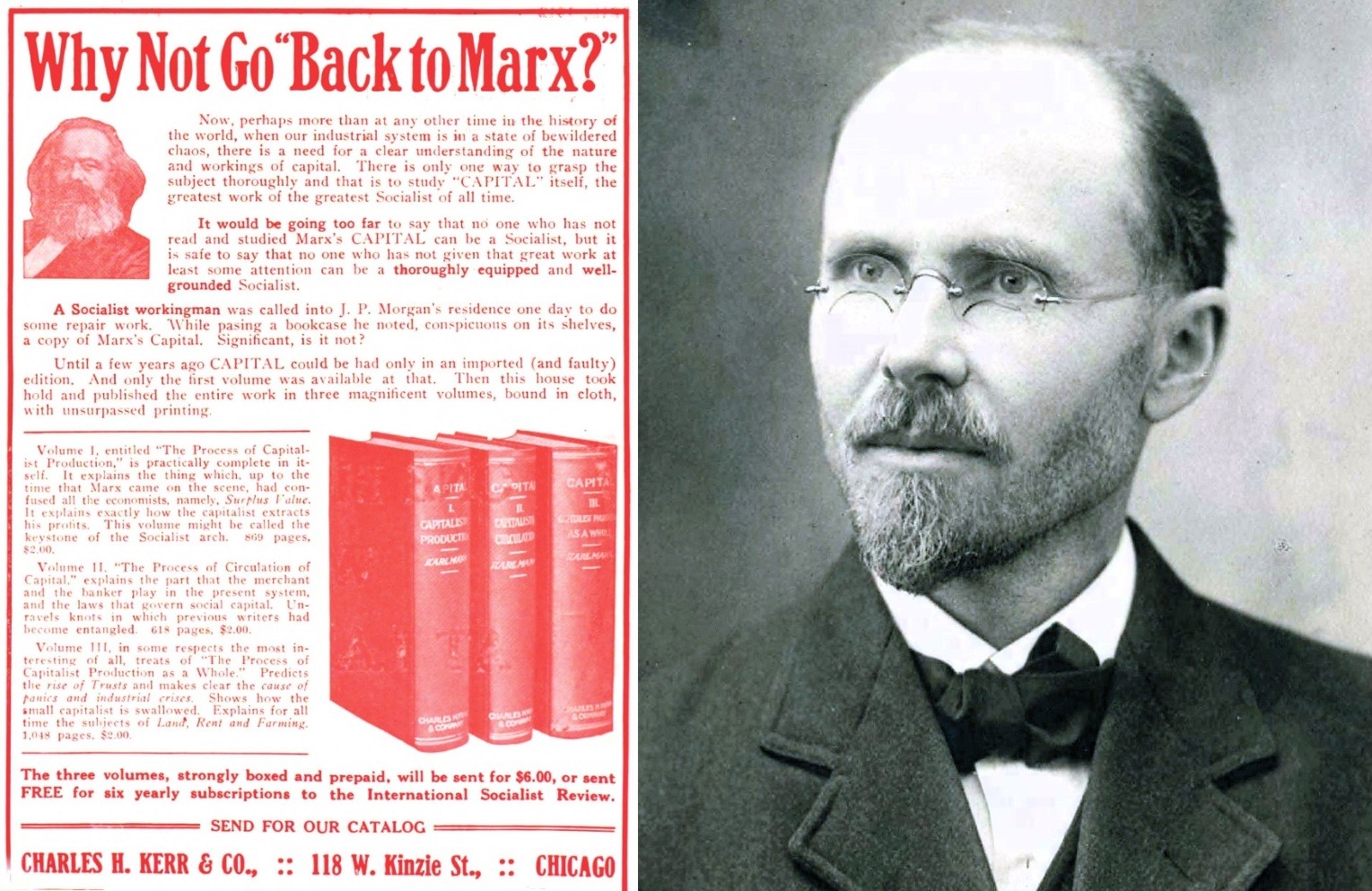
As the most important and effective Left voice in the country, the Socialist Party’s right-wing leadership majority long had it out for the International Socialist Review. As William D. Haywood’s successful 1911 run for the seven-person National Executive came to its conclusion, accusations and insinuations were directed at the magazine, which had championed Haywood’s candidacy while not a party organ, by the right. Eventually the only charge brought, by John Spargo, was misuse of ISR funds to influence the election. The two wing of the Kerr publishing co-operative were the Review, increasingly edited by Mary E Marcy, and the publication of Marxist books and selling them at cost, led by Charles H. Kerr. Kerr viewed this as his activism, and took responsibility for the debts incurred as a way of getting Marxism, included the first full three-volume English edition of Capital, in the hands of workers. A task he was as successful as anyone has been. Below, Kerr gives a valuable history of the operation and explains how the most important left wing publishing concern in U.S. history worked. While Kerr and the Review would soon be cleared by a Socialist Party investigation, the Right was able to alter the Party’s constitution with the notorious Article Two on membership in which Section Six declared that “any member of the party who opposes political action or advocates crime, sabotage or other methods of violence as a weapon of the working class to aid in its emancipation shall be expelled from membership in the party.” On the basis of its violation Haywood would be successfully recalled from the N.E.C. and much of the Party’s Left membership would drop from activity or membership.
‘Our Publishing House’ by Charles H. Kerr from International Socialist Review. Vol. 12 No. 7. January, 1912.
Is Our Publishing House Co-operative?
This question has been raised by Robert Hunter, a member of the National Executive Committee. He asks an official investigation of the question. We go to press too early to know what action will be taken by the party organization, but we shall most certainly welcome an inquiry, since we have nothing to cover up, while, on the other hand, our work would be doubled and quadrupled in the near future if our aims and methods were clearly understood by the entire membership of the Socialist Party.
How We Began.
The publishing house has been in business under the same name since the beginning of the year 1886; that is to say, it is far older than the Socialist Party of America or any American Socialist movement worthy the name. For the first seven years it was owned exclusively by Charles H. Kerr, who is still president of the publishing house. Its early publications were mainly in the line of free thought, but in 1891 it began the publication of literature in the interest of the People’s Party, which surprised old-party politicians with a vote of over a million in 1892. In the year 1893 the publishing house was incorporated. Mr. A.U. Hancock invested some capital, which was used for the purchase of a printing plant, the remainder of the stock being subscribed by Comrade Kerr. Mr. Hancock was compelled by ill health to retire from business within two years and the printing plant was sold, since which time the company has done a publishing business exclusively.
The New Time.
In 1907 Mr. Frederick Upham Adams, a prominent newspaper man, bought a half interest in the publishing house, and an auxiliary company was organized for the publication of a reform magazine called “The New Time,” which reached a high-water mark of 40,000 monthly circulation during the year 1898. Owing, however, to a disagreement regarding financial methods, Mr. Adams and Charles H. Kerr parted company toward the end of 1898; the former became owner of a controlling interest in “The New Time,” which survived only three or four months, while the latter again became owner of over ninety per cent of the capital stock of the book business.
About this time the publishing house established fraternal relations with the Social Democracy, of which Eugene V. Debs and Victor Berger were directors, and by the middle of the year 1899 we were issuing no new books except along the lines of International Socialism.
Books at Cost to Stockholders.
About this time a plan was developed which solved the difficult problem of how to secure more ready money which urgently needed for the purpose of bringing out the new books required by the Socialist movement. Many shares were sold to locals and individuals at $10.00 each, usually paid for in monthly installments of $1.00 each, and the money thus raised was used to pay for the typesetting and electrotyping of new books. No dividends were paid or promised, but each subscriber to a share of stock was given the privilege of buying books at a discount of one-half from list prices, plus the cost of transportation. This has been and is a very practical method of CO-OPERATION, by means of which the Socialists of the United States, who in 1899 had no literature worthy of the name have within twelve years put all the most important works of International Socialism within easy reach of American workers at only a fraction of the prices charged for similar works by capitalist publishers.
A Heavy Load of Debt.
The money raised from the sale of stock was not enough to pay for the books which had to be printed to meet the growing demand. Our credit had to be utilized to its fullest extent. Moreover, the INTERNATIONAL SOCIALIST REVIEW, as edited during the first seven years of its existence, was a steady drain on the resources of the publishing house.
New Blood and Rapid Growth.
The present editors of the REVIEW took hold four years ago–in January, 1908. The paid circulation was then less than 3,000 monthly; today it exceeds 40,000, with every prospect for a rapid increase in the immediate future. We go to press too early to give a complete financial report. for the year 1911, but it is safe to say that the cash receipts of the REVIEW for the year will exceed $22,000, while the book sales will exceed $38,000. Nearly the whole of this sum will have been expended for wages, paper, printing, postage, advertising, rent, taxes and miscellaneous expenses, while the year’s profit, amounting to not far from $2,000 on total transactions of over $60,000, will have been applied to the paying off of loans made during the difficult years of our beginning.
As to “Fat Jobs.”
A sneering phrase is a very cheap form of argument, but it has its effect, and while no other Socialist periodical makes its salary list public, the actual figures will be a quicker answer to sneers than pages of argument. The salary of Frank Bohn since he has been with the publishing house has been $100 a month; the joint salary of Leslie H. and Mary E. Marcy has been $160 a month for the past year, and Charles H. Kerr has received $137.50 a month. As a partial offset to this immense sum he has, however, been paying interest on a debt of $3,400 for money borrowed by the publishing house–a debt which he assumed last year by arrangement with the directors, receiving therefor stock to the par value of $3,400, on which no dividends are paid. His total holdings of stock amount to $11,370, which represent his total earnings during twenty-six years. No other employe has during the past year received so much as $100 monthly. It will thus be seen exactly how fat are the jobs connected with the publishing house.
How the Company Is Controlled.
It is organized under the corporation laws of Illinois–the only practicable way in which a co-operative company can be organized in this state, and it is controlled by a board of seven directors elected annually. The present board, R.H. Chaplin, J.H. Greer, Marcus Hitch, Walter Huggins, Charles H. Kerr, L.H. Marcy and Charles Roux, were elected by a unanimous vote at the annual meeting in January, 1911. The holders of single shares. constitute an absolute majority of the 3,691 shares which had been issued up to Dec. 1, 1911, and if they were not satisfied with the management they could have changed it, but, as a matter of fact, there have never been more than a dozen votes cast in opposition to the board of directors that has been chosen. And that is for the very good reason that the publishing house has been run in exactly the way the majority of the stockholders wish it to be run. When they desire a change, the remedy is in their own hands.
The Haywood Lectures.
During the National Executive Committee election (not over as we go to press) there has arisen a sudden and peculiar misunderstanding with relation to the routing of Comrade William D. Haywood by this office. Friends may have imagined that Comrade Haywood has yielded to the repeated and urgent requests of former National Secretary Barnes, acting under instructions from the National Executive Committee, to become one of the authorized lecturers on the National Lyceum Lecture Bureau, as did Comrade Frank Bohn under similar pressure, but we are glad to announce that Haywood preferred to continue lecturing under the auspices of the REVIEW. The statement has recently been published broadcast by Comrade Robert Hunter, that locals securing Haywood were compelled to pay the REVIEW $250 a night. We take pleasure in repeating here the terms we have made ever since Comrade Haywood began to lecture for us. Except in the West, where close dates cannot be arranged at this time, our terms for Haywood dates are the local’s guarantee to take 500 admission tickets to the lecture (each ticket being good for a three months’ REVIEW subscription at 25 cents each, amounting to $125.00. Out of this sum we pay $25.00 hall rent, supply all advertising material, donate 200 copies of the current REVIEW and pay all Haywood’s expenses. The State Committee of Ohio is arranging dates in Ohio for Haywood from Jan. 15 to Feb. 15. Arrangements for other states may be made through this office. It might be well if our friends, who believe in fair play, would ask Comrade Hunter upon what foundation he based his published statements in this regard.
Another “Printer’s Error” (?).
Comrade John Spargo, candidate for re-election on the N.E.C., has made wide allusions recently in the party press to certain alleged circular letters which he claims were sent by this publishing house (at the “expense of the stockholders”) to all Socialist Party locals in the United States urging the election to the N.E.C. of Comrades Haywood and Bohn. Now, the local of which you are a member has received no such letter, because none was sent, and we think it only fair that Comrade Spargo be required to produce such letters, or copies of such letters, upon the request of your local, in order that comrades may know whether or not he acted in good faith in this matter.
An Odd N.E.C. Oversight.
In the printed list of recommended Socialist books attached to the Lyceum Bureau Lecture Tickets sent out by the N.E.C. in SEPTEMBER are found many books published by Charles H. Kerr & Co. In fact, all the best books therein, those recognized all over the world as the classics of Socialism, have been brought out by this company. Among these books you will find listed by the N.E.C. (prior to nomination of candidates for the new N.E.C.):
INDUSTRIAL SOCIALISM by WILLIAM D. HAYWOOD and FRANK BOHN
Of this book Debs says:
“A splendid pamphlet is Industrial Socialism, written jointly by William D. Haywood and Frank Bohn, and which I heartily commend to the working class and to all who are interested in Socialism and in the group of vital questions which have sprung from our modern industrial development. Every page of this pamphlet is clear, cogent, and convincing. The true revolutionary attitude of the working class movement is here maintained. It states the industrial and political positions of the workers in plain, straightforward terms, in their own language, and is well calculated to open the eyes of the workers to the weakness of craft unionism and political Socialism, and impress upon them the necessity of proletarian solidarity, both economic and political, and supplementary to each other, as the true basis of the revolutionary movement. The pamphlet is especially adapted to the educational propaganda of the working class and ought to be spread broadcast among the workers.”
Why This Change of Front?
Now readers of the REVIEW, who are also readers of some of the Socialist newspapers, are perhaps guessing! We don’t blame them! Is Industrial Socialism, by Bohn and Haywood, endorsed, advertised and circulated by the National Executive Committee in September and October the same book that has been placed on the Index Expurgatorius by the Party Popes along ’bout ‘lection time? So many unusual and subtle changes have taken place in the mental attitude of the Socialist Party N.E.C. during the months of November and December that we think it only fair to Comrades Bohn, Haywood and Kerr that every member of the Socialist Party read the book and decide upon its merits for him or herself. Do your own thinking. The strength of the movement lies in the fact that the Socialist Party is composed of thinking men and women, perfectly capable of coming to their own conclusions. After you have read Industrial Socialism and discussed it at your local, we want you to write us what you think of the book. Price, 10 cents a copy, postpaid; 6 cents a copy to members of locals if ordered through the secretary or literature agent.
The International Socialist Review (ISR) was published monthly in Chicago from 1900 until 1918 by Charles H. Kerr and critically loyal to the Socialist Party of America. It is one of the essential publications in U.S. left history. During the editorship of A.M. Simons it was largely theoretical and moderate. In 1908, Charles H. Kerr took over as editor with strong influence from Mary E Marcy. The magazine became the foremost proponent of the SP’s left wing growing to tens of thousands of subscribers. It remained revolutionary in outlook and anti-militarist during World War One. It liberally used photographs and images, with news, theory, arts and organizing in its pages. It articles, reports and essays are an invaluable record of the U.S. class struggle and the development of Marxism in the decades before the Soviet experience. It was closed down in government repression in 1918.
PDF of full issue: https://www.marxists.org/history/usa/pubs/isr/v12n07-jan-1912-ISR-riaz-ocr.pdf

