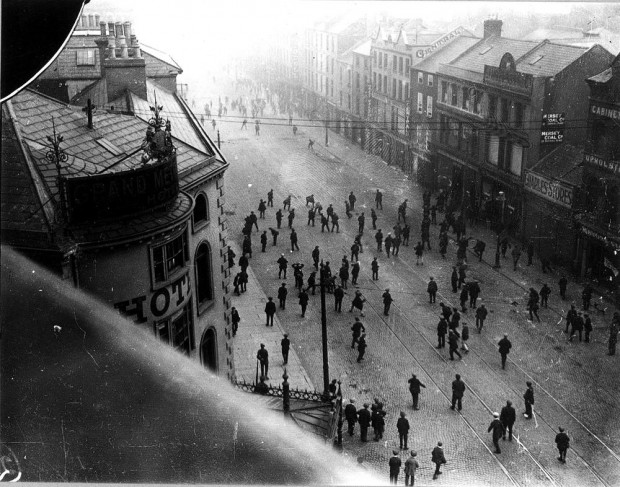
Imperialist ideologies make monsters. Many of the same Loyalist communities that are ‘rioting’ today against the recent arrival of ‘immigrants’ were just yesterday rioting over the proximity of their very native neighbors. In one of innumerable pogroms in the history of Britain’s first colony, on July 21, 1920 Protestant Unionist mobs expelled Catholic and progressive Protestant workers from Belfast’s massive shipyards then launched a ferocious and orchestrated assault on Catholic neighborhoods as the sectarian pogrom that saw dozens die soon spread to Lisburn and other northern cities.
‘Irish Religious Riots are Agitated by Exploiters’ from The Butte Daily Bulletin. Vol. 3 No. 5. August 25, 1920.
“Divide and Conquer” Is the Creed of the Murderers and Robbers of the Irish People.
(By Special Correspondent for the Federated Press.) Belfast, Ireland, Aug. 2. Workers, here are gradually realizing that the riots at shipyards on July 21, when the Protestants drove the Catholics from their jobs, were engendered by the employers for the purpose of keeping labor divided. Seventeen dead must be charged against those who reap the profits, at the expense of the plain people.
So bitterness is broadcast. It burns in the hearts of the workers not only in Belfast, but in Bangor, Newtownwards, Lisburn and Ballynahinch, where the riots spread, and where many heads were broken by, the clubs of the police.
After being deprived of their work, the shipyard toilers sought to hold a meeting in St. Mary’s hall to discuss the facts behind the situation. But the city authorities forbade the meeting, thus siding with the employers in keeping the men apart.
“There is a great fear upon the employers,” said a trade union official here today. He is neither a Sinn Feiner nor a Carsonite. “The capitalists know that the moment labor in Belfast becomes united as it is in England and Scotland, the workers will demand what is coming to them, and the days will be gone when anything was good enough for the laborer in wages or employment conditions.”
Another trade unionist described one of the Belfast raids thus: “About one hundred Carsonites, led by a man carrying the Union Jack, forced their way into the Abercorn engine works, and compelled the home rule employes to cease work. The raiders smashed windows and stole the men’s tools, then broke into the dining room and confiscated the food for the workers’ dinners.”
The plan for the riots was formulated at a meeting held by the Ulster Protestant and Unionist workers on Victoria wharf, which is city property. Capitalists from Bangor and Londonderry addressed the gathering. They rounded the patriotic note, waved the British flag, and grew tearful as they plied the emotion of their hearers. Each phrased the following sentiment in his own language:
“Since the war Sinn Felners have come to the shipyards in large numbers and have taken the places of men who were away fighting in France and Mesopotamia. Yet there are many Protestant ex-soldiers unemployed. In view of this and in view of the murder and outrage which is going on in other parts of Ireland, these people, who are rebels, and who either passively or actively assist Sinn Feiners, should not be allowed to work among Protestants and law-abiding citizens.”
That was the spark which set the powder magazine ablaze.
Immediately there followed a pogrom which exceeded in ferocity and brutality anything yet experienced in sectarian troubles in Belfast. The disturbances here in 1912 were child’s play compared to those of July 21.
Crowds of boys and young men, armed with clubs, iron bars and iron pipes began to search for religious and political heretics. They visited Harland and Wolff’s East Yard, where a force of Catholics were laying foundation of new slip-ways. Some of the Catholics ran without waiting for their coats, attempting to escape by sealing the beardings.
Many were forced into the Musgrave channel fully dressed, and as they swam were subjected to a fusillade of iron rivets and washers. But when they reached the opposite side of the channel–a quarter of a mile wide–they were not allowed to land. They had to swim back and were beaten when they reached the shipyard again.
That evening the mob went forth wrecking stores, public houses and homes owned by Catholics.
No interference to all the brutality and looting was offered by the police. Men staggered along with a case of stout between them: others requisitioned a handcart to convey barrels of whisky to unknown destinations. Flour was used to create snow-effects, and the children had the time of their lives running in and out of the shops, using the windows as doors. Furniture from the homes was burned in the streets.
Out of 15 Catholics not allowed to work by the raiders, nine were ex-service men; and of five men shot on the Falls road, where the Catholic poor live, three were ex-soldiers. Which indicates how much real solicitude the riot-makers had for “the men who bled and died in France and Mesopotamia.” The Belfast newspapers, both Catholic and Protestant, have followed their usual tactics of publishing editorials which are counsels of perfection, and in the next column, painting their opponents in a manner to further incite the mob.
The Butte Daily Bulletin began in 1917 in reaction to the labor wars in Montana, the Speculator Mine fire killing 168 miners; IWW organizing, and the murder of IWW organizer Frank Little in Butte. Future Communist leader and IWW organizer William F. Dunne and R. Bruce Smith, president of the Butte Typographical Union published the paper as an outgrowth of a strike bulletin with the masthead reading, “We Preach the Class Struggle in the Interests of the Workers as a Class.” It became daily in August 1918 and in September 1818 officers raided their offices and arrested Dunne and Smith on sedition charges. An extremely combative revolutionary paper, while unaligned, it supported the struggles of the Left Wing in the SP, reflecting the large radical Irish working class of Butte also supported Ireland’s and the Bolshevik revolution, as well as the continued campaigns of the IWW locally and national as well as the issues in Butte. It ran until May 31, 1921.
PDF of full issue: https://www.loc.gov/resource/sn83045085/1920-08-25/ed-1/?sp=2#viewer-pdf-wrapper

