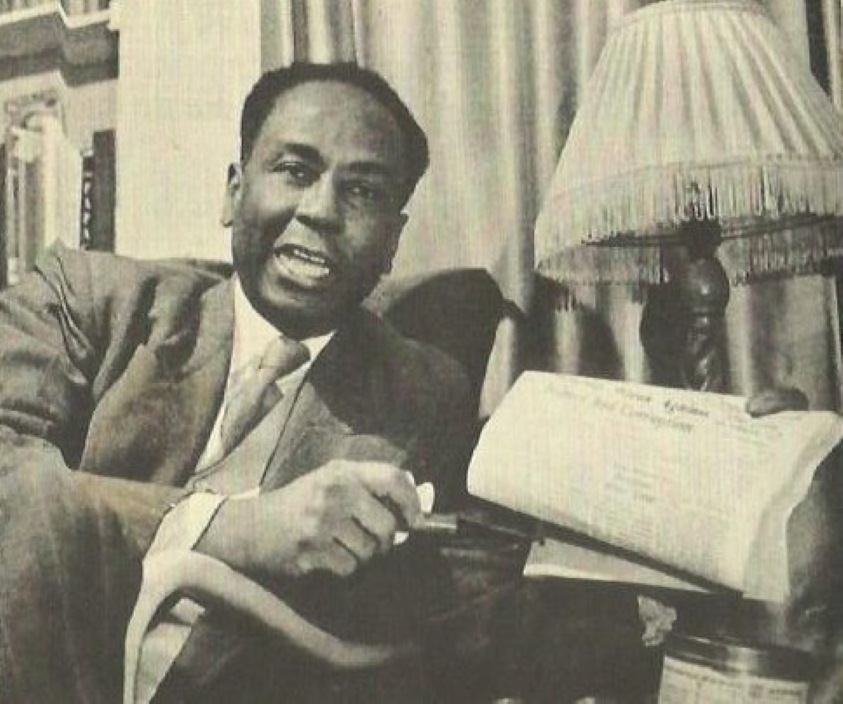
George Padmore surveys the continent, centering on the depopulation of French Equatorial Africa by six million people, two-thirds, in just twenty years of imperialist rule.
‘How the Imperialists are “Civilizing” Africa’ by George Padmore from The Negro Worker. Vol. 3 No. 2. March, 1932.
The French, British, Belgian and other capitalists who say that they have no money to give aid to the unemployed, could nevertheless find millions of dollars to spend in staging a pompous colonial exhibition in Paris. This exposition took place just at the time when the colonial slaves in Asia and Africa are in open revolt against their brutal slave masters. Every exploiting class always attempts to create some ideology justifying their oppression, and this is exactly what the capitalists, bankers and absentee landlords, who squeeze super-profits out of the colonial toilers are trying to do. By means of this display in Paris they hope to create the impression among the white workers in Europe that the mission of the imperialists in the colonies is not to exploit the natives, but to carry “the blessings of civilization” to these benighted masses. And for this reason, the Africans the Chinese, the Indians, the Indo-Chinese, the Indonesians and other subject races have no cause to be dissatisfied and therefore should not revolt. The capitalists and their agents are doing their best to suppress the true facts of their bloody misrule in the colonies, and mobilize the more backward strata of the European workers to support their robber policies by promising them a share in the spoils.
In this connection, the social-democrats, the traitors of the European workers and the greatest enemies of the colonial masses, together with the missionaries, are the most active agents of the European imperialists. For example, in England, MacDonald and Henderson are the vilest oppressors of the toilers of Africa, India and China. Despite all for their hypocritical pacifist phrases, these lackeys of British imperialism can match Baldwin, Churchill, and the other openly reactionary politicians for suppressing every attempt of the colonial peoples for freedom. The same applies to the socialists of France. Paul Boncour, Jouhaux. & Co. are not only worst types of chauvinists, but are the very ones actively helping the French bankers and concessionaries to squeeze millions of Francs out of the sweat and blood of the Negroes in Africa and the workers of Indo China. As for the Socialists in (Belgium, they are in a class by themselves. Headed by Vandervelde, they have not only offered themselves as the watchdogs of the Belgian imperialists, but they themselves take an active part in looting the Congo. Many big concessions are led by social-democrats in the Congo. Not satisfied with actually grinding super-profits out of the black workers, they vote millions of francs in the Belgian parliament for the maintenance of a huge military force in the Congo in order to suppress revolts. The same is true of the Dutch socialists in Indonesia and the West Indies.
The following facts tell of some of the horrors of colonial oppression in Africa.
Forced Labour Policy.
The conditions of the native toilers in the French and Belgian colonies are disgraceful and revolting due to intensive exploitation through forced labour, low wages and long hours.
The aims of French imperialism in Africa are economic and military. In order to carry these out, two methods are applied: (1) annexation of the land, and (2) compulsory labour. By means of expropriation, the Government accomplishes two purposes at one blow. On the one hand it has been able to grant great concessions to French capitalists for the cultivation of cocoa, rubber, cotton, etc., etc., and on the other hand to provide these plantations with cheap labour.
The workers are collected by the soldiers in the villages and assigned to work on the plantations where they are organized into squads and sent into the forest to collect rubber, manioc, palm kernels and other products for which they are paid at the rate of a few francs per month. Each worker is allotted a certain task and failure to accomplish this within a specific period of time means flogging and sometimes death, for the lives of the Africans are entirely in the hands of the European overseers.
With respect to Government labour, the situation is even worse. Railway construction across the Sahara and from the Congo to the Atlantic forms part of the war preparations of the French imperialists against the Soviet Union. In order to convey the reserve black army which France is mobilizing in West and Equatorial Africa to Europe when the war begins, the imperialists are building these railroads.
The French have therefore militarized the labour supply. All able-bodied men are forced to work on the railroads.
This has the most disintegrating influence on tribal life, as the men are taken hundreds of miles away from home for months at a time. They are only released when their health is so broken that they are unable to work any longer. Between the year 1921 and 1925, the territory of the Upper Volta alone supplied 49,000 labourers for railway work, and 312,814 for the plantations, mines and factories.
Depopulation in the Congo.
The extent to which depopulation has taken place in Equatorial Africa, due to the application of forced labour by the French, is to be seen from the tremendous decline in population. For example, in 1910 the population of French Equatorial Africa was about 9 millions; two years later, in 1912, their number had decreased to 7 millions, and in 1921 only 2,8 millions remained. Since then no more statistics on the number of natives in these districts have been published, the reason being, it is believed, that another decline in the native population has been so alarming that the publication of statistics is probably not considered desirable. In Gaboon, French Equatorial Africa, the native population has slumped from 1,500,000 in 1911 to 300,000 in 1921. In Upperroghue the death rate was 4,000 in a total of 20,000 inhabitants. Over 25,000 Negroes died from hardship, starvation and disease while working on the construction of the Congo-Atlantic Railway. This is how France, which prides herself as the torchbearer of civilization, ravishes the country of the blacks and makes slaves of millions of men, women and children.
“Jewel” in the Belgian Crown.
What India is to British imperialism, the Congo is to the Belgian capitalists—the “jewel” in the Belgian crown.
The entire territory is about 80 times the size of Belgium and possesses tremendous agricultural and mineral resources, so in order to exploit these, the Belgian bourgeoisie, with the aid of the social-democrats, have organized joint stock companies. The concessionaires have adopted a uniform policy of taxation of the natives, who were made to pay the tax in produce instead of money. In order to get the products, all the healthy people in the villages are collected into labour armies and despatched into the forest to collect rubber and ivory. A native army under European officers has been organized for the purpose of supervising the work of the labourers, who are shot down whenever they attempted to revolt. As the natives are forced to go into the jungle unarmed and at great distances away from their villages without any adequate provisions of food, clothing’ and shelter, they die like flies. The population used to be twenty millions whereas at present very optimistic calculations put their number at seven millions.
Forced labour is also applied for the mining industry and the railroads. The copper mines of Katanga are among the largest in the world. They are supplied by an army of over 20,000 miners. These workers are recruited by agents of the Company under Government protection. The miners are forced to work for a certain number of months for wages which average between 10 and 15 francs per month.
During their stay in the mining camps, they are kept under armed guards. All of the railroads in the Congo have been constructed with forced labour. More than 10,000 Negroes were working on a new line connecting the Metadi-Leopoldville railway.
Despite all of the attempts of the imperialists and their socialist agents to deceive the workers in the “mother” countries, the class conscious workers, and revolutionaries are making the terrible plight of the colonial toilers known to the broad masses. It is the revolutionary duty of the advanced1 sections of the working class of Europe and America to support the struggles of the colonial masses, for only a united front of all the oppressed and exploited can free the toiling masses of all countries and races from their common enemies—the imperialists and their social-democratic agents, missionaries and chiefs, as well as the black capitalists and landlords who help the white imperialists to keep the native workers and peasants enslaved.
First called The International Negro Workers’ Review and published in 1928, it was renamed The Negro Worker in 1931. Sponsored by the International Trade Union Committee of Negro Workers (ITUCNW), a part of the Red International of Labor Unions and of the Communist International, its first editor was American Communist James W. Ford and included writers from Africa, the Caribbean, North America, Europe, and South America. Later, Trinidadian George Padmore was editor until his expulsion from the Party in 1934. The Negro Worker ceased publication in 1938. The journal is an important record of Black and Pan-African thought and debate from the 1930s. American writers Claude McKay, Harry Haywood, Langston Hughes, and others contributed.
PDF of full issue: https://www.marxists.org/history/international/comintern/negro-worker/files/1932-v2n3-mar.pdf

