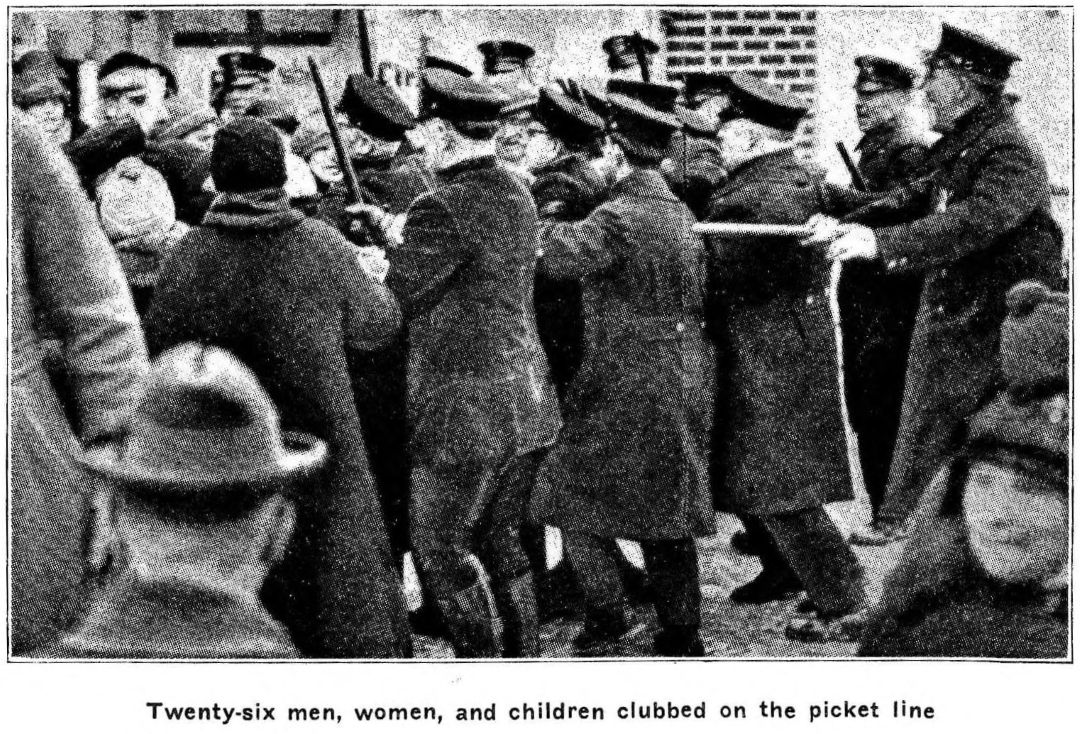
To defeat the determined Passaic strikers, general police and court violence is employed. Along with clubbing and tear gas, arrests for simple picketing sent workers to months in jail and cost thousands of dollars in fines. One of those leading the defense, and under indictment himself, J.O. Bentall reports on the fight.
‘The Passaic Textile Strike Encounters the Courts’ by J.O. Bentall from Labor Defender. Vol. 1 No. 4. April, 1926.
THE cry for bread is mingled with the cry for justice in the struggle now going on in Passaic and neighboring municipalities in the state of New Jersey, known as the bitterest of the commonwealths in the class fight.
The strike in the textile industry is now well into the fourth week of the conflict, and during that time there have been continuous attacks upon the workers by the police and numerous brutal sentences imposed by the courts.
What is behind this almost spontaneous break by the workers in the textile mills? How did it happen that they decided to go out in mills that have been practically strike proof for decades?
Since the close of the war the slaves have been cut from time to time in a most conscienceless way. Now twenty per cent, now five per cent, then another cut and another, until it seemed that the bosses would not try to go any further.
But in November there was still another reduction of ten per cent, a thing so unexpected and so unreasonable that the workers could not stand it any longer.
Some of the more progressive workers in the Botany mill called a few of their fellows together to talk matters over. They decided to send a representative to the bosses and ask that the cut be given back. This was flatly refused, and in addition to that the leader, Gustav Deak, was fired and others suspected of being leaders lost their jobs one after the other.
A conference was held with the United Front Committee of Textile Workers and it was decided to call a strike. The first to come out were the Botany mill workers. After a week all were out and the mill tried to use scabs as usual, but the attempt proved so unsuccessful that after two weeks the plant shut down entirely and has been closed tight ever since.
The picket line kept growing from a few hundred until now it can call from two to three thousand workers into action. The slogan has been, “If you want to know what is going on get into the picket line.” As a result the workers have attended to their business faithfully and when the press has shouted that the workers have gone back to the mill they laugh and tell their fellows, “We know that they are not back, because we have been on the picket line and watched the gates and none except a few white-collar slaves have entered.”
Much unrest was felt in other mills. The Passaic Worsted and the New Jersey Worsted as well as the New Jersey Spinning soon went out. The Gera mill followed, when 1,000 of its workers came out one noon and joined the meetings held in the halls, where their cheering fellow workers welcomed them.
A big parade was held after the second week to test the strength of the strikers, and it was estimated that about 20,000 took part in the gigantic demonstration. The authorities did not interfere and the parade came off in a most orderly manner, but it indicated the wide sympathy the population has with the strikers. This was a great surprise to the strikers themselves and a greater surprise to the bosses and the city officials.
Up to this time the demand of the strikers had been very mild. All that the committee, headed by Albert Weisbord, as organizer, asked was to get the wage cuts back. But after the parade the demands became more bold. The committee drew up and had published these demands as follows.
1. Not only the abolition of the wage cut but a 10 per cent increase in wages over the old wage scale.
2. The return of the money taken from us by the wage cuts.
3. Time and one-half for overtime.
4. A 44-hour week.
5. Decent and sanitary working conditions.
6. No discrimination against union workers.
7. Recognition of the union.
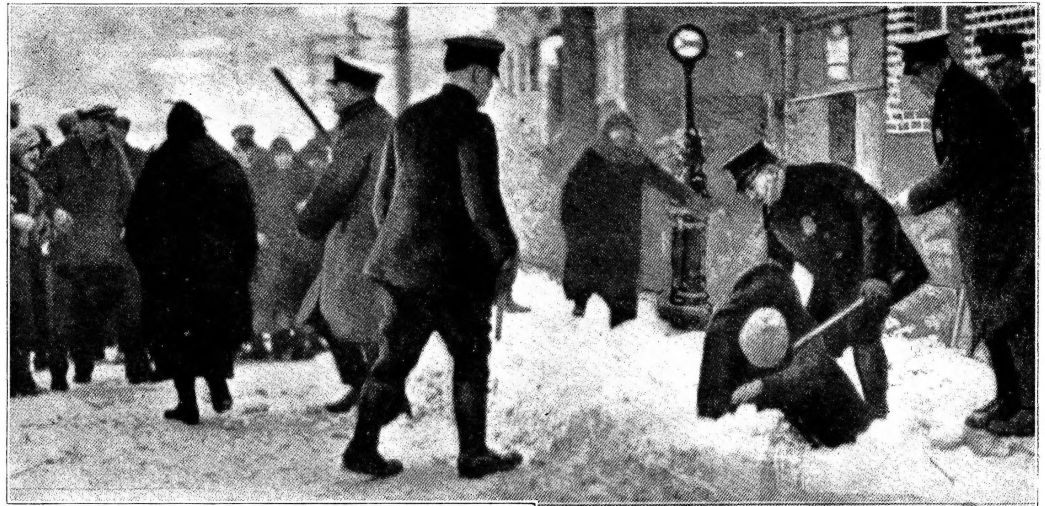
This policy spurred the workers on to greater solidarity, and all the mills affected became paralyzed, most of them shutting down.
The first clubbing by the police occurred when six pickets were sent to the nearby town of Clifton to prepare the ground for the picketing of the Forstmann-Huffmann mill. The six were beaten and told that they could not enter the city as there was no need of looking after the mill in question.
These six returned to headquarters and reported to Organizer Weisbord what had happened. He at once ordered out the entire line of nearly 3,000 pickets with instructions to proceed in orderly manner over the line to the Forstmann-Huffmann plant. They did, but were met on the Ackerman Ave. bridge by the police and beaten and clubbed and kicked till dozens were on the ground and had to be carried off by their fellows.
But the line proceeded. A wedgelike head was formed and waged forward. The police were busy on the lower side. On moved the wedge. The whole police force was shoved and finally pushed into the ditch below and the pickets went on singing and cheering, passing by the Forstmann-Huffmann plant where the workers looked at them thru the windows and in the doorways.
From that day on the Forstmann-Huffmann was doomed. It was only a matter of time, and that time came on Tuesday after Washington’s birthday, when the three thousand workers in this, bitterest of the slave-driving mills, capitulated. The walkout was so complete that the bosses announced that the plant would be shut down as the Botany, the Gera and the other mills had done.
But the struggle was not to be fought without interference by the courts. First two were arrested. Then two or three more. Then six. Almost every day men and women were arrested.
Jack Rubenstein was given 90 days. Bela Varga 30 days. John Penarisi was given 6 months. Others have gotten suspended sentences and “warnings.” J.O. Bentall was hauled before the judge for contempt of court. He was found guilty, but later discharged. The judge openly declared that “I have no sympathy with you,” as he sentenced one of the pickets.
The judge has fixed bail at figures ranging from $250 to $1,000. The local attorneys under the direction of the International Labor Defense of New York have done good work and have handled the cases with much skill and gotten bail reduced wherever possible.
This morning six more were arrested and the International Labor Defense is on the job taking care of them. The expense is heavy as the judge makes the trials as difficult as possible. Joseph Feder and Sigmund Unger are the local attorneys, while Joseph Brodsky of New York is directing the battle for the defense.
Much money has already been used and over a dozen cases are coming up during the next few days. If the International Labor Defense cannot fight these cases it means that many of the workers will remain in prison for long terms, for the crime of wanting to live. The International Labor Defense is doing more than fighting to keep these strikers out of jail. It is giving security and encouragement to the strikers and making them feel that they are not alone in the fierce fight against the brutal attack by the entire forces of the tyrannical ruling class.
Labor Defender was published monthly from 1926 until 1937 by the International Labor Defense (ILD), a Workers Party of America, and later Communist Party-led, non-partisan defense organization founded by James Cannon and William Haywood while in Moscow, 1925 to support prisoners of the class war, victims of racism and imperialism, and the struggle against fascism. It included, poetry, letters from prisoners, and was heavily illustrated with photos, images, and cartoons. Labor Defender was the central organ of the Scottsboro and Sacco and Vanzetti defense campaigns. Editors included T. J. O’ Flaherty, Max Shactman, Karl Reeve, J. Louis Engdahl, William L. Patterson, Sasha Small, and Sender Garlin.
PDF of full issue: https://www.marxists.org/history/usa/pubs/labordefender/1926/v01n04-apr-1926-ORIG-LD.pdf
 Revolution's Newsstand