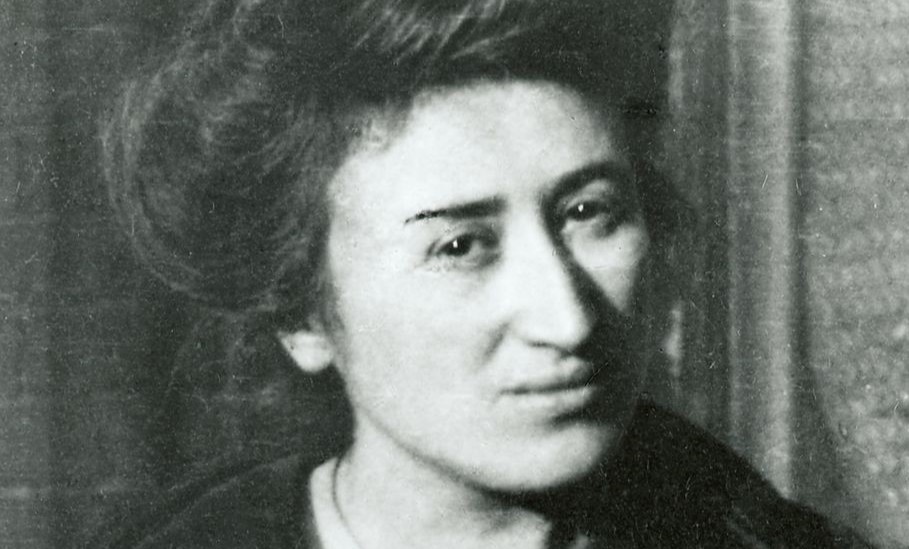
The letters of Rosa Luxemburg are as politically sophisticated, literary and emotive as their author. Taken as a whole they are a singular treasure. Below is a February 2, 1906 letter to Luis Kautsky from Rosa while she was in Warsaw describing the city as the 1905 Revolution continued to unfold.
‘My Very Most Beloved’ (1906) by Rosa Luxemburg from Letters to Karl and Luise Kautsky, 1896 to 1918. Robert M. McBride and Company, New York. 1925.
My very most beloved:
I have not given a sign of life for a long time and no doubt you are angry with me—and rightly so. In my defense, however, I can cite the unceasing troubles and the “insecurity of existence,” from which one suffers here constantly. I can’t well describe all the details here; the main point is: unusual difficulties with the print shops, daily arrests, and the threat of shooting all who are taken into custody. Two of our comrades had this sword of Damocles suspended over them for days; it seems, however, that matters will rest there. Despite everything the work progresses lustily, great meetings take place in the factories, handbills are written and printed almost every day, and the newspaper appears almost daily, albeit amid sighs and groans. A little conference has just taken place in Finland, in which all parties took part. It was a new edition of the “bloc” idea and of course went into the discard. At least one had the opportunity of taking a closer view of the situation in Petersburg. Unfortunately the real picture looks like a veritable taunt at the latest correspondence from Petersburg in the “Leipziger Volkszeitung!” Indescribable chaos within the organization, factional splits despite the union, and general depression. Let’s keep this to ourselves. In any case, don’t take it too seriously. As soon as a new wave of events reaches them, the people there, too, will step more lively and briskly. The pity of it is that they still waver so much and are so little dependable and firm on their own account. The family party will take place somewhat later than intended; in any case, sincere thanks for the greetings from the old folks, which I shall transmit in due time.
The thing that constitutes the sore spot of our movement in Petersburg as well as with us is the colossal spread of unemployment, which causes indescribable misery. I had intended to write only a few lines by way of introduction concerning the situation, in order to come to the matter that interests me most at this moment, but I see that in this letter, too, the “events” threaten to swallow me up; I will therefore call a bold stop and at last emerge as “human being” with the question: how are you, dearest Lulu?! To be sure, Carolus wrote me several times reassuringly, for which I am thankful to him. Nevertheless anxiety gnawed at me amid all the commotion here, even if I did not get to writing. As to what was the matter with you so suddenly, that I don’t know to the present day. It must certainly have been something execrable, if it has such after-effects. Are you able to stir out of the house? Have you been weakened much? Look here, all the years that I was with you, you were always in good health and spirits, but hardly do I go out into the world—when, suddenly, you fall seriously ill! How many times have I thought during my work here: were I over there, I should like to sit with you for a few hours every day and be your devoted nurse! Well, I hope you don’t require nursing any longer. If it is at all possible for you, do write me a few lines as a sign; it will give me such pleasure! The rest of you are, I hope, well. That the boys haven’t written me till now grieves me not a little. We don’t receive the “V.” at all, and the “L.V.” only very irregularly. As far as I am concerned, the next days will decide whether I shall leave from here for Petersburg for a short time or whether, indeed, I shall first go for two months ad penates—to you. Frankly, the only thing that draws me there personally is you, for otherwise, to tell the truth, the thought of the treadmill and of the discussions with Peus and Rexhauser1 is horrible!
To pick up the thread again: the unemployment—voila la plaie de la revolution—and no means of curbing it! But in connection therewith there is developing a quiet heroism and a class consciousness of the masses that I should very much like to show to the dear Germans. Everywhere the workers of their own accord make such arrangements as, for instance, having the employed give a day’s wages each week to the unemployed. Or, where employment is reduced to four days per week, they arrange things in such a way that nobody is dismissed, but all work several hours less per week. All this is done so simply, so smoothly, and so as a matter of course that the Party receives word of it only in a casual manner. As a matter of fact the feeling of solidarity and of brotherliness is so strongly developed among the Russian workers that one cannot help but be surprised even though one has personally worked to develop this feeling.—And here is an interesting result of the revolution: in all factories committees elected by the workers have come to life “all by themselves,” which decide about conditions of work, employment and dismissals of workers, etc. The employer has actually ceased to be “master in his own house.” Herewith a curious little example: the other day a factory management wanted to punish several workers for being very late, but the committee prevented this; thereupon the manufacturer lodged a complaint with the Committee of the Social Democratic Party, saying that the factory Committee was not “acting in accordance with social-democratic principles,” for the Social Democracy favored diligent and honest fulfillment of obligations! And so in instance after instance. Of course, all this will in all probability be very different after the revolution and after the return of “normal conditions.” But these conditions will not pass over without leaving their marks. For the present the work accomplished by the revolution is enormous—deepening the cleavage between the classes, bringing conditions to a sharp issue and clearing them up. And all this is not appreciated abroad! People think the struggle has been abandoned, but it has only gone down into the depths. And at the same time the organization progresses untiringly. Despite martial law trade unions are industriously built up by the Social Democracy—quite in due form: with printed membership books, stamps, by-laws, regular meetings, etc. The whole work is conducted just as though political freedom were already a fact. And the police is, of course, power less against this mass movement. In Lodz, for instance, we already have 6000 enrolled members in the social-democratic union of the textile workers! Here in Warsaw: 700 masons, 600 bakers, etc. In Petersburg, on the contrary, the work is said to have gone “underground,” for which reason it is now at a standstill. And they are absolutely unable over there to issue a paper or even hand-bills. I should certainly like to be there in order to investigate all this. Unfortunately I must close, therefore one more request: Dearest Carolus, send us 1600. M. immediately from the Main Account2 by check made out to the name of: Otto Engelmann.3 Send it by registered letter to the usual address. Haste is necessary! As concerns that letter from Vilna, everything is in order. A thousand kisses and greetings to you all, especially to you, dearest Lulu. Do write me very soon!!!
Your R.
NOTES
1. A discussion concerning the political neutrality of the trade unions. L.K.
2. During Rosa’s absence we had taken the fund for the Polish party over onto our own bank account. During the Spartacus disorders in 1919 the Lieut. Krull who is mentioned earlier and who was ransacking Rosa’s home and conducting a search in it, found a bank book there in the name of Karl and Louise Kautsky. This induced him to entice Kautsky into the Moabit barracks on the excuse that Col. Reinhard demanded certain information of him. Arrived there, Kautsky was turned over to a certain Sergt. Penther, who declared him to be under arrest because “he had financed the criminal operations of Rosa Luxemburg.” Penther is the same “honorable” man who afterwards played such a prominent part in the murder of 32 sailors who were shot in a most cowardly manner, though innocent, by reactionary officers who suspected them of being rioters. L.K.
3. Leo Jogiches. L.K.
Letters to Karl and Luise Kautsky from 1896 to 1918 by Rosa Luxemburg. Edited by Luise Kautsky, Translated by Louis Lochner. Robert M. McBride and Company, New York. 1925.
Contents: Introduction by Luise Kautsky, Beginnings, 1896-1899, Incipient Friendship1900-1904, From the Imprisonment at Zwickau to the First Russian Revolution, The First Russian Revolution 1905-06, Up to the World War 1907-1914, Letters from Prison During the War 1915-1918, Postscript by Luise Kautsky, Appendix: Biography of Karl Kautsky. 238 pages.
PDF of book: https://www.marxists.org/archive/luxemburg/posthumous/lettersofrosaluxemburg-1922.pdf

