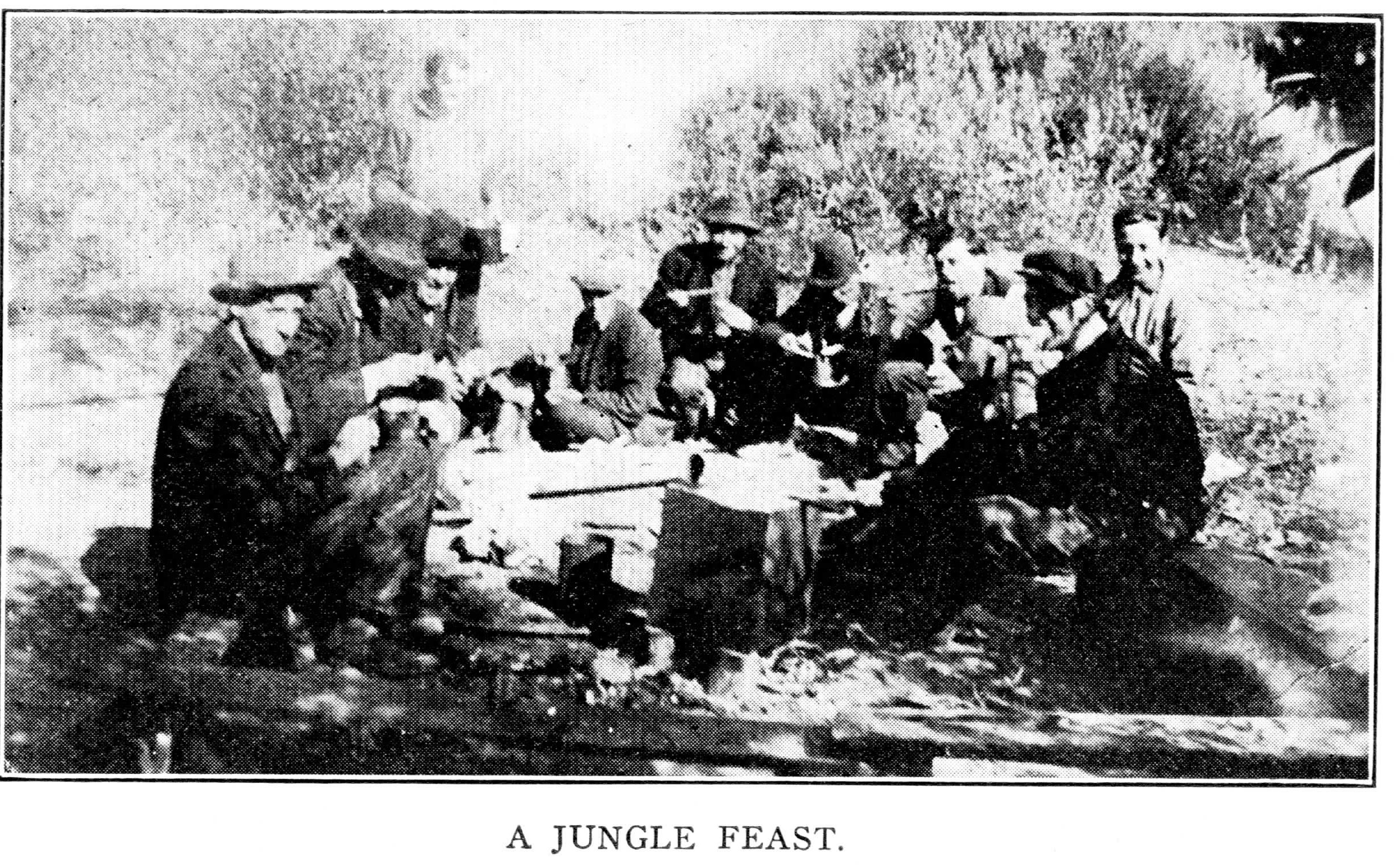
Jungle stories of the wobbly harvest organizer is almost a writing genre unto itself and a fabulous collection could be made of them. Here, tales from the fields, camps, and jails around Groton, South Dakota in 1914.
‘On the Trail of the Dakota Harvest’ by P.A. Sullivan from Solidarity. Vol. 5 No. 237. July 25, 1914.
Some Lively Experiences of I.W.W. Agitators in the Farming Towns of South Dakota.
(Special to Solidarity) In the Jungles, Groton, S.D., July 16. In my last letter I told how we made some of the Kansas farmers come across. The cutting being about finished there, on July 4th we set sail for K.C. Arriving, we found the agitation carried on throughout had not been in vain, as members were coming in every day.
After resting up a day or two we started for the Dakotas, carrying on agitation all along the line. Coming from Omaha to Sioux City the train crew attempted to put everybody off. All hands stood pat, so the attempt was useless. We seized the opportunity and gave everybody a talk on industrial unionism, pointing out what solidarity would do.
Finding about 20 “wobblies” in Sioux City, where we spent Friday, the 10th, we decided to hold a street meeting. Had a very large crowd. The writer spoke for about an hour and a half. At the conclusion we were besieged on all sides for Song Books and literature, also by four or five who wanted to line up and also asked why we did not establish a local in Sioux City. One man told the writer that he would spend $95 to help start a local. All of which goes to show that Sioux City is ripe for the One Big Union and would like to see something done there.
Leaving Sioux City, we proceeded to Yankton, S.D. After spending the day in the jungles, we decided to hold a meeting, as there were a large number of men in town on. their way to the harvest fields. We went up town 22 strong, and opened our meeting, but had not got through the first verse of the opening song when a big, burly bull rushed through the crowd, which was gathering rapidly. He pushed Fellow Worker Matt Fox, of Detroit, who was leading the song, off the box. His place was at once taken by Fellow Worker Herzberger, who was grabbed at once and placed under arrest. Fox again mounted the box and concluded the song. The writer then mounted the box to address the crowd, but had only got started when five or six bulls came up. I was at once pulled from the box and placed under arrest. Then the fun started, and the natives and slaves got a lesson in solidarity. Looking back as I was being led away, I beheld 20 of them all trying to mount the box, while the natives stared with gaping mouths and remarked on the spirit of the boys. They pinched all the 20. Down the street they went singing, “Just as Fast as They Can Pinch Us Wel Can Always Get Some More.” The catchy air made a hit, and later in the evening all the kids in town were singing it.
Once in the monkey cage, all hands started singing. The cops shut the doors and cut off all air. Then the boys started to “battleship” in earnest. Presently the chief came in; he wanted to release us if we would leave town. Acting as spokesman, the writer informed him that we would leave provided they allowed us to hold our meeting. They refused, then threatened to turn the fire hose on us if we did not keep quiet. Their bluff was called. Then a reporter came to interview us. He must have represented a paper antagonistic to the administration, as he was run out. Again they wanted us to leave; our reply was a demand to be allowed to hold our meeting. Then they told us the mayor was out of town and no one else had authority to give us a permit. We replied we would wait until he returned. They said, “Well, if you do you will wait in here.” The boys answered, “Then here we stay.” All efforts to scare the boys meeting with failure, they changed their tactics, and called the writer and Fellow Worker Phillips out of the monkey cage, saying they wanted to talk to us. Taking us into the other room, they again tried to bluff us. Failing, they took us two, put us into an auto, and took us to the county jail, placing a charge of jail-breaking against us. This was based on the fact that the boys had broken a window to get air.
This act of the authorities was intended to break the solidarity of the bunch, as they then went back and told the boys we had left town, and wanted them to leave also. Fox, acting as spokesman, told them nothing doing, unless Phillips’ and I were produced. Then they told the boys we were in the county jail and did not want to leave. Fox replied, “Neither do we.” The chief then told them that they (the boys) would leave on the midnight train and if they did not go willingly he had been authorized by the district attorney to swear in every man in town if necessary, and that he would do it and club them out of town. Fox replied: “You may beat us up; you may shoot us and ship us out in coffins, but we will never leave alive without Phillips and Sullivan.” This took their breath, but they said they would not allow us to go, but would make an example of us. In the meantime Fellow Workers Cahill and Simmons, who had remained outside, got a telegram off to General Headquarters, notifying them of the fact that we were in jail. The chief got wind of that, and it made him think, so the officers came in and made the boys a proposition that they would release Phillips and I if we would all leave. Fox told them to get out of the room and the boys would talk it over. Owing to the fact that we did not come up this way to start free speech fights, but to carry on agitation, they agreed to leave provided us two were produced unharmed; but Fox told them if there had been a hair of Phillips’ and Sullivan’s heads harmed or a hand put on them, the boys not only would not go but would have a thousand men in Yankton in a week and put it on the map. So they then came and brought Phillips and me back from the county jail. Then the boys demanded supper, which they got.
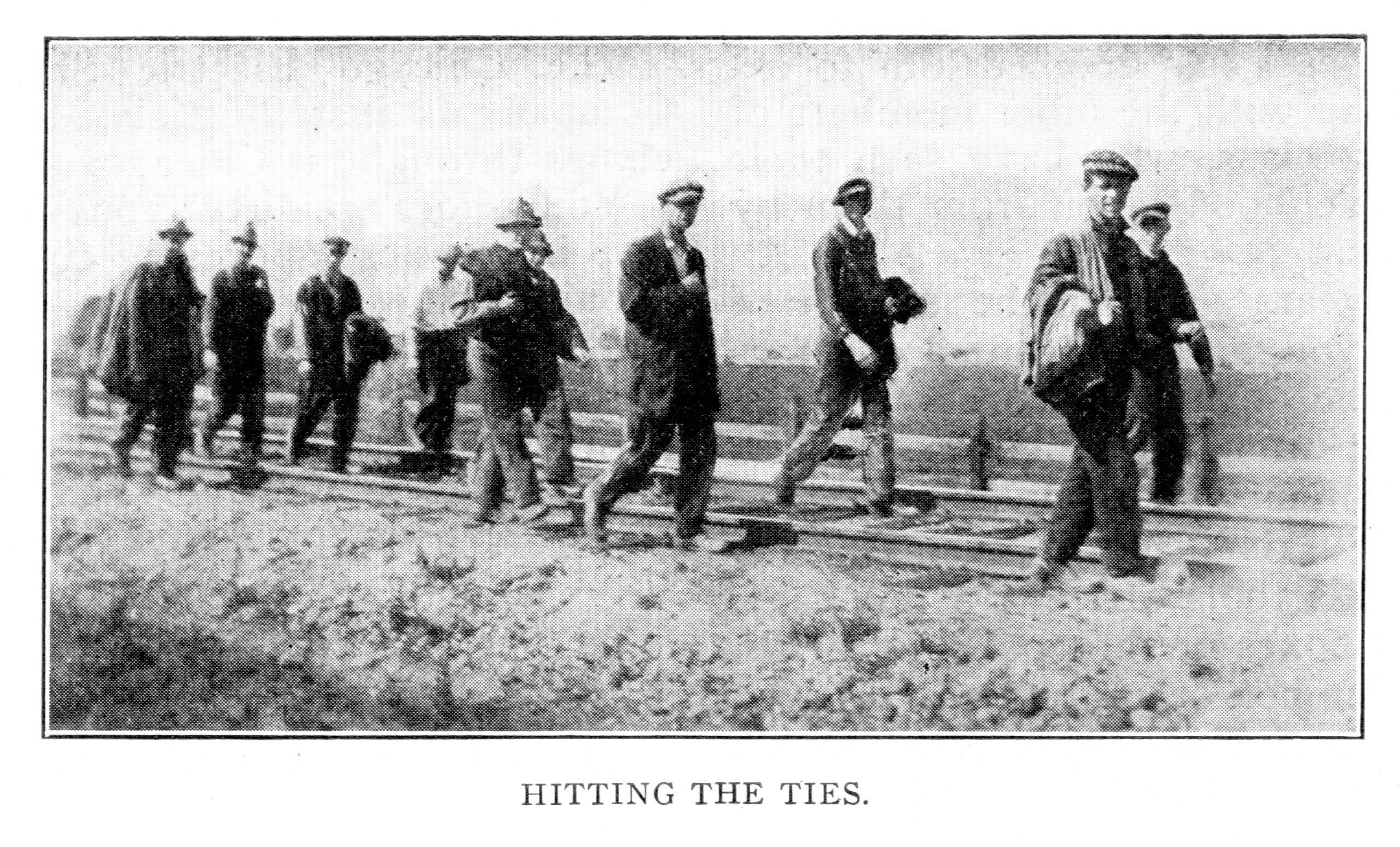
All this time the boys were continually singing one song after another. When it came time to leave, the authorities had about 60 citizens, all heavily armed, to escort us to the railroad. The boys marched in an orderly manner. When we reached the railroad the chief thanked us and told the boys he admired the spirit they had shown, and that he realized now they were men of their word. Said he had thought they might make trouble on the way down, even after they had agreed to go peaceably. The writer then told him that any time a bunch of I.W.W.’s said they could do anything and passed their word, they would do it. With that they left us to wait for our train. We were joined by Cahill and Simmons and left Yankton behind us. Proceeding on our way, Mitchell, S.D., was, the next stop. Reaching there Sunday morning, there were 300 or 400 slaves in town all bound for the harvest fields. When we were all aboard ready to move on to Aberdeen, we found the car we were in stopped right in front of the depot, The boys started singing. Soon there was a crowd of 400 or 500 scattered around the boys. Seeing a chance to spread some propaganda they called on the writer, who talked for abut 45 minutes and was well received by the crowd.
Upon our arrival in Aberdeen about 6 P.M. Sunday, we found we were about 60 strong. We at once established a “wobbly” jungle camp. Monday morning, a committee of four fellow workers called on Mayor Hall, asking for a permit to hold a street meeting. He asked what the nature of the meeting was to be; when informed it was to discuss industrial unionism he refused point blank and walked away. Returning to the camp, we talked it over and decided that as there was no one who had organizer’s credentials, we had no authority to force the issue. Anyhow, as stated above, we were not here to start free speech fights. After a lot of discussion we agreed to do nothing further regarding street meetings, but we rounded up about 200 slaves in the jungles and had a meeting there. Again the writer was called upon for a talk and was followed by that rebellious old war horse of Spokane fame, Gatewood, who had just arrived. He made a soul-stirring appeal to the slaves. There was a great deal of interest and enthusiasm displayed, and I cannot help but think we will get results later on.
In conclusion I would like to ask, Where are all the people who hold credentials as organizers? Why are they not on the job? The writer knows for a positive fact that at least 20 cards could have been issued Monday alone in Aberdeen had there been some one there with books and authority to issue same.
All along the line we are kept busy answering the question, “Where and how can I join the I.W.W.?” Wake up, you organizers; et out on the job and get busy. That is where your services are needed and in demand. Anyway, some of you locals should have camp delegates out on the job with credentials. Now is the time to do the work. Let us all make a long pull, a strong pull and a pull all together and watch results–see the One Big Union grow.
We have sent a request to Local 61, Kansas City, to grant credentials as camp delegate to Fellow Worker Phillips. If this request is granted we will be in position to do something and we will do our part. If all other rebels will do like- wise and get their eyes and mind off that “big stake” they went for, and will pull for the One Big Union, better wages and shorter hours, we will have some results to show for our work after the harvest is over. After our meeting in the jungles we decided to split up, scatter out and get on the job.
P.A. SULLIVAN.
P.S. Forgot to mention that during the argument at Yankton the writer called the chief’s attention to the United States constitution which “guarantees” us free speech. The chief replied: “That does not go in Yankton.” It is not in the United States.
The most widely read of I.W.W. newspapers, Solidarity was published by the Industrial Workers of the World from 1909 until 1917. First produced in New Castle, Pennsylvania, and born during the McKees Rocks strike, Solidarity later moved to Cleveland, Ohio until 1917 then spent its last months in Chicago. With a circulation of around 12,000 and a readership many times that, Solidarity was instrumental in defining the Wobbly world-view at the height of their influence in the working class. It was edited over its life by A.M. Stirton, H.A. Goff, Ben H. Williams, Ralph Chaplin who also provided much of the paper’s color, and others. Like nearly all the left press it fell victim to federal repression in 1917.
PDF of full issue: https://www.marxists.org/history/usa/pubs/solidarity-iww/1914/v05-w237-jul-25-1914-solidarity.pdf

