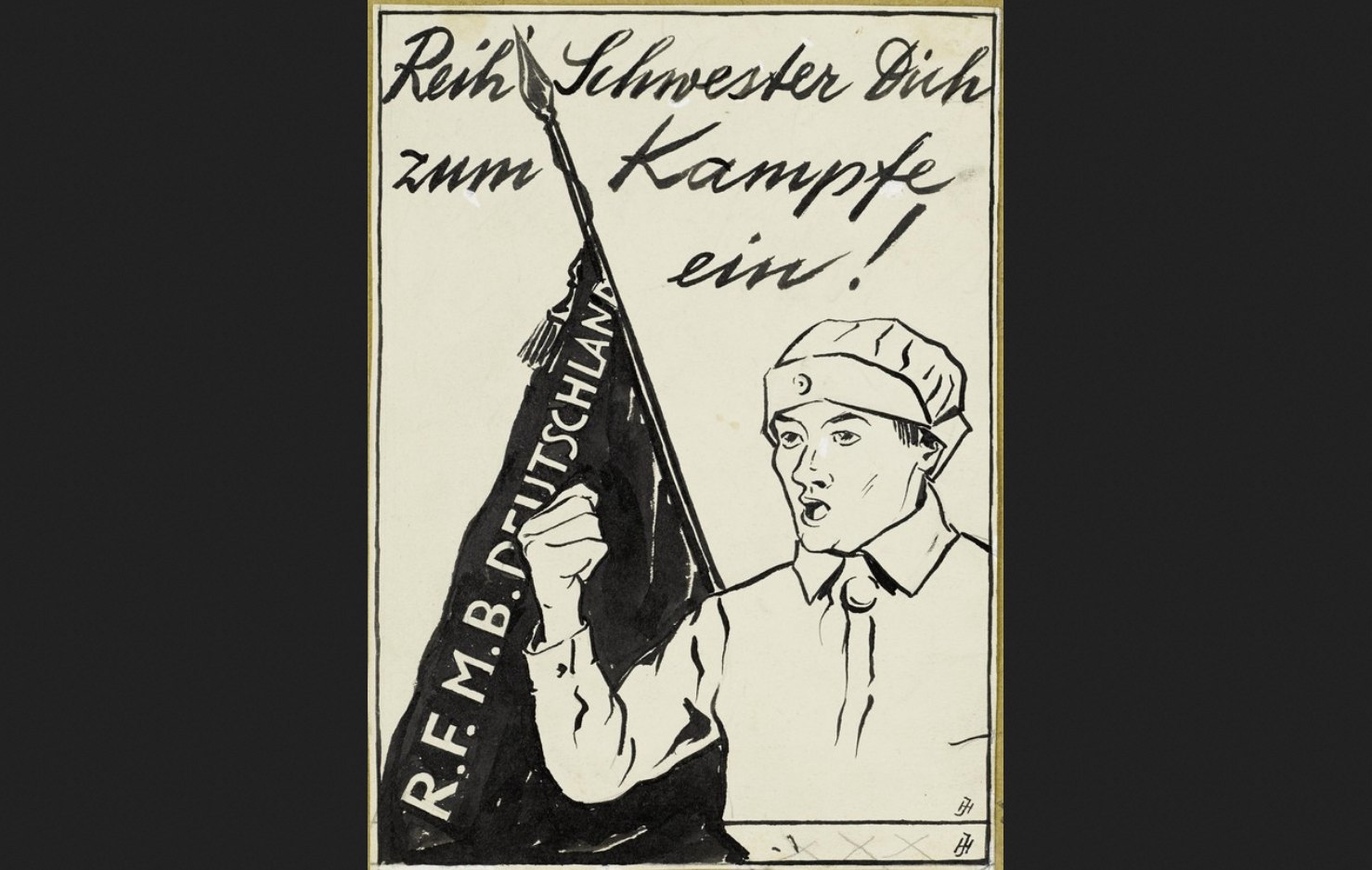
In what was, perhaps, a high-point period for its work among women, hundreds of delegates gather in Berlin for a conference hosted by the German Communist Party and chaired by Lena Overlach, leader of the Roter Frauen und Mädchenbund, the women’s Red Front Fighters and member of the Reichstag from Dusseldorf. Along with the voices of its many participants, the gathering was also addressed by Ernst Thälmann and a representative of Soviet women.
‘National Congress of Working Women in Germany’ from International Press Correspondence. Vol. 9 No. 62. November 1, 1929.
The National Congress of the Working Women of Germany took place in the Moabit Assembly Hall, Berlin, on October 20th. The very composition of the congress showed that it signified a turning point in the work among the women, which is now directed towards winning over of the majority of the working women.
A total of 408 delegates represented 229 works (79 big factories, 100 medium-sized ones and 50 little ones). Of the delegates 233 were non-party, 163 belong to the C.P.G., 10 to the Y.C.L. and 2 to the Young Spartacus League. The women delegate movement is apparently getting a footing in the factories. The international solidarity of the working women found expression in the attendance of the 8 foreign delegates.
In addition to the factory women, 71 housewives were present. The clerks had 16 delegates, the outworkers 12, while the female agricultural labourers had the smallest representation, namely, 3 delegates.
Comrade Thälmann greeted the congress in the name of the C.P.G. and of the illegal Red Front Fighters’ League. He said:
“The 12th Party Congress of the C.P.G. placed in the foreground of our revolutionary policy the energetic application of our mass work to those important strata of the workers, who in the process of the capitalist rationalisation are most exploited and oppressed by finance capital and the capitalistic State system with fresh predatory means and methods: the working women and the young workers. This congress is a proof that we have tried rapidly to overcome the conservative backwardness, which unfortunately still prevails in the whole of the proletariat and in a measure in the Communist Party too, in relation to the role and significance of the revolutionary working women’s and housewives movement in Germany. The development in Germany presents us with big tasks, which at this congress will be discussed and settled.”
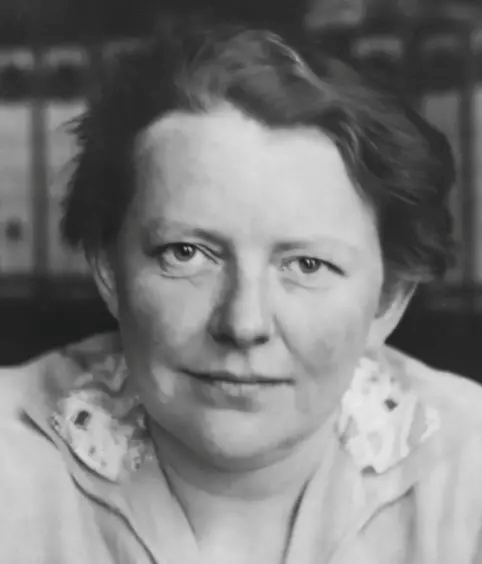
The main speech was delivered by the chairman of the National Committee of the Working Women, Comrade Lene Overlach, who stated:
“In the first place, the discussions at this conference relate to measures against the aggravated attack on the part of capital, which must be replied to with organisation of mass strikes for higher wages and a seven-hour day, with organisation of political mass strikes against the government of starvation and of war. Every blow which you deliver in the works is at the same time a blow against the war preparations of imperialist Germany, is a step towards the protection of the Soviet Union. Every surrender means strengthening of capitalism and thereby strengthening of its war preparations against the Soviet Union.
“The bourgeoisie is proceeding to carry out the Young Plan at the cost of the workers through increased speeding up methods, wage cuts, increased cost of living, mass taxes and reduction of social benefits. By means of new criminal laws, of State protection acts, of the projected police regulation for the supervision of all proletarian meetings the workers who are advancing towards the revolutionary fight are to be gagged and, with the help of the police, the Fascists and Social-Fascists, are to be bloodily suppressed.
“The employers and landed-proprietors are proceeding with the greatest brutality against the factory women and the female agricultural labourers and against all strata of working women. When on a single evening 20 workwomen faint at a conveyor band and the employer mockingly declares that the conveyor will shortly be speeded up, when the silk spinners in Silesia have to attend to six machines instead of two, when hours of labour are lengthened by means of overtime to 10, 12, and even 14 hours and when the employers announce at their conferences further measures of rationalisation, you know what you have to expect.
“Which path do you intend to take? The only road open to you is that of revolutionary fight, and you have already proved in numerous strikes that you are prepared to fight.
“Elect revolutionary fighting committees and see to it that in all these fighting committees working women and workers’ wives are represented.
“The fight in the factories is closely related to our fight against the threatening danger of war. The Young Plan implies the united front of the imperialist State against the Soviet Union.”
A delegate sent by the workwomen of the Winkler & Gabler factory in Erzgebirge-Vogtland spoke about the position of working women, especially in the textile mills. She described the consequences of rationalisation for the workers, and especially for the working women, who are used up and then thrown into the street. The wages of the women are always lower than those of the men and in every collective agreement are always treated differently from the wages of the male workers. Not ever the federation defends the stanpoint:
“Equal pay for equal work.”
A non-party working woman from Eisleben preserve factory reported that the people there work from 6 o’clock in the morning till 10 at night and sometimes longer for 3 1/2d an hour. When anybody takes a day off for any private reason, he can expect dismissal on the spot. The working women of this factory appealed to the Red Women’s and Girls’ League, which called a meeting. The speaker herself was victimised. “I recognised what is necessary and am now joining the Communist Party.”
A working woman of the Lorenz factory, Berlin, called her factory a jail. Wages of 27 to 30 marks are paid there for at working week of 53 hours. The conveyor runs at a terrible pace, so that 3 to 5 women faint every day.
A mill girl from the Leipzig cotton spinning mill reported how rationalisation is carried on there. Every new machine imported from America displaces six working women. The wage is 22 marks a week for work which is extremely injurious to health.
The treacherous attitude of the reformist shop stewards was described by a working woman from the Salamander works and the representative of the Reimsma cigarette factory. In this factory, too, furious speeding up methods have been introduced with the result that 6 or 8 people fall ill every day. The women were compelled to do overtime, although dismissals have shortly followed on account of “lack of orders”.
A shop girl from a store in Dresden reported that the shop girls there get 108 marks a month, while the girls employed in carrying goods to the cash desk, where they are handed over to the purchasers, get 10 marks a week. A cleavage deliberately made between the sales staff and technical in order to prevent the exploited employers from joining forces. The shop assistants are, however, still very backward and indifferent to the class struggle.
The speakers repeatedly advocated that the women be taught the art of self-defence, so that they might fight for Soviet Germany. This was the main content of the speech by the delegation of the Red Front Fighter League.
In regard to the role of the working women in the fight against the danger of imperialist war the representative of the dye industry at Treptow made a speech, in which she pointed out the importance of the chemical industry in regard to war. Mass dismissals are at present taking place in Treptow as a consequence of rationalisation. A Labour aristocracy is being artificially bred. The women are still quite passive, but by means of the nucleus newspaper, Party functionaries, etc. are being gradually roused.
To the accompanying strains of the “International” a delegate of the working women of the Soviet Union, comrade Petrova, mounted the platform. She said:
“We bore the same chains as the German working women have still to bear. When I compare the privations of the German working women with the conditions in the Soviet Union, I recognise how much progress we have made. Under the leadership of the Bolsheviki we have chased away the bourgeoisie and taken the power into our own hands. There are perhaps many among you who say: The path is a difficult one, had we not better be cautious and give up the advance? From my experience of the Russian revolution I would answer: Never vacillate. Only by boldness, by the offensive, only with rifle in hand can the proletariat gain its freedom.
“In the Soviet Union we are engaged upon the task of overtaking the capitalist countries and racing ahead of them. We too, have our process of rationalisation, but it does not do it by throwing large batches of workers out of the process of production, but reducing unemployment, reducing hours of and raising the standard of living of the workers. In our factories there are no hustlers speeding us up for the sake of higher profits.
“All States are arming against us. We are accused of wanting war. We do not want war, what we want is socialist construction; we want peaceful work for the million masses. Why is war being prepared against us? Because we threaten capitalism, because our cry to the workers of the whole world is: Forward, take the power into your own hands and overthrow the bourgeoisie!
“As regards the political equality of the women in the Soviet Union, 30 per cent. of all the members of the soviets, from central executive committee down to the smallest village are working and peasant women They rule, make the laws and see that they are carried out. And I ask you: If you had the power, if you were at the head of the government, would you make bad laws? No, you would make good laws, good laws for the proletarian women.
“The wish of your Russian working sisters is that you should proceed along the path along which Lenin led us.”
Speeches were also made by women delegates from Sweden England, Austria, Czechoslovakia and France, as well as a representative of the striking plumbers, a representative of the illegal Red Front Fighters League and a woman representative of the Anti-Fascist Young Guards, etc.
After Comrade Overlach had delivered her speech in response to the discussion the congress was closed by Comrade Thälmann. A delegation to Russia was elected. The “battle cry” of the congress, protest resolutions against Fascism, battle greetings to the Russian working women, to all political prisoners, to Humanité, etc., were passed unanimously.
International Press Correspondence, widely known as”Inprecorr” was published by the Executive Committee of the Communist International (ECCI) regularly in German and English, occasionally in many other languages, beginning in 1921 and lasting in English until 1938. Inprecorr’s role was to supply translated articles to the English-speaking press of the International from the Comintern’s different sections, as well as news and statements from the ECCI. Many ‘Daily Worker’ and ‘Communist’ articles originated in Inprecorr, and it also published articles by American comrades for use in other countries. It was published at least weekly, and often thrice weekly.
PDF of full issue: https://www.marxists.org/history/international/comintern/inprecor/1929/v09n62-nov-01-1929-inprecor.pdf

