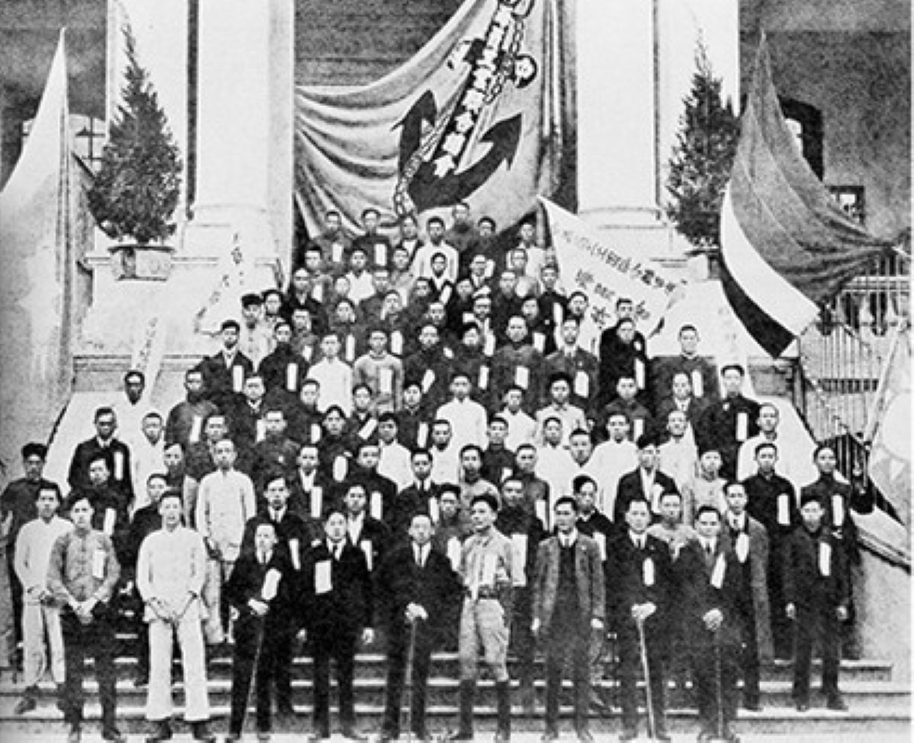
A summary of what was historically among the most important unions of our class. The Chinese Seamen’s Union would play a central role in the revolutionary struggles of the 1920s; leading general strikes, organizing the Chinese diaspora, and connecting China’s movement internationally.
‘The Chinese Seamen’s Union’ from International Press Correspondence. Vol. 6 No. 46. June 10, 1926.
The Chinese Seamen’s Union is based on the industrial principle and includes in its membership the Chinese seamen who do the long-distance traffic and the coasting trade along the coast of the Pacific Ocean, as well as those who are employed on harbour-and-river boats.
The central committee of the Chinese Seamen’s Union has its headquarters in Canton, and is administered by the most independent and most trustworthy of the Chinese revolutionary seamen who endeavour to introduce proletarian class politics in their Union.
According to the last reports made by one of the most reliable leaders of the Chinese Trade Unions movement, the Chinese Seamen’s Union includes over 30,000 Chinese seamen and river boatmen and has its branches in all the larger ports of the Chinese coast, such as Canton, Shanghai, Hongkong, Amo, Tsientsin, Swaton etc.
The strongest and best organised branches of the Chinese Seamen’s Union are in Canton and Shanghai.
The branches in the other seaports represent relatively more recent organisations which are gradually getting stronger, and spread their influence over an ever-increasing bulk of Chinese seamen.
The bulk of Chinese seamen has a distinct class feeling and supports the revolutionary elements among the seamen. Conditions in all the ports, except Canton, are very difficult.
In the registered enterprises of the Imperialists the Chinese seamen are unscrupulously suppressed. The same is done by the Chinese police which is at the disposal of the Chinese militarists.
Owing to such a situation the Chinese seamen in Shanghai are exposed to continued persecutions. For the same reason the Shanghai section of the Chinese Seamen’s Union is not able to publish its own periodical, which the Chinese sailors in Shanghai badly need.
Although there is a strong revolutionary spirit among the Chinese seamen in the port of Shanghai, this disposition is not openly expressed by the leaders of this section, who often overcome their class feeling and keep up a connection with the Shanghai Chamber of Commerce with which they work together.
It was pardonable that they adopted such a policy at the time of the Shanghai general strike, when the Chamber of Commerce financially assisted the striking Chinese workmen, joined the workmen who fronted the Imperialists, and supported the national liberation movement in China; but the leaders of the Shanghai Seamen’s Union section cannot be pardoned for maintaining the connection with the Chinese bourgeoisie after the strike, as the Chinese bourgeoisie agitates against the Chinese workmen and thus sets up a contact with the Imperialists. The General Congress of the Chinese Seamen’s Union acted correctly when it endeavoured to change this system of cooperation.
The other sections of the Chinese Seamen’s Union are under the management of class-conscious Chinese seamen.
On December 27, 1925 the central committee of the Chinese Seamen’s Union had convoked a General Congress of Seamen which was attended by 200 Delegates of all the branches of the Chinese Seamen’s Union. Shanghai alone was represented by 20 Delegates.
At the Congress of the Union, held under the administration of revolutionary seamen and communists, it was decided definitely to join the Red International of Labour Unions from January 1st 1926 by becoming members of the International Propaganda Committee of transport workers. Owing to this resolution the Congress has put an end to any indecision and definitely adopted a revolutionary class standpoint.
This resolution formed an important point in the realisation of the International Unity of the Trade Union Movement and was a decisive answer to those reformist leaders of the Trade Union movement who continue their hostile policy against the Unity of the international Trade Union Movement. This connection between the Chinese Seamen’s Union and the R.I.L.U. is, however, of still greater importance for the development of the class feeling of the Chinese proletariat, and leads the way to their complete liberation from international robber capital.
The Chinese Seamen’s Union has taken the first step by putting the vanguard of Chinese proletarians seamen and railwaymen on the right proletarian way. The Chinese workmen of other branches of work must follow the transport workers on their way to the delivery of China from the international imperialist bourgeoisie.
International Press Correspondence, widely known as”Inprecor” was published by the Executive Committee of the Communist International (ECCI) regularly in German and English, occasionally in many other languages, beginning in 1921 and lasting in English until 1938. Inprecor’s role was to supply translated articles to the English-speaking press of the International from the Comintern’s different sections, as well as news and statements from the ECCI. Many ‘Daily Worker’ and ‘Communist’ articles originated in Inprecor, and it also published articles by American comrades for use in other countries. It was published at least weekly, and often thrice weekly.
PDF of full issue: https://www.marxists.org/history/international/comintern/inprecor/1926/v06n46-jun-10-1926-Inprecor.pdf

