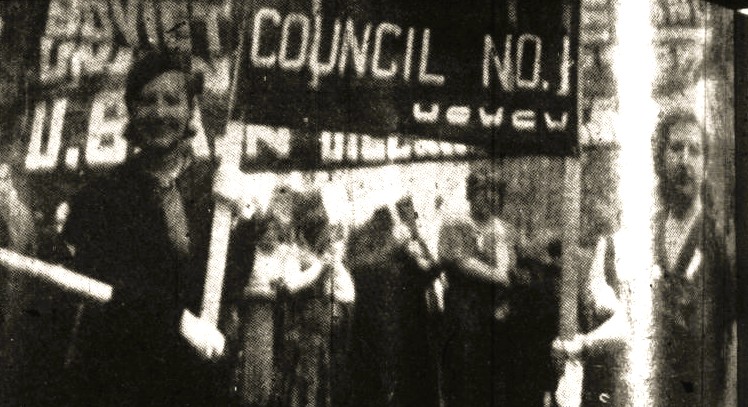
How the United Women’s Councils of New York formed the Bakers Woman’s Council No. 1 for women family members and supporters of striking bakers in the city.
‘We Help Them Strike’ by Esther Schwager from Working Woman. Vol. 4 No. 5. July, 1933.
HOW THE United Women’s Councils of New York Supported the Strike of the Int’l Bakers Union
The baker’s wife is like most housewives of the working class, tied to the home by the many tiresome tasks of housekeeping, taking care of the children, and making both ends meet. During the years of the so-called prosperity this was not so difficult because the baker brought home union wages, and worked union hours, that is, eight hours a night.
But little by little, wages were cut, and hours were added, until the baker was working fourteen, sixteen, and even eighteen, hours, out of twenty-four.
Bakers Wives Join Men Folks
Knowing the intolerable conditions under which her husband was working, and being thrown out of even such means of earning a few dollars, the baker’s wife promptly answered the call when she was asked to help in the strike, which began in May.
The United Councils of Working Class Women organized in preparation for the present struggles. The original members are still the really active workers in the strike and appreciate the help that the other Councils and the Central Body have given the strike so far, and know that this assistance will continue right through to the finish.
Try to Break Militant Spirit of Women
The work done by the women is not appreciated by a small reactionary element which is known to be the enemy of the Union and organized labor. This element tries to minimize the importance the women play in the strike and in the labor movement as well.
Some of these misleaders have succeeded in influencing a good part of the rank and file membership in the same direction. Upon being asked why his wife does not participate actively in the strike one of these member’s will say that it is the husband’s part to do the fighting, and that the wife must not meddle in such affairs.
More Women Help Fight
However, more women are joining in the work daily. Of course, the women in the Bakers Women’s ‘Council No. 1 are the most active workers–on the picket lines, on the side lines, among the women in the stores and markets, and on the platform at open, air meetings.
When women made their appearance at the beginning of this strike in picketing the bakery the bosses were very much upset. They called out the police and insisted that the women be arrested because their business was falling off.
Police Terror Used Against Women
I heard one policeman plead with a proprietress of a bakery, “But, Madam, I can’t arrest her. There is no charge.” Not satisfied with this answer she telephoned the police station for another policeman. Two others came. Now there were three husky policemen watching one little woman picketing the bakery.
The result was that the policemen attracted still more attention to the spot, a crowd gathered, and the strike was better advertised at the expense of the bosses and the police department. A few arrests have been made on false charges of assault, and the cases of these women are still in the courts. The women are all out on bail.
Learn Value of Organization
It is wonderful to see these women who were never connected with any organizational work, whether social or political, or economic, come out of the kitchen and throw themselves into the work of the strike with such zeal.
It is a long time since the last Pechter and Messing strike, about fifteen years, and the public has forgotten ten that women were on the picket lines then, and were the best fighters.
Bosses Loose Business
Today the fight is carried on with less damage to the scab bread; but more damage to the scab bosses. When groups of women in a neighborhood go to a grocer and command him not to deal with the scab bakeries, they must be heard because they are his customers, and he obeys because he knows he will lose business unless he does so.
This is the strength of organization; this group of women is invariably a group of Council women. Whether the grocer is sympathetic with the strike or not, the loss of money speaks very emphatically.
These women are now ready to fight any worker’s fight when this one is settled. They will be on the alert in all struggles of the workers.
ESTHER SCHWAGER.
The Working Woman, ‘A Paper for Working Women, Farm Women, and Working-Class Housewives,’ was first published monthly by the Communist Party USA Central Committee Women’s Department from 1929 to 1935, continuing until 1937. It was the first official English-language paper of a Socialist or Communist Party specifically for women (there had been many independent such papers). At first a newspaper and very much an exponent of ‘Third Period’ politics, it played particular attention to Black women, long invisible in the left press. In addition, the magazine covered home-life, women’s health and women’s history, trade union and unemployment struggles, Party activities, as well poems and short stories. The newspaper became a magazine in 1933, and in late 1935 it was folded into The Woman Today which sought to compete with bourgeois women’s magazines in the Popular Front era. The Woman today published until 1937. During its run editors included Isobel Walker Soule, Elinor Curtis, and Margaret Cowl among others.
PDF of full issue: https://www.marxists.org/history/usa/pubs/wt/v4n05-jul-1933-WW-R7524-R2.pdf

