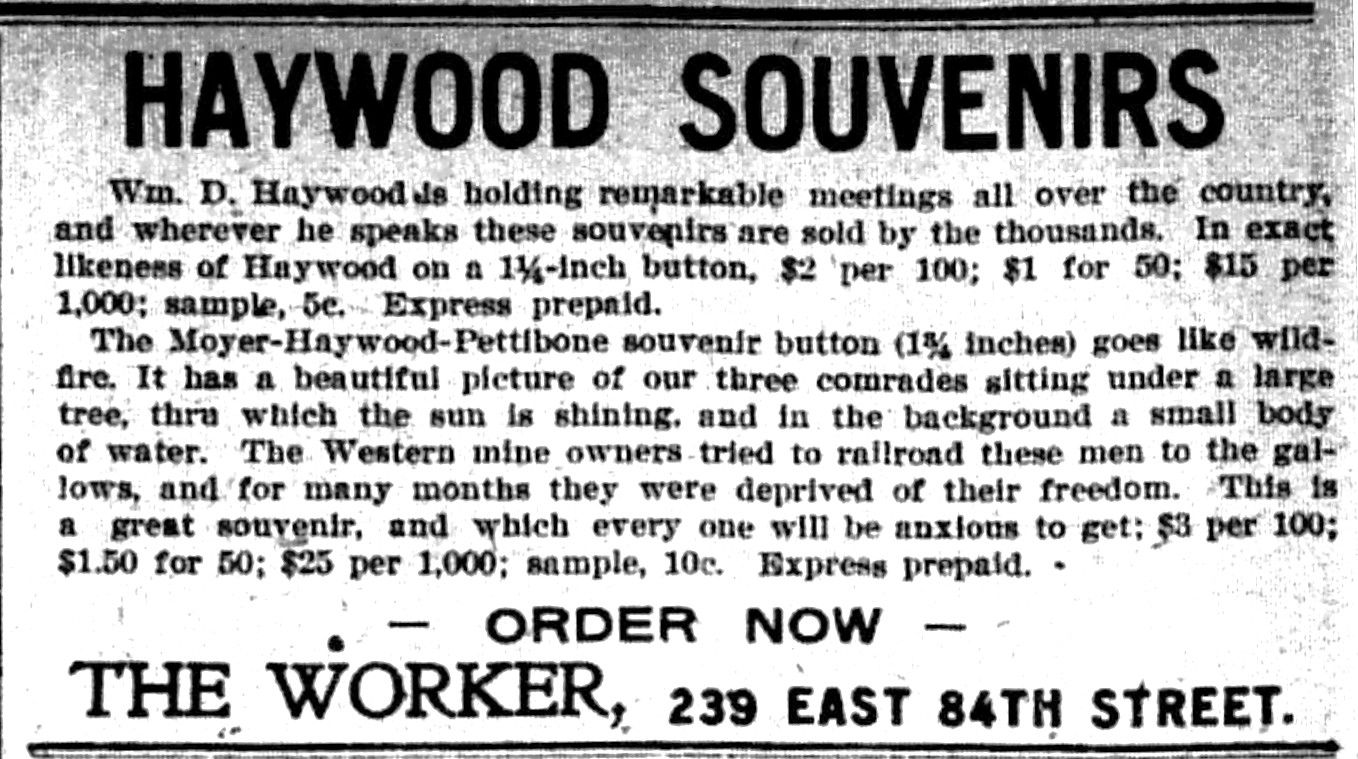
William D. Haywood’s 1907 trial first brought him to national attention and the campaign around it helped to galvanize a growing industrial labor movement. Called by Theodore Roosevelt an ‘undesirable citizen,’ Haywood and his supporters wore the name as a badge of honor. A report of Big Bill’s triumphant visit to New York as the western miner speaks to masses of workers across the city as they celebrate his acquittal in the death penalty cases against W.F.M. leaders for the killing of Idaho’s governor. Includes texts of his speeches.
‘Myriads of New York Workers Welcome Undesirable Citizen’ from The Worker (New York). Vol. 17 No. 43. January 25, 1908.
MYRIADS OF NEW YORK WORKERS WELCOME “UNDESIRABLE CITIZEN.”
Reception Accorded to William D. Haywood Surpasses All Previous Labor Demonstrations–Tho Arranged on Short Notice, Meetings Pack Great Halls and Many Thousands Are Turned Away–He Bespeaks Aid for Adams and Central Labor Body Responds–General Rejoicing Over Victory for Workingmen Conscious of Solidarity.
William D. Haywood the proposed victim of the mine owners of the west; the man who was kidnapped by the authorities of two states with the endorsement of the Supreme Court of the United States, and the open support of Roosevelt and Taft; the man whom the capitalist press eagerly endeavored to hang on the word of an arch-murderer; this man with these credentials was accorded a reception last week in New York City, that has seldom been equaled in this country. A week’s notice was sufficient to arrange a mass meeting, that over-taxed the seating capacity of the Grand Central Palace on Friday of last week and disappoint thousands of workingmen who were unable to get in.
A Magnificent Reply.
An hour before the meeting was opened the doors were closed by the police who were kept busy for two more hours in assuring the great mass of people in the streets that no more could be admitted. Had Madison Square Garden been secured it is certain that it would have been easily filled. The constant flow of people to the meeting place, and the enthusiasm of the spectators when Haywood stepped on the stage, was a magnificent reply of the workingmen of New York City, to the conspiracy that included all the capitalist powers of the United States.
The demonstration marked the great progress made in 21 years, when, in 1887 the apathy of the working class permitted a similar capitalist conspiracy to hang and imprison the martyrs of the eight-hour movement. By this time the capitalist class should realize that the scaffold can no longer be employed against the leaders of the working class without arousing a great protest in the labor world.
Brooklyn’s Enthusiasm.
That the reception accorded Haywood in New York City, was not exceptional, is evident from the demonstration in the Labor Lyceum of Brooklyn, the following Sunday, where only 24-hours’ notice enabled the Moyer-Haywood Protest Conference, to pack the building to the doors. Over 8,000 people gathered in the auditorium and hundreds were turned away. A large delegation also attended the meeting of the New York Central Federated Union on Sunday, although it was known that Haywood would have only a few minutes in which to speak.
Lack of space makes it impossible to report the speeches of the other speakers who in New York City, were Jos. Wanhope, Albert Abrahams, and William Coakley, and in Brooklyn, Luella Twining. Following is a partial report of Haywood’s remarks at each meeting:
At Grand Central Palace.
“I came here this evening expecting to make a brief talk, but I am so overwhelmed with this tremendous ovation that I have almost forgotten my task. But there is one thing that I believe that I can never forget and that is that I owe my life and my liberty to the working class of this country, and I advise you and the working class of America that what you have done for me you can do for yourselves. A united politically and industrially organized working class, whether here in America or abroad in Europe, cannot be deprived of the full product of its toil. Perhaps the reason that the W. F. of M. was given such prominence throughout this country is that we have for many years fought for the principles that labor produces all wealth and that wealth belongs to the producer thereof.
Born in Prison Cell.
“On the 15th of May 1893, the Western Federation of Miners Was born in Idaho directly after the first Coeur d’Alene strike. Its birthplace was a cell, the same prison cell in which later Moyer. Pettibone and I were obliged to pass so long a waiting time. And we are proud of it, for many good things have come out of the prisons, the abiding place of the poor and the shelterless, into freedom. The first strike of our union was, like all of the later ones, for the weaker among us, for the so-called “unskilled” whom so many unions prefer not to have in their ranks at all. In almost all districts we have been able to fix by law the minimum wage and the length of the workday, we have forced the politicians, without selling ourselves to them body and soul, to grant the workers at least certain demands.
“The Mine Owners’ Association had been founded before the W. F. of M. came into the light, and also first saw the light of the world in Idaho. But not in prison was it born, for mine owners do not go to prison. Not because they do not belong there, hut because they are in possession of the machinery, they have power over life and death, over prison and freedom, and they know well how to use this power in their own interest.”
Capitalism Knows No Boundaries
Haywood then described the different struggles which the W. F. of M. has had to carry on. Continuing he said:
“The trials in Idaho seem to me a combination of all the methods used by the capitalists in the great Colorado labor war to overwhelm and destroy the labor movement. The capitalists know no state borders nor legal rights. From these things the working class may take a great lesson, which must not be overlooked, if we would count upon success, the lesson that we, too, must not heed boundary lines and little differences where our vital interests are concerned. When the employers need strike breakers they go where they can get these useful elements of our society. When we need help, we as well must go where we have a claim upon this help, to the working class, to our brothers.
“War is a terrible survival from the days of barbarism. In general we do not consider it praiseworthy to shoot or stab our fellowman. We fight with our brains, with thoughts, with mind. In general, I say, not always. There are people still today who think it brave to insult an opponent who is down and render him powerless. When the president of the United States wrote his letter about undesirable citizens with pen made of steel which had been brought to the surface of the earth by ore miners he knew that his opponents were bound, chained and locked in, that they stood defenseless against his attacks. This act of the president was the worst thing that could have happened to us and the cowardly deed would have harmed us more than anything else if the working class had not stood behind us and protected us.
For Woman’s Rights.
“In Colorado women have the suffrage, and whereas in my home we used to say the women were above us: now we say they are our equals. I hope with all my heart that soon in the whole country they will be regarded as complete citizens. Let me, dear sisters and comrades, take this opportunity of thanking you in the name of my wife and my children because you have worked for our freeing, have believed in our innocence and have stood by us.”
Haywood then extended thanks to the working class of New York in his own name and that of the W. F. of M. for their grand support and he warned them now to do for themselves what they had done for the miners of the West. All workers should unite, organize politically and industrially and then with steady muscle put their shoulders to the wheel in order to pull, the wagon of the working class out of the mud into which it has fallen. Continuing he said:
“In the East the employers say that they are fighting the closed shop and other demands of organized labor, but in the West they fight the organization exactly the same, although there is no question of the closed shop. It is a question of the fight of capital against labor, the fight which can only be won by the closed up ranks of the workers.
“Now let us work, my friends; let us organize in order to be prepared to take over production and its distribution. That is the program of the W. F. of M. in whose name I speak to you today. Let it also be yours for the welfare of the whole working class, here and in all the world.”
At the C.F.U.
The delegates and visitors at the Central Federated Union session on Sunday afternoon crowded the hall and greeted Comrade Haywood with rousing applause. He said in part: “On behalf of Moyer, Pettibone and myself I wish to express my appreciation of the work you have done in our behalf. Never before in this country was such a struggle waged by the workers. I feel that I owe to you, to the efforts of union men, that the capitalist conspiracy to disrupt the Western Federation of Miners was thwarted. The mine owners hoped that by hanging some of us they would place a stigma on all organized labor but the protest of a million workers prevented that.
Solidarity Won.
“Pettibone is now free. The evidence submitted by the prosecution against Pettibone was a rehash of that presented against me. Our attorneys submitted Pettibone’s case to the jury without argument and the result was a magnificent vindication of the solidarity of the working class. If no other result of these trials was realized than a spirit of unity among the workers, then that result was worthy of the ordeal. Henceforth I shall devote my efforts to bringing about a closer unity of the working class and I hope to see the time when, wherever I go, I shall feel that I am meeting with brothers.
“The Western Federation of Miners is made of stern material. During the strike of the San Francisco teamsters a few years ago our organization contributed more to the strikers than the United States and Canada combined. The aid we have always given to fellow workers on strike was not given in vain. It returned to us in the hour of need.
Remember Adams.
“Do not forget that there is still another victim the mine owners would swing. The fight is still on and the mine owners are not satisfied. Steve Adams, whom they twice failed to convict is now in a Colorado jail. They want to swing him by the neck and would use a forged confession to accomplish their purpose. That confession was secured by McParland, a man who is so crooked that his mother had to break his legs when a child to make him lay in the cradle straight. Gov. Gooding assisted in extorting the confession by telling Adams he would be mobbed if he did not sign it. They brought his wife and baby into Idaho and imprisoned them in the female ward of the penitentiary. Adams was never indicted in connection with the Steunenberg murder but for another crime. After failing to convict him they rushed him to Colorado where he now lies in the Telluride bull pen. There he is under the eyes of notorious thugs like “Bill” Hicks and “Bob” Meldrum, men who boast of the number of men they have killed.”
Comrade Haywood concluded his address with another appeal for the unity of the workers and Delegate Coakley moved a vote of congratulation to Haywood upon his acquittal, and thanks for his address, and pledging the support of the Central Federated Union to Steve Adams in his battle for freedom. The motion was unanimously adopted, as was also a motion to appropriate $15 toward the Steve Adams defense fund.
Big Crowd in Brooklyn.
After the New York meeting Haywood proceeded to Brooklyn where a meeting had been arranged in the Labor Lyceum, with only 24 hours’ notice. The meeting was arranged by the Brooklyn Moyer-Haywood Conference, and three or four thousand people filled the hall and hundreds were turned away. The hall was decorated with flags and union banners and the applause lasted five minutes when. Haywood appeared on the stage. He spoke in part as follows:
“I am glad of the opportunity to address a small part of the working class of Brooklyn and I want to preach a sermon to you today that no preacher dare preach in your city. That sermon is the emancipation of the working class. Preachers cannot tell you what they believe because they would lose their jobs. The politicians dare not tell the truth for then they would have to go to work. Statesmen never utter the truth, for there would be little use for the present statesmen if the truth prevailed. It is to your shame that Platt and Depew represent New York in the senate, as well as for Colorado, where Guggenheim bought his seat for $500,000.
“Were it not for the united Socialists and unionists of this country we would have been sent to the scaffold. We appreciate the splendid work you have done and hope it will bring more solidarity in the labor movement of this country. You have heard of the wild and wolly West, where men go armed with sawed-off shot-guns. I go armed myself, and advise all workingmen to also arm themselves. My ammunition consists in a union card of the Western Federation and a dues card in the Socialist Party paid a year in advance.
What We Demand.
“What we want is to see that all workingmen get the full value of their toil and the capitalists can have the rest. There is no preacher in this city that will preach that doctrine. (A voice: There are two.) Good, I am glad to hear there are two preachers in Brooklyn who do something every day in the week to better the world, I would like to meet them. They must indeed be curiosities, for I have met few of that kind. Socialism is my religion and I would go a long way to hear them.
“In Goldfield they now have a strike. Gold is the only article of standard value. Unlike other commodities it is stable year in and year out. If dividends are increased, they cannot take it out of the public but must reduce wages. The mine owners wished to pay wages in worthless paper and the miners refused unless the paper was guaranteed with gold! The capitalists saw their opportunity in the panic, and called for federal troops. The President was willing to send troops but did not wish it to become known that they would assist in reducing wages. It was not the first time Roosevelt sent troops at the request of the mine owners. The territorial legislature of Arizona passed an eight-hour law, the smeltermen went on strike to enforce the law and Roosevelt sent troops to crush the strike and violate the law. He sent troops to Alaska, to Idaho and to Colorado. There is not as much reason for troops in Goldfield as there is for troops in this hall, for most of you have the revolutionary spirit that would make these conditions impossible. The miners seldom lay down their picks and shovels but the mine owners look up the politicians for troops. And so we have to contend with the Cossacks and hirelings of capital. And this is the land of the free and home of the brave! It is enough to make an American ashamed that those who live under monarchs point the finger of scorn at this country.
“The other day I stood on Brooklyn Bridge and I looked back upon the harbor. I saw the ships and the buildings, and most everything I saw would be impossible without the miner. If the miner had not dug the metals from the earth this civilization would not be and you people would probably be running around with a breech cloth on and digging clams with a stick. Frothing Bob’s fleet would be unable to make its cruise it were not for the miner. Even Roosevelt, who holds the olive branch in one hand and the torch in the other could not have used a pen to write ‘undesirable citizens’ were it not for the toil of the miner.”
After again thanking the workers for the aid they had given, Haywood concluded his address amid thunderous applause. It was a long time before he could get out of the hall, so many wanted to shake his hands.
Resolutions were adopted reciting the conditions that led up to Roosevelt sending troops to Goldfield and demanding that they be withdrawn, and if not, calling on Congress to impeach the President.
The Worker, and its predecessor The People, emerged from the 1899 split in the Socialist Labor Party of America led by Henry Slobodin and Morris Hillquit, who published their own edition of the SLP’s paper in Springfield, Massachusetts. Their ‘The People’ had the same banner, format, and numbering as their rival De Leon’s. The new group emerged as the Social Democratic Party and with a Chicago group of the same name these two Social Democratic Parties would become the Socialist Party of America at a 1901 conference. That same year the paper’s name was changed from The People to The Worker with publishing moved to New York City. The Worker continued as a weekly until December 1908 when it was folded into the socialist daily, The New York Call.
PDF of full issue: https://www.marxists.org/history/usa/pubs/the-people-the-worker/080125-worker-v17n43.pdf

