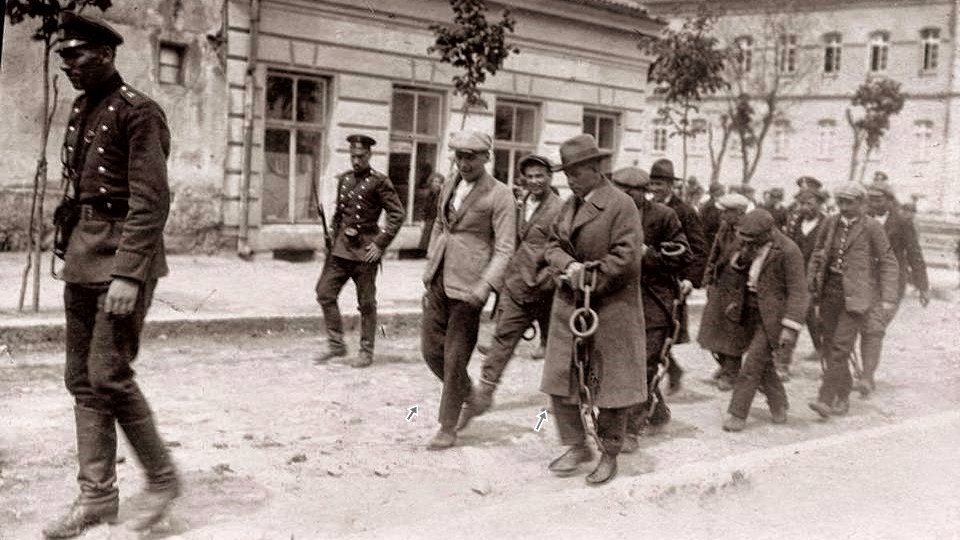
One of the reasons I do this project is an almost overwhelming obligation I feel to our dead; the desire to breathe life into their contribution, their sacrifice, by saying their names aloud again. Below is an account of of a small insurgent group fighting in Bulgaria’s mountains against the murderous ruling class regime, with identifications of the comrades cut down in reprisals. A bow of respect and a Red salute.
‘New Wholesale Murders in Bulgaria’ by D. Ivanoff from International Press Correspondence. Vol. 6 No. 74. November 11, 1926.
The international public still knows practically nothing of the terrible events in the districts of Trojan and Lovech in Bulgaria, where hundreds of peasants have been executed without a legal sentence, where whole villages have been burnt to the ground and where, in 15 villages, the population has been interned for months, since the inhabitants are forbidden to leave their villages.
In the Summer of this year, the insurgent group of Wassily Popoff, who is known far and wide under the name of “The Hero”, was formed in the districts of Trojan and Lovech. The ten members of this “band of robbers”, as the Government papers term it, are young men educated at public schools, who are preparing to enter the University. Popoff himself is a master at a public school. They were arrested and beaten in the cruelest way. They nevertheless succeeded in fleeing into the mountains, where they formed a group of insurgents. It is a remarkable fact that a pronouncedly bourgeois paper (“Nessawissomost” of August 30th) could not but state that the insurgents had made no attack on the population either in the villages mentioned or anywhere else and that on the contrary the population was entirely in sympathy with them.
At first the Chief of Police Sandansky was entrusted with the pursuit of the “robbers”. This Sandansky is a well-known murderer on a large scale who, amongst others, murdered the peasant deputy Fsonjo Matoff. He had also been guilty of many common crimes. Wherever he and his expedition arrived, he brought fire and murder.
He was later replaced by Lieutenant-Colonel Ditchell, the commander of the 1st. regiment in Sofia, who, however, was worse than his predecessor.
The fight against the “robbers” was made a pretext for the literal extermination by fire and sword of the opposition peasant elements in the district of Bulgaria in question.
A state of siege was declared throughout both districts; no one was allowed to pass the boundaries of the village before 7 a.m. or after 5 p.m. (in summer) on pain of being shot. The inhabitants of the villages Golema, Jelesna, Borima, Orshak, Mikra etc. (including their cattle) were altogether forbidden to leave their villages. In this way, the crops of the peasants in these villages were simply destroyed.
This, however, did not satisfy their persecutors. For months on end, murders and tortures took place in the villages, the women were violated. Of the persons arrested who were alleged to be “accomplices of the robbers”, hundreds were slaughtered without any legal proceedings.
The following recent data have become known with regard to these victims:
A group of eleven peasants were fettered and shot on the road between the villages of Lometz and Leshnitza. Several weeks elapsed before the corpses of the following peasants were found and identified by their relatives: Missalky, Milko and Nikola Gatjeff, Mirtcho and Peter Datcheff, Nikola and Datcho Ditcheff.
On August 4th, a group of nine arrested persons were shot in the forest of Ussojnata, six kilometers from the village of Golema-Jelesna. Their names were Ivan Missalsky, Mrs. Maritza Kratchonsky and her son Simeon, Stoja Handieff, a reserve officer from the village of Jelesna, Christo Todoroff, elementary school master and his wife from the village of Barima, as well as a Moslem from that village.
Two other groups, each consisting of thirty persons, who were being led from the barracks in Lovetch towards Gurotovo, were shot near the State Hospital.
A further group of 17 unfortunate peasants were shot on the main road from Lovetch to Pleven, between the 13th and 14th kilometer stones.
Between the villages of Mikra and Borima, a grave was found, containing numbers of mutilated corpses. Only ten of the peasants could be identified: Ilya Koleff, a shoemaker in Trojan; Koljo Gatcheff, Secretary to the municipality of Borima; Wassil Pavloff, Ilya Tchervenakoff, 20 years of age; D. Petkoff, 15; Ivan Tsankoff; Radko Usunoff from the village of Borima; Lazareff; Vetoff and Ilya Todoroff from Lovetch.
From the village of Orshak 15 peasants have disappeared without leaving a trace. In the neighbourhood of the village of Mikra, human corpses were found, which had been torn to pieces by dogs.
As far as has been found out up to the present, the following amongst those who were arrested, have been shot: The wife of Dotcho Ciratzky from Jelesna, the student Marin Pentchoff; Gentcho Koloff, the burgomaster of Borima; Ilya Zemibarsky; Christina Kovatchova and her sister Raina Kovatchova, a school mistress in Trojan.
About 200 of those arrested were thus murdered, usually after horrible tortures.
These data are chiefly based on the appeal of the foreign representatives of the Bulgarian Peasant League to the French League for Human Rights and on newspaper reports, above all the social democratic “Narod” and the “Nessavissomost”. The “Narod” has pointed out that up to the present, the troops executing the Government’s orders have done far more harm than all the bands of robbers in Bulgarian together, and pointed out that the whole responsibility for these infamous deeds lies on the shoulders of the Liaptcheff Government.
The terror in this district is still continuing. Thus, October 10th, at a Fascist demonstration in the town of Lovetch, a female head, stuck on a pole, was carried in front of the procession.
The declaration of Liaptcheff, who is himself Minister for Home Aitairs and therefore at the head of the police and gendarmerie, to the effect that in Bulgaria there is no longer civil war, no deeds of violence and that the country has calmed down, harmonizes very well with these conditions in the “democratically governed Bulgaria”.
International Press Correspondence, widely known as”Inprecorr” was published by the Executive Committee of the Communist International (ECCI) regularly in German and English, occasionally in many other languages, beginning in 1921 and lasting in English until 1938. Inprecorr’s role was to supply translated articles to the English-speaking press of the International from the Comintern’s different sections, as well as news and statements from the ECCI. Many ‘Daily Worker’ and ‘Communist’ articles originated in Inprecorr, and it also published articles by American comrades for use in other countries. It was published at least weekly, and often thrice weekly.
PDF of full issue: https://www.marxists.org/history/international/comintern/inprecor/1926/v06n74-nov-11-1926-Inprecor.pdf

