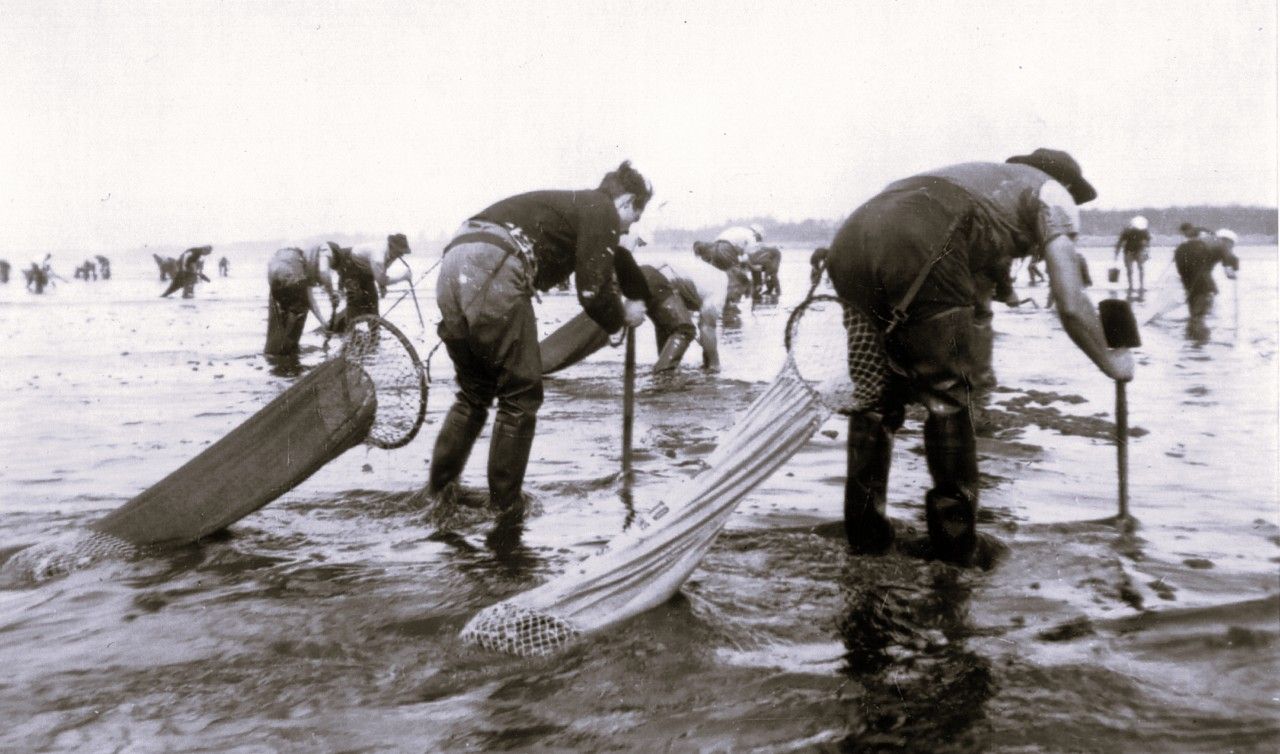
Digging clams when there was no other work to be had was one way of making it through down times in the Pacific Northwest. Like every job, acquiring the most basic of wages and rights was a battle. A description of one of those fights during the post-war recession in 1921.
‘Clams and Other Clams: The Digger and the Dug’ from Industrial Worker. Vol. 2. No. 49. March 26, 1921.
BOTH ARE STANDING PAT
Grayland, Wa. March 11. Most of you probably know what clams are–an edible shell-fish. The clam season is from March 1 to May 31 of each year, during which time there is a goodly bunch of workers of all kinds engaged in digging clams.
There are lumberjacks, mill workers, shipyard workers and men and women representing almost every industry and trade in the Northwest. The men are usually engaged in digging, with a small percentage working in the canneries, while practically all the women engaged in this industry work in the cannery cleaning the clams ready for canning.
Clams do not stay fresh for very long, so they are sent to the canneries as soon as they are dug, the cannery companies furnishing the transportation at a cost of 25 cents per hundred pounds in most cases. If the diggers do their own transporting, they are allowed the 25 cents for their trouble.
Competition still survives in this industry among the canning companies, with each company trying to quote lower prices on the market than the others, but still, as in most cases, there is one dominating factor. In this instance it is the packing concern known as the Pioneer Packing Co. This concern has two plants, both in the Grays Harbor district. One plant is located south of the Harbor at Grayland, and the other is north, located at Copalis.
At present the clam diggers have been out on strike since the season opened. At the opening of the season March 1 the prices quoted to diggers were $2.25 per hundred pounds on the beach and $2.50 per hundred at the cannery. The cleaners working in the canneries (jyppos) getting 55 cents per hundred pounds (cleaned), and hour work at 40 cents per hour.
A meeting of diggers was called, first at Copalis, declaring a strike for $3.25 at cannery and $3 at the beach for diggers. No provision was made for cannery workers. A committee of three was elected to cross the Harbor to the South Beach (comprising Westport, Cohassett, Grayland and Tokeland), where a meeting of diggers was called and the same demands agreed upon. This is where the joker comes in.
A chairman was nominated, taking his place (without a vote in favor or against), and given full power to appoint a strike committee and any other committees needed, and the strike was on. Meetings were held, at one of which, with two cannery owners present, a full hour was spent in arguing about the prices of clams on the market. The vote to stay out at that time was solid.
The next day the strikers heard the companies had offered two bits more to the diggers. That is where some of the good friends of the boss got in, working upon the weaker ones to go out and dig, a few of whom went out. A meeting was called by the strikers where this was threshed out and a motion was made and passed to stick behind our former demands. It was carried without a dissenting vote. Then a funny thing happened. An amendment (as it was called) was passed by a vote of 39 for and 28 against to lower the demands to $3 at the cannery and $2.75 at the beach. No meeting has been held since and it is hard telling what will happen when one is called. With all indications in favor of the strikers winning within a couple of days, the cannery men made a splendid move, breaking the strikers into two factions.
Oh, ye mules! When will you kick down the braces which are holding you! The idea held by some of the diggers: “We don’t want to break the boss by such big demands, because if he goes bankrupt, who will we dig for?” Oh, ye gods! The logic of a mule is too tame for a rebel to swallow.
When you slaves get wise to your predicament and join the One Big Union of all the workers the bosses will be working right alongside of you, digging clams or doing whatever you see fit to put them to doing. Then, and only then, will we see the end of wage slavery.
(Harry Lindholm.)
Copalis, March 11. Halferty, the clam king, held a meeting in his office today and told the diggers that he would pay but $2.75 per hundred pounds for clams and then commenced on the red flag.
Seeing a man in front of him smile, Halferty asked him what he knew about it, and if he was a digger. The man replied that he was, when Halferty asked, “Well, what have you to say?” The man replied, “We are organized to get $3.25 per hundred and you are organized to pay $2.75. But what kind of a red flag did you have in mind?”
Then a soldier took the floor and made the statement that the cannery company could not pay over $2.75 per hundred. This is the second offer, the first being $2.50 per hundred. Then the soldier wanted to know how many thought Halferty was a square shooter, asking the men to hold up their hands. Not one hand went up.
The diggers are standing pat and will get $3.25 per hundred or the canneries will get no clams.
(Delegate B-2031.)
Copalis, March 15. Just a few facts about the clam industry. We are striking for something that is against our principles. If we were asking for day work in the clam industry it would be much better. Everything is bushel work on the beach and in the cannery.
There are lots of I.W.W. and ex-I.W.W. here, but we never hear a word of agitation for day work. If you say anything about day work some of the fellow workers will say it cannot be done. I tell them that if we would stand as pat for day work as we do for $3.25 per hundred we can make it day work and it would put one-third more men to work. But some can make big wages, while others cannot make even half wages. I speak of wages because we are living under the wage system now.
(Delegate B-2031.)
PDF of full issue: https://washingtondigitalnewspapers.org/?a=d&d=IWW19210326

