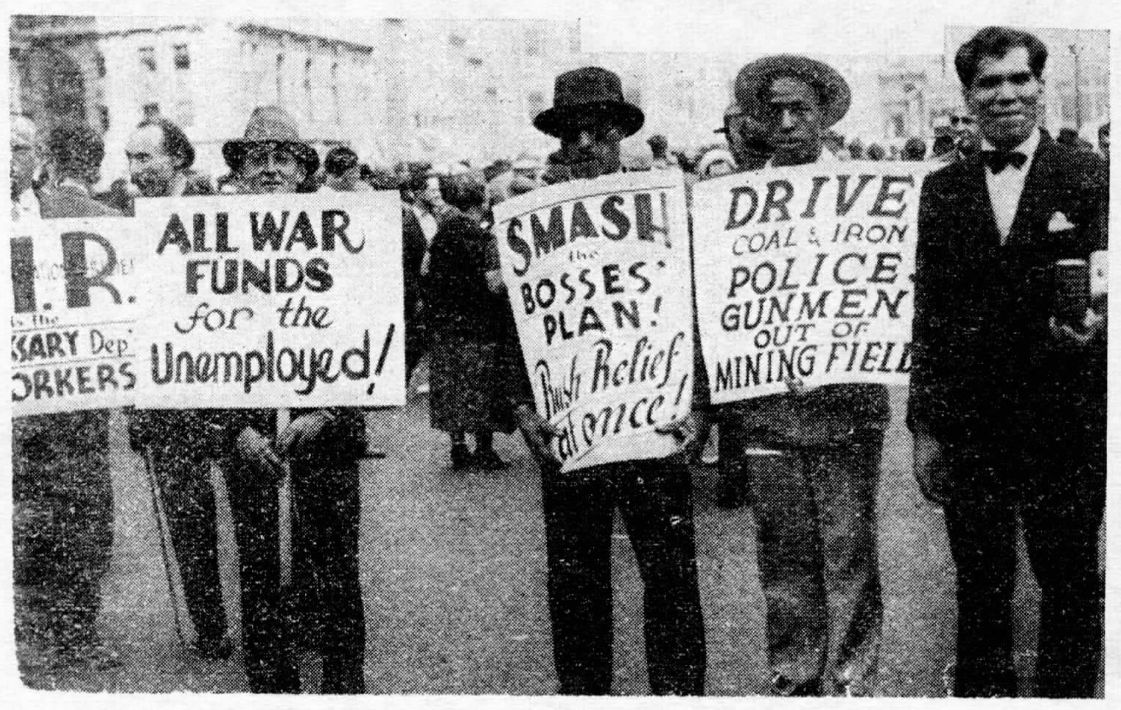
Unity around economic demands was not enough. A review of the role of the Communist Party in defending Black miners’ interests during the wave of insurgent miners’ strikes led by the Party’s National Miners Union in 1931.
‘Achievements and Mistakes of Our Work Among Negroes in the Miners Strike’ by A. Mills from The Daily Worker. Vol. 8 No. 276. November 17, 1931.
IN the struggle of the miners in Western Pennsylvania, West Virginia and Eastern Ohio, our Party was confronted with new problems. While some of the phases have been discussed in our press, the phase of our Negro work and the experiences derived from it were not sufficiently brought forward.
In the course of the strike we succeeded in bringing unity of the white and Negro miners who fought shoulder to shoulder against their common enemy, the coal operators, the bosses government and their fascist agents, the UMWA officials.
Many Negro miners have been drawn in to the leadership of the N.M.U., occupying important positions in the section and district organizations of the union, as well as nationally. The workers understood splendidly the slogan of unity, as a prerequisite for a successful struggle against the bosses. Such solidarity was never witnessed before. We saw for the first time thousands of Negro workers joining our union, fighting militantly on the picket line, white workers nominating and electing Negro workers into leadership of the union, defending Negro workers when attacked by the state troopers and deputy sheriffs.
Of course these are achievements of our Party. achievements which cannot be overestimated. We must, however, understand not only that our Party fights for the economic interests of the Negro workers, but also that we are the only ones who are fighting for social and political equality of the Negro masses, the only ones who are fighting against jim-crowism and segregation.
For the Negro masses in the country, faced with lynching and most inhuman conditions imposed upon them by the white ruling class, the struggle for the economic demands of the working-class in general has some of the character of unreality unless it is actively coupled with the struggle for the Negro rights. Furthermore the ability to unite the Negro and white workers for the economic struggles lies primarily in our ability to convince the Negro workers, that the revolutionary unions and our Party, are fighting for the Negro rights, against jim-crowism.
While it is true that the Negro miners saw in our Union, not only an organization for the white miner, but an organization of the Negro and white, nevertheless this is not sufficient. Yes, the National Miners’ Union treats the Negro miners equally with the whites, but who will defend the Negro miners from the onslaught of race discrimination in the mines, in the patches, in the restaurants and recreation places?
Especially with experiences the miners had in the past with the United Mine Workers of America where, during a strike, the officials somehow tolerated the Negro miner, but after the strike there always occurred a wave of discrimination on the part of the bosses as well as of the union bureaucrats. It was, therefore, especially important to convince the Negro miner, that not only does the National Miners Union defend his interests in the mine, but that this is the organization which, hand in hand with struggle for better conditions, fights also for his specific rights.
Even as regard to the economic demands were we behind. Not until late we considered the question of special demands for Negro miners, who are put at the most dangerous work, who are given the dirtiest jobs, who are employed in the worst mines. The special demands were not concrete enough, and this, in itself, was a serious mistake. Furthermore in the course of the struggle, when we succeeded in mobilizing thousands of miners, strikers and unemployed in our hunger marches and demonstrations, we had a splendid opportunity to smash the jim-crow habits in such towns as Canonsburg, Brownsville, etc. Thousands of miners, and among them Negro miners, were fighting the Fagins and Murrays and their scheme to smash the strike, right in the same town in Canonsburg, where there exists jim-crowism similar to that of the South; and it was our task at that time to mobilize the miners in the struggle against this jim-crowism.
What was the effect of our mistake?
It has a serious effect. The unity that existed in the strike was primarily a unity narrowly considered a necessity for winning the strike. The white miners from experience in the past, and especially them our agitation, understand that without unity of the white and Negro miners, the struggle would not and could not be won; and this gave a better approach, more united action, and more solidarity on the part of the white workers.
But this is not sufficient. It was our task to convince the miners that the unity of Negro and white workers is a more basic one, that we are fighting for full equality of the Negro masses against segregation, against every form of discrimination. Could we find a better opportunity to convince and mobilize the white workers for the struggle of the Negro rights than by a real fight, during the strike, against segregation, jim-crowism, discrimination, etc.?
The effects of this mistake was shown later. When the strike was in its decline, when thousands of miners went back to work due to terror, hunger and evictions, we could notice an increased tempo of white chauvinistic acts, which showed that the unity was not deep enough among the white miners. When relief became more scarce, discrimination in relief became evident. In the Brownsville section the union was compelled to take organizational measures against the members of the National Miners Union, who resorted to jim-crow practices.
The major mistakes in connection with our work among the Negroes during the strike can be summarized:
1. Lateness in working out a program of demands for the Negro miners.
2. Not linking up the struggle for better conditions with the struggle against jim-cowism, segregation, etc.
4. Not popularizing sufficiently the L.S.N.R. and Liberator.
Wherever this was applied, we must register, despite the shortcomings, definite progress in our work among the miners. When the miners went back to work, and the union began to reorientate the struggle from district to local demands and grievances, the Union correctly put forward the demand “No discrimination against the strikers, especially against Negro strikers.” This was correct and served on one hand to convince the Negroes that we are fighting against the special discrimination imposed by the bosses against the militant Negro workers, and on the other hand to mobilize the white miners for the fight for the Negroes as part and parcel of the general struggle.
The beginnings of carrying through of a correct approach towards Negro workers in the course of the strike showed splendid results. The Union and the Party succeeded in bringing splendid elements who are devoted to our movement and show tremendous possibility for leadership.
The Daily Worker began in 1924 and was published in New York City by the Communist Party US and its predecessor organizations. Among the most long-lasting and important left publications in US history, it had a circulation of 35,000 at its peak. The Daily Worker came from The Ohio Socialist, published by the Left Wing-dominated Socialist Party of Ohio in Cleveland from 1917 to November 1919, when it became became The Toiler, paper of the Communist Labor Party. In December 1921 the above-ground Workers Party of America merged the Toiler with the paper Workers Council to found The Worker, which became The Daily Worker beginning January 13, 1924.
PDF of full issue: https://www.marxists.org/history/usa/pubs/dailyworker/1931/v08-n276-NY-nov-17-1931-DW-LOC.pdf

