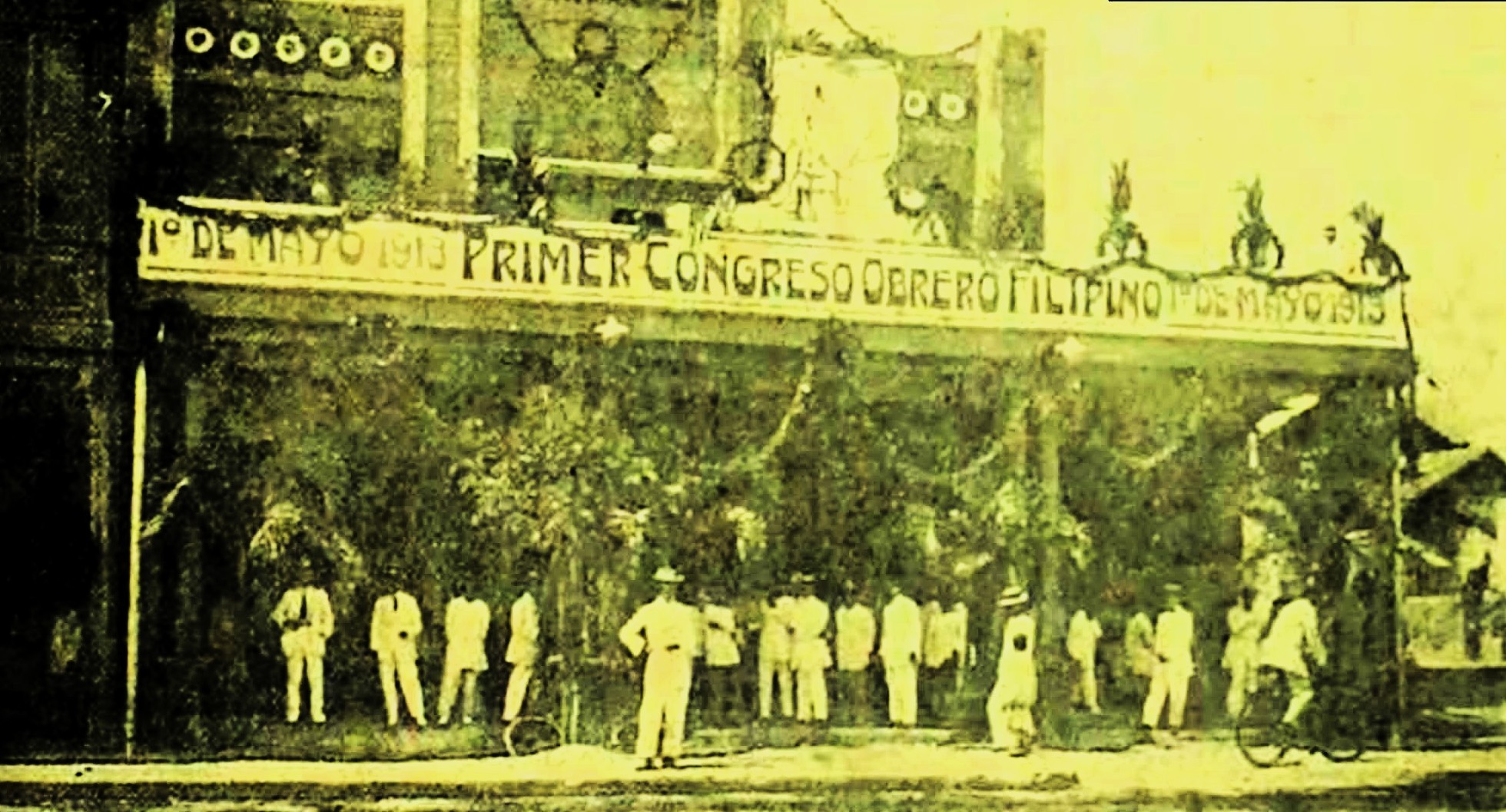
Becoming editor and senior official in the Pan Pacific Trade Union Secretariat, Harrison George was also the P.P.T.U.S. representative to the Philippines and Australia. Founded in 1913, the Congreso Obrero de Filipinas would affiliate with the P.P.T.U.S. in 1927. Despite that, its 70,000 members remained deeply divided over, broadly, left and right wing orientations. At the upcoming 1929 convention of the C.O.F., those divisions broke wide open with a split developing. Below, Harrison George gives us an informative history of the union’s development, while the P.P.T.U.S. sends a statement to the conference of its perspective and positions.
‘The Philippine Islands’ by Harrison George from Pan-Pacific Monthly (San Francisco). No. 27. June, 1929.
THE affiliation of the Congreso Obrero de Filipinas to the Pan-Pacific Trade Union Secretariat in 1927, and the development of the C.O.F. since then, in a period of increasing class struggle, makes necessary a brief review of this chief colony of American imperialism, the characteristics of which have long been obscured by complete isolation from the world labor movement.
There are 7,083 islands in the archipelago, 11 being large and important, the largest is Luzon. The total area is 114,000 square miles. The Northern islands lie 800 miles from Japan, only 100 miles from Japan-ruled Formosa, and but 600 miles from the British base at Hongkong. The Philippines are the chief naval base of American imperialism in the Far East.
Rice, sugar, coconuts, hemp, corn and tobacco, successively, are the most important products. America, of course, dominates trade and increases its role of exploitation, upsetting the feudal relationship between the peasantry and artisan handicraft by its commodities from the United States as well as introducing such mechanical devices as displace labor (cigar making machines) and the ancient means of transport, the motor in place of the plodding carabao or water-buffalo. Former Governor General Forbes has said that 90 per cent of the wealth is owned by foreigners, and most of that by Americans.
Pauperism is increasing. Infant mortality in Manila is 48.8 per thousand compared with 18.28 in the U.S.A. Of those dying from beri-beri and malnutrition, 87 per cent are nursed by mothers, which shows the terrible poverty. Manila is second only to Calcutta in deaths from tuberculosis, scarcely a toiler’s family in the whole archipelago is without a tubercular member. In 1917, the Manila death rate was: Americans, 7.12 per thousand; Filipinos, 26.67 per thousand. On the main streets of Manila 13-year-old girls are offered for prostitution by male solicitors. “The best governed city in the world”–say American imperialists.
The bulk of organic and administrative law is made in America, by the U.S. Congress. The Jones Law of 1916, hailed by the bourgeois nationalists because it gave a vague promise of independence (sometime), placed supreme executive power in the hands of the U.S. President, exercised by him through the Bureau of Insular Affairs of the U.S. War Department. Hence the Filipino people live under continual martial law.
A Miserable Fake
True, there is a miserable fake of native government, called the Philippine Legislature, 91 Representatives and 24 Senators from the 48 provinces. Nine of the first and two of the latter are appointed by the Governor General to “represent” the non-Christian provinces. This gentleman, appointed by the U.S. President, can veto any act of the Legislature, controls all armed forces and departments of government.
A Supreme Court of nine is appointed by the U.S. President. Literate males over 21 years can vote. Illiterates also who pay 50 pesos taxes. Wholesale coercion and general corruption annuls even this pretension of “democracy”. Governors of the nine “non-Christian” Mahommedan provinces are appointed by the Governor General. Imperialism craftily incites division between Christian and Mahommedan.
A population, in 1926, of 12,108,688 estimated, making 87 to the square mile, has 25 per cent living in cities and towns. Manila, the largest, has 320,000; Legaspi, 52,760; Iloilo, 49,115; 27 towns have from 25,000 to 50,000; 79 villages from 18,000 to 25,000. In 1918, there were 65,149 foreigners, 44,239 of them Chinese, 8,294 Japanese, 5,829 Europeans (mostly Spaniards), and 5,808 Americans. The latter in addition, of course, to the large body of American armed forces continually occupying the country.
About 75 per cent of adults can read and write either English, Spanish or their Malay dialect. Of these dialects, two, Tagalog and Viscayan, are spoken by 75 per cent of the population. Illiteracy is Illiteracy is most prevalent among the impoverished peasantry.
Imperialist Propaganda
American imperialism plays up, through cinema and press in America, the customs of the Moros of the South, and of the few remnants of aboriginal Negrito tribes in the mountains of Luzon, to picture all Filipinos as barbarians and, of course, “unworthy of independence”. We have even seen pictures of “men with tails”! But the average Filipino (Malay) can give lessons in civilized behaviour to the Americans who rule him, in fact, one weakness of the labor leadership is its polite attitude toward those who oppress and rob the masses, its timidity toward breaking through the formalisms and legal bars set up by capitalist-imperialist authority.
Of course, this is based on a class collaboration tendency, and a change is going on. Soon the struggle itself will make courtesy a class affair between comrades, and blunt words and rude acts the treatment of all class enemies and those who defend them or betray the masses.
In 1925, the working class was classified as follows: Agricultural laborers, 2,547,572; in commerce and transport, 118,178; in trade and industry, 113,171; fishermen, 50,830; miners, 12,850; forest workers, 11,763: government employees, 3,037.
Always Starving
The following table of average wages illustrates the trend in Pesos (50 cents U.S.) and Centavos (100 to the Peso):
1903—1911—1917—1918–1926
Farm workers .55–.64–.67–.65–.82
City workers .73–.88–1.25–1.98–2.00
Yet the Bureau of Labor in 1926, estimated the cost of living for a family of five to be 2.32 pesos daily in Manila, in the provinces, 1.82 pesos. We can see where the high death rate and tuberculosis comes from, as well as child and women labor and prostitution. No laws limiting hours of labor exist, except for youth labor under 16, set at seven hours, but wholly ignored in practice. Land and forest workers especially work 14 and more hours and official figures on all are false.
Mutualist and religious labor guilds appeared early in the 19th century, growing more numerous just before the revolution against Spain. On February 2, 1902, a national center was formed called the “Union Obrera Democratica”. Its founder, Isabello de los Reyes, was a non-worker. When jailed, he promised to cease agitation and is now a bourgeois politician. Dominador Gomez, a doctor, with a militant agitation under the slogan “Always united to conquer”, built the U.O.D. up to 40,000 members and strikes occurred. Gomez was also imprisoned and his honesty attacked, and the organized dissolved by decree of the U.S. in 1903.
A more conservative body, the “Union del Trabajo” followed, but broke up over political rivalries of non-worker leaders and mismanagement of funds in 1907. Isolated unions of several trades remained. On May 1, 1913, the present Congreso Obrero de Filipinas was formed, led by H. Cruz, the present Director of Labor in the Philippine government and a strong class collaborationist.
Gompers’ Prototype
But the C.O.F., led mostly by non-worker elements following the bourgeois “Nacionalista” party, had a small split of similar or worse elements in 1916, who followed the bourgeois “Democrata” party. The splitters formed the “Asemblea Obrera”, which later changed its name to “Federacion del Trabajo”, an organization which has no constitution and no other officer than one Joaquin Balmori, who deserves the epithet he adopts for himself as “the Gompers of the Philippines”. This gentleman it is with whom the Amsterdamers are connected with the Philip pines, though till now rather loosely. Balmori is one of the worst traitors to the Filipino workers, and has become rich by selling their interests, serving as a bootlicking spy for Governor General Wood and owns much property as a reward for his servile treachery. In 1927, when the Congresso Obrero affiliated to the P.P.T.U.S., it was still much under class collaboration influence and tended to follow the guidance, greatly to its injury, of the Director of Labor, its old leader but gone over to the class enemy, where he belonged with his ideas of collaboration, arbitration, compromise and peace between classes. It was also wandering about in craft unionism and mutualism. But it was and is the real national trade union center, with 81,137 members; while Balmori’s personally- owned center had only 3,268 (all in Manila); isolated independent unions having 22,786.
Since affiliation to P.P.T.U.S., the C.O.F. has shown a new spirit and an excellent policy, with great progress and practical results in the field of daily struggle. Of these events up till the time of its convention this year in May, articles in the next issue of the “Pan-Pacific Monthly” will tell.
The Struggle for Independence
During the 350 years of Spanish despotism, there were over 100 armed revolts, but poorly led and unorganized. Bourgeois historians have wholly concealed the fact, of which all workers should be proud, that it was a worker would have succeeded had it not been for his who organized and led the first revolt that murder by the bourgeois traitor, Emilio Aguinaldo.
This worker, Andreas Bonifacio, a poor shop clerk or “bodeguero”, in 1892 began to organize an “Katipunan” (Sons of the Country), and on an insurrectionary society, the August 23, 1896, at its assembly, the Katipunan led by this worker, declared armed revolt against Spain.
The traditional hero venerated by Filipinos as Sun Yat Sen is venerated by the Chinese, was Jose Rizal. While it is quite true that Rizal was executed and freely gave his life. it was not in battle for he was a simple pacifist of the Ghandi type, an intellectual, a doctor by profession. who volunteered to serve as such in the Spanish army then oppressing Cuba as well. But Bonifacio was a worker and a fighter and, wounded in battle, died at the hands of a cowardly and murderous traitor who today is robbing the Filipino peasantry under protection of American imperialism.
“An Ignorant Worker”
When the Katipunan, led by Bonifacio, declared war, Aguinaldo, controlling a part of Cavite province, refused to follow him and attacked Bonifacio as “an ignorant worker and atheist”. and atheist”. Aguinaldo formed a separate force, half-heartedly and often treacherously pretending co-operation. Aguinaldo’s intrigue against Bonifacio broke up a unity assembly in March, 1897. In April of that year. Bonifacio, who had been wounded in battle with Spanish troops, was arrested by Aguinaldo and treacherously murdered at his order. In December, 1897, Aguinaldo made peace with the Spanish commander, who was none other than the present Fascist dictator of Spain, Primo de Rivera.
The non-fulfillment of the peace pact brought about resumption of hostilities, and Aguinaldo’s bourgeois mind could think of nothing better than to bring in American imperialism to oust Spanish imperialism–since Aguinaldo feared the masses and relied upon foreign arms rather than the heroism of the Filipino masses as did Bonifacio, the worker. What happened should be a lesson for the present independence movement, never to be forgotten.
American forces entered Manila on May 1, 1898, but remained after the Spanish were ousted, and after deliberately provoking conflict with Filipino troops on August 13, began a war of utter extermination in which torture and massacre spared neither age nor sex. The most popular song of the American troops was “Civilize ’em with a Krag” (!), a rifle.
An Unspeakable Traitor
Aguinaldo was captured and turned traitor, urging surrender. But war continued, lasting nearly three years. For his treachery, to be expected from bourgeois leadership, the American government granted him an annual pension, a bribe, of 12,000 Pesos and permitted him to defraud peasants of an enormous area of land. This is the cowardly and traitorous murderer of the worker and real independence fighter, Andreas Bonifacio. Yet ignoramuses who write of the Philippines, picture this snake, Aguinaldo, as a hero; and are silent about the brave worker-Bonifacio.
Until 1907, American imperialism permitted no elections. Since then it has let the native bourgeois politicians befool the masses with the notion that the Philippine Legislature would do something for independence. These politicians did nothing but talk for over 20 years, and have lately ceased even to talk for independence. The dominant “Nacionalista” party endorsed Stimson as Governor General in 1928, and the party leader, Manuel Quezon, after an accord with American bankers in New York, kowtowed to Chiang Kai-shek in China. Like all his kind in both parties, Quezon is very wealthy from exploiting the Filipino toilers. He owns under “dummy” holders, vast estates and also owns banks in Argentina, South America.
The Labor Party, formed in 1925, is a healthy counterpoint to the bourgeois parties, attacking them as traitors to independence, and following a generally clear class line, but somewhat confused and weak organizationally. There has existed no Communist Party, but recently a Young Workers’ League has been formed. The role of the youth, women and peasant toilers must receive special attention in other articles.
***
Official Communications From the P.P.T.U.S. to the Congresso Obrero De Filipinas
DEAR Comrades: The Pan-Pacific Trade Union Secretariat greets the delegates assembled at the Philippine Labor Congress. Your Congress takes place at a most critical period in world history. In every Pacific country the capitalist offensive increases against the trade unions. The forms of attack vary in each country. They comprise terrorism in China and Indonesia, special anti-working class and anti-trade union laws in Japan and India, anti-native laws in Africa, persecution of leaders in South America, corruption of trade union leaders in U.S.A. and the most subtle of attacks is “industrial peace” as attempted in Australia, while in the Philippines, due to the increased activity of the C.O.F., we can already note preparations for a new offensive and feel the maneuvers being made to disrupt the C.O.F. Obviously, with the use of such varied methods of attack against the trade unions, there is no straight tactic line in launching an offensive. We must develop special tactics according to the situation existing in each country.
In order to halt this offensive the united strength of the Pan-Pacific Trade Union Movement must constantly be applied. Every affiliated organization of the P.P.T.U.S. must be mobilized to assist in stopping the offensive. The recent arrests and suppression of the labor movement of India is the immediate concern of the organized Filipino workers and peasants, for the success of the British imperialists in India, or elsewhere, will make it so much easier for the capitalists to intensify the attack in the Philippine Islands, just as the successful use of every other weapon, from white terror to “industrial peace” becomes an incentive to apply the same tactics against the Filipino trade and peasant unions.
As the II Conference of the P.P.T.U.S. draws nearer the maneuvers of the various imperialists and their lackeys within the labor movement become more numerous and adroit. In addition to attacks in each country, attempts are being made on an international scale to stop the growing influence of the P.P.T.U.S. The British and Japanese imperialists are most actively engaged in an attempt to disrupt or split the P.P.T.U.S.
Attempts are being made, but without any great success, to organize an “Asiatic” Labor Conference in opposition to the Pan-Pacific trade union movement. This is being done with the assistance of the International Labor Office of the League of Nations, and is supported by the Amsterdam International, who, because of their imperialistic designs against the Asiatic workers and peasants, have failed to obtain any influence in colonial and semi-colonial countries.
Bunji Suzuki is the prime mover in the Far East of this attempt to split the P.P.T.U.S. He is the agent of the Tanaka Government within the Japanese social-democratic trade unions, and this maneuver also constitutes an attempt to extend the influence and domination of Japanese imperialism throughout Asia. It goes without saying that every organization affiliated to the P.P.T.U.S. will never lend assistance to any imperialist country against the colonial peoples, but we must be careful of these sneaking tactics which are being used under the cover of a “labor movement” and which are deliberately designed to assist imperialist exploitation of Asiatic peoples. We are sure that the C.O.F. Congress will condemn in no uncertain terms this attempt to perpetuate the slave conditions of the colonial workers and peasants, and give a fitting reply to this international attack against the P.P.T.U.S.
Between the various imperialist powers irreconcilable antagonisms exist, and increase daily. These are expressed in the policies of the two leading powers, Great Britain and the United States of America. In every part of the world these two leading powers struggle with each other for financial, industrial and political power, and nowhere is commercial rivalry more pronounced than in the Far East and especially in China, a center of colonial revolution.
Since the violent suppression of the real trade unions in China, they exist secretly, and poverty among the workers and peasants is far worse than before the betrayal of the revolution by the Kuomintang. Each competing imperialist power in a divided China extracts the greatest amount of loot at the expense of the toiling masses, with the aid of the Kuomintang. This results in factional civil wars, dismemberment, and keeps China a semi-colonial country.
Because of its strategic position the Philippines is of great importance in this universal rivalry. Each imperialist country is definitely preparing for war while camouflaging their intentions by hypocritical phrases about peace. This hostility can be measured by concrete facts: (1) failure of the Naval Armament Conference at Geneva, (2) the recent exposure of the secret Anglo-French Naval and Military Alliance, (3) the passing of the United States Cruiser Bill (which is the reply to the Anglo-French Pact), (4) the construction of England’s £10,000,000 naval and air base at Singapore, (5) the strengthening of the fortifications at Pearl Harbor and the Panama by U.S.A., and the Philippine Islands is a veritable base of the next world war which will be centered in the Pacific.
The Pan-Pacific T.U.S. would be negligent in its duty if it did not draw attention of the Congress to this growing war danger against the first Workers’ and Peasants’ Republic. The greatest danger to the international working class movement is the constantly threatening danger of war against the U.S.S.R. The British imperialists never tire in their unending conspiracy to involve Soviet Russia in war. However, these intrigues, practiced upon every border of the Soviet Union and in every country, have been met successfully by the diplomats of the worers and peasants.
Briefly, this is the situation arising out of the present international rivalry which threatens to involve the workers and peasants in another world war. The offensive against the trade unions and the P.P.T.U.S., which is the only organization rallying the millions of trade unionists in the Pacific area, is directly conditioned by this world situation, for not only does the capitalist class try to obtain a favorite position in the world market by forcing the workers to slave longer hours for less wages, but this offensive is also to prevent organized labor developing a fight against the imperialist war danger.
What is the situation in the Philippines to day? As in China, we see the bourgeois politicians of the Nationalist and the Democratic Parties betraying the struggle for national independence, and accepting the formula of Colonel Stimson: “Political independence can only follow economic development.” Translated into actual practice this means giving up the struggle for national independence, slavishly accepting the colonial status and inviting greater imperialist exploitation. This is actually the position of the followers of Senator Manuel Quezon, who said recently:
“The United States are in the Philippines, not for the purpose of exploiting the Filipinos, but to help or develop our country for our own benefit, and for the purpose of establishing here a free self-governing community.
If the United States really meant to adopt the policy of exploiting the Filipinos, there would be no power that would stop her from doing it.”
It is for the delegates now to judge whether this “economic development” preferred by Quezon and the national bourgeoisie carries with it exploitation. Your Congress is confronted with an increasing number of propertyless peasants, impossibility of meeting their debts due to exacting money-lenders, tradesmen and landowners, imprisonment of protesting workers and peasants, evictions of the peasants from their land, strikes against terribly low standards of living, unemployment, etc. These facts furnish the answer to Sena–tor Quezon, and the Congress will derive the correct conclusion.
As in India, China, Indonesia, etc., the workers and peasants are the real custodians of the struggle for a higher standard of living and national independence, and all who refuse to accept this fact are only seeking to use the workers and peasants for their own personal interests.
In order that the C.O.F., in co-operation with the Confederation of Peasants and Farm Laborers, can remedy the existing low standards of living, and take up the struggle for national independence, your Congress must recognize all weaknesses and adopt measures to repair all organizational defects. Out of a population of 12,000,000 there are approximately 3,000,000 wage earners, peasants and workers. Only a small fraction of these are organized into their respective organizations, but a good beginning has been made, although the organized workers are divided into more than 100 different unions.
The delegates should settle first that only the C.O.F. is recognized as the national center for the Philippine trade union movement. Proceeding from this basis the Congress must lay down a policy for the E.C. of the C.O.F. The most important tasks are: (1) to strengthen the existing unions by helping to organize the unorganized; (2) to obtain affiliation from trade unions still unconnected with the C.O.F.; (3) the C.O.F., E.C. to organize the workers in unorganized industries into industrial unions and assist them until they function properly; (4) to work in co-operation with the officials of the affiliated unions for the establishment of shop or factory committees in the various industries; (5) where small unions exist in one industry, to work in co-operation with the officials of affiliated unions and assist in reorganizing them into industrial unions; (6) to carry on a campaign for industrial unionism within those unions not affiliated to the C.O.F.; (7) to prepare special campaigns for bringing the women and the youth into the trade unions and to draw them into the daily work of the unions; (8) to establish a constitution and rules for the C.O.F.; (9) to establish educational classes for trade unionists, and (10) to issue small pamphlets explaining the class struggle and the benefits of trade unionism.
The E.C. should be instructed to draft a national program of immediate demands embodying, (a) the eight-hour day, (b) minimum wage, (c) limitation of child and woman labor, (d) social insurance including unemployment benefits and a period of rest with full pay for women before and after childbirth, etc.
The C.O.F. must not be forgetful of its duty towards the peasantry which constitutes the bulk of the Filipino wage earners. The organized workers must support the peasant demands for lower rents, higher wages and shorter hours on the plantations, etc., help them to fight against evictions and the exactions of the landlords and traders. In this way a real workers’ and peasants’ alliance can be built up.
Although you have correctly estimated the need for international unity by affiliating to the Pan-Pacific Trade Union Secretariat, there is great need for an educational campaign among the workers and peasants, explaining the objects of the P.P.T.U.S. and the real meaning of international unity. This should be carried on simultaneously with an intensive struggle against the danger of imperialist war and especially the danger of war upon the Union of Soviet Socialist Republics, the only workers’ and peasants’ republic.
Finally, the Pan-Pacific Trade Union Secretariat congratulates the C.O.F. in its sincere attempts to improve the existing conditions in the Philippines. The achievement of the united front between the Filipino and Chinese workers during the recent disputes is of the greatest value. The small gains during the slipper and timber workers’ strikes are directly attributable to this united front tactic. If made stronger, it will help to cement the bond of lasting unity between the Chinese and Filipino workers both in the Islands and on the continent of Asia, and will constitute a big step towards international unity.
Comrades: as one of our affiliated organizations, the Secretariat offers to Congress delegates the above suggestions which we hope will serve as a guide to your decisions. We feel sure that the Congress will prove one of the most important and constructive ever held in the history of your organization. With best wishes and comradely greetings,
THE PAN-PACIFIC TRADE UNION SECRETARIAT.
The Pan-Pacific Monthly was the official organ of the Pan-Pacific Trade Union Secretariat (PPTUS), a subdivision of the Red International of Labor Unions, or Profitern. Established first in China in May 1927, the PPTUS had to move its offices, and the production of the Monthly to San Francisco after the fall of the Shanghai Commune in 1927. Earl Browder was an early Secretary of tge PPTUS, having been in China during its establishment. Harrison George was the editor of the Monthly. Constituents of the PPTUC included the Australian Council of Trade Unions, the All-China Federation of Trade Unions, the Indonesian Labor Federation, the Japanese Trade Union Council, the National Minority Movement (UK Colonies), the Confédération Générale du Travail Unitaire (French Colonies), the Korean Workers and Peasants Federation, the Philippine Labor Congress, the National Confederation of Farm Laborers and Tenants of the Philippines, the All-Union Central Council of Trade Unions of the Soviet Union, and the Trade Union Educational League of the U.S. With only two international conferences, the second in 1929, the PPTUS never took off as a force capable of coordinating trade union activity in the Pacific Basis, as was its charge. However, despite its short run, the Monthly is an invaluable English-language resource on a crucial period in the Communist movement in the Pacific, the beginnings of the ‘Third Period.’
PDF of full issue: https://www.marxists.org/history/international/profintern/pan-pacific-monthly/n27-jun-1929-PPM.pdf
 Revolution's Newsstand