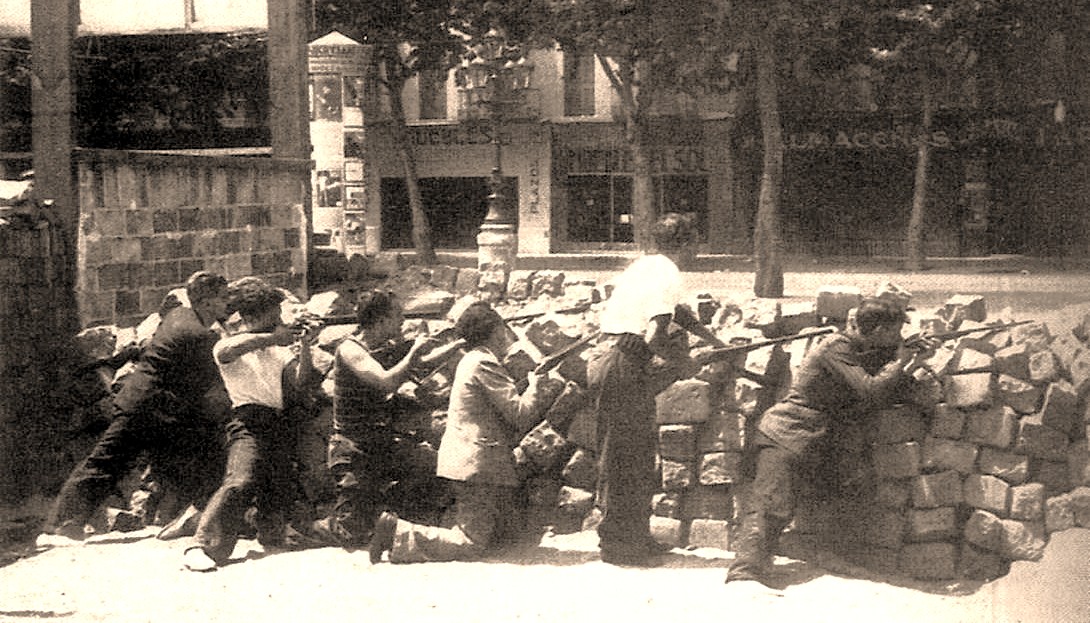
Statements and articles from the Catalan C.N.T.-F.A.I. in the weeks before the organizational, political and class conflicts within Spain’s anti-fascist front descended into civil war on the streets of Barcelona in May, 1937. The fractures that had been there since the beginning became insurmountable as the conflict shifted from its initial revolutionary and fluid months to the creation of front lines and formal powers behind them that followed.
‘Catalonia Crisis’ from Spanish Revolution (United Libertarian Organizations New York) Vol. 1 No. 16. April 23, 1937.
STATEMENT OF BARCELONA F.A.I.
The Local Federation of Anarchist Groups published a manifesto concerning the political crisis in Catalonia in which it formulates the basic demands of this organization,
which are:
(1) That Cabinet seats in the Catalonian government be apportioned according to the strength of every organization.
(2) The immediate annulment of the Public Order Decree [*Ed. note: reorganization of police along reactionary lines] concocted by the government and its substitution by another decree in consonance with the aspirations of both trade-union organizations (the anarcho-syndicalist C.N.T. and the socialist U.G.T.).
(3) To punish severely every manifestation of self-seeking and anti-revolutionary morality.
(4) Immediately to purge the armed bodies (militia and police forces) of Fascist sympathisers who have crept into war fronts as well as into the central bodies of the government and the responsible committees of the rear.
From “Solidaridad Obrera,” 3-28-37.
***
PROVISIONAL GOVERNMENT IN CATALONIA ONLY EMERGENCY SOLUTION
Until now only a provisional government has been formed. Negotiations about the formation of a regular government are still pending.
The provisional government has a reduced cabinet consisting of 2 C.N.T. representatives, 2 Left Republicans, 1 U.G.T., Rabassaires (Tenant Farmers).
The crisis has not yet been solved. The slogan of the C.N.T. is to win the war and go on with the revolution at the same time.
It presented a document in which it laid down the following conditions for the formation of a government:
1) A new plan for the reorganization of the police.
2) The carrying out of the proposed agrarian reform.
3) The reorganization of the Councilors Departments.
4) The dissolution of Committees for the Regular Army. [*Ed. note. Committees set up by the politicians in order to wrest the control of the army from the Councilor of Defense, which Department is in the hands of the anarcho-syndicalists.]
5) The control of the following ministries: Defense, Inner Affairs (Police), Economy, Agriculture and Finance.
From Journal Des Nations Geneva.
***
From the Statement on the Catalonian Crisis by the C.N.T.-F.A.I.
“The National Confederation of Labor (C.N.T.) demands that the workers should be the ones to mark out the road to be followed. We are convinced that the workers will be able to administer the affairs of Catalonia as successfully as they have been administering the factories, fields and mines. No one who is earnestly desirous of triumphing over Fascism can fail to recognize that the moment has arrived WHEN THE WORKERS THEMSELVES HAVE TO TAKE OVER THE DIRECTION OF WAR AND FINANCES IN CATALONIA.
“The Catalonian workers know perfectly well what their responsibilities are: they know better than anyone else what measures to take in order to increase production and to intensify the struggle against Fascism. And as to the maintaining of order, it is the workers who should be charged with it for no one else knows better who are the open and the hidden enemies of the anti-Fascist movement.
“There is no hatred or rancor within the working class; we are convinced that when the workers assume the responsibility of administering the government of Catalonia, perfect order will be established in the political, economic and social life of the country.
“We do not deny the sincerity of the other anti-Fascist sectors, but since war and revolution demand discipline, it is just and logical that the majority of the population should assume the directing role.”
Bulletin, 3-27-37
***
C.N.T. Demands Revolutionary Government
Supplementary Bodies of Workers Control Possible Solution of Crisis
The reports coming from Barcelona on the last Catalonian crisis have been very vague. We still do not know the exact nature of the shifts taking place in the cabinet as a result of this crisis, nor have we any basis for an evaluation of those results in political terms. Whether the revolutionary workers represented by the anarchists of Catalonia lost or won, or whether a stalemate has been produced leading to a postponement of the solution–we are not in a position to tell.
We do, however, learn something on the initial phase of the crisis from the latest French and Barcelona papers dealing with the circumstances leading to it and the first days of its development.
We are reprinting a direct communication from Barcelona appearing in the last issue of the French anarchist weekly, “Libertaire.” April 2:
Political Crisis Was Due to Come
“If one can note with great satisfaction the improvement of the military situation in Spain, one has also to note at the same time a turn for the worse in the relations among the anti-Fascist sectors.
“The Catalonian crisis which, at the moment these lines are being written, is already one week old, has created very serious difficulties. The basic cause of the latter are the differences which for more than a month have separated the C.N.T.–followed by the great mass of Catalonian people from the political and trade-union factions, such as the P.S.U.C. (the United Socialist-Communist Party) and the U.G.T. (General Union of Workers) which is compensated for its numerical weakness by the support given it by Soviet Russia, which threw all the weight of its power behind the politicians.
Anarchists Attacked by Politicians
“Until now our comrades of the C.N.T. and F.A.I. did not hesitate to sacrifice a great deal for the sake of anti-Fascist unity. But those sacrifices were not reciprocated.
More and more are the anarchists represented before the public opinion as the ones who are mainly responsible for the economic disorders caused by the revolution and the stagnation on the military front of Aragon, which was directly due to the deliberate abandonment of this sector by the Valencia government.
A Campaign of Enlightenment
“The anarchists reacted to this provocative policy quite vigorously. An intensive educational campaign through the medium of numerous mass meetings–more than a thousand of them were held in Catalonia-was organized throughout the country. All that brought to the light and established before the public opinion of Catalonia the real causes of inertia forced upon the militia of the Aragon front.
“The Catalonian crisis threatened to have its repercussions in the Valencia government whose evident partiality for the sectors where Marxists predominate taxed the good will of the C.N.T.
Patent Sabotage of Aragon Front
“The C.N.T.-F.A.I. put up some sort of an ultimatum to the Catalonian government to remedy the situation on the Aragon front by arming the five newly mobilized classes of population. The government declared, however, that it lacks the necessary financial means for it since the Valencia government refuses to advance them to the Catalonian government. [*Ed. note. The anarchist papers pointed out in connection with that, that considerable financial means are in the hands of private people and that it is necessary to tackle this source by pursuing a more drastic policy in regard to the middle classes.] That was why our comrade Iglesias (Councilor of Defense in the Catalonian government) was led to turn in his resignation, soon followed by the resignation of other C.N.T. representatives in the cabinet.
“There were other reasons such as the reorganization of police. The C.N.T. demanded the control of the latter and this also was a contributing cause of the crisis.
[*Ed. note. The C.N.T. never accepted the decree on the police reorganisation, the counter-revolutionary nature of which aroused the revolutionary workers to such an extent that the law was kept in temporary abeyance. The C.N.T. sent out instructions: to all municipal police departments not to disband in favor of the newly established centralized force.]
Safeguards of Revolutionary Control
“It is quite certain that from now on the C.N.T. will demand certain guaranties in order that the sacrifices made by it for the maintaining of an anti-Fascist: front be not lost for the revolutionary cause.
“It is in this sense that Valerio Mas, the Secretary of the Regional Committee of the C.N.T. declared yesterday in Catalunia, the evening paper of the C.N.T., that the crisis might be solved by having the cabinet made up in the same way as the previous one but supplementing every Department of the Ministry with a consultative body formed by representatives of workers’ unions and political parties.”
“It is quite clear that such a body will not remain consultative in character, that it will gradually transfer the real power from the Ministries to the unions.”
The Barcelona anarchist paper La Noche interprets this suggested solution in the same manner:
“If every Ministry Department is supplemented by a Commissariat represented by the workers’ unions which are affected by the work of the Ministry, the decisions of the latter will inevitably come to represent the will of the syndicates. The Ministry in that case will be nothing else but the executive organ and the official representative of the Commissariat built up by the unions as supplementary bodies of the Ministries.”
Spanish Revolution (not to be confused with the POUM supporters’ paper of the same name, time, and look) was the English-language twice monthly journal of the United Libertarian Organizations (ULO) from 1936 until 1938. The paper was initiated by Spanish C.N.T. delegates in New York City to support the anti-fascist revolutionary syndicalists of Spain. Editorship was collective, with the ULO including the Jewish Anarchist Federation (Freie Arbeiter Stimme), the Russian Federation (Dielo Trouda), the Vanguard group, several IWW locals, a Spanish language federation (Cultura Proletaria), and Carlo Tresca’s Il Martello.
PDF of full issue: https://www.marxists.org/history/spain/spanishrevolution/v1n16-apr-23-1937-span-rev-nyc.pdf

