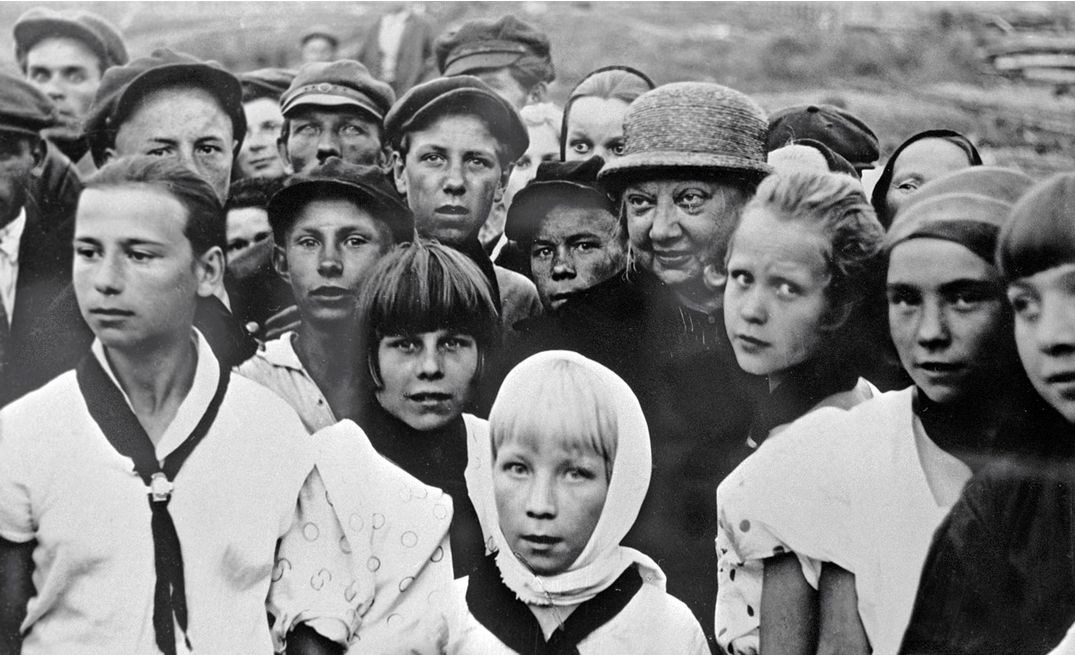
In its essence, the workers’ movement, Socialism, is a movement of masses of people acting in their own historic interests. To mobilize those working masses requires being among them, in their organizations, neighborhoods and workplaces; speaking to their professed concerns in their own language. For Krupskaya, this was the method of Bolshevik organization.
‘Mass Work’ by Nadezhda Krupskaya from International Press Correspondence. Vol. 7 No. 60. October 27, 1927.
The Leninist Way of Putting the Question of Relationship to the Masses.
The Communist Party is a party which is more closely linked with the broadest masses and more deeply anchored in them than is any other party in the world. From the very beginning of its existence the Communist Party has devoted special attention to a close alliance with the masses. Hardly had circles of revolutionary Marxism come into being when they developed their point of view with regard to the task of the working class in contrast to that of the Narodniki and Narodovolzi. When, at that time, the Narodovolzi placed their heroes, which did great deeds in the name of the people, in the forefront, the revolutionary Marxists said: Yes, heroes deserve every respect, but we do not set our hopes on heroes; we look to the masses of the working class who are making the revolution, who are at the head of all the workers and are getting the power into their own hands, Comrade Lenin wrote concerning this in one of his first books: “Who are the Friends of the People?” From that time onwards, the Party has always devoted its attention to the problem of how to get as large masses as possible of the workers under its influence, of how to get linked as firmly as possible with the masses.
The whole history of the Party goes to prove that the efforts of the Party were essentially directed towards being in connection with the masses. From the nineties onwards, when the Party just started its propaganda and agitation, this question was taken very seriously.
In reading Lenin’s works, we see that the problem of the relationship to the masses runs right through all his articles and speeches. Let us for instance take the October revolution. If we consider the work of the Party in the period from April to October we see that the activity of the Party was characterised by a clear and exact observation of the role the masses play in the revolution. When Vladimir Ilyitch returned from abroad in April, he immediately came forward with his theses which he had thoroughly, though out, and developed in them the view that the Provisional Government was not our government, that, we can place no confidence in it, and that we ought to fight in order to establish a new form of the State which had hitherto, never existed the Soviet Power. And at the time, when Vladimir Ilyitch said this, his proposal seemed to many to be an empty dream.
On September 16th, 1917, the Cadet “Rjetch” wrote:
“In spite of all their volubility, their vainglorious phrases, the Bolsheviki are, the exception of a few fanatics, only bold in words. They would not dare to seize “the whole power” on their own initiative. They are disorganisors and destroyers par excellence, their true character is cowardly and at the bottom of their hearts they know “quite well their own ignorance and the ephemeral character of their present successful results. They know quite well that the first day of their final victory would at the same time be the first day of their rapid decline. In no circumstances are they capable of creative work.”
Now, when we are celebrating the tenth anniversary of October, it is clear that the Cadets did not see further than a blind man.
The bourgeoisie said that “the position of the Bolsheviki can practically not be taken into consideration from any point of view.” The position was such that the bourgeoisie could not even imagine that the suppressed, ignorant working class and the “obscure” peasantry could wish for anything else but to be well governed by that the workers in common with the landowners and capitalists were unable to imagine. The peasants actually wished to rule the country themselves, that they could do without the landowners and capitalists.
Now, all, this talk of the “Rjetch” seems absurd. At that time many persons got confused by it. Thus, for instance, the Mensheviki thought that the working class could not seize power, in view of the cultural level on which, owing to tsarism, it had remained.
Lenin knew the working masses better. He worked with them for more than twenty years as their comrade and leader. He learnt to live and breathe as the mass of workers lived and breathed. He learnt to learn from the masses.
Ilyich know what the masses were capable of, and therefore he was firmly convinced that they would achieve miracles if they once realised that the Soviet Power is actually that order which helps to reorganise the whole of life.
The following is very characteristic: Three weeks after the theses had been published, the Party Conference was held. In the meantime, in these three weeks, Vladimir Ilyitch did everything in his power to talk as often as possible with workers, peasants and soldiers. His speech at the Party Conference is characteristic:
“I was more convinced by the words of a miner,” said he, “than by anything else. The miner explained how they had seized power. He did not use a single high sounding word and reported that the, workers did not debate whether or not a president should be elected, but discussed the question as to how the cables should be secured and they had taken possession of the pits how a just distribution of the bread ration among the workers, could be organised.”
Vladimir Ilyitch concluded his speech with the words: “This is the present programme of the revolution.”
Knowing however the attitude of mind of the masses, he said:
“We must not abandon ourselves to illusions. We must say straight out it that the masses do not yet understand us, that they do not yet follow us.”
This soberness, this clear understanding for the feelings of the masses at a definite moment this was a characteristic feature of Comrade Lenin, and it helped him to calculate correctly the moment at which this or that step should be made.
At this Conference, he said:
“As the masses are not with us, the most important thing now is to explain our point of view to them.”
Lenin moreover gave extraordinarily exact directions, which were of great importance for every propagandist and agitator. He said that, since our standpoint was correct, life would with every step prove how correct our standpoint was, and that we only had to explain the meaning of the events to the masses. Vladimir Ilyitch said that we should do this in a very popular way and give the masse concrete answers to their questions. We should not approach questions by roundabout ways but as simply as possible, as concretely as possible and by basing our statements on facts.
Why the Masses followed the Bolsheviki in October.
Let us take a fact from the time preceding the April Conference: the Provisional Government issued a note saying that it was in favour of war to a victorious conclusion and considered it necessary to fulfil all the pledges made to the Allies. What did the Bolsheviki do?
The Bolsheviki explained in the Press what was the nature of these pledges. They pointed out that the Provisional Government was promising to fulfil engagements which the Government of Nicholas II and the whole Tsarist band had taken upon themselves. They pointed out for whose benefit these pledges were made, being pledges given to the bourgeoisie. And as soon as this became clear to the masses, we saw they went out into the streets. This fact made the masses realise whose interests the Provisional Government was serving. This was the method suggested by Lenin at the April Conference, the method of throwing light on the events of the day and explaining them to the masses.
The Party fully shared Comrade Lenin’s point of view. We were witnesses of the great campaign of enlightenment carried on by the Bolsheviki in May and June up to the July days. We saw that the unhappy offensive at the front spoke for itself as soon as it was correctly explained and illustrated by the Bolsheviki. We saw that, when in the July days the regiments took action without directions from the Party, against the wishes of the Party, the Party issued the slogan that the July action should be transformed into a peaceful demonstration. For the lesson taught by events was that, although the insurgent regiments were in favour of the Bolsheviki, in favour of the Soviet Power, the masses as a whole would nevertheless at that moment not have followed the Bolsheviki to the last. Later, when Kornilov had marched on Petrograd, when the danger of the revolution being suppressed and the Tsarist Power restored when this danger had stood revealed to the masses, then, after the Kornilov days the Soviets of Petrograd and Moscow also voted for the Bolshevist resoutions.
The months from April to October afforded a clear picture of the necessity of allowing oneself to be guided by the attitude of mind of the masses, of listening to the voice of the masses and at the same time the necessity of explaining to them the state of affairs. Experience proved that this was absolutely the right policy. When the moment had come in which the Petrograd and Moscow Soviets and the masses were on the side of the Bolsheviki, Comrade Lenin recognised the voice of the masses and began at once to fight for power.
I remember the following incident: Vladimir Ilyitch lived in Helsingfors, he remained in hiding there. I had to go there twice under the name of Atamanova, disguised as a working woman. I sat in the car of a troop train and recall the deep impression which the discussions between the soldiers made on me.
The attitude of mind of the masses of soldiers and sailors was extremely revolutionary. They talked openly of insurrection.
I told Vladimir Ilyitch of these discussions carried on by the soldiers and sailors in the train. I remember how his face clouded over; he believed that the moment of insurrection had matured, that quick action was necessary in order to prevent the bourgeoisie from finding time to strengthen themselves.
Only the fact that the Bolsheviki had estimated all the forces correctly, made it possible for the Bolsheviki to find the correct line of action, to convince the masses, to attract them and to lead the October revolution to victory.
The role of the Communist Party, which was the vanguard of the working class and which was amalgamated with the masses and understood how to convince them and carry them along with them, became especially clear in the six months which preceded October.
All the tasks are not yet fulfilled, but the Construction of Socialism still goes on.
Ten years have elapsed since the October revolution. It would be ridiculous to maintain that the Soviet Union has already realised all the tasks evolved by the October revolution, that any general state of well-being has already been reached. We are standing with both feet on firm ground and do not shut our eyes to the fact that there is still a great deal of poverty and distress. It is not for nothing that we call ourselves Lenin’s disciples. We face reality unswervingly and know very well that only some of the great tasks which the October revolution revealed to the masses in such a brilliant light have been brought to a finish, and that much strenuous work is still required to complete these tasks. We should however realise that, even though not everything has been fulfilled, there is nevertheless a vast gulf between the state of affairs before October and at the present. There is no going back.
If we talk of our achievements and only take the statistical figures into consideration, the difference between what was and what is probably not so very great. If however, let us say, for instance, that a foreigner comes to Soviet Russia and observes how a new life is being built up on new foundations, he suddenly becomes aware of the tremendous difference between things as they were before October and to-day.
The whole public order, man himself, is changing more and more from year to year.
“Socialism”, writes Lenin “cannot be introduced by a party minority. It can only be introduced by the many millions when they have learnt to do everything themselves.”
He wrote:
“It is necessary that all those from among the people who have awakened and are fit for creative work, should in large numbers join the organisations which exist and will, in the future, be built up by the masses of workers.”
“The masses are impotent when they are divided, they are strong when they are united.”
If we judge from this point of view what has been achieved, we recognise that, in reality, the development of class-consciousness and of the organisation of the masses is a grandiose achievement.
Let us take an example:
On October 10th, the All-Russian Congress of Women Workers and Peasants, members of the rural and urban Soviets, was opened. They are not simply women workers and peasants who sympathise with the Soviet Power, but those who do important, practical work in the Soviets. This Congress was preceded by District Conferences, such as the Leningrad Conference. A lively atmosphere prevails. Enthusiastic, passionate speeches are made by the women workers. They speak freely, in good literary language, with firmness and conviction. There are now some among the women workers who have attended Labour Colleges, a kind of secondary school. Peasant women are sitting there in their kerchiefs, noting down with a swift hand, figures and facts. An aged peasant woman from a remote corner of the Leningrad district is standing on the platform. “Having examined the plan of work for the first six months”. “The plan of work for the first six months”. This is not the way in which peasant women spoke in former times. But they not only learn how to speak, they also learn to do public work, to work systematically. Anyone who knew our peasant women of former times must be conscious of the forces of progress.
At the Congress of Women Workers and Peasants, a report is made on their work in the Soviets, the avenues of further work are decided upon.
After the Congress of Women Workers and Peasants the Conference of the All-Russian Central Executive Committee will be held in Leningrad. This Congress will show how closely the Soviet Power has united the working and peasant classes, in what a fraternal alliance it has linked together all the peoples of our country.
But the Congress of Women Workers and Peasants and the Conference of the All-Russian Central Executive Committee will clearly prove how the class consciousness and organisation of the masses have developed in the past ten years. In this fact lies our colossal strength, which nothing can break down.
International Press Correspondence, widely known as”Inprecorr” was published by the Executive Committee of the Communist International (ECCI) regularly in German and English, occasionally in many other languages, beginning in 1921 and lasting in English until 1938. Inprecorr’s role was to supply translated articles to the English-speaking press of the International from the Comintern’s different sections, as well as news and statements from the ECCI. Many ‘Daily Worker’ and ‘Communist’ articles originated in Inprecorr, and it also published articles by American comrades for use in other countries. It was published at least weekly, and often thrice weekly.
PDF of full issue: https://www.marxists.org/history/international/comintern/inprecor/1927/v07n60-oct-27-1927-inprecor-op.pdf

