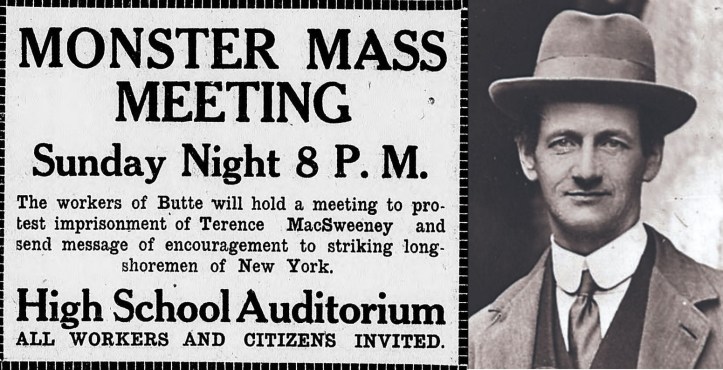
The 1980-81 hunger strikes of Irish prisoners of war held in British prisons brought Ireland’s struggle to the attention of the world; helped to galvanize and legitimize support for the Republican campaign, while simultaneously damning and delegitimizing Britain’s long misrule in Ireland. Led by I.R.A. volunteer Bobby Sands, a fast demanding the rights of political prisoners began on March 1 as others joined over the following weeks. Leading from the front, Sand was the first to succumb, dying on May 5, 1981 after 66 days without food. Nine more Republican prisoner agonizingly followed Sands to their deaths over the next five months. Sands and his comrades were part of one of Ireland’s most potent, and costly, methods of confronting the enemy and were intensely conscious of the story of Terence McSwiney. Though less known today, but no less monumental in its consequences, was McSwiney’s 1920 fast. McSwiney (spelled McSweeney in these articles), was anti-imperialist, a poet, and elected Sinn Fein Mayor of Cork City. As with the 1980-81 Hunger Strikes, McSwiney’s situation was increasingly followed by millions of oppressed around the world, far beyond the Irish diaspora, in such colonies as India, China, Indo-China, Cuba, and others. Like Sands, perhaps even more so, McSwiney’s sacrifice made deep impressions on a generation of anti-imperialists, including no less than Ho Chi Minh. McSwiney, utterly committed, survived an astonishing seventy-four days without food before his body gave out on October 20, 1920. A watershed in the War of Independence, Britain would never morally recover from McSwiney’s selfless dead. Thousands of miles away, in a hardscrabble, radical mining community rich with Socialist and union history, Buttle, Montana was a citadel of diasporic Irish Republicanism. Home to a long-lasting Pearse-Connolly Club, who leading labor paper, The Butte Daily Bulletin, edited by Irish-American worker and proud descendant of Fenians, William F. Dunn. As the campaign to save McSwiney’s life reached its pitch, leading Irish-born revolutionary Jack Carney, comrade of Larkin and Connolly, and editor of the Duluth Truth traveled to Butte to speak in front of 1200 workers on the importance of McSwiney’s actions.
‘Jack Carney: Death of McSweeney Will Result in Annihilation of British Empire’ from Butte Daily Bulletin. Vol. 3 No. 15. September 6, 1920.
BRITISH ATROCITIES IN IRELAND SCORED
Prominent Speakers Tell of Bitter Struggle of the Working Class
DEATH OF TERENCE MCSWEENEY WILL RESULT IN ANNIHILATION OF BRITISH EMPIRE
While more than 1,200 enthusiastic Butte people made the high school auditorium tremble with their cheers of approval, Jack Carney, editor of Truth, Duluth, Minn., and for many years an associate of James Connolly and Jim Larkin, in the fight for the emancipation of the Irish working classes, declared that the long series of British atrocities, culminating in the death of Terence McSweeney, lord mayor of Cork, would result in the annihilation of the British empire.
The meeting was called under the auspices of the Silver Bow Trades and Labor council, and the Irish Societies of Butte, to protest against the incarceration of Terence McSweeney, and incidentally against British atrocities everywhere. The other speakers were: W.F. Dunn, chairman; John Driscoll, president of the Central Labor council; Louis S. Irvin, democratic nominee for state attorney general; Judge Jeremiah J. Lynch, and Miss Jeanette Rankin, ex-congresswoman from Montana.
Driscoll took the floor first, after a short introductory address by the chairman, and assured the audience of the sympathy of the workers of Silver Bow county with the struggling Irish people in their attempts to cast aside the yoke of British misrule.
Mr. Irvin then took the platform and expressed his sympathy with Ireland’s age-old struggle for freedom. “Ireland has been offered much,” Mr. Irvin said, “but she has not been offered that which she most desires, her independence. The end is not yet in the struggle for Irish liberty.” The speaker then voiced the protest against the latest British atrocity, and spoke of the “man who lies in our prisons, whose One thought is for the betterment of humanity.”
“The longshoremen,” declared Irvin, “who have struck in protest against British atrocities, have held in mind more than a mere protest–they have done things. The tide all over the world is surging forward toward the overthrow of the oppressor and the success of the oppressed–the overthrow of the master and the release of the slave.”
Judge Lynch was the next speaker. “I am glad that this meeting was called by labor,” he declared, “for labor has a heart; labor is human; labor has the understanding and sympathy for the feelings of humanity.”
He then went on to explain how the political prisoners of today were placed on a level with common murderers and defilers of virtue in society’s prisons. He was greeted with a storm of applause when he declared thar Terence McSweeney was the superior of Lloyd George. “It will be a bad thing for the British government and for Lloyd George,” declared the judge, “if Terrence McSweeney dies!” Speaking of the attitude of the Wilson administration toward the outrages, he said, “If our government can assist Poland in an unworthy cause, why should it be afraid to tread on the toes of John Bull, I would like to know.”
Before introducing the next speaker, Mr. Dunn made a brief address. He spoke of the imperialism of the British nation as a part of the world-wide chaos of capitalism. He told how the workers of world had never had a quarrel with each other, but how their minds were poisoned by the capitalist press and how they had been driven into the shambles of war in 1914, totally against their better natures. “Labor in Europe is today keeping the masters from plunging it into another cataclysm,” he said, “and the youth of America must follow its lead to prevent further war.” He spoke of the 750 years of suffering and oppression of the Irish people and of James Connolly, Larkin and other great Irish working-class martyrs. “It is wrong for the oppressed to use violence,” declared Dunn, “because the prevailing idea of an age is the idea of the ruling class. Now I am going to introduce to you the man who organized the Belfast transport workers’ union, and who fought shoulder to shoulder with Jim Larkin–Jack Carney.”
With seven years in American prisons staring at him because he dared to raise his voice in behalf of the oppressed of all countries, including Ireland, Jack Carney took the platform and intrepidly sounded the clarion call to the workers to throw off all masters and rise in their majesty, the masters of their own destinies. He spoke in glowing terms of the man “who thinks so little of his own life that he gives it up for the freedom of the coming generations,” and urged the people of the meeting to send out a protest against the imprisonment of McSweeney.
Carney traced the history of Irish oppression from the earliest stages of British domination, graphically relating the struggles and the unbreakable spirit of the Irish people. He told of the starvation wages paid to women and men in the city of Belfast. Women, employed at the embroidering of silk parasols, were paid 2 cents an hour in 1914, he said.
“The outcome of oppression in Ireland,” he declared amid thunders of applause, “will be the annihilation of the British empire. Ireland is going to be free, and you and I will live to see it. We shall see ships come into New York harbor flying the Irish flag.”
Carney emphasized the fact that the greatest of the Irish revolutionists stood not merely for political freedom in Ireland, but for industrial emancipation as well. “I am not in favor of an Irish republic where men are hanged to railroad trestles and shot in the back,” declared Carney, “and where two-by-four newspaper men lick the hands of the masters. I believe in an Ireland in which the workers shall be their own masters. McSweeney will die, but the fight for Irish freedom will go on, inspired by his sacrifice.”
Chairman Dunn then noticed Miss Rankin in the audience, and called upon her for a few remarks. She was greeted with a thunder of applause as she took the stage. “Wherever there is a meeting being held to further the cause of liberty,” Miss Rankin said, “I am always thinking to be there. The great fight is not for the freedom of Ireland alone, but for the freedom of the oppressed all over the world.” Discussing the attempt of the enemies of Ireland to make a religious issue out of the struggle, Miss Rankin declared, “No religion, Catholic or Protestant, can survive, that fights the liberties of a people.”
A collection amounting to $307.95 was taken up, and it was announced that further collections for the benefit of the striking longshoremen of the east would be received by Con Downey, 309 North Main street. Two resolutions, one to the longshoremen, encouraging them for their spirit in protesting against British terrors; and the other to President Wilson, deploring his silence on the question, were passed by the meeting in a storm of acclamation.
The resolutions follow:
To the President of the United States:
“Workers of Butte in mass meeting assembled denounce the atrocities of British rule in Ireland and deplore the continued silence of yourself and cabinet on this subject. We denounce as subversive to the principles of American government the fact that British secret service agents operate freely in this country, as evidenced by their activity in the cases of Archbishop Mannix and Jim Larkin.
“We demand that steps be taken to end this shameless acquiescence in acts of British imperialists.
(Signature of Chairman)
“W. F. DUNN.”
To the Striking Longshoremen of New York:
In mass meeting assembled, workers of Butte express deepest appreciation of your courageous stand against British atrocities and your protest against the treatment accorded Terrence McSweeney by the British government.
(Signature of Chairman) W.F. Dunne.
“W. F. DUNN.”
The Butte Daily Bulletin began in 1917 in reaction to the labor wars in Montana, the Speculator Mine fire killing 168 miners; IWW organizing, and the murder of IWW organizer Frank Little in Butte. Future Communist leader and IWW organizer William F. Dunne and R. Bruce Smith, president of the Butte Typographical Union published the paper as an outgrowth of a strike bulletin with the masthead reading, “We Preach the Class Struggle in the Interests of the Workers as a Class.” It became daily in August 1918 and in September 1818 officers raided their offices and arrested Dunne and Smith on sedition charges. An extremely combative revolutionary paper, while unaligned, it supported the struggles of the Left Wing in the SP, reflecting the large radical Irish working class of Butte also supported Ireland’s and the Bolshevik revolution, as well as the continued campaigns of the IWW locally and national as well as the issues in Butte. It ran until May 31, 1921.
PDF of full issue: https://www.loc.gov/resource/sn83045085/1920-09-06/ed-1/?sp=1&st=image&r=0.326,0.085,0.504,0.248,0#viewer-pdf-wrapper

