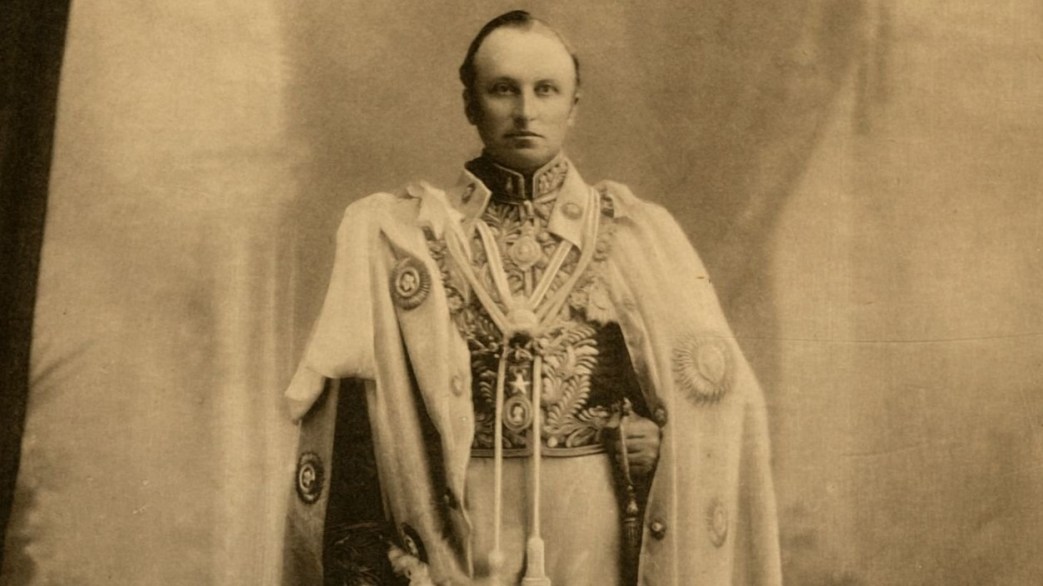
Karl Radek reacts to the death of one of history’s more nefarious proponents of imperialism with a particularly unhinged hatred for the Soviet Union. A Henry Kissinger-type figure, but with a parchment full of pretentious titles, and the kind of financial inheritance only a British aristocrat could have been bequeathed. Blood-drenched imperialist par excellence, George Curzon–the 1st Marquess of Kedleston, 5th Baron of Scarsdale, Head of the King’s Privy Council, Leader of the House of Lords (a Peer for Ireland), Member of Parliament, sometime Foreign Secretary, and former Viceroy of India—who made it his–and tried to make it the U.K.’s–sole mission after 1917 to destroy the Soviet Union.
‘Lord Curzon and the Soviet Union’ by Karl Radek from International Press Correspondence. Vol. 5 No. 25. April 2, 1925.
When the late Lord Curzon in 1898, at the age of 39, achieved the ambition of his life and was appointed viceroy of India, the highest dignity which the British Empire can confer, the fear of Russian tsarist imperialism constituted for this representative of British imperialism the central point of his entire policy. To prevent Russia from penetrating into Asia was the dominating idea of Curzon. When he perceived that Tsarism had its hands full with its enemy in the Far East, he decided to undertake some risk. The expedition to Tibet (1903-1904) over the snowy passes of the Himalaya mountains was intended to show that Russia must not venture to oppose the will of English imperialism.
On the 18th November 1905 Curzon left India after he was defeated in the dispute with the military commander, Lord Kitchener. Overloaded with honours, he was buried, while still living, in a golden sarcophagus. His further stay in India was rendered impossible as Tsarist Russia was at that time so crushed in the Far-East that she ceased to be a danger to English imperialism, and Lord Grey, then Foreign Minister, arrived at an agreement with Russia in all Asiatic affairs. Russia turned her front against Germany, who had become the most threatening rival of English imperialism. Russia was necessary as cannon-fodder against Germany, and the anti-Russian policy of Lord Curzon had to be hidden away in the archives,
The political resurrection of Curzon did not take place until the year 1919, after the end of the world war when once again England’s relations with Russia occupied the central point of English policy. Curzon, who had now become Foreign Minister, seems not to have opposed the change of policy which Lloyd George made after the defeat of Denikin and Koltchak. England did not carry on intervention with all her forces. This was prevented not only by the profound social crisis through which England was then passing, but also by the commencement of the struggle with France for hegemony. Besides this another thing had to taken into consideration: if the white guards had succeeded with the help of the Entente in defeating the Soviet power, then they would have been compelled to submit to the Allies the old treaties concerning Turkey and Persia. In 1919 Curzon took advantage of the weakness of Russia at that time in order to grab Persia. The English were also masters in Constantinople. This state of affairs would have become impossible in the event of a victory by the whites.
But even if the whites in order to maintain power had capitulated to England, there existed not the least doubt that in the future a white Russia would have had to direct its efforts in the direction of the weakest states, that is, towards the East. “In Russia the Whites and the Reds are fighting. This is not enough. It would still be necessary to arm the Greens,” said one of the English agents after his return from the Baltic area. England required before all that the civil war in Russia should drag on as long as possible. The longer it lasted the more weak and shattered must Russia have emerged from it.
When Soviet Russia was victorious one had to be reconciled with her. Lord Curzon made no objections when Lloyd George sought to obtain raw materials from Russia in order to free England from her dependence on America, for he believed that Russia has been sufficiently weakened and that she would not be able to exercise an influence upon the development of Asia. He also hoped that the famine which had broken out in 1921 would compel Soviet Russia to capitulate to England.
But when, at the Genoa Conference, Russia did not capitulate, when she began to recover and to become the centre of the liberation movement in the East, the old hatred which Curzon had cherished against Tsarist Russia broke out against the new workers and peasants’ Russia with redoubled force. But Lloyd George, who kept a tight control over Foreign policy, did not give him full liberty of action. The hate against this “lebian”, the rage of Lord Curzon that during the conferences in Cannes and Genoa he was compelled to be “ill”, assumed hysterical forms, Lloyd George was abandoned by the Conservatives.
Curzon finally obtained complete control of foreign policy. He concluded the peace with Turkey in order to divide the revolution of the East from the Russian revolution. He allowed the French to enter the Ruhr Area in order that he might have a free hand; then he sent an ultimatum to Soviet Russia. The man whose agents had surrounded the Soviet Union on all sides and organised all the hostile forces against it, decided to demand from Russia that she abandon propaganda in the East. He decided to humiliate her at all costs in order to show the peoples in the East that it was enough merely to raise the whip and the unruly “rabble” the Russian workers and peasants would sink on their knees; if they did not sink on their knees, then he, Curzon, would show the Soviet Union that he was not to be trifled with, that he would unleash his dogs against it. Here was to be seen his entire shallowness, his complete incapacity to understand any forces other than hard cash and bayonets.
The government of the Soviet Union made every concession which was possible, but did not surrender. And then Curzon had to undergo the experience of seeing the leading circles of English industry raising a protest against his insane policy. The chairman of the industrial group in the English House of Commons called the leader of the Labour Party, Henderson, to him and declared to him that he would not permit a breach with the Soviet Union, and that Curzon would have to be content with the sum which the Soviet government had paid to the “insulted” English spy, as well as with the repetition of the promise not to carry on propaganda. Thus Curzon failed to bring about a breach with the Soviet Union.
His Turkish policy ended likewise in a defeat. Turkey who was compelled, owing to the relation of forces, to agree to the negotiations of Lausanne, did not reconcile herself with English imperialism which is threatening her existence. In Afghanistan, Curzon failed to drive the Soviet Union from the positions she had taken up. In the Far East the position of the Soviet Union is becoming stronger every day.
When, after nine months of the government of the Labour Party, the Conservatives again came to power, Curzon was not given the position of Foreign Minister. He was again buried in the Upper House. He no longer had any influence upon the course of foreign policy. His star was finally eclipsed. The representative of the English aristocracy, the representative of the brute force and of the romance of imperialism, the boundlessly self-satisfied and conceited Curzon, was not capable of grasping the whole complication of the situation of the British world empire, which had lost its strength not as a result of the agitation of this or that power, but owing to the fact the United States of America has become the leading industrial power, that the peoples of the East, who were at one time the dumb slaves of the British world empire, have awoken, and wish to live and to develop, that the Russian people, in the shape of the Soviet Union, is developing its forces, that finally, the conditions of modern warfare have destroyed the advantages due to the insular position of England. The puffed-up Lord who thought that it sufficed to raise the English whip and the people would tremble, was an old fogy who did not understand the world and whom the world had ceased to understand.
Even at his grave-side one cannot say that he embodied the greatness of British imperialism. The greatness of British imperialism lies in that period when it was the driving force of capitalist development. Curzon entered the arena of history at a time when British imperialism had become a hindrance even for the bourgeois development in the East. Curzon only embodied the soulless force whereby British imperialism wishes to save its rule. This force was directed against the people of the East and against the Russian people. He hated Russia, even quite independent of the class which was ruling in it. He hated the Russian people in general because of that role which it was called upon to play in the awakening of Asia, this selected object of English exploitation. In addition to the hate he had for the Russian workers, he also had the profoundest contempt for them; he could not understand how the workers could even think of venturing to compete with him, Lord Curzon of Kedleston. The Russian workers had the same attitude towards him. They could not understand how the representative of a world which has outlived its time could venture to hold up the stream of history. History will show that there was every reason for the contempt of the Russian workers, at a time when the attitude of Curzon towards them was only an expression of the haughtiness of the representative of the old world which has not understand that it is time for it to die.
International Press Correspondence, widely known as”Inprecorr” was published by the Executive Committee of the Communist International (ECCI) regularly in German and English, occasionally in many other languages, beginning in 1921 and lasting in English until 1938. Inprecorr’s role was to supply translated articles to the English-speaking press of the International from the Comintern’s different sections, as well as news and statements from the ECCI. Many ‘Daily Worker’ and ‘Communist’ articles originated in Inprecorr, and it also published articles by American comrades for use in other countries. It was published at least weekly, and often thrice weekly.
PDF of full issue: https://www.marxists.org/history/international/comintern/inprecor/1925/v05n25-apr-02-1925-inprecor.pdf
 Revolution's Newsstand