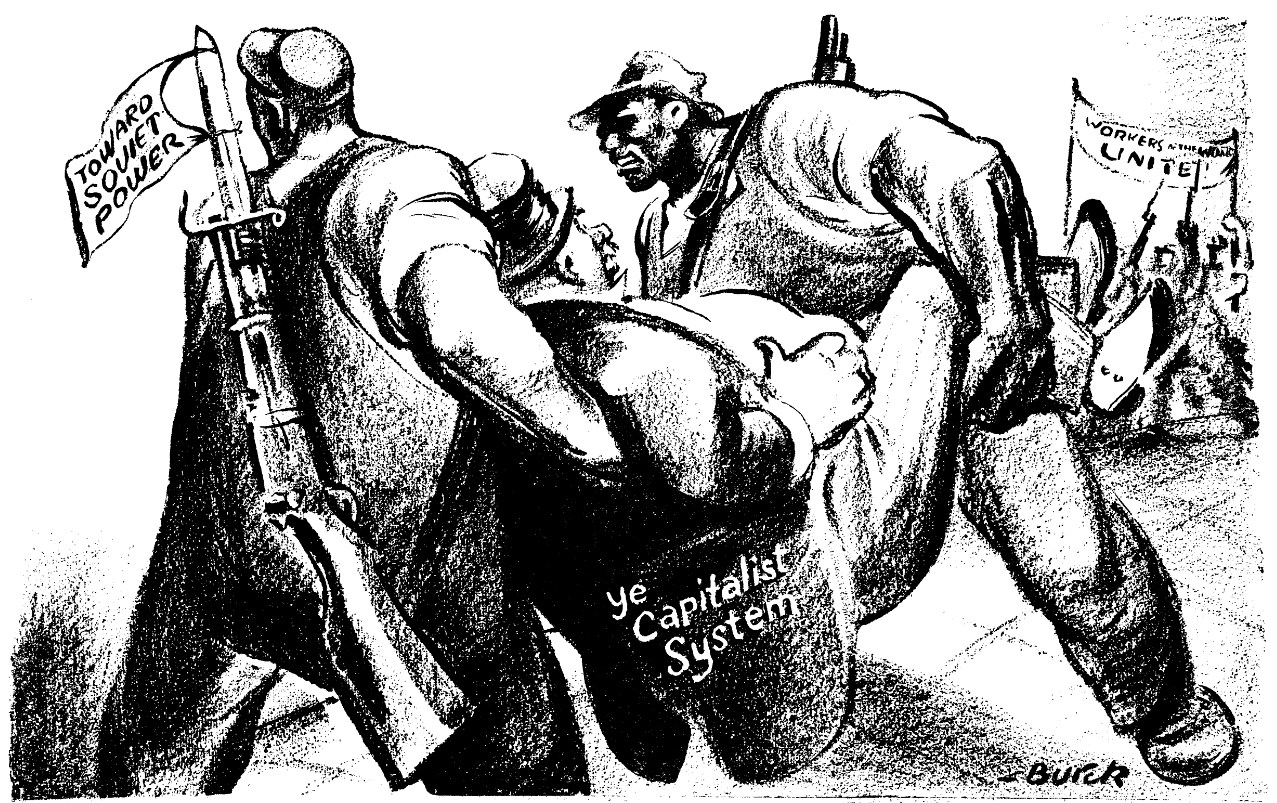
The Daily Worker hosted some superlative artists, supplying thousands of drawings and cartoons to the paper; many of them remaining relevant and retaining their power today. Among those whose art made its pages were Adolph Dehn, Fred Ellis, Robert Minor, William Gropper, Art Young, Hugo Gellert, Maurice Becker, Lydia Gibson, H.J. Glintenkamp, Hay Bales, Don Brown, William Siegel, K.A.Suvanto, and the great Jacob Burck, who is profiled here as his collection of over 120 works, Hunger and Revolt, was published.
‘Jacob Burck: American Political Cartoonist’ by Walt Carmon from International Literature. No. 3. 1935.
I.
A few years ago heated disputes often took place at the general meetings of the New York John Reed Club. Problems of the theory and the function of revolutionary art were bitterly fought about. Among those who were clearest in these disputes, who fought most stubbornly, was Jacob Burck. He always spoke briefly and to the point. And he had a vitriolic tongue which got a lot of respect from his opponents.
Burck was only 25 years old then. He was just beginning to mature as an artist. In his controversies on the floor of the John Reed Club neither his age, nor the fact that he stood before older men, established painters and political cartoonists of note, made any difference to him. He doggedly stuck to his guns. He read considerably into the theory and history of art. He had his viewpoint. Neither age nor reputations were going to stop him.
Burck’s cartoons were then attracting considerable attention. Fred Ellis, with twenty years of political cartooning experience behind him, was helping out the young, aggressive Burck. Then Ellis left the Daily Worker where he was staff cartoonist, to come to the Soviet Union. Jacob Burck stepped into his shoes. He was a worthy successor. From that point on his stature as an artist grew daily. He also did cartoons for the New Masses, book jackets for publishers; and his paintings, hung in foremost galleries, drew high praise from leading critics in the bourgeois press.
In three short years Burck has risen to the position of not only the best political cartoonist in the American revolutionary movement, but among the very best in all of the American press.
II.
Perhaps no revolutionary newspaper in any country has been as fortunate in its artistic talent as the Daily Worker, organ of the American Communist Party. First came Robert Minor, greatest political cartoonist, now a leader of the American communist movement, who has not drawn for the last ten years. He was followed by Fred Ellis, worker-artist, now on the staff of Trud in Moscow. Jacob Burck was his successor. (Already grooming Russel Limbach for his position.)
This follows in the great tradition of American revolutionary political cartooning. A tradition which does justice to the master Daumier. This tradition began in 1910 with the birth of the “old” Masses. It continued through the Liberator, The Workers Monthly—and now the New Masses and the Daily Worker. Splendid craftsmen they were. Men like Art Young, Boardman Robinson, Maurice Becker, Robert Minor, William Gropper, Fred Ellis—and Jacob Burck. They drew for our press, their drawings and paintings appeared in leading bourgeois newspapers and magazines; their paintings hung in leading galleries. In fact they still do.
Here is one instance of their effect on the American working class: I was fortunate enough to be assigned to edit Red Cartoons, the yearly collection of revolutionary drawings which was issued for five years. When we decided to publish Red Cartoons of 1926 the first of the series, we had in mind, of course, to preserve some of the best of this great tradition of American revolutionary art.
We wanted it also to be a means of promoting our Party organ, the Daily Worker. We knew that these cartoons were prized highly in strikes, etc. That they were hung in workers’ homes and clubs. But we wondered how far this appreciation would be shown for a full book of cartoons, covering all phases of the class struggle and drawn by 14 of our artists. The results went beyond our fondest expectations. They went in sixes in fact. Offering Red Cartoons of 1926 with every yearly subscription for the Daily Worker, for six dollars a year (a very high price), we secured 6,000 yearly subscriptions in six weeks. Here was evidence of how close to the heart of the American worker were the cartoons of our artists.
We got more proof. Besides the copies given out as premiums with subscriptions, over 25,000 other copies were sold at the relatively high price of one dollar. Jacob Burck made his first appearance between book covers in this yearly collection.
Now Jacob Burck appears in a large book of his own work. A beautifully edited, printed and bound volume of 248 pages called Hunger and Revolt which is a tribute to the progress of the American revolutionary movement. Henri Barbusse has written an introduction for it and there are short notes on separate sections of the book by John Strachey, Michael Gold, Langston Hughes, Earl R. Browder (general secretary of the American Communist Party) and others. It is a splendid opportunity to judge the work of Jacob Burck. Here is the chosen fruit of five years work. The cartoons are divided into special subjects: unemployment, Socialist Party, politics and politicians, the farmer, the Negro, fascism, war, the Soviet Union, etc.—all the subjects that are the concern of the revolutionary artist and close to the heart of the working class.
Henri Barbusse said: “…Here is projected a kaleidoscopic film…there unrolls before your eyes a great and tumultuous spectacle taken from nature.”
Earl R. Browder wrote: “This collection of Burck’s cartoons is an historical document. In these cartoons is combined all the force of Communist theoretical analysis with that of the strongest tradition of American cartooning. It is an essential part of the history of our times.”
This alone does not, of course, cover all the virtues of the work of Jacob Burck. These drawings are often in a satirical vein, dipped in acid. Burck gets “earthy,” he often borders on the very edge of indecency. His drawings sometimes speak in the language of the street. But they are always powerful, they strike home and they strike hard. They reach the worker with their message as sure as revolution.
For example: mother earth is notoriously bountiful. American capitalists during the crisis have destroyed cotton, slaughtered cattle. They want to restrict the production of wheat. Burck shows us a huge, fullbreasted, pregnant woman standing in a field of wheat. A horrified capitalist stands before her. And Burck’s caption is “What…Again!”
Since military training is aimed to make automatons of American youth, for Burck the problem is very simple (though a bit revolting). He shows us a military officer scooping out the brains of a student into a garbage can. The caption is “…What d’ya need them for!”
Burck’s book Hunger and Revolt does not include other memorable cartoons which show his deep satirical sense. To show the servile role of the English “socialists,” especially Ramsay McDonald, Burck drew a cartoon of the king of England entering his bedchamber, where the queen is already seen retired. McDonald assists the king there. Under the king’s arm is a book of “Pink Fairy Tales” and under the bed one can see very personal utensils. When this was printed in the New Masses many workers wrote in to us, chuckling between lines. The political lesson was as clear as daylight. Because, as Earl Browder wrote, “here is combined all the force of Communist theoretical analysis with that of the strongest tradition of American cartooning.”
Among the American cartoonists not all of them are reasoning, logical artists. Some are exceptionally able, but essentially instinctive. Not Burck. Not the medium built. strong figure that rose up in the meetings of the New York John Reed Club and tongue-lashed those who differed with him.
Burck reads, studies, consciously directs his work along lines dictated by Marxian principles. He writes seldom, but he writes well. For the March, 1935 issue of the American Mercury, a leading bourgeois magazine, he wrote the article “For Proletarian Art.” It is satirical, mature—like his cartoons. There he tells how the early confusions of the John Reed Club artists were clarified. (“Whether nudes and bananas are revolutionary themes.”) “To achieve this,” he writes, “the John Reed Club artists felt that a deeper understanding of Marxism was necessary…Previously, emotional impulses were sufficient for revolutionary artistic existence. Now, many John Reed artists are enrolled in the New York Workers School and similar institutions elsewhere. The Club itself has to meet this demand for political education with special lectures given by outstanding leaders of the labor movement.”
Jacob Burck is the thinking, conscious artist.
III.
Jacob Burck was born in 1907 in Cleveland, Ohio, a mid-west American city. He came of proletarian parents and in his youth he worked at various occupations: as a messenger boy, in a fruit store, etc. A scholarship enabled him to further his art studies in New York.
He began his professional activities as a portrait painter. After a year of this work he revolted at this catering to the vanities of a parasitic class. He decided to give up “art” and turned to sign painting as a more wholesome means of earning a living. In 1926 he entered the revolutionary movement. In 1927 he began to draw cartoons for the Daily Worker and other revolutionary publications. Two years later he became the staff artist of the Daily Worker; and for a while, art editor of the New Masses.
In the past year Jacob Burck has received increasing attention as a mural painter. He has done a series of five panels on the Soviet Union which have been highly praised by the critics.
Now, only 28 years of age, Burck feels that he needs a deeper understanding of socialism, to continue his artistic growth. He is coming soon to the Soviet Union for his “post-graduate course.” He will become staff artist of the Komsomolskaya Pravda.
Both in the field of political cartooning, and as a painter, Jacob Burck looms up as an outstanding American artist, He will continue to grow that is certain. He is ambitious and he is intelligent. He is a conscious revolutionary. As evidence of the great talent that lies within the working class, we proudly present: Jacob Burck, American revolutionary artist.
Literature of the World Revolution/International Literature was the journal of the International Union of Revolutionary Writers, founded in 1927, that began publishing in the aftermath of 1931’s international conference of revolutionary writers held in Kharkov, Ukraine. Produced in Moscow in Russian, German, English, and French, the name changed to International Literature in 1932. In 1935 and the Popular Front, the Writers for the Defense of Culture became the sponsoring organization. It published until 1945 and hosted the most important Communist writers and critics of the time.
PDF of full issue: https://www.marxists.org/subject/art/literature/international-literature/1935-n03-IL.pdf

