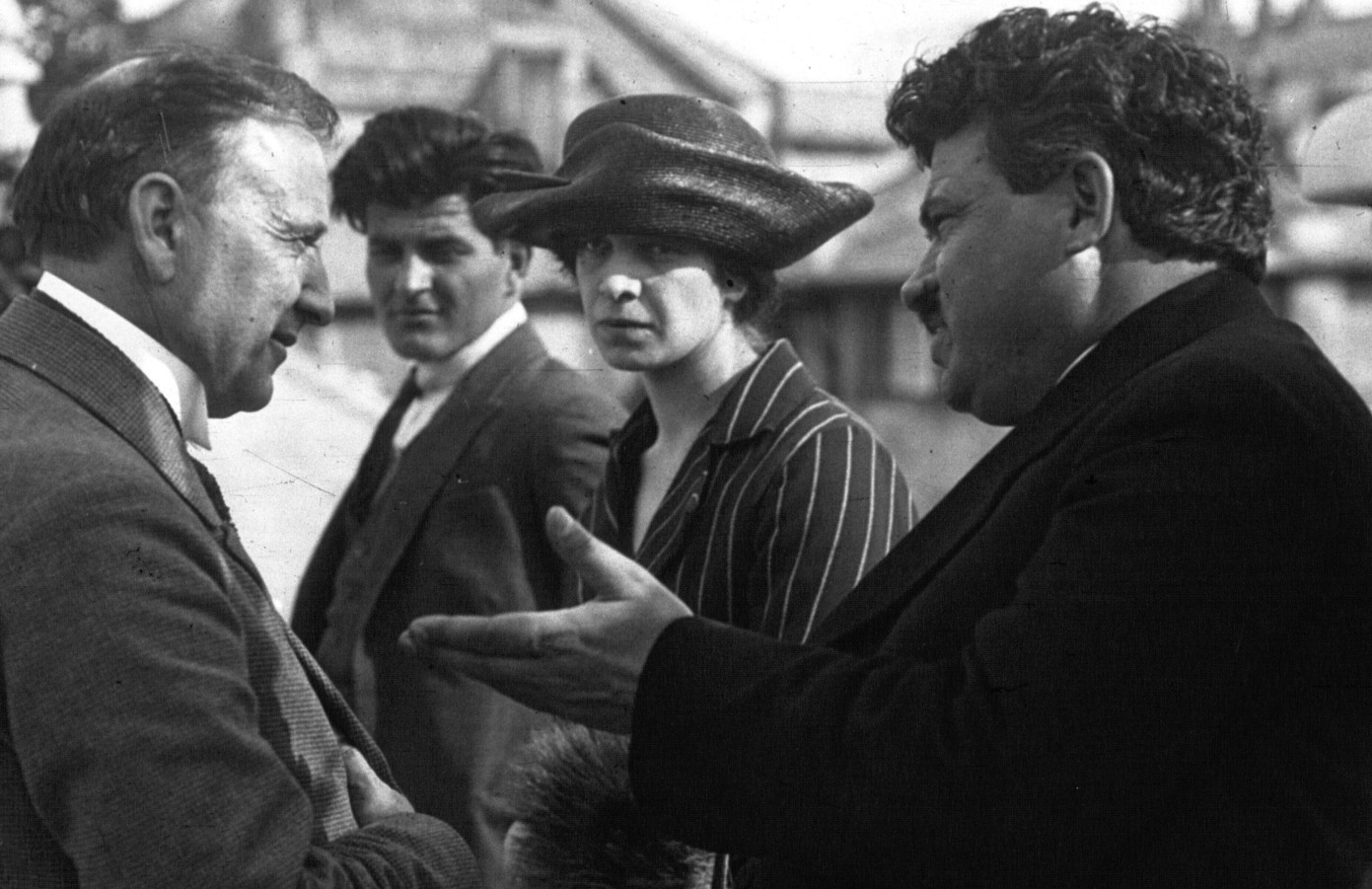
The crisis that would lead to the revanchist coup in June, 1923 was evident in Bulgaria the year before. Kabatchieff describes the majority view of the Communists in 1922, of the conflict between the Agrarian government of Aleksandar Stamboliyski and the emerging right-wing threat, all connected to the larger Balkan question of Macedonia and the multiple imperialist fingers, including Mussolini’s new dictatorship, stirring the pot.
‘Bulgaria and the Balkans’ by Christo Kabaktchieff from International Press Correspondence. Vol. 2 No. 89. October 17, 1922.
We already communicated with regard to the coup d’état in Bulgaria by the bloc of the bourgeois parties in alliance with the Wrangel generals and their troops. This coup d’état had for its object the overthrow of the present agrarian government and the placing of power in the hands of the old bourgeois parties in order to annihilate the Communist Party.
In order to prop up its domination which was unsettled by the war, the Bulgarian bourgeoisie entrusted power into the hands of the “left” parties, the Socialists, radicals and agrarians. The first two of these parties have long since been discredited and dismissed from power. Today, the Agrarian Party, which represents, the village bourgeoisie grown rich through the war is in the saddle.
This party still drags in its train hundreds of thousands of small and even propertyless peasants. After the city bourgeoisie and its parties had recovered their courage, they began to organize their forces, and today they wish to seize power again and to govern independently. They are discontented with the agrarian government, not only because it represents the interests of the village bourgeoisie, but in particular because it was unable to suppress the growing influence and power of the Communist Party, which in Bulgaria constitutes the actual and immediate danger for the bourgeoisie.
The first attempt of the bourgeois bloc at a coup d’état was frustrated by the mass-struggle of the workers and small and propertyless peasants organized by the Communist Party. Notwithstanding this, the agrarian government did not possess the courage to expel the Wrangel generals from the country, nor to disarm the Wrangel and white-guardist troops, nor the various officers’ and other organizations of the bourgeoisie.
Emboldened by these timorous and half-hearted measures of the agrarian government, the bourgeois bloc undertook a new campaign for the attainment of power, this time in the form of political demonstrations for the upholding of the “Constitution”, which were to have their commencement on the 17th of September in Tirnovo and were to be repeated in the course of October in Plovdiv and Sofia. The bloc of the old bourgeois parties which had been discredited during the war was unable however, to stir up the masses, and on the 17th of September it led to Tirnovo some thousands of reserve officers, bourgeois youth and other instruments in the pay of the bourgeoisie.
The agrarian government made use of this circumstance, and by the use of the police and various other paid bands, but mainly by taking advantage of the great bitterness of the village masses against the bloc parties, it delivered a severe blow to the bloc.
On the way to Tirnovo (a town in the centre of the country) the followers of the bloc were beaten and thrown out of the railway trains, the staff of the bloc, the former ministers were mishandled and narrowly escaped being lynched.
The agrarian government arranged a meeting (a sort of conference) in Tirnovo on the 17th of September, which decided that all ministers who conducted the wars of 1912-13 and 1918 should be brought up for trial. (It must be explained that the ministers who conducted the war of 1915 and 1918 have already had to stand before a national court of law which has been carrying on its proceedings for six months in Sofia.) The government arrested all these ministers–leaders of the bloc–and submitted a bill to Parliament by which the people will be consulted over the proceedings against these minsters.
The Communist Party throughout the whole country is engaged in a relentless struggle against the bloc. Recently the bloody collisions between the bloc and the party have increased. There were such collisions in Dubnitza, Gabrovo, Trevna and other places in which there were wounded and even killed on both sides. The party effectively repelled all these assaults. It took no part in the events of the 17th September. The party, however, had mobilized all its forces and was ready to throw itself decidedly against the bloc in the event of greater struggles, and if the supporters of the bloc had not already been defeated before their arrival in Tirnovo.
The Communist Party fights independently against the bloc which constitutes the bourgeois reaction and counter-revolution in Bulgaria. With this it does not cease to expose the timidity and the half-heartedness of the party of small land owners and to fight against the agrarian government which remains a government of the village bourgeoisie.
The Communist Party possesses a powerful influence over the small and propertyless peasant masses, which the agrarian party drags after it; it endeavours on the one hand to draw these masses from the influence of the agrarian party and to enroll them under its own banner, and on the other hand to push over to the left wing these small and propertyless village masses who still continue to follow the agrarian party. These leaders of the agrarian party and their government have been untrue to their promises and are losing the confidence of their adherents. While the Communist Party works in this manner it gathers round itself ever greater masses of the towns and villages and places before the agrarian party and its leaders the alternative: either to go towards the left, to accept the people’s judgment upon the leaders of the bloc as demanded by the Communists, to disarm the Wrangel followers and the bourgeois white-guard organizations, restrict profits, and so on, or they, the agrarian party and its leaders, will entirely lose their influence over the village masses, which masses will in their entirety go over to the camp of the Communist Party.
On the 17th of September the bourgeois bloc was defeated. It has abandoned the carrying on of any further political demonstrations for the upholding of the “Constitution”. Its officers’ leagues and other armed organizations continue to carry on their conspiratory preparations. The situation of the country remains critical The Communist Party is organizing mass meetings and demonstrations throughout the country in which thousands of workers and peasants take part (such meetings have already been held in Varna, Shumen, Vratza, Gorna-Dechumaya, and so on). At these meetings the demands of the Communist Party are put forward, such as: repudiation of the Peace Treaty and the reparations; higher wages for workers and the state employees; confiscation of the stores of provisions as a first necessity and their division by the municipality under the control of the workers’ and peasants’ organizations; disarming of the bourgeoisie and arming of the workers and propertyless peasants; for the peace and alliance with Soviet Russia.
In this manner the Communist Party prepares itself for the ever more imminent unchaining of civil war.
The defeat of Greece renders the situation in the Balkans more acute. The defeat is a defeat of the Greek national bourgeoisie; it is at the same time, however, a defeat of the policy of national conquest of the whole of the Balkan bourgeoisie.
The Greek government attempted to retain the home- coming troops on the Islands of the Aegean and Mediterranean seas in order to escape their rage and revenge. The troops, however, deserted the islands, occupied Salonika and Athens, dethroned Constantine, demanded the expulsion of the dynasty and the proclamation of a republic.
The national bourgeoisie again attempted to deceive the masses and the mutinous troops and to place at the head of the revolt the old criminal, the chief culprit in the national catastrophe, Venizelos.
The revolutionary wave is rising in Greece and is giving a powerful impulse to the Communist Party of Greece and is giving a powerful impulse the Communist Party of Greece, which is the only party no covered with the blood which has been so freely shed in Asia Minor, which has fought the war throughout, and whose leaders have been thrown into prison.
The defeat of bourgeois Greece and of imperialist England in the Near East effected a great change in the whole situation in the Balkans.
The Turkish army is approaching the Balkans. Turkey is becoming our neighboring state. The Entente is losing important positions in the Balkans. Greece, the hired tool of England, is also beaten.
The prospects of the revolutionary movement in the Balkans are bright. It is true that the Entente will make fresh attempts to make use of its vassals in the Balkans–the governments in Belgrade, Sofia and Bucharest–in order to fling them against Turkey. Notwithstanding, there exist the antagonisms between France and England on the one side, between Italy and Greece on the other, and then, the differences between Bulgaria and the Balkan states. All these constitute a hindrance to their warlike intentions.
If, however, the Balkan governments determine to embark upon such an insane adventure, they will not succeed in dragging the Balkan peoples along with them, to shed their blood for the imperialist aims of the European and Balkan bourgeoisie. Such a war will certainly be the beginning of great revolutionary movements in the Balkans, which will be directed towards accomplishment of the great object for which the Communist parties of the Balkans fight–the overthrow of the capitalist regime and the setting up of the Socialist Federative Soviet Republic of the Balkans.
International Press Correspondence, widely known as”Inprecorr” was published by the Executive Committee of the Communist International (ECCI) regularly in German and English, occasionally in many other languages, beginning in 1921 and lasting in English until 1938. Inprecorr’s role was to supply translated articles to the English-speaking press of the International from the Comintern’s different sections, as well as news and statements from the ECCI. Many ‘Daily Worker’ and ‘Communist’ articles originated in Inprecorr, and it also published articles by American comrades for use in other countries. It was published at least weekly, and often thrice weekly.
PDF of full issue: https://www.marxists.org/history/international/comintern/inprecor/1922/v02n089-x-supp-oct-17-1922-Inprecor.pdf

