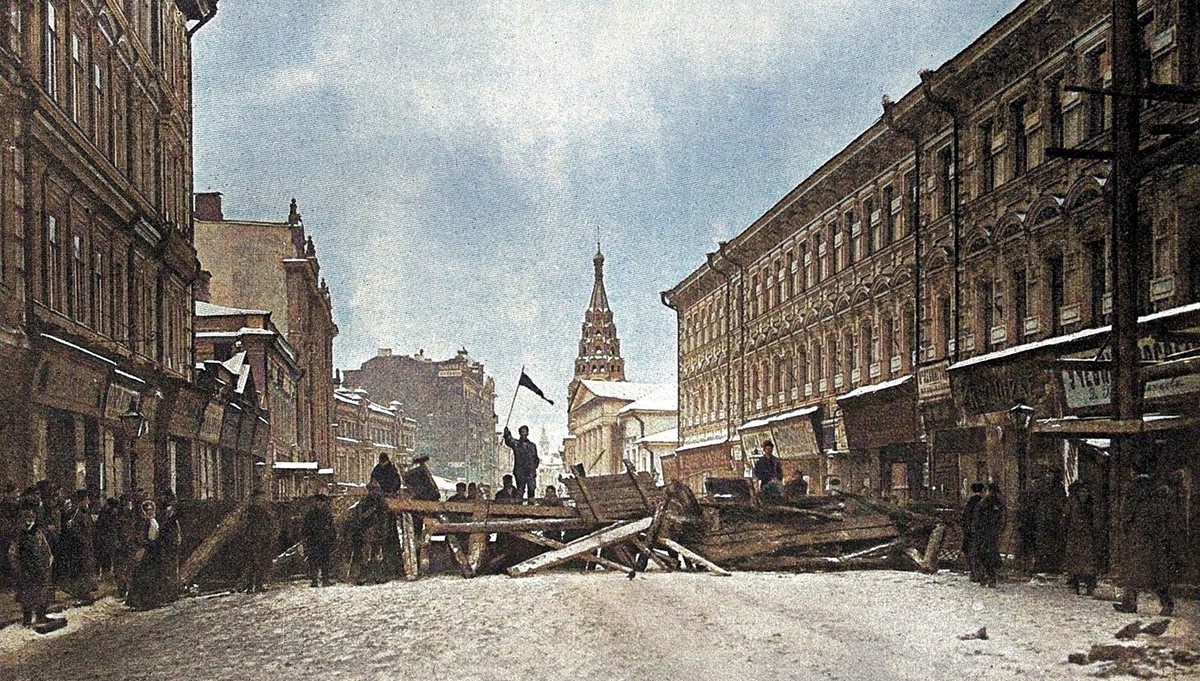
Lenin on the debate over ‘self-activity’ and ‘spontaneity’ that coincided with 1905’s Revolution throughout the Czarist Empire.
‘Two Tactics’ (1905) by Vladimir Ilyitch Lenin from Workers Monthly. Vol. 5 No. 11. September, 1926.
(From “Vperyod” No. 6, Feb. 1, 1905.)
FROM the very beginning of the mass labor movement in Russia, i.e., for about ten years now, there have existed deep-going differences among the social democrats on questions of tactics. As is known, there grew up out of differences of just this sort at the end of the nineties the tendency of economism, which led to the split into an opportunist wing of the Party (“Rabotcheye Dyelo”) and a revolutionary wing (the old “Iskra.”).
Russian social democratic opportunism differs from the West European in certain respects. It reflects very distinctly the views or perhaps the lack of independent views of the intellectual wing of the Party, captured by the now stylish slogans of Bernsteinism1 and by the immediate results and forms of the labor movement, pure and simple. This deviation has led to the epidemic betrayal of the legal Marxists who are drifting towards liberalism and to the invention on the part of the social democrats of the famous theory of “tactics as a process” which won for our opportunists the nickname of Khvostists (hanging on like a tail, “tailists”). They hung on helplessly to the tail of events; they swung from one extreme to another; they underestimated, in every case, the range of activity of the revolutionary proletariat and its faith in its own power glossing over all this generally with references to the self-activity of the proletariat. It is curious but it is a fact. Nobody talked so much as they about the self-activity of the workers and nobody so narrowed, so curtailed, so degraded this self-activity with their preaching as the people of the “Rabotcheye Dyelo”.
“Talk less about raising the activity of the working masses,” the conscious workers told their zealous but unwise advisers. “There is far more activity in us than you think. We even know how to support with open street fight demands that do not promise any tangible results. And it is not for you to raise our activity, for you haven’t enough activity for yourselves. Bow less, gentlemen, before ‘element-ariness’ and think more of raising your own activity.” Thus was it necessary to characterize the relation of the revolutionary workers towards the opportunist intellectuals. (Compare, “What Is To Be Done?”)
The two steps backwards, taken by the new “Iskra” in the direction of the “Rabotcheye Dyelo” put new life into this relation. From the pages of “Iskra” the preachings of Khvostism are again flowing, covered with such distasteful pronouncements as these: Ah, gentlemen, I believe in and preach the self-activity of the proletariat. In the name of the self-activity of the proletariat, Axelrod and Martinov, Martov, and Liber (from the “Bund”2) defended at the Party Congress the right of professors and students to become members of the Party without joining any Party organization.3 In the name of the self-activity of the proletariat was created the theory of “organization as a process” that justifies disorganization and praises intellectualist anarchism. In the name of the self-activity of the proletariat there was invented the no less famous theory of the “higher type of demonstration” in the form of an agreement of a workers’ delegation sifted through three elections with the people of the Zemstvos4 for a peaceful demonstration, without arousing panic fear. In the name of the self-activity of the proletariat the idea of the armed uprising was confused, vulgarized, debased, and perverted.
We want to draw the attention of the reader to this last question because of its everyday practical significance. The development of the labor movement has played a cruel joke on the wiseacres of the new “Iskra”. Their first message in which they, in the name of the “process of the systematic development of the class consciousness and self-activity of the proletariat,” recommended as a higher type of demonstration “the sending out of the statements of the workers to deputies at their houses thru the mail and their distribution in halls where the Zemstvos held their sessions,” this message of theirs hardly succeeded in being distributed in Russia; a message in which there was made the quite upsetting discovery that in the present “historical moment the political scene is filled with the quarrels between the organized bourgeoisie and the bureaucracy,” and that “the objective sense of every (hear, hear!) revolutionary movement is one and the same and will lead to the support of the slogans of that one of the two forces which is interested in breaking down the present regime (these democratic intellectuals are proclaimed as a “force”). Hardly had the class conscious workers succeeded in reading these magnificent letters and having a good laugh at them–when the events of the actual struggle in one clean sweep dumped on the rubbish heap all this political trash of the editors of the new “Iskra”. The proletariat showed that there was a third force (in reality, of course, not a third, but a second according to figures and a first in fighting ability) which is not only interested in this breakdown but is also ready to go out and actually break down absolutism. Beginning with the ninth of January the workers’ movement has actually been growing before our eyes into a popular rebellion.
Let us see how this transition to rebellion was estimated by the social democrats who discussed it before as a question of tactics–now that the workers have begun to decide this in practice.
Three years ago the rebellion which defines our next practical tasks was discussed as follows: “Let us picture to ourselves a popular rising. At the present time, perhaps, all will agree that we must think about it and prepare ourselves for it. But prepare how? Perhaps the Central Committee should appoint agents in all localities to prepare the uprising. If we really had a Central Committee it could not accomplish anything thru such appointments under the present conditions in Russia. On the contrary a network of agents arising in the process of work through the organization and distribution of a general paper could not ‘sit and wait’ for the slogan of rebellion but had to do its regular work which would guarantee the greatest likelihood of success in case of rebellion. Precisely this work would strengthen the connections both with the broadest masses of the workers and with all elements dissatisfied with absolutism, a thing that is so necessary for the uprising.
“Just in precisely such work is developed the ability to estimate correctly the general political situation and, in consequence, the ability to select the proper moment for the rebellion. Precisely this work would teach all local organizations to react at the same time to the same political questions, events and happenings that are agitating all Russia, to respond to these events in the most energetic way possible, as uniformly and systematically as possible, for the rebellion, is, in reality, the most energetic, the most uniform, and most expedient answer from the whole people to the government! Precisely such work, finally, would teach all revolutionary organizations in all corners of Russia to keep up the most constant and, at the same time the most secret connections, creating the actual unity of the party, and without such connections it is impossible to work out in common the plan of the rebellion and take all the necessary preparatory steps for it, which must all take place in the utmost secrecy.
“In a word, ‘the plan of an All-Russian paper’ is not only not the result of the office work of people afflicted with doctrinarism and literateurism (as it seemed to people with muddled ideas) but, on the contrary, it turns out to be the most practical plan to begin, from all sides and at once, the preparation for the rebellion, at the same time not forgetting for a minute one’s everyday party work.” (“What Is To Be Done?”)
These last words, which we have emphasized, give a clear answer to the question how the revolutionary social-democrats pictured to themselves the preparations for the revolt. But, however clear this answer was, the old Khovtist tactics could not get away from it even on this point. Not long ago Martinov published a pamphlet, “The Two Dictatorships” warmly endorsed by the new “Iskra” (No. 84). The author is agitated to the depths of his Rabotcheye Dyellst heart that Lenin could talk about the “preparation,” the designing, and the carrying out of the armed uprising of all the people. The terrible Martinov scolds his enemy thus: “International social-democracy has always, on the basis of historic experience and scientific analysis of the dynamics of social forces, recognized that only palace revolutions and pronunciamentos can be arranged beforehand and carried out successfully according to a ready-made plan, and these can be just because they are not people’s revolutions, i.e., not changes in the social relations, but only disturbances in the governing clique. Social-democracy has everywhere and at all times recognized that a popular revolution cannot be arranged beforehand, that it is not prepared artificially, but accomplishes itself.”
Perhaps the reader will say, after reading this tirade, that Martinov is not a serious antagonist and it would be ridiculous to take him earnestly. We would wholly agree with such a reader. We would tell him that there is no worse torment on earth than to take seriously all theories and all arguments of our “New Iskraists.” The pity is that such nonsense should figure even in the editorials of “Iskra” (No. 62). And it is still more a pity that there are people in the Party and not a few of them who litter their minds with that nonsense. And it is necessary to speak about non-serious things as we had to talk about the “theory” of Rosa Luxemburg,5 who invented the “process of organization.” We must explain to Martinov that he should not confuse rebellion and popular revolution. It must be explained that profound reference to the change in social relations in connection with decisions about the practical question of the means of overthrowing Russian czarism, are worthy only of a Kifa Mokievitch6 These changes already began in Russia with the overthrow of serfdom in 1861, and the very backwardness of our political superstructure in regard to the change which has been going on in social relations makes the crash unavoidable. Besides, this crash is quite possible at once, at one blow, because the popular revolution has already struck hundreds of blows at czarism, and whether it will be felled by the hundred and first or hundred and tenth blow is not known to us. Only opportunist intellectuals who try to blame their philistinism on the proletarians can, at a time when the practical methods of striking a blow of the second hundred, come out with their student’s wisdom about “the change in the social relations.” Only the opportunists of the new “Iskra” can cry hysterically about the terrible “Jacobin” plan, the center of gravity of which lies, as we have seen, in an every-sided mass agitation with the help of a political paper.
It is true that a people’s revolution cannot be made to order. But for the knowledge of this truth you need not thank Martinov and the author of the editorial in No. 62 of “Iskra” (“Yes, and of what preparations for a rebellion can there be a question at all in our party” he asked there, fighting with the Utopians, a true companion and follower of Martinov). But to design a rebellion, when we have actually prepared it and when a popular revolution is possible through the force of the changes taking place in the social relations this is quite realizable. Let us try to make it plain to the people of the new “Iskra” with a simple example. Is it possible to design the labor movement? No, it is not, because it is a composition of thousands of separate acts, caused by changes in social relations. Is it possible to design a strike? Yes, in spite of imagine to yourself, Comrade Martinov–in spite of the fact that every strike is a result of the change in social relations. When is it possible to design a strike? When the organization or circle which designs it has influence among the masses of workers concerned and is able to estimate correctly the moment of growing discontent and irritation in the masses of workers. Do you now understand what it is all about, Comrade Martinov and the comrade of the leading article of No. 62 of “Iskra”? If you understand, take the trouble to compare the rebellion with popular revolution. “Popular revolution cannot be designed befor hand.” The rebellion can be designed when those who design it have influence among the masses and are able to estimate the moment correctly.
Luckily, the initiative of the advanced workers ran ahead of Khvostist philosophy of the new “Iskra.” During the time that the Iskra has sweated out the theory proving that a rebellion cannot be designed by those who prepare themselves for it through organizing the vanguard of the revolutionary class, events have proved that the rebellion can be designed and must be designed by people even when they are not prepared for it.
Here is a proclamation sent us by a Petersburg comrade. More than 10,000 copies were set up, printed, and distributed by the workers themselves, who on January 10 had captured a legal printing shop in Petersburg.
“WORKERS OF THE WORLD, UNITE!
“CITIZENS:
“Yesterday you witnessed the brutality of the absolutist government. You saw blood flowing in the streets. You saw hundreds of fighters for the cause of the workers killed; you saw death; you heard the groans of wounded women and defenseless children. The blood and the brains of the workers spattered the pavement which was made by their own hands. Who directed the troops, the rifles and the bullets against the breasts of the workers? The Czar, the grand dukes, the ministers, the generals and the trash of the court.
“They are the murderers. Death to them! To arms, comrades, seize the arsenals, the munition supplies, and the rifle stores. Throw open the jails, comrades, set free the fighters for liberty. Smash to pieces the gendarmerie and police centers and all crown institutions. Let us overthrow the czarist government, let us establish our own government! Long live the revolution! Long live the Constituent Assembly of the Representatives of the People!
“Social Democratic Labor Party of Russia.”
The call to rebellion by this little group of advanced workers who took the initiative, was without success. But a few unsuccessful calls to rebellion and unsuccessful “designs of rebellion” do not surprise or discourage us. We leave it to the new Iskra to philosophize about the necessity of “the change in social relations” and scorn from on high the “utopianism” of the workers, who cry: “Let us establish our own government.” Only hopeless pedants or confusionists can see the center of gravity of such a proclamation in this cry. For us it is important to take note of and emphasize this wonderful, brave, practical approach to the solution of the problem which stares us in the face. The call of the Petersburg workers was not realized and could not be realized as fast as they had hoped. This call will be reiterated and not only once, and the attempts at rebellion may again be unsuccessful, more than once. The gigantic importance of it lies in the fact that this question was raised by the workers. The gain for the workers’ movement, which has become conscious of the practical importance of this task and will raise it at every popular movement in the future this gain can no longer be taken from the proletariat.
As early as three years ago the social-democrats on general considerations raised the slogan of the preparation for the rebellion. The self-activity of the workers arrived at the same slogan under the influence of the direct lessons of the civil war. There is self-activity and self-activity. There is the self-activity of the proletariat with revolutionary initiative, and there is the self-activity of the undeveloped proletariat, beset by obstacles; there is self-activity consciously social-democratic and there is Subatovist7 self-activity. There are social-democrats who even at this moment speak with reverence of the second kind self-activity, who think that you can avoid a straight answer to everyday questions by reiterating innumerably the word “class.” Take No. 84 of “Iskra” “Why,” the leading article writer of the Iskra attacks us with the air of a conqueror, “why was it not the narrow organization of professional revolutionists that gave the impetus to the movement of this avalanche (of January 9), but a conference of workers? Because the conference was really (hear!) a broad organization, based upon the self-activity of the working masses.” If the author of this classic phrase were not an adorer of Martinov, he could perhaps understand that the conference served the movement of the revolutionary proletariat just for the reason and to the extent that it passed from the Subatovist self-activity to social democratic self-activity (after which it also ceased to exist as a legal conference.)
If the people of the new “Iskra” and of the “Rabotcheye Dyelo” were not Khvostists they could see that it was precisely the ninth of January that justified the prediction of those who said: “In the end the legalization of the workers’ movement will bring advantage to us and not to the Subatovs (“What Is To be Done?”).” It was precisely the ninth of January that showed once more the importance of the task formulated there: “Prepare reapers who can reap even the tares of today (i.e., paralyze the present Subatov corruption) and harvest in the wheat of tomorrow” (i.e., direct in a revolutionary way the movement that takes a step forward with the help of the legalization.) And the fellows on the “Iskra” refer to the splendid crop of wheat only in order to depreciate the importance of a strong organization of revolutionary mowers.
“It would be criminal,” the leading article writer of the new “Iskra” continues, “to attack the revolution from behind.” What this phrase is supposed to mean, Allah only knows. On the question of what connection it may have with the opportunist physiognomy of “Iskra” we will perhaps speak another time. It is enough now to point out that the real political sense of this sentence is this: The author bows before the rear of the revolution, with a contemptuous frown for the “narrow” and “Jacobin” advance guard.
The tactics of the Khvostism and the tactics of revolutionary social-democracy, come into contradiction the more clearly, the more eagerly the new “Iskra” writes in the spirit of Martinov. We said already in No. 1 of “Vperyod” that the rebellion must unite with one of the elementary movements. Consequently we are not at all underestimating the importance of the “protection of the rear,” to use the military comparison. We spoke in No. 4 about the correct tactics of the members of the Petersburg committee, who directed all their efforts from the very beginning to supporting and developing the revolutionary elements of the elementary movement, with a reserved, sober relation towards the dark, Subatovian rear of this elementary movement. We will close today with a piece of advice which we are compelled to give once more to the people of the new “Iskra”: Do not degrade the task of the advance guard of the revolution, do not forget our obligation to support this advance guard with our organized activity. Utter fewer general commonplaces about developing the self-activity of the workers–they are showing a range of revolutionary self-activity you do not notice. And see to it that you do not corrupt the undeveloped workers with your own Khvostism.
NOTES
1. Edward Bernstein had begun his “revision” of Marxism before the beginning of the century and the Russian “economists,” later the Mensheviks made use of his arguments against the Bolsheviks.
2. Axelrod is still alive as an ardent opponent and slanderer of the Bolsheviks. Martinov admitted and criticized his errors several years ago and has joined the Communist Party. Martov died some years ago in Berlin as the editor of the Menshevik organ there, which provided “arguments” against the Russian revolution for the Mensheviki of all countries. Liber, a Menshevik leader, belonged at that time to the Jewish Band, which opposed the Social Democratic Party on the principle of not allowing the existence of national federations and which remained outside the party until 1919.
3. The question of professors joining the party without joining any party organization refers to the controversy about Paragraph 1, in the Party Statute of 1903.
4. The Zemstvos were a kind of country organization, a substitute for self-government, controlled by liberal landlords and bourgeois intellectuals, who used them for a feeble opposition to czarism. Lenin ridicules the Mensheviks who recommended proclamations in the Zemstvo meetings when the workers were already demonstrating and fighting on the streets.
5. Rosa Luxemburg, although a radical in Germany, a critic of the deviations of Kautsky and Bebel, did not understand the necessity for a strongly organized and centralized party in Russia and did not agree with Lenin on all points.
6. Kifa Mokievitch is a literary figure in a fable, a stupid man.
7. Subatov was a czarist official who started the czarist “Workers’ Societies” which were penetrated by the revolutionaries.
The Workers Monthly began publishing in 1924 as a merger of the ‘Liberator’, the Trade Union Educational League magazine ‘Labor Herald’, and Friends of Soviet Russia’s monthly ‘Soviet Russia Pictorial’ as an explicitly Party publication. In 1927 Workers Monthly ceased and the Communist Party began publishing The Communist as its theoretical magazine. Editors included Earl Browder and Max Bedacht as the magazine continued the Liberator’s use of graphics and art.
PDF of full issue: https://www.marxists.org/history/usa/culture/pubs/wm/1926/v5n11-sep-1926-1B-FT-80-WM.pdf

