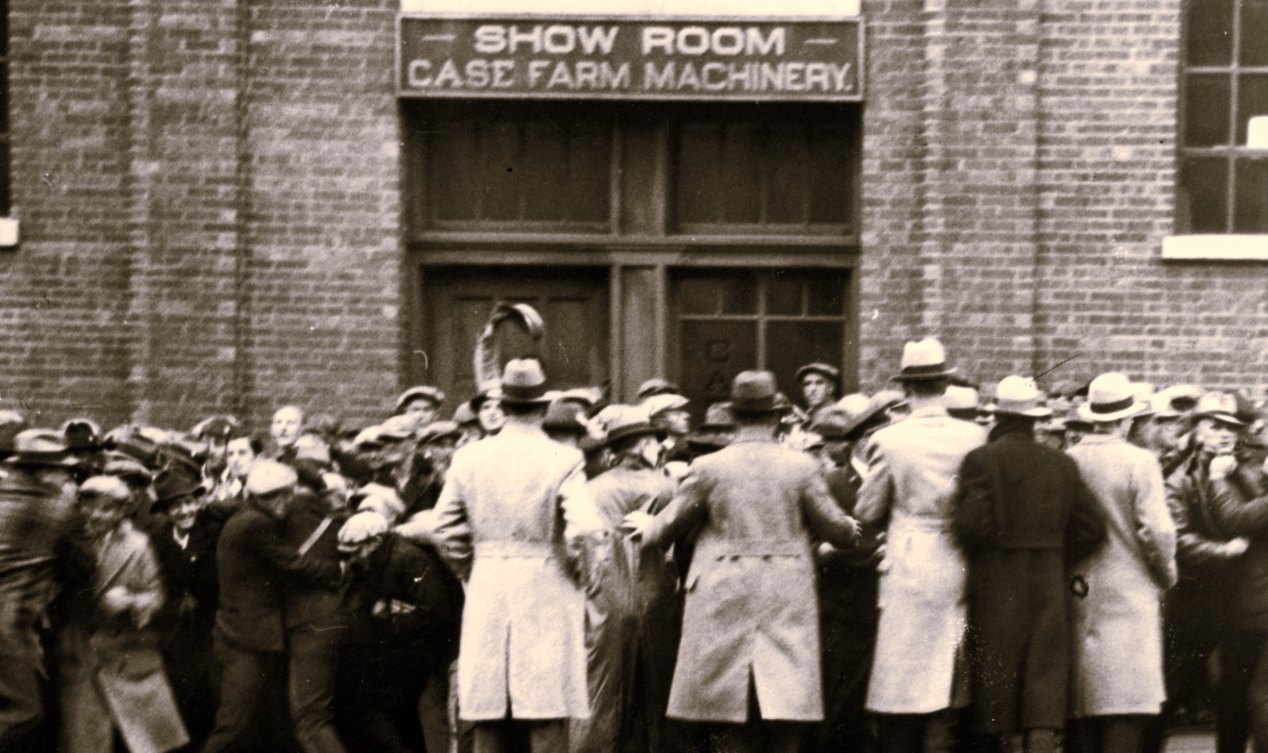
Strikes and unemployed protests in the normally quiet town of Racine sees the ever-present, if sometimes latent, fascism in the United States emerges with attacks on labor halls and the whitecapping of organizers.
‘Terror in “Liberal” Wisconsin’ by Paul Romaine from New Masses. Vol. 14 No. 2. January 8, 1935.
MILWAUKEE. IN THE first week of December a reign of terror against the workers of Racine, Wisconsin, began that has shown no signs of abatement to date. The acts of fascist violence have been directed against the working-class organizations in general and the Communist Party in particular.
This terrorism has been unleashed because of a whole series of successful struggles for relief waged by the employed and unemployed together. These organized demonstrations and protests have been led by such varied groups as the militant Wisconsin Emergency Relief Administration Workers (W.E.R.A.); Unemployment Council; Unemployed Workers’ Committee of Action; and the Communist Party.
Events leading directly up to the terror were the Horlick strike; the occupying of the relief station by the unemployed for more than three hours; the packing of the seventh floor of the Court House by the workers to present their demands for increased relief to the County Board; later, the removal of a door by the workers in order to get into these same chambers; and finally a picket line, four blocks long, that demonstrated at the Court House and paraded along Main Street to the relief station. The demands presented were very immediate and broad ones to which every worker subscribed.
Racine is a city of about 67,000 and is controlled by Horlick’s, the First National Bank, Nash, J.I. Case and other similar corporations. Mayor Swoboda is an ex-Socialist and one of his principal pastimes is putting on sham battles with Chief of Police Lutter.
The bosses answered the growing militancy of the workers by organizing a “Vigilantes Committee” with the help of the police, American Legion officials and a few high-priced union chair warmers. The committee’s first step was to announce in its own name and that of the American Legion that it would “drive the reds out of town by physical force.” They then raided the headquarters of the Racine section of the Communist Party at 900 State Street. The doors were torn down, furniture smashed, papers, etc. taken and destroyed and the headquarters wrecked generally. Meetings protesting against the raid, several held in public schools, were broken up. Many of the meetings were not sponsored by the Communist Party but by other workers’ organizations.
The Chamber of Commerce now began publicly demanding a fascist terror against the Communist Party and all militant workers, through its mouthpiece, The Racine Journal-Times, supported by Horlick. The Bar Association of Racine County, headed by large corporation lawyers, issued a long statement demanding that “radicals” (class-conscious workers) be tried under criminal-syndicalism charges-pointing out the existing statute that could be used for this purpose, since there is no criminal-syndicalism law in Wisconsin, a “liberal” state.
The Communist Party immediately re-established its office in the same building and arranged for a large protest meeting Dec. 8. Many workers’ organizations were to be represented and a delegation of liberals (including a minister) and members of the Milwaukee branch of the League Against War and Fascism went to Racine. Lutter, the police chief, had vowed that not another meeting of “the Communists” would take place in Racine and he persuaded the landlord to refuse the use of the hall which had been rented. The meeting was held in another hall.
Then the headquarters of the Communist Party were stoned and windows smashed by hooligans. The police made no efforts to catch the hoodlums merely announcing that they were “looking for them.” The League Against War and Fascism organized a protest meeting that was addressed by liberals, Socialists and Communists. The police chief said he had “been caught napping” but repeated that no further meetings would be held.
The Racine local of the Socialist Party and the Central Trades Council wasted no time in issuing statements and protests against this terrorism. The essence of their statements was that though they did not agree with the political line of the Communist Party, etc., they protested against the tactics of the vigilantes against the Communist Party and workers in general. Because of the tremendous rank and file sympathy in the Socialist Party and in the unions for the Communist workers, sympathizers, etc., there was little else for the leaders to do. Moreover, it seems the lessons of Germany and Austria have begun to sink into the heads of the more sincere leaders of some of S.P. locals.
On Dec. 13, in the morning, Sam Herman, one of the Communist Party organizers of Racine, was kidnaped from a busy street by two gangsters and driven to the outskirts of the town, where he escaped after a bloody beating. A witness stated that, “Two policemen saw everything that went on when he was kidnaped downtown and never did a thing.”
Herman asked the gangster holding him in the back seat if he was a police officer and received the reply, “Don’t ask me anything or I’ll smash your face in.” They asked him where Sekat lived. (Sekat is section organizer of Racine and out on bail in connection with the Horlick strike, in which he was framed-up.) Herman refused to answer. “Sekat is in for the same thing you are going to get,” the kidnaper said.
The following night a meeting was held in Sokol Hall, attended by workers of all parties and organizations. It met to protest the attack on Herman, to take action in his defense, and to combat the general fascist activities in Racine. Suddenly the windows in the hall were shattered by rocks. The workers ran outside, saw two hooligans running toward a waiting car, and ran after them. As they closed in on the hoodlums a squad of police rushed out of the darkness of a side street and began pummelling and tackling the workers in football fashion. Meanwhile, the rock throwers escaped.
Herman went to the district attorney’s office and was signing John Doe warrants for the arrest of his kidnapers when he was arrested at the instigation of Lutter on the charges of “criminal libel.” These charges are based on the statement of Herman issued to the press: “I openly charge that Chief of Police Lutter, has knowledge of and was one of the organizers of this attack by the underworld element who kidnaped me on State Street yesterday before noon…If anything happens to me he will be the guilty one…This is the Merry Christmas that Lutter has prepared for the unemployed: a Merry Christmas of terror. The struggle will go on, as such fascist terror has never in history succeeded in stopping courageous fighters and their movements from carrying on.”
This is a portion of the statement Lutter called, “belligerent and false.” Herman’s bail was set at $2,500.
During an investigation now being made by certain individuals from Milwaukee into the gangster-police-Legion-Mayor-Big Business tie-up in Racine a legionnaire under questioning admitted that the only “violent” action he could think of the “Reds” committing was their taking the door of the council chambers off its hinges, as mentioned earlier in this article.
Hundreds of protests have poured in on Mayor Swoboda, the Fire and Police Commission, Chief of Police Lutter and Gov. Schmedeman. Several delegations have gone to Racine from Milwaukee and a student and professional delegation is being organized at the University of Wisconsin by the N.S.L. and the L.I.D. to present protests personally.
The terrorism since Herman’s kidnapping has continued. Workers have been arrested and intimidated; the store windows of two of Herman’s bondsmen have been smashed, but as Herman stated, “The struggle will go on, as such fascist terror has never in history succeeded in stopping courageous fighters and their movements from carrying on.”
The New Masses was the continuation of Workers Monthly which began publishing in 1924 as a merger of the ‘Liberator’, the Trade Union Educational League magazine ‘Labor Herald’, and Friends of Soviet Russia’s monthly ‘Soviet Russia Pictorial’ as an explicitly Communist Party publication, but drawing in a wide range of contributors and sympathizers. In 1927 Workers Monthly ceased and The New Masses began. A major left cultural magazine of the late 1920s and early 1940s, the early editors of The New Masses included Hugo Gellert, John F. Sloan, Max Eastman, Mike Gold, and Joseph Freeman. Writers included William Carlos Williams, Theodore Dreiser, John Dos Passos, Upton Sinclair, Richard Wright, Ralph Ellison, Dorothy Parker, Dorothy Day, John Breecher, Langston Hughes, Eugene O’Neill, Rex Stout and Ernest Hemingway. Artists included Hugo Gellert, Stuart Davis, Boardman Robinson, Wanda Gag, William Gropper and Otto Soglow. Over time, the New Masses became narrower politically and the articles more commentary than comment. However, particularly in it first years, New Masses was the epitome of the era’s finest revolutionary cultural and artistic traditions.
For PDF of full issue: https://www.marxists.org/history/usa/pubs/new-masses/1935/v14n02-jan-08-1935-NM.pdf

