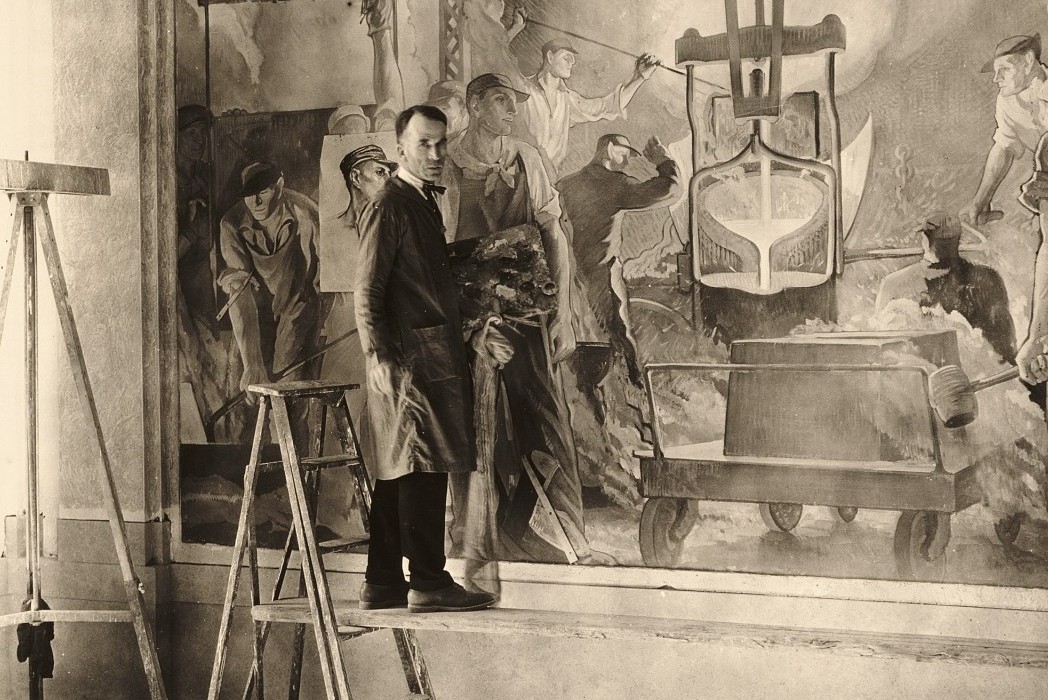
The capitalist propaganda and banal artists invariably attending most large public art projects in the U.S.
‘Mural Painting in America’ by Stephen Alexander from New Masses. Vol. 14 No. 9. February 26, 1935.
BY common definition a mural painting is “a painting on a wall.” From the viewpoint of broad classification it is distinguished from other forms of painting by its size and location. But these qualities do not in themselves serve adequately to differentiate mural from easel painting. There are easel paintings which are as large or larger than many mural paintings, yet are essentially easel pictures. The essential difference consists not in size and scale, but in the public character of the mural.
In the past, and particularly during the Renaissance in Italy when it had its most widespread development, the mural was associated predominantly with public buildings where it glorified the ruler of the day and served the Church as a vehicle for religious propaganda. The recent Mexican mural movement, was almost entirely a public institution, devoted to the dissemination of social ideas. But during the last few years of American capitalism the mural has been subjected to multiple abuse.
To begin with, the public character of the mural has been perverted; under our system of private property individuals have segregated the mural from the public. Since only the wealthy can afford to own murals they are shaping the mural character either directly by dictating the subject-matter or indirectly by selecting an artist who will “out of his own choice” produce the kind of painting desired. This latter method is most effective in moulding the artist, because the nature of the process is hidden by the capitalist market.
The second abuse consists in the capitalist class’ utilization of the mural for its own propaganda in public and semi-public places. Ranging from such blatant stuff as Arthur Covey’s “Worcester War Memorial” (in the recent exhibition at the Grand Central Galleries), a typical example of the romanticization of war for profits, under the guise of patriotism, this propaganda includes paintings which paint forthright lies glorifying Big Business, such as Dunbar Beck’s decorations for the Ever-Ready Label Corporation. Beck’s work deserves examination, since it typifies one of the ways in which business uses art. The Ever-Ready Label Corporation announced a competition for these decorations, one of the obligatory themes being “The Loyalty of Labor to Industry.” Beck delivered the goods, and handsomely. A horizontal panel, divided into three sections; on the left, “Unemployment,” depicted by several huddled figures; on the right, “Strikes” with some fiendish-looking fellows doing the striking; in the center, two fine upstanding men, one a worker and the other “Industry,” shaking hands like good democratic fellows, while God with a white beard (or maybe it’s the old man “Loyalty” in this case) banishes both “Unemployment” and “Strikes.” And so capital and labor get together and solve that nasty bad depression.
Other painting typical of capitalist propaganda finds expression in school book versions of history. Benton’s Indiana mural may not be as saccharine in form as the above two cases but his American history is just as false an idealization. Then there is a large category of work which totally evades the social responsibility of the mural painter. Finally, by virtue of its ownership of the public walls the capitalist class exercises a censorship which is all the more effective because it operates under the cover of “free choice.” Artists who worked for the P.W.A. were in most instances told to choose their own subject, but when a certain Philadelphia artist decided to carry out a revolutionary theme he was viciously attacked; and when Paul Cadmus painted a politically-innocent portrayal of some sailors “on shore leave” the Admirals rose in high dudgeon and denounced his slander of their navy, refusing to permit his sacrilege in the group exhibited in Washington, D.C. Artists working on the C.W.A. mural projects know how much chance an artist has of doing a painting of even faintly-revolutionary meaning. Only when an event like the destruction of the Rivera mural by Rockefeller becomes public does one get a chance to observe the workings of this subtle capitalist censorship.
The hysterical cry of “propaganda” by the capitalist at the sight of revolutionary art is of course merely an attempt to cover up the fact of his own propaganda.
The New Masses was the continuation of Workers Monthly which began publishing in 1924 as a merger of the ‘Liberator’, the Trade Union Educational League magazine ‘Labor Herald’, and Friends of Soviet Russia’s monthly ‘Soviet Russia Pictorial’ as an explicitly Communist Party publication, but drawing in a wide range of contributors and sympathizers. In 1927 Workers Monthly ceased and The New Masses began. A major left cultural magazine of the late 1920s and early 1940s, the early editors of The New Masses included Hugo Gellert, John F. Sloan, Max Eastman, Mike Gold, and Joseph Freeman. Writers included William Carlos Williams, Theodore Dreiser, John Dos Passos, Upton Sinclair, Richard Wright, Ralph Ellison, Dorothy Parker, Dorothy Day, John Breecher, Langston Hughes, Eugene O’Neill, Rex Stout and Ernest Hemingway. Artists included Hugo Gellert, Stuart Davis, Boardman Robinson, Wanda Gag, William Gropper and Otto Soglow. Over time, the New Masses became narrower politically and the articles more commentary than comment. However, particularly in it first years, New Masses was the epitome of the era’s finest revolutionary cultural and artistic traditions.
PDF of full issue: https://www.marxists.org/history/usa/pubs/new-masses/1935/v14n09-feb-26-1935-NM.pdf

