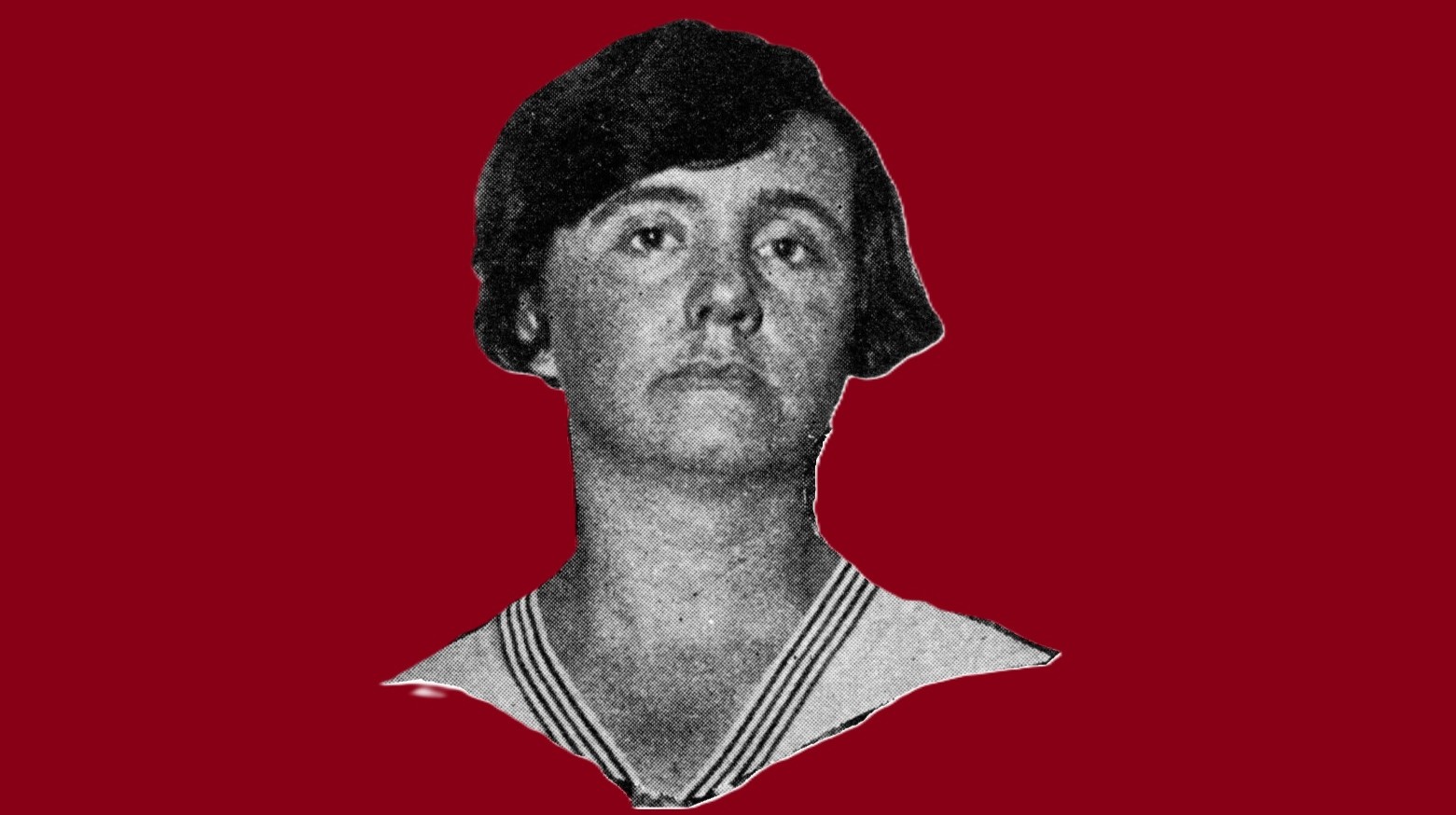
A leading participant of the 1926 strike in the New Jersey mill town, returns to the city and its class struggle eight years later, particularly reflecting on the role of the Communist Party, which she was a member of in ’26 and an opponent of in ’34.
‘Passaic Eight Years Afterward’ by Vera Buch from Class Struggle (C.L.S.). Vol. 4 No. 8. August, 1934.
It is interesting indeed to revisit a city one knew long ago, especially when that city is one which was the scene of such a profound and all embracing labor drama as the Passaic strike. One gets for a moment an entirely erroneous impression that time stands still, as the old streets, the mills, the old faces reappear scarcely changed. A few wrinkles in the foreheads of the old fighters, the children we use to feed in the soup kitchens of the women’s Councils coming in to the headquarters now as members of this or that adult organization. But these are trivial things.
The most striking symbol of the change of eight years is a sign on a prominent window on Main Avenue, in the very heart of the town, just a few doors from where the strike headquarters was in 1926: “Khaki Shirts of America; U.S. Fascist”. Here, not so long ago, an effort was made to rally the unemployed and many italian workers came around. But the only program was to send a telegram to Roosevelt about the C.W.A. jobs, and since nothing was accomplished and no organization built, the workers fell away. Some of these Italian workers are now joining the Workers Unemployed Union. Fascism is springing up too in another section of the city, and meetings of several hundreds have been held among the Germans in Neubauer’s Hall. A fertile ground for the fascist seed is the German population which from the beginning was favored by the German bosses of the mills, getting all the best jobs in the mill and the steady jobs in time of depression. It was this section that furnished most of the scabs in 1928, as well as some good fighters. But, Julius Forstmann, so we are told, has given orders that anyone employed in his mills joining the Fascist ranks is to be immediately thrown out of his job, and thirty odd have already been fired. Forstmann anti Fascist? No, but the firms handling his cloth are composed of Jews, and you know how business is these days.
In the days of the strike, there were language societies around which the workers flocked, lodged then for the most part in plain wooden houses. Now the Polish national Home, the Russian National Home, have fledged out in magnificent big brick buildings, equipped inside with every possible convenience—pool rooms, bars, lounging rooms, dance halls, etc. And in this change a certain evolution—far from a progressive one, of the working population stands out. Small business men and foremen form the core of those language societies and support them financially. The workers join to have support, to get a job, for protection, in other words. Some years ago, the Communists had fractions in these groups powerful enough to sway the policy but such fractions have now disappeared, and the middle class red-baiting patriotic elements and the church are now in full control. Thus the language society, like the American fraternal orders, becomes a most efficient vehicle of class collaboration.
The dingy streets, the squalid tenements, are unchanged. Passaic is a typical drab mill-town, typical especially of the life of the foreign born in America, who came here two or three decades ago with signs on their chests “Botany”, “Gera” and were herded from New York out to spend their lives working in those mills. It has not changed, this worker’s life in which the mill, the church, the bedroom, forced a monotonous triangle. But now over all hovers the crisis, the unemployment, like a great crushing weight. The woolen mills are working from 10 to 20% of capacity on a stagger system. A few favorites only work steadily and the majority of the workers get two or three days work in the month. The rubber mills are considerably more active, but they also are not up to capacity, nor can they absorb more than a small fraction of the unemployed. The parks are crowded with the permanently unemployed who have degenerated into chronic card players. The youth in the factories scoff at a union leaflet, or hang around the street corners, as everywhere. Since the YCL and the YPSL have failed to take any impression on them for whose mill will they become grist?
The relief in New Jersey is on a disgracefully low level. The food ticket system prevails with all its humiliations and inconveniences. The amount averages around a dollar per person in a family. Rents are paid when an eviction takes place and the family is shoved around from pillar to post finding new quarters. Under nourishment and sickness are rife. On top of this the State N.R. A. instituted a work relief system whereby the head of the family receiving the food ticket is called out to work on city projects for a few days or a week per month until he has worked out the amount of the relief received. Fifty cents of his “earnings” per hour go to pay off the relief, and in addition he is handed the magnificent cash “bonus” of 10 cents an hour! No wonder, when the Workers Unemployed Union, with Sam Fisher as organizer, called a few meetings for the project workers, the response was almost 100% and a strike vote was readily taken. The strike cleaned out the projects and the workers rallied in large numbers to our headquarters.
The strikes against the work relief have been general throughout New Jersey. In Passaic and Paterson they were called by the Workers Unemployed Union, but in most sections they were spontaneous walk-outs which local conservative elements were able to get control. Nevertheless, they have been so effective that the State has decided to go on cash relief (the main demand of the strikers) although the actual putting into effect of this measure was held up for a time.
The role of the Communist Party in the situation has been such that certainly the ruling class and their agents must have sat back and laughed, and congratulated themselves that hired agent provocateurs have become superfluous in the workers’ movement with these people around. In Passaic the Unemployment council had been, as everywhere else, dead, after a feeble spurt of activity when the CWA was ended. The strike in Passaic was, as we have said, called and organized by the Workers Unemployed Union (affiliated with the Passaic Valley Organization Committee) and the organizer, Sam Fisher, was a member of the Communist League of Struggle. Seeing an efficient organization being built up, the Stalinists enter upon their usual role. Herbert Benjamin (he of the aeroplane “hunger” flight to Washington a couple of years ago) swoops down upon Passaic armed with a squad of “organizers” and bushels of leaflets. Meetings are called, members of the Unemployment Council take the floor in the strike meetings of the W.U.U. and call upon the workers to leave their organization and to come down to “Third Street” (The Unemployment Council). Counter demands, much lower than those of the W.U.U. are set up. The project strikers had called for, among other things, cash wages of 60 cents an hour for project work (in addition to relief on a cash basis) and union wages for skilled work. But those great radicals, the Staliniests, finding these demands no doubt too “revolutionary” came out demanding the great wage of 25 cents an hour! Picture it, Communists call upon workers to strike for 25 cents an hour! Does this not make a caricature of any attempt at a fight against Fascism or of giving the workers a conception of struggling for power?
In the meantime, at the meetings called by the Unemployment Council, floods of slander and vicious personal attacks were poured forth. Notwithstanding the unprecedented attacks, the W.U.U.in Passaic has been able to gather a good group of militants around itself and is consolidating its organization by the formation of block committees.
In Paterson, now for almost a year, the Communist League of Struggle has dug in and during the winter months regular lectures, forums, classes have been held and some progress made. Our influence has some effect among the union members but the chief work has been among the unemployed. With the termination of the C.W.A. work at the end of March, great activity among the unemployed was started. it was decided to send a committee of 25 to see the Mayor and to present to him the demands of the C.W.A. and Unemployed Workers. The spokesman of the delegation was Henry Weser who presented the following resolution:
“We make the following demands upon the City Administration of Paterson:
a) The Mayor must immediately call a special emergency session of the City Council and municipal officers solely to consider what is to be done to aid the unemployed workers. At this meeting the C.W.A. and Unemployed workers Organization will have its representatives and spokesmen to present our point of view and our demands.
b) All city funds are to be allotted to meet the needs of the unemployed, first of all. Each unemployed worker to receive a weekly minimum of $15 in cash relief.
c) A special fund must be raised by utilizing all the power of the city to tax and assess the wealthy property holders of the city and county.
d) A moratorium should be declared on all debts under $500.
e) No further evictions of unemployed must take place in Paterson. Further rent collecting from the unemployed to be disallowed.
f) Every effort must be made to reduce the tax burden thrown on the poor by the Public Utilities Corporations. Especially must the very high electric rates, the highest in the entire country be reduced and their collections disallowed.
g) All the distribution of relief agencies must be handled by the organized labor movement and unemployed organizations of the city.
“The C.W.A. and Unemployed Workers Organization of Passaic County further calls upon the City Administration to protest against the cutdown of the C.W.A. work, to protest against the cut in pay being given, to raise its voice in demand for adequate unemployment insurance in cash by the government to the end that no worker should receive less than a minimum of $15 a week for no more than a 30 hour week work, skilled workers to get prevailing rates of pay.”
However, the Communist party, pursuing the same tactics as in Passaic was able to disrupt our influence to some extent and by a maneuver of enlarging the executive, after the project workers came on strike, and by dint of joining hands with the most backward and conservative element among the workers, the Stalinists have managed to get control of the executive of the strikers. But they have done this at the cost of driving away most of the following of the strike. At a recent conference called by the party, the Stalinists actually called for relief of four dollars a week! Further they “demanded” work of “at least 30 hours a week” and when some worker complained that this would not be enough for him to take care of his family at the prevailing rates, the Party declared that in special cases they would fight for 40 hours work! This is the “revolutionary”Communist Party!
In Paterson a really outstanding achievement is the formation of the Negro Chamber of labor. Within the few months since its organization it has been able to free a young Negro worker, Charles Grant, from a prison term which threatened him on a frame up charge of assaulting an officer. under the leadership of Comrade Frank Griffin, an old time Negro C.P. member, who is in our ranks. This Negro group, unique in its kind, is making steady progress. Our next issue will see a full report on this phase of our work.
The Communist League of Struggle was formed in March, 1931 by C.P. veterans Albert Weisbord, Vera Buch, Sam Fisher and co-thinkers after briefly being members of the Communist League of America led by James P. Cannon. In addition to leaflets and pamphlets, the C.L.S. had a mostly monthly magazine, Class Struggle, and issued a shipyard workers shop paper,The Red Dreadnaught. Always a small organization, the C.L.S. did not grow in the 1930s and disbanded in 1937.
PDF of original issue: https://archive.org/download/the-class-struggle_1934-08_4_8/the-class-struggle_1934-08_4_8.pdf

