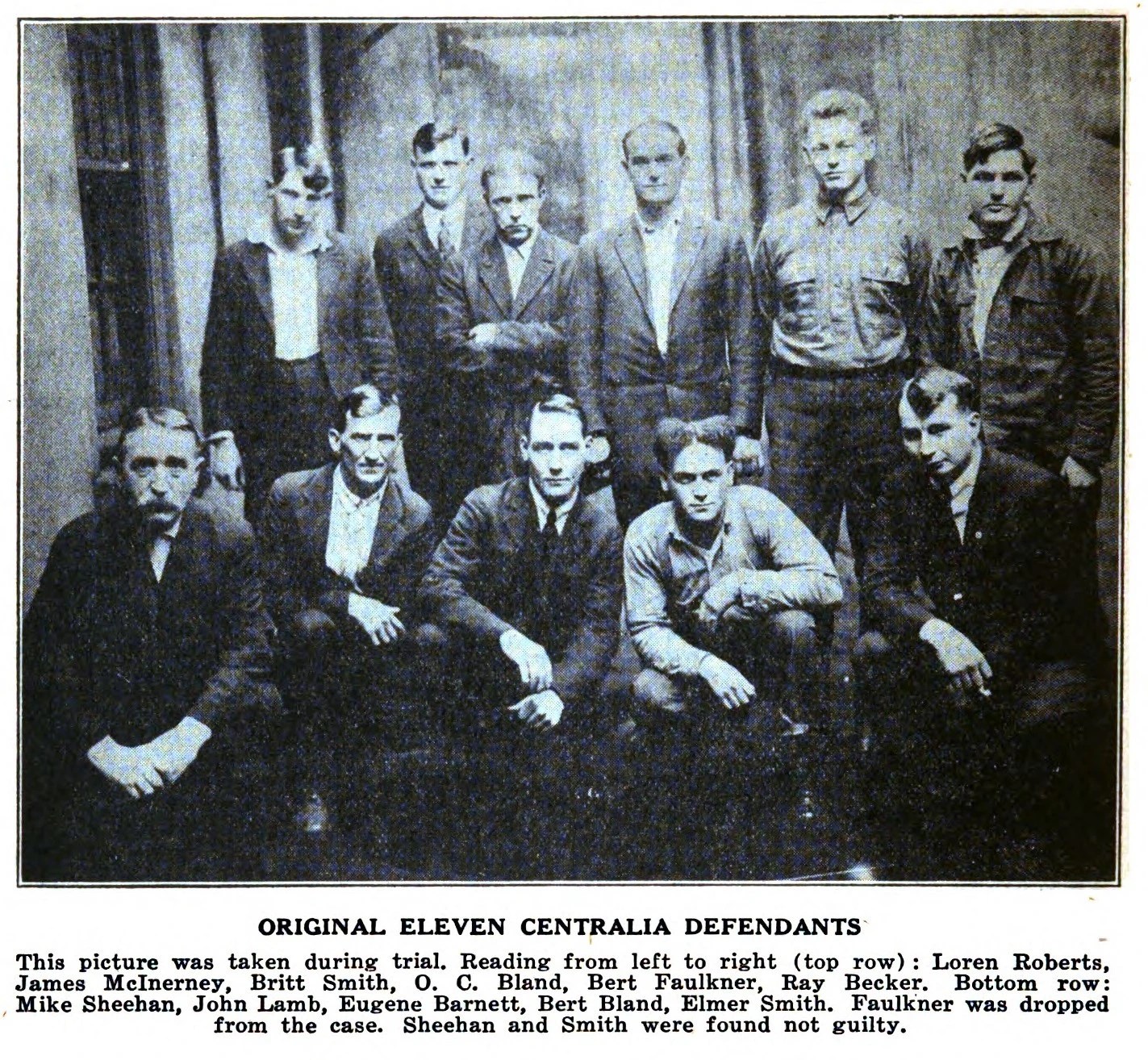
Ten years later and the Centralia Liberation Conference meets in defense of victims of 1919’s ‘Red Summer’ of anti-Left/anti-Black/anti-Immigrant legal and extralegal violence that has never left us. The so-called Centralia Massacre saw I.W.W. members defend their hall against armed American Legion thugs in a 1919 Armistice Day attack, resulting in the deaths of five reactionaries and the lynching of I.W.W. activist, and fellow veteran, Wesley Everest as the arrest of eleven heroic comrades and those swept up in the repression. No one was even charged for the sadistic torture killing of Everest. Long jail terms were imposed for seven; Bert Bland, John Lamb, Britt Smith, James McInerhey. O.C. Bland, Eugene Barnett, were pardoned, paroled or died in jail by the mid-1930. The last to be freed in who refused a parole because of his continued professed innocence was Ray Becker in 1939.
‘For the Freedom of the Centralia Prisoners’ by Vern Smith from Labor Defender. Vol. 4 No. 1. January, 1929.
THE Centralia Liberation Conference, which recently concluded its first congress in Seattle, with 145 delegates representing 60 organizations, marks an important development in the fight to liberate the eight Centralia victims. The conference included representatives of the International Labor Defense, which took a prominent part in the work of organizing the conference, delegates from the Tacoma Central Labor Council and the Seattle Central Labor Council, the two largest in the state, and from the Building Trades Council, Structural Iron Workers, Order of Railway Conductors, locals of painters, iron, steel and tin workers, Electrical Workers Local 77, Laundry Workers Union, Steam Engineers, Meat Cutters, Teachers, Boiler makers, Machinists. In fact all the really organized sections of the labor movement in the state of Washington took part in the conference.
The resolutions, which were unanimously passed, called for the immediate release of these class war prisoners, demanded the repeal of the Washington criminal syndicalism law, and called on the parole board to immediately release these working class fighters. The importance of the conference, and the effects of the long hard campaign conducted by the International Labor Defense for the release of the eight Centralia loggers, is demonstrated by the fact that the state Parole Board is already sending out rumors that Eugene Barnett, one of the prisoners, is soon to be released on parole. This would mean a great victory for the I.L.D. and for the workers of Washington and the entire country who have carried on this fight, and would serve to intensify the campaign for the release of the remaining prisoners.
Why are the workers interested in the fate of eight lumberjacks convicted of murder in the second degree, members of the I.W.W., and why are they determined to take them out of prison?
The American Legion is the very key to the Centralia conspiracy. It was this fascist organization, parading in military formation before the I.W.W. hall in Centralia, on Armistice Day, 1919, which at word of command broke ranks and raided the hall. The four men in the attacking party who were killed during that attack were Legionnaires. The Legion attended the trial in uniform, and howled for the death sentence upon the loggers arrested in the hall, or accused of taking part in its defense. The Legion erected a monument, after the usual financial scandals always involved in hysterical campaigns of this sort, to the four Legionnaires killed during their attack on the lumberjacks’ hall, and almost the last public appearance of the late President Harding a few days before his death, was to make a speech at this monument, in the isolated lumber town of Centralia, in condemnation of organized labor in the lumber woods, and in commendation of the American Legion, which has done so much to crush the I.W.W., stopping not even at arson and murder.
Yet, in this American Legion, this anti-labor organization of Washington state lumber lords and business men, a certain Captain Coll, of Hoquiam, Washington, who to his dishonor has not seen fit to leave the Legion or to repudiate this fascist organization, says, “The I.W.W.’s in Centralia, Washington, who fired upon the men that were attempting to raid the I.W.W. headquarters were fully justified in their act. A great wrong has been done and the innocent party has suffered. Yet the day is coming when the prison doors will also open to liberate the innocent Walla Walla prisoners.”
Wesley Everest who was lynched in the raid fired back in defense of his life. In retaliation for the death of four of their number killed by a man defending himself against a lynch mob armed with ropes, a mob attacking deliberately and in accordance with a conspiracy to raid a union hall, to destroy it and the union, Wesley Everest was taken from the jail by hundreds of local business men. He was horribly mutilated by five big business men who rode in an automobile with him, bound and gagged, and “worked on him” with razors on his way to the Chehalis River bridge; he was hanged off the bridge with a short rope, pulled up half-dead because the bloodthirsty mob wanted inch-long pieces of the rope for souvenirs, and hanged again. When there were not enough souvenirs to go around, the still living body was hauled onto the bridge again, another and longer rope substituted and once more pushed off–and so for four times. The mob got its souvenirs, and the last rope allowed so long a drop that Everest’s head was half torn off. Then followed the legal lynching of the eight lumberjacks, seven of them seized in or near the hall, and one, Eugene Barnett, taken from his home, miles away, because he was known as a leader in union activity.
The court room at Montesano, Washington was packed with soldiers, soldiers were camped in the jail yard, witnesses were terrorized, kidnapped, hidden. Perjury unstinted for the prosecution brought a final verdict of “guilty in the Second Degree”, a verdict now repudiated by nine out of twelve of the jurors, who have issued written statements that they were tricked and brow beaten into voting “guilty”. The jurors thought that their recommendation for mercy would bring a light sentence. The judge gave 40 years.
And now for eight years, while Labor in general had its attention taken up with other cases, Eugene Barnett, Roy Becker, John Lamb, Bert Bland, O.C. Bland, J. McInerney, Loren Roberts and Britt Smith have lain in Walla Walla penitentiary. They are innocent of every crime. They had a right to defend their hall.
The Centralia Liberation Conference, determined to free these martyrs to the cause of the workers ,elected a resident executive committee consisting of, M.J. Miller, Carpenters Union; Carl Brannin, Federal Labor Union; John C. Kennedy, Teachers Union; Charlotte Todes, International Labor Defense, Mrs. L. Burke, United Council of Working Women; A. Winton, Painters Union; Rev. F.W. Shorter, minister. The resolution recommending action for the release of the Centralia victims, calls for an intensified campaign of publicity, the formation of local co-operating committees in each organization, the raising of funds, and the selection of a representative to serve on the Centralia Liberation Committee.
Labor Defender was published monthly from 1926 until 1937 by the International Labor Defense (ILD), a Workers Party of America, and later Communist Party-led, non-partisan defense organization founded by James Cannon and William Haywood while in Moscow, 1925 to support prisoners of the class war, victims of racism and imperialism, and the struggle against fascism. It included, poetry, letters from prisoners, and was heavily illustrated with photos, images, and cartoons. Labor Defender was the central organ of the Scottsboro and Sacco and Vanzetti defense campaigns. Editors included T. J. O’ Flaherty, Max Shactman, Karl Reeve, J. Louis Engdahl, William L. Patterson, Sasha Small, and Sender Garlin.
PDF of full issue: https://www.marxists.org/history/usa/pubs/labordefender/1929/v04n01-jan-1929-LD.pdf

