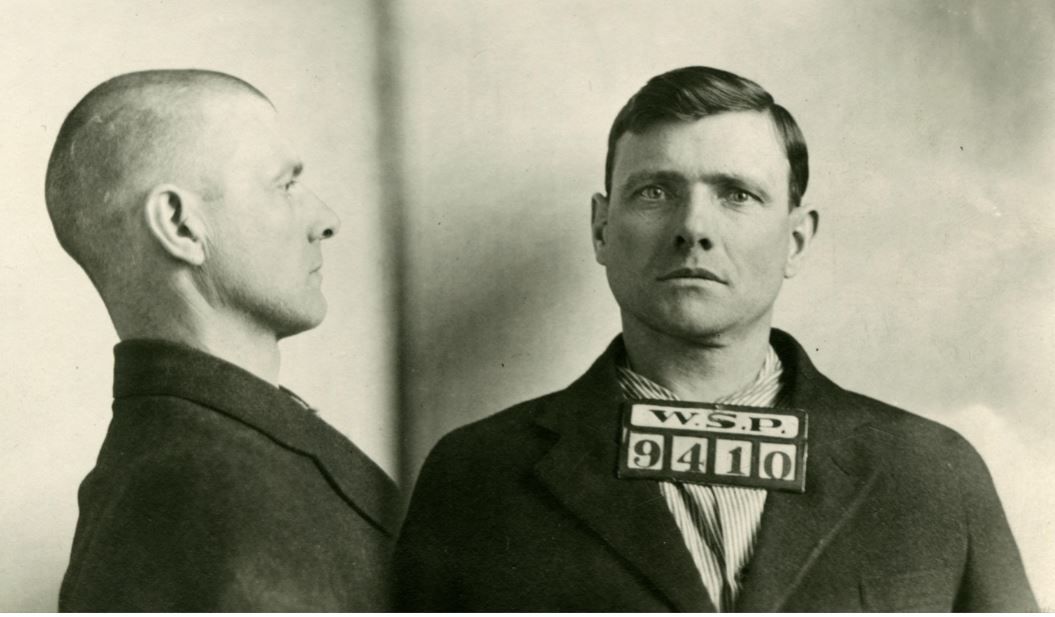
Born in the village of Scarriff, in Ireland’s County Clare, wobbly logger James McInerney died in Walla Walla prison from meningitis and neglect on August 13, 1930. Jailed for ‘murder’ in the Centralia fight which saw I.W.W. members defend their hall against American Legion thugs in a 1919 Armistice Day attack, resulting in the deaths of five reactionaries and the lynching of I.W.W. activist Wesley Everest,. One of seven who served at least a decade, McInerney, spent the final ten years of his life locked up for defending himself, his comrades, and his class.
‘Last Tribute to the Memory of James McInerny’ from Industrial Worker. Vol. 12 No. 35. August 30, 1930.
Throngs Gather At Graveside After Following Remains Through Streets of Centralia To Pay Last Respects To Labor Martyr.
CENTRALIA. Wash., Aug. 20. Banked with flowers and amid the assemblage of over fifteen hundred people who gathered at the graveside to pay their last respects to his memory, Fellow Worker James McInerney’s casket was lowered into the grave this afternoon.
The funeral cortege left the funeral chapel at 2 o’clock and wound its way around the park block where the “Sentinel” monument erected by the American Legion to Warren Grimm and his legion comrades stands, thru the streets of the “little western city in the shadow of the hills.” Crowds of citizens gathered on the sidewalks and stood quietly and respectfully as the train of around one hundred automobiles and auto busses passed on to the cemetery. There was no animosity displayed. Sympathy for the heroic labor martyr shone from many tear-dimmed eyes. A trio of motorcycle police preceded the cortege clearing traffic. They were unobtrusively efficient and remarks were heard repeatedly that had the police department of Centralia on November 11, 1919, showed similar zeal in maintaining order, the tragedy would never have occurred and there would have been no monument to the dead in the public square and no funeral winding through the streets.
The funeral services were very impressive. There was no formal ceremony. The crowds, which included hundreds of citizens of Centralia, stood with uncovered heads, three while C.S. Smith introduced the speakers. The afternoon sunlight, tinged with the amber glow of approaching autumn, fell slantingly across the flower embedded grave and the coffin of simple design which lay in the midst of floral designs and wreaths.
Captain E.P. Coll, legionnaire, whose efforts to secure fair play for the Centralia prisoners is well known, was the first speaker. With eloquence and sympathy that moved his hearers to tears in many instances, he told in simple, well chosen words, the life of Fellow Worker McInerney, from the time he left his home in County Clare, as a youth, in eager search of that liberty promised in the land beyond the seas.
“His heart bear high with hope as he came in view of the Statue of Liberty enlightening the world. Here at last he seemed to have arrived in sight of a land of deals such as had nourished his dreams since childhood. But, alas, he soon found that the land to which he had come was no longer the ideal one which the Fathers of the Republic had planned. He found it in possession of the few with opportunity closed to the toiling masses.”
Captain Coll traced the eager strivings toward liberty of the brave idealist down to the fatal day of the tragedy that cost him ten years of his liberty and ended in his death within capitalist prison walls.
“McInerney died in defense of those ideals which lured him to these shores-a sacrifice to entrenched greed–a martyr to the cause of human liberty,” concluded Capt. Coll.
Katie Phar, the song-bird of the I.W.W. had opened the services with the plaintive song to Wesley Everest, “Where the Chehalis River Flows.” She followed Capt. Coll in duo with Henry Gehrig, with another song, which was beautifully sung, touching the hearts of the audience.
Fellow Worker James P. Thompson then followed with a short explanation of the principles of the I.W.W. to which Fellow Worker McInerney had devoted his life. It was in the usual lucid manner of Fellow Worker Thompson and made a profound impression upon his hearers.
Elmer Smith, Centralia attorney, who was tried at the Montesano legal lynching along with the other defendants now in prison, made the closing speech. His many years devotion to the cause of the prisoners and his well known love of fair play lent an intensity to his words that moved his auditors. He outlined the legal aspects of the case and cleared the name of the dead fellow worker of the faintest suspicion of “conspiracy.”
“There was a conspiracy,” said Smith, “but it was on the part of those business interests represented by F.B. Hubbard, to commit in violation of the law, one of the most atrocious outrages of history against the workers’ rights for which the deceased fought and died.”
He told the story of the night of horror that followed the lynching of Fellow Worker Wesley Everest–the story of fiendish cruelty that went as far as deliberate mutilation of the wounded and helpless victim. He recalled the torture of Fellow Worker McInerney in the city jail where he was suspended with a rope around his neck all night, with only his toes touching the ground, in an effort to force him to give lying information against his fellow workers. But the heroic Irish lad could not be broken. He returned throughout the torture, the game and stubborn defiance of his heroic race.
The service was closed by another song from Katie Phar and then the crowds of mourners silently dispersed, lingering for a little to pass in review by the simple coffin which stood on its bier with lid removed, for a last farewell to a heroic man. One lone lingerer remained at last–an old mother who wept silently for a little while beside the lowering coffin. She was the mother of a young member of the I.W.W.–a boy, who disappeared on the night of the mob outrage eleven years ago-never to be heard again. Doubtless he was killed by the raging brutes on that November night and his body, like Wesley Everest’s, secretly buried in some unknown grave.
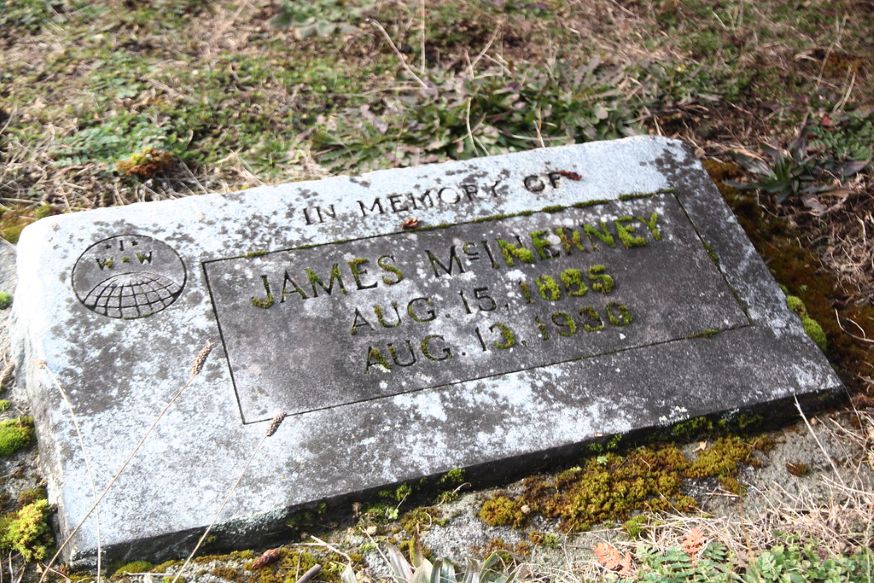
The autumn sun set on the grave of Fellow Worker McInerney, as the crowds departed on their various roads. But not a hearer but will recall that memorable scene. Not a man, woman or child, but will hold the name of brave Fellow Worker McInerney deeply engraven on their hearts, and pass it along as a heritage long after the names on the “Sentinel” monument have rusted into oblivion.
The Industrial Union Bulletin, and the Industrial Worker were newspapers published by the Industrial Workers of the World (IWW) from 1907 until 1913. First printed in Joliet, Illinois, IUB incorporated The Voice of Labor, the newspaper of the American Labor Union which had joined the IWW, and another IWW affiliate, International Metal Worker.The Trautmann-DeLeon faction issued its weekly from March 1907. Soon after, De Leon would be expelled and Trautmann would continue IUB until March 1909. It was edited by A. S. Edwards. 1909, production moved to Spokane, Washington and became The Industrial Worker, “the voice of revolutionary industrial unionism.”
PDF of full issue: https://washingtondigitalnewspapers.org/?a=d&d=IWW19300830
 Revolution's Newsstand