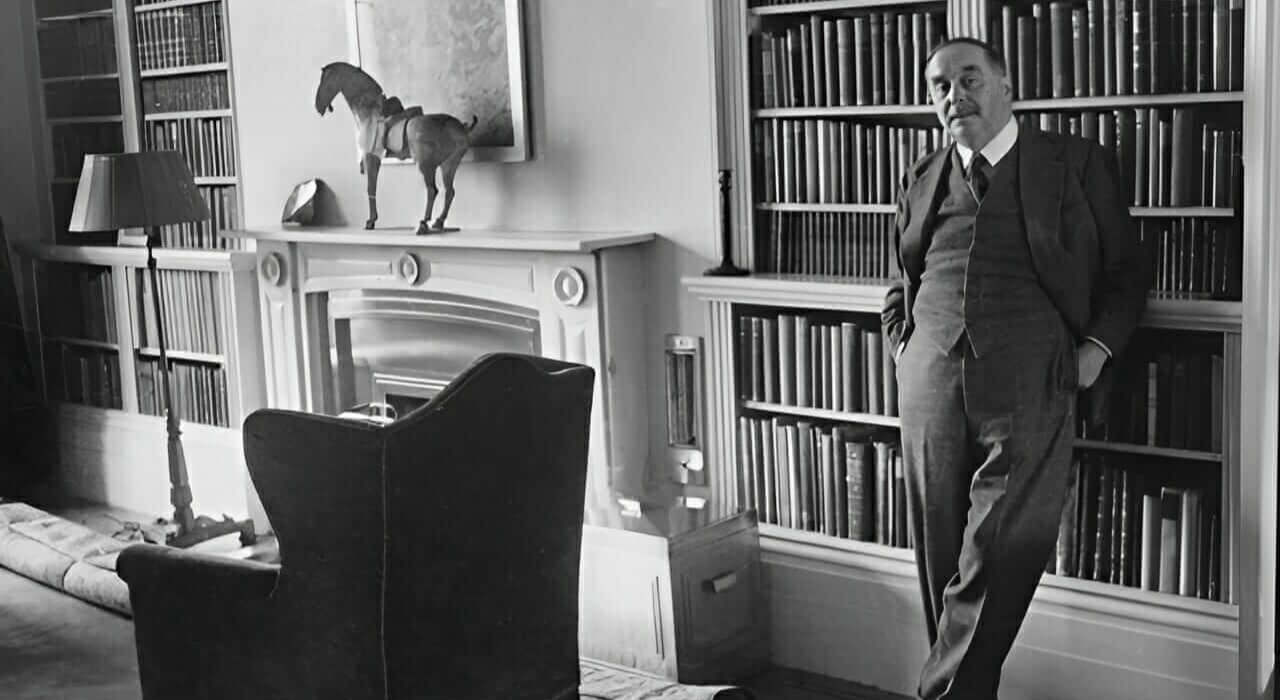
Reading his just published ‘Men Like Gods’, James Fuchs gives the world-view of H.G. Wells the once-over.
‘The Last of the Great Parlor Socialists’ by James Fuchs from The Liberator. Vol. 6 No. 9. September, 1923.
THE question arises at the outset of our considerations: What is a parlor socialist? I believe I have a definition ready, in reply to that question, which is neither too narrow nor too wide–just co-extensive with the concept itself: A parlor socialist is a non-combatant Utopian in an age of combative socialist mass-movements; in other words, a Utopian without a historical reason for being one. To make my point plain: Fourier, Robert Owen, Saint-Simon were Utopians, but they were not parlor socialists. It is true that their socialism was evolved within their four walls as a matter of purely individual reflection based upon observation, but it is likewise true that at the turn of the eighteenth and nineteenth centuries when they flourished, there were no mass-movements outside of their four walls whereof their socialism could by any possibility be the clarified expression. There was no organized proletariat then to which they could step with their message from their “parlors,” nor did they anticipate in their calculations the existence of one as an indispensable means of realizing their schemes for social reconstruction. In default of one actually extant, they naturally looked to the illuminati among the well-to-do for support of their plans. The parlor socialists of our own days are the epigones of the great Utopians. What divides them from their famous exemplars and puts them on a lower plane of mentality, is the simple fact that they are now eighty years behind their age. In an epoch of militant class-conscious labor movements, any attempt of “the parlor” to dictate and direct is a superannuated presumption.
Being busy with themselves and their own inventions rather than with the mass urge toward a socialist commonwealth, it is patent that nearly all parlor socialists will develop into petty personages, alike devoid of genius and virile enterprise. There are, however, a few exceptions over-topping the pigmy size of the type the late Edward Bellamy, to mention a fellow-countryman, was one of them; Mr. Wells, a much more versatile, more articulate, more restless and curious intellect than Bellamy, is another. This being the eleventh hour before the cataclysm of capitalist society, he may be looked upon as the last of the great parlor socialists. As such, he is an instructive subject fora brief survey. I mean to essay one in briefest outlines for the readers of the Liberator, the immediate occasion for such an attempt being his latest volume–a Utopian novel entitled “Men Like Gods.”
Mr. Wells, as a man of letters, is not only the greatest of all known parlor socialists; among the living he is likewise the purest, most consistent specimen. Most others of his ilk have at one time or another, felt stirring within their bosoms a response, however faint, to the urge and clamor of class-conscious proletarian mass-movements. Not so Mr. Wells. Organized labor, to him, is merely a stepladder in the career of the executive intellect. The very term “class-conscious proletariat” is and always was an offense to his educated nostrils. He first imbibed his socialism, such as it is, through contact in the early nineties with the Fabians. Before his literary successes during the first five years of the new century had made of him a guinea-shovelling celebrity astonished at its own greatness, he must have been a student of some natural sciences–chemistry, and biology and mechanics. The traces of his early studies are observable in nearly all his multifarious writings. Economics, however, and the history and literature of modern labor movements, never were among the disciplines with which he busied himself in any but the most cursory, copy-hunting sort of way. In his immense output of forty-five volumes, all published since 1897, there is no evidence showing that he ever labored his way through “Das Kapital” or “The Critique of Political Economy.” In fact, there is plenty of recent evidence to the contrary. He never mentions Marx and Marxism except to bestow upon a novel-reading mob of capitalist retainers and leisured ladies some such journalistic drivel as this:
“The Marxist had wasted the forces of revolution for fifty years; he had had no vision; he had had only a condemnation for established things. He had estranged all scientific and able men by his pompous affectation of the scientific; he had terrified them by his intolerant orthodoxy; his delusion that all ideas are begotten by material circumstances had made him negligent of education and criticism. He had attempted to build social unity on hate and had rejected every other driving force for the bitterness of the class war.”
The quotation is of the Wells vintage of 1923, being culled from “Men Like Gods.” It is of the same pattern with similar utterances scattered thinly over a quarter of a century. From first to last, this re-inventor of socialism has considered himself its patentee, and the liberal professions its future adherents and executors. There is a curious smallness about this man of enormous diligence and vast literary reaches. With all his wonderful cleverness and roving social intelligence, he is essentially Thackeray’s Man-Meanly-Admiring-Mean-Things; in plainer words, a typical English middle-class climber and a devout snob in the presence of bourgeois success. His classical petty-burgher mind attains now and then to the heights of genius in satirizing the very celebrities of organized privilege before whom, in the end, he will invariably cringe and cower. To exemplify: In 1909, in “Tono-Bungay” (perhaps his one enduring novel) he was at the height of his satirical powers. The volume is a truly devastating picture of the new English society of “self-made” millionaires, containing, as a centre-piece, a killingly veristic portrait of an industrial “Napoleon.” A year or two thereafter he published “The New Machiavelli,” a Freudian daydream of wishfulness, wherein Mr. Wells himself, thinly disguised, is depicted as a middle-aged statesman evolving schemes of social and political reform, far, far from the madding crowd of the Great Unwashed, with the assistance of his worshipping typist and stenographer! Three years before “Tono-Bungay” Mr. Wells, for the first time, came to the United States, where he was dined and wined by a good many American counterparts of the industrial Napoleons of his own annihilating satire. He brought forth the usual British lecturer’s shallow volume on the American social scene. A rather characteristic passage:
“It is ridiculous, I say, to write of these men (meaning the big sharks of finance) as though they were unparalleled villains, intellectual overmen, conscienceless conquerors of the world. Mr. J. D. Rockefeller’s mild, thin-lipped, pleasant face gives the lie to all such melodramatic nonsense…I must confess to a sneaking liking for this much-reviled man…“
II.
Do you wonder, dear reader, at this incapacity of a professed socialist to feel something like decent indignation when face to face with the archetype of American pirates grabbing national resources? There is no cause for wonderment–it is the New Machiavelli that is speaking–the British arriviste whose idea of heaven is a seat in parliament and an occasional weekend invitation from a peer–the statesman who will presently launch socialism into being by dickering with Right Honorables and converting the impressible wives of baronets and bishops–the socialist Superman, who given a chance, will by fluting and conciliatory accents, win the Rockefellers over to a social scheme that does away with them.
Not only the plutocrats are fair game to his superior intellect. Some day in the future he will charm and convert, as a socialist, those very statesmen whom he has made immortally ridiculous as a satirist. We are facing here the innermost secret of the petty-burgher soul in its literate state: Mr. Wells is flesh of the flesh and bone of the bone of the very notabilities he assails in his satiric moods. He knows and has depicted more than once, under various fictitious names, the pre-war and post-war executives of the Western nations–the Georges, Churchills, Clemenceaus, Wilsons, Poincarés and their likes–as narrow-visaged, hypocritical mediocrities, impotent for good and potent only for infinite harm–presumptuous, vain old men, whose periodical gathering in conferences cannot possibly advance the cause of civilization. Yet when they foregathered at the most transparent humbug of a Washington Disarmament Conference, Mr. Wells, to the tune of ever so many thousand guineas, wrote gravely and in a statesmanlike vein about their daily doings. Viewed consciously or subconsciously, the eminent politicians he showers with ridicule are at the same time his exemplars and envied forerunners, until one day he will take his seat among them. His farcical run as a labor candidate for Oxford!!, of all places on the moral map, is merely a first augury of future greatness. One day in a near future he will run for a more auspicious borough, with lots of old-fashioned British trade-unions to back his candidacy, the local Boots, Brewer, and a few Fabian Lady Tippinses will rally round him. Behold him then in that place, which, as Mr. Twemlow feelingly remarked, is still the best club in London. He will lunch with real cabinet-ministers. He will susurrate a diluted socialism into the rosy ears of their womenkind. He will gently argue with the Bishop’s Bench about the essential Christianity of socialism purged of class-struggles. And at the next threat of a gigantic strike in a key-industry he will instruct the coarser element within the I.L.P. representation in parliament in the art of ratting eloquently and with profuse assertion of a superior social morality.
III.
This, however, is anticipating the impending career of an “elderly statesman,” (a favorite locution of Mr. Wells), who, during his journey through Soviet Russia saw little of its moral grandeur, which for him was overshadowed by the ubiquity of Karl Marx’s bushy beard and mane. For the present, he is still busy poking fun at his future ministerial weekend hosts, in “Men Like Gods” and saying now and then, in the same volume, rather pointed things about the odor of the capitalist cheese wherein he lives and has his being, as a comfortable and respected mite.
In “Men Like Gods” an exact dozen of holiday-making Britishers, with their automobiles, are shunted off from an English highroad into another planet called Utopia, and at the same time they are projected into a future several centuries distant. How shunted? How projected? To quote Mr. Wells: “The Shadow of Einstein Falls Across the Story, but Passes Lightly By.” Just so. And there we are in Utopia, with an ensemble that pretty nearly encompasses the entire personnel of the author’s novelistic obsessions.
The priggish Fabian is missing–be it known to a forgetful world that Mr. Wells quarrelled with the Fabians in 1906–also, the man-of-the-plain-people patronized by prigs, and a few minor clichés; the rest of his standard creations, modified to suit, answer the roll-call.
These are the twelve “earthlings” transplanted by a Jules Verne trick to Utopia:
First of all, the indispensable variant and avatar of H.G.W. Name, this time, Barnstaple. Occupation, associate editor of a liberal weekly. Leads a comfortable suburban existence. Loves, like Tennyson’s Ulysses and Mr. Britling, his ageing wife, but is ready to leave her behind in search of H.G.W., he is the only man among the “earthlings,” of new adventures. In his capacity of variant and avatar intelligent enough to approve whole-heartedly of Utopian institutions and to side with his hosts against his eleven fellow-Britishers.
The question of how an intelligent workingman with social ideals would react to Utopian surroundings does not interest Mr. Wells. The only two workers among the eleven companions of his fancy are both flunkeys, cockney chauffeurs of a submissive and conforming type. From a business point of view, the author followed a correct instinct. No novelistic capital could be made out of proletarian rebels with his petty-burgher mob of readers. A great deal of novelistic capital could be made by turning his Utopia to some extent into a “roman a clef,” by introducing and cleverly satirizing public personalities under transparent surnames. The idea of palming off badly written fiction to leaders in thin disguise was an invention of Disraeli’s. Mr. myriads of British snobs, by introducing well-known society Wells, however, like a true genius, takes his own wherever he finds it.
There is a gentle Tory philosopher, a tall, long-legged, dignified-looking oldster, full of insights and devoid of springs of progressive action, introduced as “Mr. Cecil Burleigh, the great conservative leader”–a composite portrait of Balfour and Lord Cecil. There is the aggressive Imperialist and enterprising snob “Rupert Catskill, Secretary of State for War–” meaning, of course, the fiery Winston Churchill, idol of the patriotic ‘Arrys and ‘Arriets of London and the provinces. There is his secretary, Freddie Mush, a retainer of local reputation, probably unknown to larger fame; there is Father Amerton, a fashionable preacher, full of nasty suppressions and fierce zealotries; Lord Barralonga, another of the transplanted “earthlings,” is a moneyed newcomer among the peerage, bluff of speech, a lay-figure reminiscent in a shadowy way of the late lamented Northcliffe. Monsieur Dupont, a French bourgeois, weekend guest of Barralonga, hurled together with him into Utopia, is introduced for one purpose only, to be mentioned forthwith. No Wells novel can do without a scientific analyst, which is the raison d’etre for a chemist among the exiled dozen, Mr. Hunker. A moneybag without a cocotte in his automobile is, of course, unthinkable–hence the famous vaudeville singer, Miss Greta Grey. The dozen is completed by Lady Stella–one of those plain-spoken, quick-witted feminine aristocrats that are all the rage with the patrons of Mudies.
These specimens of British privilege and its entourage are thrown into high satirical relief against Utopian backgrounds. Both sexes among the Utopians walk about in decent nakedness, healthy, handsome, browned by the sun, impervious to the obtrusive sexual innuendo wherewith the atmosphere of the “earthlings” is surcharged. They are hospitable folk, these Utopians, but not exactly overjoyed at the arrival of their guests, who are in a hurry to make fools of themselves. The fashionable preacher thunders against their physical and spiritual nakedness and is threatened with a Utopian commission de lunatico inquirendo. The excitements and incoherencies of the guests are piquantly contrasted with the pertinent speech and calm courtesies of their supermen hosts. The latter speak and listen by direct thought–transference–until undeceived, the eleven Britons imagine them to speak English and Monsieur Dupont marvels at their perfect French. These supermen, after going through centuries of economic anarchy, battle, murder and sudden death, have emerged as libertarian socialists from what they call the Age of Confusion. During a long evolutionary turmoil, they have outbred not only physical imperfections and grave vices, but minor shortcomings as well. To present their guild socialist society as the Rose of the Ages, Mr. Wells ruthlessly kills off the slow, the dense, the stupid, the discourteous in their millions–an immense surplus population, leaving only the well-bred and the quick-witted to manage a world suitable for the clairvoyant perceptions of sensitive authors. There is something curious about this readiness of the aesthetic mind to choke off and to slay, to clear the road to perfection.
In justice to Mr. Wells it should be mentioned that his aesthetic ruthlessness has not attained the heights of our national philosopher, Mr. Arthur Brisbane. Some months ago, when five millions of Volga dwellers seemed to be doomed, the Francis Bacon of the Tired Business-Man came forward with this consolation: the five millions, he pointed out, were after all only Tartars with slit-eyes and prognathous cheek-bones–presumably not as good to the sight as the average Harlem flat-dweller. To such altitudes of Yankee complacency even Mr. Wells cannot ascend.
To return to the story: the “earthlings” carry on their vestments, bodies and luggage millions of disease germs that can’t do them any harm but speedily spread havoc among the non-immunized Utopians. An epidemic breaks out and the twelve intruders are quarantined in a mountainous region of Utopia, far off from the centres of population. The strategic advantages of their new dwelling-place inspire Rupert Catskill, British Secretary of State, with a splendid idea; why not organize in military fashion, plant the British flag, begin hostilities against the Utopians and subjugate them–civilize them by annexation to the Empire? His fellow-Britons with the exception of Mr. Barnstaple immediately assent. So does Monsieur Dupont, a Poincaré in partibus infidelium, after making exceptions and exacting reservations in favor of a France jealous of British territorial aggressions.
What follows is splendid farce in Mr. Well’s best early manner. I must not keep any reader from buying the book by being too explicit he would miss a treat. Suffice it to say that the dissident Barnstaple is returned to earth, where the last chapter takes leave of him at the breakfast-table of his villa in Syndenham, drinking tea, reading the Times, and vaguely accounting to his wife for a month’s unexplained absence. He does not, like Captain Lemuel Gulliver back from the Houyhnhnms, complain about the malodor of his wife, or for that matter, of the society about him. He is after all only a British Philistine, returning to his native element after an eccentric excursion. We hope Mr. Wells will not disappoint us of a second volume, continuing the career of his revenant: Mr. Barnstaple leaving authorship behind and going in for politics under the fresh glow of his new inspiration; Mr. Barnstaple standing for Gomperstown, Lancashire, or some other industrial rotten-borough, and returned by a triumphant majority; Mr. Barnstaple in the House, a lonesome dignified figure surrounded by noisy vulgar I.L.P. charges upon his good-humored sufferance; Mr. Barnstaple rising to his legs and attacking capitalist society in the exact spirit of George Sampson in Our Mutual Friend: “Demon–with every respect for you be it said–behold thy work!” Mr. Barnstaple sitting down under thunders of applause, congratulated by one or two generous political adversaries on the ministerial bench: Mr. Barnstaple invited to dinner and made much of by the gallant Rupert Catskill. And finally, Mr. Barnstaple handsomely capitulating to the Powers that Be in a social crisis, and included himself in the cabinet he assaulted. If Mr. Wells can read the book of his own future as plainly as the records of a remote Utopian epoch, he will surely not grudge us that interesting second volume.
The Liberator was published monthly from 1918, first established by Max Eastman and his sister Crystal Eastman continuing The Masses, was shut down by the US Government during World War One. Like The Masses, The Liberator contained some of the best radical journalism of its, or any, day. It combined political coverage with the arts, culture, and a commitment to revolutionary politics. Increasingly, The Liberator oriented to the Communist movement and by late 1922 was a de facto publication of the Party. In 1924, The Liberator merged with Labor Herald and Soviet Russia Pictorial into Workers Monthly. An essential magazine of the US left.
PDF of full issue: https://www.marxists.org/history/usa/culture/pubs/liberator/1923/09/v6n09-w65-sep-1923-liberator-hr.pdf

