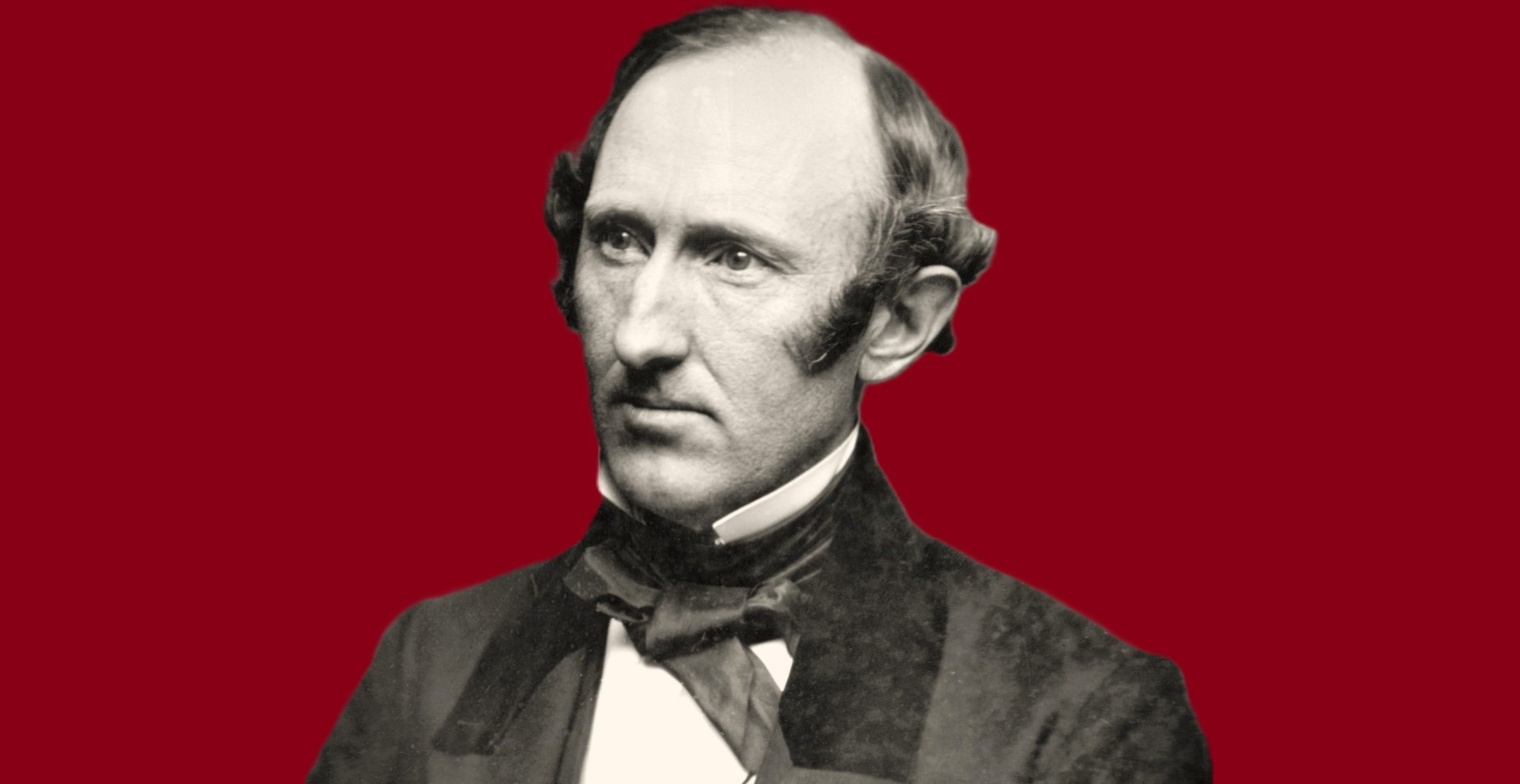
Said Karl Marx of Phillips: “For thirty years he has without intermission and at the risk of his life proclaimed the emancipation of the slaves as his battle-cry, regardless alike of the persiflage of the press, the enraged howls of paid rowdies and the conciliatory representations of solicitous friends. Even by his opponents he is acknowledged as one of the greatest orators of the North, as combining iron character with forceful energy and purest conviction.” In this deep-cut of U.S. radicalism from a speech to thousands at 1854’s annual Fourth of July gathering of the Massachusetts Anti-Slavery Society held at Farmington, Massachusetts, Phillips says 1776 was a war to create a nation, not a fight for liberty and that a new, far more radical revolution, was necessary. A leading abolitionist of his generation, legendary orator, founding member of the First International, and champion of all oppressed, Wendell Phillips was the foremost U.S. radical of the 19th century. This talk is evidence of the thoroughgoing radicalization the broader abolitionist movement underwent in the aftermath of 1850’s Fugitive Slave Act and Bleeding Kansas, then underway, all living in the ether of 1848. Also speaking that sweltering day were Sojourner Truth, Charles Redmond, Abbey Kelly, Lucy Stone, Henry David Thoreau, and William Lloyd Garrison. When people say ‘Well, they were just of their time,’ tell them, ‘So was Wendell Phillips.’
‘To Abolitionists on the Fourth of July’ by Wendell Phillips from The Anti-Slavery Bugle. Vol. 9 No. 50. July 29, 1854.
I do not know, ladies and gentlemen, that you will like the first part, at any rate, of my speech, which is merely to deliver a message to you from one who is going just now to invade your seats, in behalf of the anti-slavery cause. I come to tell you that Abby Kelly Foster is to be among you: and what she comes for, you know very well. It is for the sinews of war’–for the means of carrying this enterprise throughout the State. God has given us a text in the late events in the city of Boston, and now our object is to take out the burthen of that rebuke, and preach a sermon upon it in every great town in Massachusetts. Massachusetts is ready to hear. The public ear was never so thoroughly aroused and awake as it is at this moment; you all know it; and in one form or another, either by our organization or by some other means, if we love the anti-slavery agitation, we are bound to make use of this summer, when public attention is so much aroused, to press upon all those who are turning their eyes, for the first time, to the claims of the slavery question, the nature and importance of that question, and prepare them for their duties, civil and political, as well as religious on this question. We are importuned from every town in the Commonwealth, to send them lecturers; and if you will give us the means, we will try to make Massachusetts worthy of the name she has always taken to herself, of an anti-slavery State. We will try to make her worthy to send back CHARLES SUMNER to the Senate, if they shall think him worthy of expulsion. (Cheers.) I wish they would expel him; it would teach Massachusetts where she stands before the National Government.
I should prefer, Mr. Chairman, to make a speech entirely on the subject of money. I really do not feel any great interest in any other part of the question at this moment. I do not believe in an anti-slavery which undertakes to listen or to make speeches, just now. I have had enough of that. What we want, in reality, is, a spot, however small–whether it be the State of Massachusetts or half of it–which we can truly say is a free State; of which we can say, that a fugitive slave is safe there; that, no matter how many laws are made to the contrary, Constitution or no Constitution, law or no law, the moment a slave sets his foot on that soil, he never goes back. (Loud cheers.) That is what we want to make Massachusetts. We never shall make her that, by undertaking to think that she is so when she is not. My friend, Mr. Conway who has just addressed you, described us rightly as just as much slaves as the parties in whose behalf we move. I am sorry to dissent, in any degree, from the remarks with which Mr. Garrison introduced this meeting. I do not agree with them. I do not fully believe, with our eloquent Senator at Washington, that Massachusetts ever was entirely an anti-slavery State, or, indeed, that there ever was such a State in this country. The truth is, there is more real anti-slavery in this country now than there ever was before. (Cheers.) We may thank God, every one of us, that we have lived to see the day when there was so much anti-slavery in the city of Boston, that it took two thousand armed men to carry a slave out of its streets. The day was, when we were boys, that they took a slave into a back parlor, and sent him home, without its being considered as a piece of news, even, in the newspapers. The day was, when no man entered a court-room where a fugitive was being tried, when no lawyer volunteered his services, no judge hesitated an hour. Old Judge Davis, (to whom the Sim’s Commissioner refers in one of his recent letters,) sent back a fugitive, and not ten men in Boston knew of it;–and that was not more than thirty years ago. Anti-slavery is now at a great deal higher growth than ever before.
I think that the Fourth of July never was a day of Liberty–never until the Abolitionists used it. The Declaration of Independence is not a Declaration of Liberty; it is what it purports to be, a Declaration of Independence, and nothing more. It undertook to separate the connection betwixt the colonies and Great Britain. It ends off by declaring that therefore, [on account of these previous principles,] they [the colonies] ‘are, and of a right ought to be’–States without slavery in them? Not at all: States where every man is a freeman? Not a bit of it–these colonies ‘are and of right ought to be’, free and independent States. That is what they fought for; that they got. Seven years they fought for it, and they succeeded and ever since, these States have been free and is ‘independent’ of all foreign power. This is what our fathers went to war for, and that they got. But it is not true, it cannot be made out from history, to that our fathers had any hatred of African slavery in 1776. It is not in the record. The allusion to the slave trade in the Declaration of Independence it as one of the grievances forced upon the colonies by the King, was struck out of that instrument. (Our fathers had just as much hatred of slavery as the Whigs of Boston have to-day;–that is, they hated slavery abstractly; they were willing that slavery should perish; but they were not willing to make a sacrifice for it. They would sacrifice neither the commerce nor the union of the country;–neither the wealth nor the strength of the colonies for the sake of abolishing slavery. They had in the same hatred of slavery that the Daily Advertiser has today; that is, a hatred that will round beautiful periods against it; that will make good speeches against it; but not a feeling that will sacrifice anything for the anti-slavery cause; and of there never was any such feeling in the country s until the anti-slavery enterprise created it.
The fourth day of July has been exactly what our fathers made it–the jubilee of a nation for its independence. It becomes us, their children, to take one step further than they dared to take, and to add to ‘Independence,’ LIBERTY–which they dared not add. (Loud cheers.) They did not dare to risk the union of the country, they did not dare to risk their material prosperity, for the slave question. There were a few leading men that did: Jefferson, Adams, Wythe, Jay, and some other distinguished men. So there are now; in exactly the same circumstances. This is the use I wish to make of the lesson: Do not imagine because there are a few leading men, whose names are to go down to posterity, who are in favor of freedom–do not imagine, because CHASE, and HALE. and SUMNER, and our friend here, [MR. GARRISON.] will leave their names for posterity to love and reverence as lovers of liberty–that it is any proof that Massachusetts, at the present moment is an anti-slavery State: neither was it the case in 76, because John Hancock, and Sam Adams, and John Lowell, an Josiah Quincy, and a few other men hated slavery.
The reason Burns went back from Boston was because the men of Boston were willing he should go–there is no other reason; and we have nothing to do but to stand here day and night, and preach that lesson without intermission. The reason the slave is sent back is because the men of Boston will it–nothing else. If it had not been so, why didn’t you give us a Governor, and not a dish of skimmed milk in his place? (Laughter and cheers.) Had we had a Massachusetts Governor that week, Burns need not have gone back. (‘Hear, hear.’) Had we had a Mayor of Boston, instead of an uncooked hasty pudding. (Roars of laughter and cheers,) Burns need not have gone back. If we had had a will throughout the Commonwealth that would have undertaken to say. ‘The law shall not be executed!’ Burns would not have gone back. If there had been an arrest at Richmond, Virginia, or at Charleston, South Carolina, where do you suppose their Governors would have been in those cities, or somewhere else, addressing a Sunday school? If you are really abolitionists, give us a Governor that has outgrown the Sunday School: give us somebody who can do something else than address a Bible Society, when the laws of Massachusetts are trodden under foot.
There is no reasonable hope of the sneers of the anti-slavery enterprise, until you make up your minds that it is not somebody else, but you, who return fugitive slaves. It is not Col. Suttle, of Virginia; it is not Franklin Pierce nor Caleb Cushing, at Washington; it is Massachusetts, that owns Massachusetts; and if you that vote every year in November, for laws and law-makers, choose to make, this an anti-slavery State, you can do it, next November, spite of all the Caleb Cushings or Franklin Pierces that the Government can buy up.
I am not going to make a long speech; but I will tell you the work which I would point out for Abolitionists to do this summer–the work which will make Massachusetts what she boasts herself to be, an anti-slavery. When it is done. I will be proud of the old Bay State. I used to be proud of her. Time was, when I took on my lips the name of the old Commonwealth with a glow of conscious pride, that gave depth to the tones of my voice, and added pulse to the heart. I was proud of her; but my pride all vanished when I saw that old Indian on her banner go floating down State street, with the Slave Brigade, with Ben Hallet and the United States Marshal, and a chained slave, beneath him. I have lost all pride in Massachusetts, till she redeems herself from that second day of June.
Now, my friends, I will tell you what is left for us to do. Let us take this summer to roll up a petition that shall be ten thousand strong, to the Legislature that is to assemble in January, asking them to turn Edward Greeley Loving out of the office of Judge of Probate. (Loud cheers.) If we do not do that, we shall not be a decent State to begin with. The second thing is, let us ask them for a law by which any man, who helps in any way the return of a fugitive slave, shall be forever disqualified from bearing office in Massachusetts. (Great applause.) Let us ask them for a law that shall direct the judges of the Commonwealth to issue a writ of habeas corpus just as often as the United States Marshal arrests a slave, no matter if they have to issue a hundred in a week, and take) him out of his hands. Let us learn of South Carolina, and nullify the Fugitive Slave Bill on the soil of Massachusetts. [A voice—’Amen.’ Lond cheers.] If the present Supreme Court would not do it, amend the Constitution, and elect another. When we are an anti-slavery State, that is what we are to do.
It is in vain to make national parties. It is in vain to get up Liberty parties and Free Soil parties, stretching from the old Bay State back to the Mississippi. National policies is not possible. The Government has got the better of us. Slavery has gotfifty million dollars of revenue to spend every year: fifty millions of dollars! We live in a country where, if you put a dollar on the other side of hell, the Yankees will spring for it, at the risk of tumbling in. (Laughter and cheers.) We live in a land of money–you know it; and do you suppose that a Government with fifty millions dollars to spend every year cannot buy up enough men in a year to carry any vote they wish to? How many men does it take, in the city of Washington, to carry any vote? Not more than thirty. This very year, on the Nebraska question, the votes of white men, white Democrats, were bought cheaper in the city of Washington, than you could buy black slaves. It is a literal fact that Democratic votes were bought cheaper, in Washington, for the Nebraska bill, than an able-bodied slave thirty years old. Now, do you believe that a Government with fifty millions of dollars to spend annually can be checkmated? Never! The only way to check-mate it is to checkmate it at home. Massachusetts is ours, if we choose to make it so. We can nullify this Fugitive Slave Bill. We can put on that Supreme bench judges who will laugh to defiance the Congress of the United States, when they undertake to carry a fugitive slave out of Massachusetts.
A Voice—’How will they do it?’
Mr. Phillips–Give me an anti-slavery State, and I will leave it to anti-slavery Yankees to find out a Way. (Cheers.) Do you suppose the men who make wooden nutmegs and cheat all the South are not sharp enough to outwit her in anything? Do you suppose the South outwits us, because her people are shrewder than Yankees? No! It is because we love to be cheated on this question: it is because our politicians are willing to compromise, and have been ever since 76. I will set a Yankee to have his own way, and find the means to have it, against the world. And yet you tell me to believe in an anti-slavery New England that has been outwitted this sixty years! I don’t believe it. I believe that when New England wants a thing, and wants it ‘with a will,’ she will have it! (Loud applause.) The only reason why she has not had anti-slavery legislation is because she has not wanted it. One man has been making brooms on the banks of the Connecticut, and another manufacturing cotton in Lowell, and another curing fish on the sea-board, and another making shoes up and down the county of Essex, and provided they made money enough, they let the Government have its own way. And then we send Mr. Sumner to Washington, and we send gentlemen to deliver Fourth of July orations, to make it out that Massachusetts is an anti-slavery State. She is not! But the time has gone by when you can smuggle a slave out of the State. Thank God! you have got to smother down the anti-slavery sentiment of ‘54 with two thousand armed men in State street, before you can carry a slave from Court Square to the wharf. (Cheers.) That is growth. There is another evidence of growth. The spear of anti-slavery rebuke has pierced through even the hide of George T. Curtis, and proved that there is a living spot of moral life even in his body. (Applause.) It has disproved the old doctrine of Total Depravity. (Great cheering.) The old physicians used to say: Experimentum in corpore rili-you must try experiments on a worthless thing. We followed the counsel. We tried the experiment on the most worthless thing we could get, and the anti-slavery spear has pierced through the hide of George T. Curtis, and proved, by these very letters he writes, that there is a moral live spot–even in him; and therefore we may hope for all above him! (Great applause.)
The great difficulty here in Massachusetts is, we are so fond of praising ourselves; so fond of rejoicing at the indignation that we feel: so fond of the after-thought of next week; of telling how indignant the ‘rural districts’ of the State are at the kidnapping of a slave in Boston. I met a man a week after Burns was surrendered, and he asked me, Mr. Phillips, was Burns really a Baptist minister? Said I. He was, sir, a Baptist exhorter, regularly licensed. ‘Well,’ said he ‘I didn’t take much interest in the ease; but when I heard that Major General Edmands had sent back a brother Baptist, I couldn’t sleep.’ He took no interest in the man–it was the Baptist! He heard the mere fact of a human being surrendered as a chattel and he went about his business; but when he heard that one Baptist had surrendered another it disturbed his slumber! (Laughter.) That is, to some extent, a fair specimen of much of the anti-slavery excitement we hear of about us. A week after Burns was sent away, we went down into State street, with a petition asking for the removal of Edward Greeley Loring from office, and we asked the gentlemen to sign it:–(they were the very men who had volunteered, among themselves, to rescue Burns and to tar and feather Suttle:) but six days had rolled away, and they were not ready even to sign a petition to remove Loring from his office as Judge of Probate! So much had their zeal cooled down in single week. This is the anti- slavery sentiment of Massachusetts.
We shall never get any better, until we see ourselves in an honest glass; until we get out of this habit of praising ourselves. The people of Massachusetts are not Abolitionists–but a very small portion of them. The State is a pro-slavery State, as a whole. The Fourth of July is a pro-slavery, day–a day meant to commemorate the independence of thirteen States, in every one of which there were slaves when the Declaration was issued: and not one of which took the slightest measure, for four years afterwards, to free a slave.
Now, gentlemen, I know that I might make a much more acceptable speech to you today. I might make a speech that should raise your plaudits, perhaps, by praising some of our anti-slavery men and measures. I could praise, as he deserves, your favorite Massachusetts Senator SUMNER, who has made a noble speech, and has grown an inch, at least, in moral stature, within the last fortnight (applause): but that is not what we want. I have had enough of anti-slavery plaudits, I lost my relish for them in the last week of May. I lost my relish for them when I saw a whole city lying prostrate at the foot of a Virginia slave-hunter. We have got to begin over again from the root. We do not want information, as Mr. Cosway says, we want a revolution–just as real, and far more radical, than that which our fathers undertook to make.
Then there is another thing, as your work for this summer. Turn out Loring as the first thing; get a statute that shall nullify the Slave Law as a second–the third is this: appoint officers, and elect a Governor and Legislature, that shall be Massachusetts men. It would have been a refreshing sight if, any time during those seven days of anxiety and trial, we could nave seen a MAN in Boston. You could not find one. You could not find a man who would take the slightest responsibility. The Mayor could not do anything unless Mr. Hilliard told him and Mr. Hilliard could not say anything unless the Mayor asked him–the Sherill could not do anything unless Attorney General Clifford advised it:–and Attorney General Clifford could not give any advice unless the Governor asked him and the Governor had gone up to Worcester, and nobody could find him. (Laughter.) During that whole week, a dozen men employed the greater part of their time in hunting up Massachusetts officers, and beseeching them to do something. They all acknowledged that something ought to be done, but nobody could settle who ought to do it. We want a real Governor and Mayor, and you can make them. We want a real anti-slavery Legislature, not one that talks anti-slavery. We want South Carolina over again, on the side of liberty. I like her pluck. When she did not fancy Mr. Hoar, she turned him out of the State. I am for turning out the men we do not like, not talking about them. I am for having half a dozen men wait on the slave hunter, when he comes to Boston on his infamous errand, and escort him to the boundary line between this State and Rhode Island, and then bid him a polite farewell. Then we can afford to despise Caleb Cushing, and not till then.
When we get anti-slavery law officers, we will find anti-slavery enough. Chief Justice Shaw can outwit Caleb Cushing any day, and not get up till twelve o’clock in the morning besides. (Laughter.) We have got Massachusetts lawyers as sharp as Philadelphia ones, if you will only show them–you want them to exert their shrewdness. Our judges have law enough; it is the people behind them that is wanted–it is South Carolina on the side of liberty: it is Virginia in favor of the black man having his rights. In the meantime, Massachusetts is a peddling State–sells her wares in the best market, and looks) out she don’t offend her customers; and then comes home and congratulates herself that she is so very anti-slavery, because CHARLES SUMNER has made a good speech in Congress! Yes, we can make good speeches enough, good resolutions enough; what we want is a good executive here at home.
We have had a Free Soil party in this State. They undertook to nominate Martin Van Buren for President: they did not elect him. Any party that undertakes to get up a national movement will be bought up, because slavery is inside the Government fortress, and has fifty millions of dollars to spend annually; and you never yet saw the land where, if you wanted a mean thing done, and had the money to pay for it, you could not find mean men to do it.
I know I am talking of very low motives; but I am talking to Yankees: I am talking to Americans, in the nineteenth century; I am talking of the men who put Franklin Pierce into office; I am talking plain matter of fact, that we meet every day. You will never have an anti-slavery Government, while slavery has fifty millions of dollars to spend every year–she can buy us up. They say it cost ‘mighty dear’ to get Burns back. Fifty thousand dollars–horribly dear! I think it was very cheap! She bought all Boston for fifty thousand dollars, and we threw the Governor in. (Loud laughter and applause.) She had our regiment, our mayor, our court-house, or judiciary, the whole Commonwealth–she only paid fifty thousand dollars for it! Cheap as dirt! Why, she can afford to buy States up at that rate for any length of time to come. If it cost only fifty thousand dollars to buy Boston, what hope have we? And yet, it is literally true, that for that the United States Government bought the city.
My friends, I am now going to give place to others; but let me urge every man who loves the anti-slavery cause to confine his attention to his own State. State politics are within our control. We can put a Legislature into that State House that shall hermetically seal Massachusetts against the slave-hunter; and the moment we set the example, Ohio, Michigan, and young Iowa and Wisconsin will follow; and, State by State we can defy the Fugitive Slave Bill. Try a little Nullification on our side! Why, we are very slow scholars. The South has been teaching us for forty years, and yet we won’t learn! She says–Gentlemen, imitate me! I never let United States law executed, when it don’t please me–why do you? My Free Soil friends who are listening to me are anxious to put another Senator into the United States Senate, and to put representatives into the House. I entreat them to forget Congress for a little while. We can do nothing there; it is beyond our reach. The National Government has beaten us. It is a melancholy fact–but it is a fact. She has written ‘Nebraska’ over the tomb of our hope she will soon add ‘Cuba’ to the legend and then she will revive the slave trade–very little doubt of it. But, in the meantime, though you cannot affect Congress, you can do this: With proper effort this summer we can put a Legislature into that State House in Boston which shall give us a series of statutes better than Connecticut, better than Rhode Island, which will make it utterly impossible to execute that law in the State of Massachusetts. When we have done that, we can defy Congress. When we have made her a free State, we can begin to think of outside. ‘Charity begins at home.’ You know farmers say, the man who takes a large farm, never cultivates it faithfully; and the anti-slavery idea, if it undertakes to cultivate a nation, fails. Confine your efforts, friends, to a small Commonwealth, and we can plough deep, and have a rich harvest. (Applause.) I mean what I say. I believe that the politics of anti-slavery–if there be any politics with anti- slavery–is Nullification. That is the only politics that is possible in the present aspect of affairs. I commend it to you for your serious work–not consideration; to the efforts, the continued labor of this summer, so that we may really be able to boast of an anti-slavery government here in the Commonwealth next fall. (Loud cheers.)
PDF of full issue: https://www.loc.gov/resource/sn83035487/1854-07-29/ed-1/?sp=1&q=fourth+of+july&r=0.47,0.221,0.19,0.094,0#viewer-pdf-wrapper

