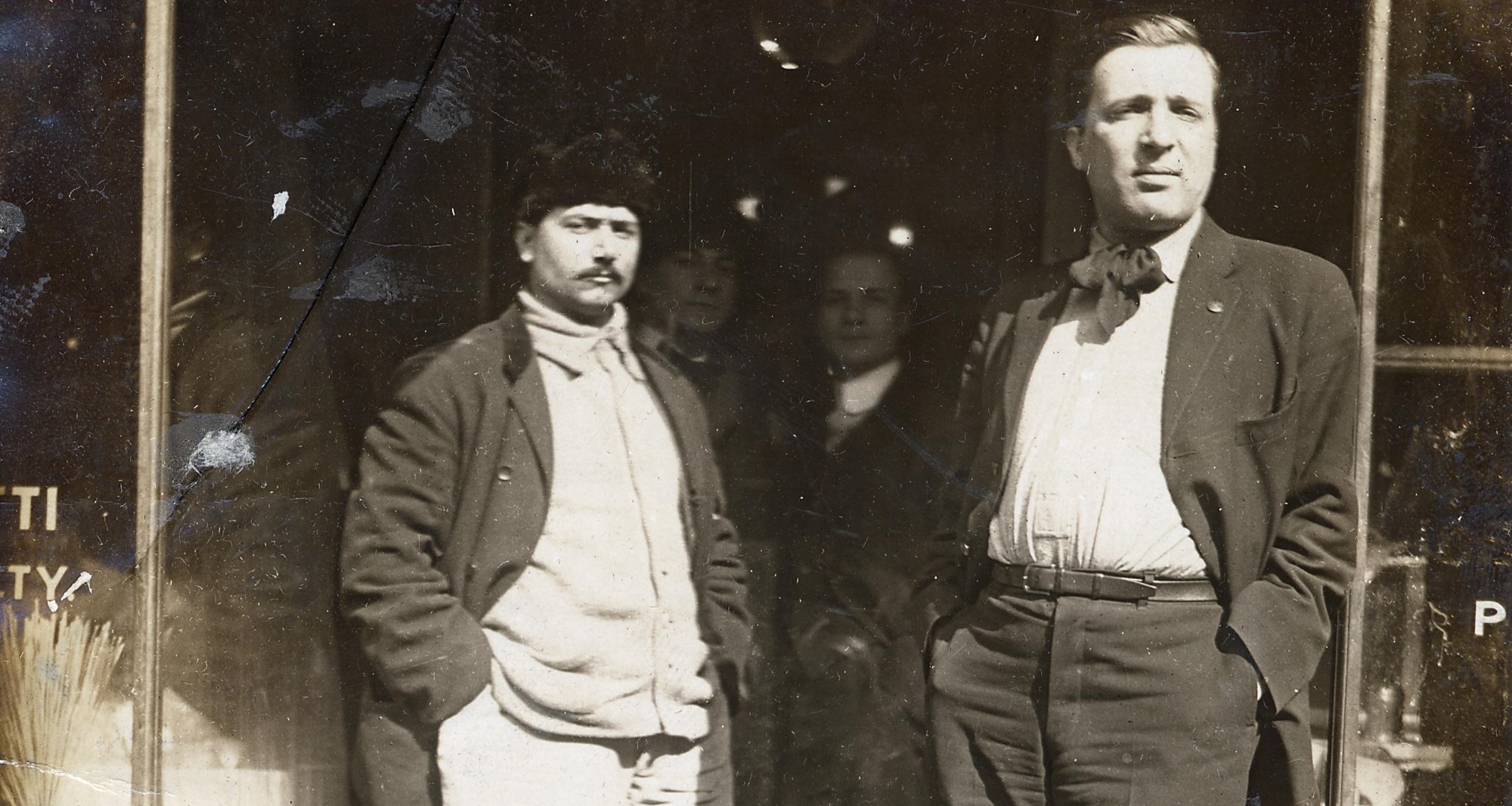
In what was a sounding of the coming World War, taking advantage of an Ottoman Empire in decline and crisis, Italy’s colonization of North Africa begins with the September, 1911 invasion of Tripoli in today’s Libya, then an Ottoman province. With his usual eloquence, Giovannitti denounces the Italian government and analyzes the imperialism of his native Italy.
‘The Brigandage of Tripoli’ by Arturo Giovannitti from The International Socialist Review. Vol. 12 No. 9. March, 1912.
IT IS a Socialist axiom that all wars are iniquitous from the point of view of humanity and disastrous and reactionary from the proletarian standpoint.
We shall leave to humanitarians and sentimentalists, of which lately there is such an over-abundant plethora, to condemn war at their peace dinners and diplomatic picnics at The Hague on account of its atrocities and horrors, and sticking closely to outclass division of humanity we shall consider war strictly from the point of view of the working class.
The working class, which does not declare war, is in the enormous majority the one that fights it—therefore it is the interest of the capitalist class to pretend that in all wars it is always in the main the welfare of the masses that is involved.
Never so much our rulers and masters insisted on this as in the present bloody vaudeville of Tripoli which has been described in the gaudiest colors as the promised land of the poor, half-starved Italian peasantry and a sort of holy sepulchre to rescue from the clutches of the “unspeakable Turk” in the name of civilization and Christianity. Strange as it may seem, a few Italian Socialists, Syndicalists and even Anarchists have openly come out in defence of the Tripolitan hold-up, claiming that the Italian working class would highly benefit by the capture of those squalid and half deserted lands, so that the issues have been confounded to such an extent that it is almost impossible to lay all the blame of this impending disaster at the door of capitalism and the monarchy.
But what are the real interests involved in the present war between Italy and Turkey? To the simplicists who have a readymade creed in politics and economics, as in everything else, this war is explained only by the tendency of a growing nation to expand whenever its political boundary has become too narrow for its industrial and commercial activities—but for those who see and study things and events from a broader field of view the answer is quite different.
As a matter of fact, you cannot explain in the same way the seizure of Tripoli by Italy and that, for instance, of the Philippines by the United States for, although the reason is the same—colonial expansion—the economic forces that make for it are divers and disparaging. Colonization, which, in the original sense of the word means the development of virgin territories, means, as a fact, a different thing to each separate nation; to some it means the exploitation of national products; to others, as in the case of Transvaal, Congo, Morocco, etc., the exploitation of natural resources, and to others still, and this in most instances, the general wanton plundering of everything that is worth anything.
Altogether, however, with the possible exception of when it has a mere political reason, colonization means only one thing—pillage.
The excuse is always the same: Civilization—an elastic and malleable word which may mean according to the points of view the Bible or the public school, the cannon or the locomotive, but which, ultimately signifies nothing but capitalism, whether it be investments, taxation or pure and simple highway robbery.
However, it would be wrong to infer from the fact that all capitalist countries have more or less taken to “colonizing” that Capitalism means necessarily war, or rather that the bourgeoise is war-like and trouble-making; for no class in history was ever, by disposition and natural temperament, so disposed to peace as the capitalist class.
The bourgeoise, which—as a class—has not fought for its birthright as the proletariat will fight, but has made the people do it—will fight, or rather will make others fight for her only when her existence is imperiled. Were it not so, with the psychology which is the same in all thieves, whether burglars or pickpockets, the capitalist class would ask for nothing better than to quietly keep on enjoying the spoils of their cunning and dexterous plundering, without raising the least disturbance. It is, as a matter of side illustration, just on account of this peaceful disposition, determined by the fact that it has no natural means of defence and no hope of surviving its defeat as the other classes of history had, that Capitalism has become the champion of Christianity, philanthropy and democracy, the moral, economic and political trinity of peace, charity and good will, the only things that can save it from Socialism, which means the absolute dictatorship of the working class.
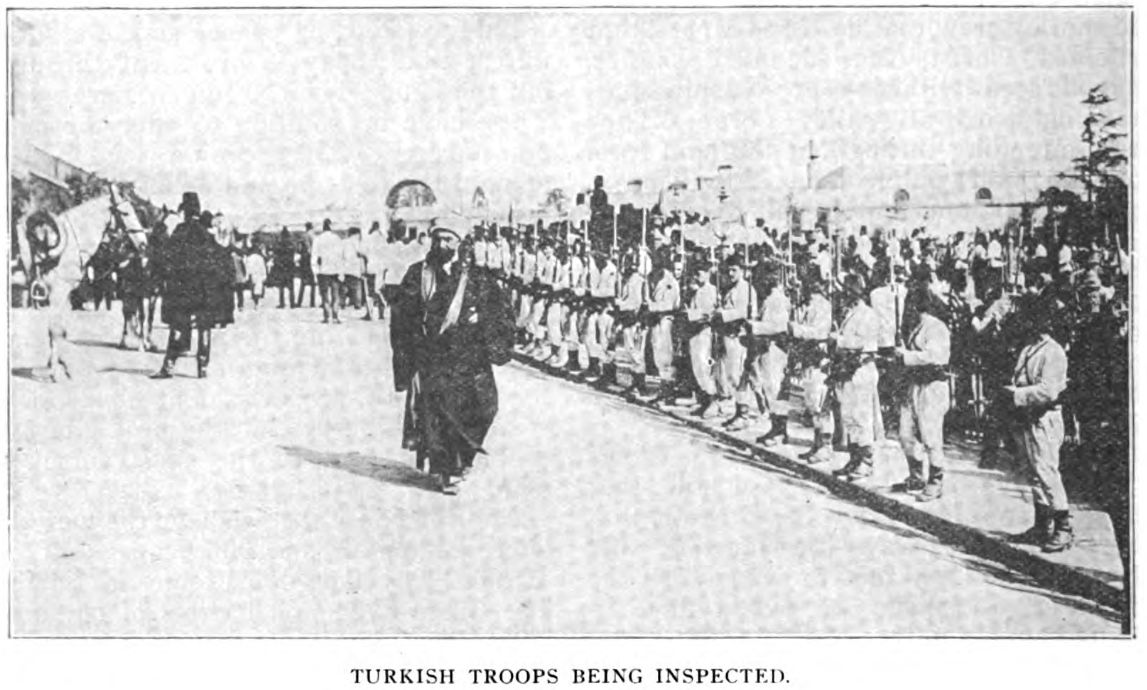
The capitalist class, therefore, recurs to war only when it is strictly compelled to do so for its own conservation; that is the maintenance of internal peace and the continuance of the existing order of things—exploitation and profits.
Whenever this peace is disturbed, which may be only by these profits being endangered by the growing demand of the working class—the only one that has any fighting spirit—the bourgeoisie opens the safety valve and tries to expand.
This expansion is determined in the different countries by two factors: either an excessive growth of production unaccompanied by a proportional growth of the producers and therefore, of the consumers, or, vice versa, by an excessive growth of the population (consumers), unaccompanied by a similar growth of production. In the first instance, it being necessary to give an outlet to products, we have the seizure of foreign commercial markets; in the second an exportation of men, either by emigration or by the capture of unexploited territories. In both instances, if it is necessary in order to keep peace at home, Capitalism will declare war abroad, but in no instance and for no reasons whatever will it reduce its profits.
By the former reason we will have sooner or later (and nothing short of an economic revolution can avert it) war between the United States and Japan for the control of the Asiatic markets, and by the latter we are now assisting to the bloody tragi-comedy between Italy and Turkey for the possession of Tripolitania.
No other economic reason can be found on the side of Italy, which has taken the aggressive, that that of relieving internal conditions by securing more land for the over-abundance of idle arms.
Italy, in fact, is not suffering exactly from what you may call over-production: she has not an overflow of idle capital and therefore has nothing to export and nothing to invest but men.
The Italian proletariat, especially in the south, has remained through the last forty years what it has always been, the same people of old, mostly addicted to agriculture, stock raising and other labors that are strictly confined to the surface land. Now during these forty years the population has steadily grown with that impetus that has made Italian fecundity famous all over the world, whilst the land has remained the same.
The Italian bourgeoisie having, through their utter lack of courage and capacity, been unable to create industries adequate to the necessity and even to apply modern systems to farming that the land might have grown more productive, has been left to face a desperate problem—that of maintaining 35,000,000 people on the resources of the country and at the same time keep their own profits at the same level. After years of discussion, scheming and heavy thinking they have been able to find only one solution: to depopulate the country.
There were, of course, other remedies—heroic remedies—like, for instance, the drainage of swampy lands, of which there are enormous tracts, the irrigation of dry ones, the further development of existing industries (iron, coal, silk, woolens, sulphur, sugar, etc.) and the creation of new ones; but the Italian bourgeoisie, being the most cowardly and impotent pack of greedy fools that ever dishonored mankind, had no heart to undertake such a tremendous task, and the Italian government could not think of saving a few million on the army, the navy, the royal appanage, the church and other similar leeches. If you only consider that Italy spends for the Ministry of Agriculture only 20,000,000 francs a year ($5,000,000), while it pays the king alone 16,000,000 and the pope 4,000,000 (which, by the way, he haughtily refuses, so that he might still pose as a prisoner), you will have a faint idea of the shameful conditions that exist there.
The only remedy then that was left was emigration. For the last thirty years the Italians have been emigrating at the rate of three to four hundred thousand a year, flocking mostly to the United States and South America. Here, however, the Italian peasant, which gives the highest percentage of emigration, has lost its characteristics, and having developed at home a sullen hatred for the land which has been such a cruel step-mother to him, he has refrained from agriculture and invaded the industrial fields.
Had the Italian peasantry in the United States taken to farming they could, perhaps, upon their return home do what the landlord bourgeoisie had not been able to do: develop, fertilize and till the soil after the scientific American ways and still manage to live—but as they have become industrialized and as the few Italian industries are over-crowded, it follows that all those who emigrate to the United States are entirely lost to the mother country. The few that return home either become small proprietors and business men there or, and this in most cases, sell whatever they have however they best can, gather all their family and clan and sail again for America.
All efforts, both by the Italian and American governments, equally interested in the game, to direct the Italian immigration towards the agricultural south and west of the United States, having failed, and America having already a fast growing army of unemployed industrial workers, Italy has seen lately another specter loom up in her stormy sky—that of a coming restriction of immigration by Uncle Sam, whose symptoms are already apparent. This, added to the strained relations with Argentina, where peonage is still in full force, the growing industrial disturbances at home, the great national disasters of the past few years (volcanic eruptions, floods, earthquakes and lately the cholera, which have been conscientiously aided by the government in its work of devastation) has made Italy look towards Africa to secure a nearer territory for the outlet of idle and, therefore, dangerous arms. Hence the conquest of Tripolitania. This is the only reason for the present war. No other economic interests are involved in it, with the possible exception of those of the Bank of Rome, which during the last few years has invested a few millions in Tripoli, in a manner that falls nothing short of open brigandage.
This Bank of Rome, whether to prepare the ground and reason for the war, already planned, in accord with the government, or to further the interests of the Catholic Church, by which it is owned, controlled and operated; after having established a branch in Tripoli, has been profusely loaning to the natives and mortgaging heavily their lands and property. The primitive Arabs and Bedouins, unfamiliar with the business ways of the white, rushed at this unexpected Christian manna that seemed to fall from heaven and borrowed whatever they could get, mortgaging the land, the houses, the trees, even their camels and horses.
The holy bank at the beginning was kind and lenient with them, renewing their mortgages and delaying payments, thus inducing them to get still further into debt, until at last having realized that it had a secure clutch on the poor people’s throats, refused any further prolongation of payments and promptly dispossessed them and expropriated their property.
This went on in such a shameful manner that the Turkish governor was compelled to issue an edict whereby he enjoined the native population from having further business dealings with the Italians, thus producing a strained situation that culminated just before the war in a general boycott of all Italian goods by Tripoli.
Italy had now at last the excuse that she had been looking for so long and probably had been patiently preparing, to declare war without interference by the Powers, which, had it been only a question of take and hold, would have each one done the thing itself with quicker and better success.
But this was not sufficient, for if this was enough justification in the interested eyes of international capital, before the world at large it was not enough to warrant such a high-handed act of piracy. It had to be cloaked, like the stealings and ravaging of India, China, Egypt, Tunis, Morocco, etc., with the blue mantle of civilization; for capitalism is always very particular about keeping the appearances of justice and morality. Moreover, Italy had to somewhat justify the burglary at home, where patriotism was called a synonism of liberty and where the Garibaldian tradition, which has made of the Italians the knight-errants of the world freedom, would have been shocked by such an unwarranted invasion of another people’s country.
The Italians, who during the last century have made their own the cause of all peoples and fought in succession by regular expeditions, in South America for the emancipation of the negroes, in Poland against Russia, in France against Prussia for the republic and the commune, and more lately in Greece against Turkey for the emancipation of Crete, and in Mexico against Diaz, could have been won over to the cause of war only if their national pride, rather than the pope’s pocket-book, had been hurt and outraged.
To this it must be added that after the disastrous adventure in Abyssinia seventeen years ago, the warlike spirit of the nation had been abated, the army discredited and demoralized and the anti-militarist sentiment fostered by the Socialist propaganda had taken alarming proportions.
Only a shocking deed could overcome all these difficulties and this, intentionally or not does not matter, was ably prepared and brought about by the buccaneers of the Bank of Rome in connivance with the government and the church. When the poor natives realized at last in what an infamous way they were being spoilated, all their dormant primitive instincts blazed up again and, driven to despair and finding no redress, they undertook to harass, insult and persecute the Italian residents, murdering a few of the most hated ones.
Everything was now in perfect order—Italy could sharpen the stiletto of the brigand and make it pass for the avenging sword of Justice. She should go.
Horrible stories of Arabian and Turkish crimes were printed and circulated; of a plain murder they made a massacre, of a burglary an expedition of Raisuli; they spoke of Italian girls kidnapped for the harems of the Moslems or altogether raped in the public squares, and with these and kindred stories, in most cases shameful and arrant fabrications, they bore so much on the spirit of the people that it became worked up to such a frenzy that even the blind beggars began clamoring for war.
And the king declared war without even convoking the parliament.
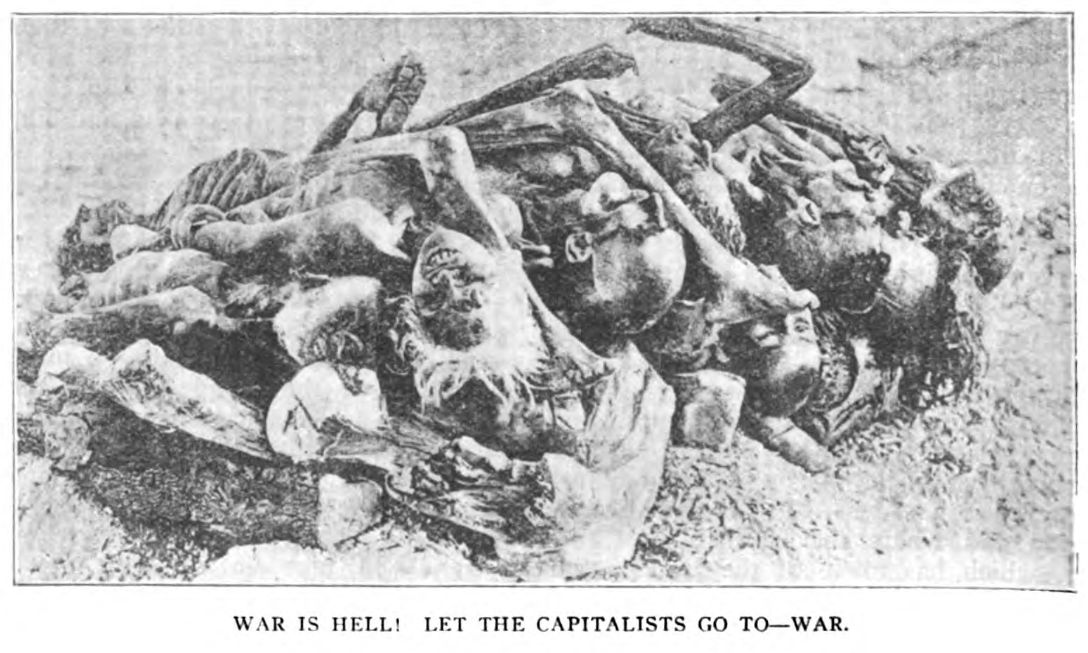
Italy will take Tripoli, it may take months, years perhaps for the Arabs are determined and have real Mauser rifles instead of flint and stock guns, but ultimately “civilized” warfare will win over primitive ways. But will Tripoli solve the problem, the many problems that Italy is facing today? And what benefit will the Italian working class derive from a few square miles of cultivatable land and an immense ocean of hot moving sand after hundreds of millions have been spent, thousands of lives destroyed and the bloody hoofs of militarism trampled a great part of that splendid class consciousness that so patiently and laboriously had been cultivated?
So far, from the war that she has heralded and acclaimed as a holy crusade she has reaped nothing but misery and humiliation, new taxes of money and blood and the atrocious anxiety of the waiting. The people have seen their country stand shamefaced before the nations of the world to, answer for nameless atrocities that have been perpetrated by the flower of its youth, they have seen the ghastly and infamous gallows that their fathers had abolished, even for punishing the murderer and parricide, raised up again in the squares of Tripoli by their grandchildren to hang men guilty of having defended their country and their homes, they have seen the most beastly primitive instincts reconquer the better nature of man, the loftiest virtues fade before military arrogance, peace ranked with cowardice, humanity with fear, brutality with heroism and over all the bloody laughing fangs of murder enthroned. But when, after the effects of the drunken brawl of pillage and slaughter have passed, they shall reckon at last their costs and their gains, they will bitterly realize that patriotism that wants to help them only by sending them to another country to light working men is a sham and a fraud.
And instead of going to Tripoli or anywhere else in the world they will finally understand that it is better to settle wrongs where they are, and that if they must kill, and get killed for their bread and their existence, it might as well be in a revolution as a capitalist war and rather than shoot a lot of ragged beggars abroad, they will hang a few well-fed thieves at home if necessary to destroy capitalism.
The International Socialist Review (ISR) was published monthly in Chicago from 1900 until 1918 by Charles H. Kerr and critically loyal to the Socialist Party of America. It is one of the essential publications in U.S. left history. During the editorship of A.M. Simons it was largely theoretical and moderate. In 1908, Charles H. Kerr took over as editor with strong influence from Mary E Marcy. The magazine became the foremost proponent of the SP’s left wing growing to tens of thousands of subscribers. It remained revolutionary in outlook and anti-militarist during World War One. It liberally used photographs and images, with news, theory, arts and organizing in its pages. It articles, reports and essays are an invaluable record of the U.S. class struggle and the development of Marxism in the decades before the Soviet experience. It was closed down in government repression in 1918.
PDF of full issue: https://www.marxists.org/history/usa/pubs/isr/v12n09-mar-1912-ISR-gog-Corn.pdf

