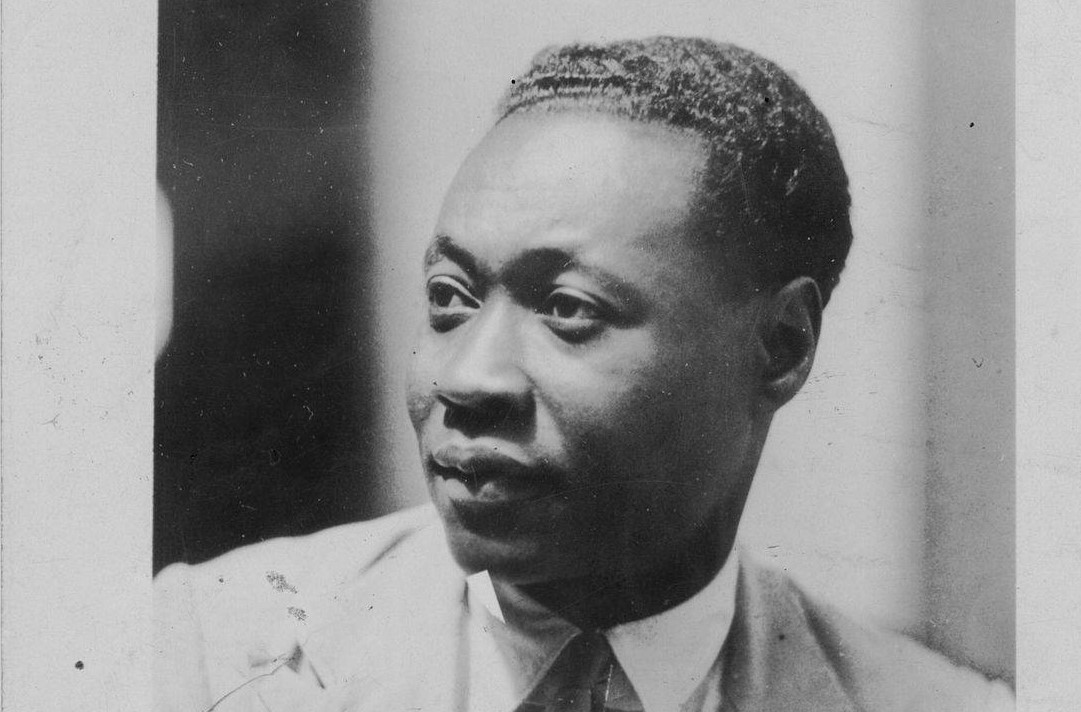
Claude McKay seethes on the inescapable, prison-like experience of everyday life in racist America and girds himself for the long, hard fight ahead. In this justly famous essay, one of his last for the Liberator, McKay recounts his evening traveling to the theater as the magazine’s critic. With gratis tickets with artist William Gropper, he attended the Theatre Guild’s production of Leonid Andreyev’s “He, The One Who Gets Slapped” where he is refused his seat among the press and made to sit in the balcony. A few months after this and McKay would resign his posts with the Liberator, leave the U.S. and head to Moscow to participate in the Fourth World Congress of the Communist International, to begin a decade-long sojourn in Europe and North Africa. He would not live again in the United States until 1934.
‘He Who Gets Slapped’ by Claude McKay from The Liberator. Vol. 5 No. 5. May, 1922.
“WOULDN’T your dramatic critic like to see ‘He Who Gets Slapped’?” So, very graciously, wrote the Theatre Guild’s publicity agent to the Liberator. Our sometime dramatic critic, Charles W. Wood, having deserted us for the season, I elected myself dramatic critic by acclamation. It would be pleasant to sit in a free front-row parquet seat along with the “The Press,” instead of buying a ticket for the second balcony. And as for the other seat–free seats come in pairs–I decided to take along William Gropper, Liberator artist of the powerful punch and vindictive line, and master of the grotesque.
So on the appointed night we presented ourselves at the box office of the Fulton. It was with keen pleasure I anticipated seeing this fantastic play of Leonid Andreyev’s “He, The One Who Gets Slapped.” A curious and amusing theme!
The stubs were handed to Gropper and we started towards the orchestra. But the usher, with a look of quizzical amazement on his face, stopped us. Snatching the stubs from Gropper and muttering something about seeing the manager, he left us wondering and bewildered. In a moment he returned, with the manager. “The-the wrong date,” the manager stammered and, taking the stubs marked “orchestra,” he hurried off to the box office, returning with others marked “balcony.” Suddenly the realization came to me. I had come here as a dramatic critic, a lover of the theatre, and a free soul. But I was abruptly reminded–those things did not matter. The important fact, with which I was suddenly slapped in the face, was my color. I am a Negro.
“He, The One Who Gets Slapped”!…Gropper and I were shunted upstairs. I was for refusing to go, but Gropper, quite properly, urged compromise. So brooding darkly, madly, burnt, seared and pierced and over-burdened with hellish thoughts, I, with Gropper beside me half averting his delicate pale face, his fingers run through his unkempt mop of black hair, shading his strangely child-like blue eyes, sat through Leonid Andreyev’s play.
Andreyev’s masterpiece, they call it. A masterpiece? A cleverly melodramatic stringing together of buffoonery, serious-comic philosophy, sensational love-hungriness and doll-baby impossiblism, staged to tickle the mawkish emotions of the bourgeois mob! So I thought. I sat there, apart, alone, black and shrouded in blackness, quivering in every fibre, my heart denying itself and hiding from every gesture of human kindliness, hard in its belief that kindliness is to be found in no nation or race. I sat inwardly groaning through what seemed a childish caricature of tragedy. Ah! if the accident of birth had made Andreyev a Negro, if he had been slapped, kicked, buffeted, pounded, n***red, ridiculed, sneered at, exquisitely tortured, near-lynched and trampled underfoot by the merry white horde, and if he still preserved through the terrible agony a sound body and a mind sensitive and sharp to perceive the qualities of life, he might have written a real play about Being Slapped. I had come to see a tragic farce–and I found myself unwillingly the hero of one. He who got slapped was I. As always in the world-embracing Anglo-Saxon circus, the intelligence, the sensibilities of the black clown were slapped without mercy.
Dear Leonid Andreyev, if you had only risen out of your introspective Nihilistic despair to create the clown in the circus of hell, the clown slapped on every side by the devil’s red-hot tongs, yet growing wiser, stronger and firmer in purposeful determination, seeking no refuge in suicide, but bearing it out to the bitter end, you might have touched me. But your veiled message means nothing to me and mine. In the great prison yard of white civilization in which Negro clowns move and have their being, your play is a baby babbling in the bedlam of the Christian market-place. And a baby has no chance under the cloven hoofs of the traders in the mart. It is marked for destruction even as I am marked; for, to the hard traders I am a mere pickaninny grown up, that has no claim to the privileges of a man. The purpose of the great traders is clear. They have a little place, a groove for their pickaninny. He must not think, hope, aspire, love in his own way, utter himself and delight in the wonderful creative experience of life as other men. For thousands of other pickaninnies who feel their painfully tragic position in the trader’s world may be aroused to action.
I cry my woe to the whirling world, but not in despair. For I understand the forces that doom the race into which I was born to lifelong discrimination and servitude. And I know that these forces are not eternal, they can be destroyed and will be destroyed. They are marked for destruction. Mesopotamia, Egypt, Greece, Carthage, Arabia, Babylonia, Tyre, Persia, Rome, Germania! The whole historical pageant of the human race unfolds before me in high consolation.
Big Business thrives on color lines and race differences. Its respectable institutions and criminal governments draw strength and power from race hatreds, class distinctions and social insults and discriminations against Negroes. I know the mighty world forces that reach out to control even such organizations as the tiny Theatre Guilds that are doubtless, so far as they can be, radical. So when the representative of the Guild talks over the telephone to the Liberator: “So sorry about Mr. McKay, but you will understand why we must give him a balcony seat,” I, too, understand her quite perfectly. I know of the cruel competition in the theatre business. I know that most of the productions are financial failures. And so, not I would ask any theatre or any business, however exquisitely artistic, however moral and aloof from the market, to shoulder the burden of the Negro race.
Poor, painful black face, intruding into the holy places of the whites. How like a spectre you haunt the pale devils! Always at their elbow, always darkly peering through the window, giving them no rest, no peace. How they burn up their energies trying to keep you out! How apologetic and uneasy they are, yes, even the best of them, poor devils, when you force an entrance, blackface, facetiously, incorrigibly smiling or disturbingly composed. Shock them out of their complacency, blackface, make them uncomfortable, make them unhappy! Give them no peace, no rest. How can they bear your presence, blackface, great, unappeasable ghost of Western civilization!
Yet for the Negro pilgrim there is sometimes a gleam in the dismal, gloomy wood. A little light that saves the sensitive, swarthy face, bruised and bloody, from constant butting against the lignum-vitae trunks of deep-rooted trees. In the populous Sahara of the whites there are little oases where the black pariahs may quench their thirst. Yes, even in the little section of the Metropolitan theatres. For example, at the “Chauve Souris” we had orchestra seats, but at that time the whole atmosphere, audience and all, was so un-American, so foreign-looking, that it must have made no difference. The patrons seemed so simple and Bolsheviki-like–they probably didn’t care if I was a Negro. They seemed so different from the philistine art lovers of the Greenwich Village Theatre, where I was placed apart in the balcony when the Liberator sent me to see Bernard Shaw’s “Candida.” And again, at the Princess Theatre, when Eugene O’Neill’s “Emperor Jones” was being played, I suffered no annoyance–maybe because Gilpin, the Negro actor, was the leading man! Could the “non-commercial” Theatre Guild venture on a play like the “Emperor Jones” with a Negro as the star? How would it solve the problem of the hundreds of well-off Negroes in New York, interested in the artistic achievements of their race, who would demand orchestra seats? Easily, perhaps, in the traditional one hundred percent American way of not noticing such a situation. Easily, for judging from the list of plays the Guild has produced, the best talent, for it, is outside of America.
Damn it all! Good-night, plays and players. The prison is vast, there is plenty of space and a little time to sing and dance and laugh and love. There is a little time to dream of the jungle, revel in rare scents and riotous colors, croon a plantation melody, and be a real original Negro in spite of all the Tom Dixon crackers and the subtly sneering fictioneer Stribling’s “Birthright.” Many a white wretch, baffled and lost in his civilized jungles, is envious of the toiling, easy-living Negro.
Cherish your strength, my strong black brother. Be not dismayed because the struggle is hard and long, O, my warm, wonderful race. The fight is longer than a span of life; the test is great. Gird your loins, sharpen your tools! Time is on our side. Carry on the organizing and conserving of your forces, my dear brother, grim with determination, for a great purpose for the Day!
The Liberator was published monthly from 1918, first established by Max Eastman and his sister Crystal Eastman continuing The Masses which was shut down by the US Government during World War One. Like The Masses, The Liberator contained some of the best radical journalism of its, or any, day. It combined political coverage with the arts, culture, and a commitment to revolutionary politics ay a pivotal time in Left history. The writings by John Reed from and about the Russian Revolution were hugely influential in popularizing and explaining that events to U.S. workers and activists. Increasingly, The Liberator oriented to the Communist movement and by late 1922 was a de facto publication of the Party and was sold to the Party by Eastman. In 1924, The Liberator merged with Labor Herald and Soviet Russia Pictorial into Workers Monthly. The Liberator is an essential magazine of the US left.
PDF of full issue: https://www.marxists.org/history/usa/culture/pubs/liberator/1922/05/v5n05-w50-may-1922-liberator-hr.pdf

