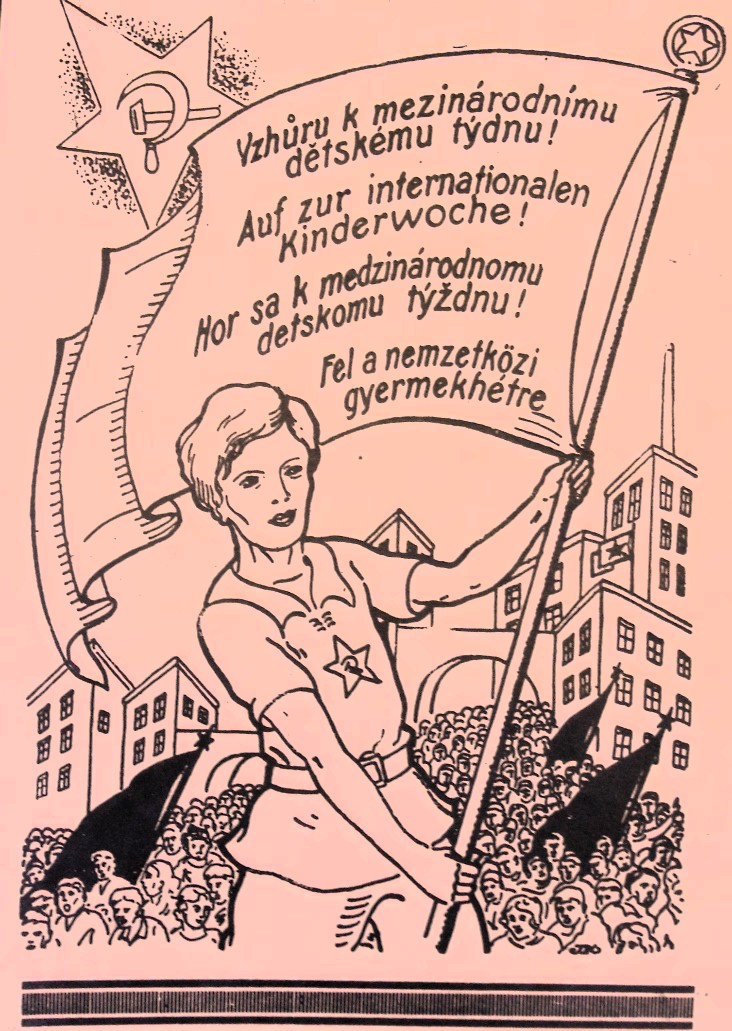
A report of the Czechoslovakian delegation on the activity of that country’s Young Communist League nearly 13,000 members (to nearly double in size in the 1930s), its internal organizational troubles and external work. With members in hundreds of communities and dozens of factories, reflecting the diverse, multi-lingual working class of that new county, it published the newspapers Rote Jugendwacht in German, Pravda Mladeze in Czech, Karpatskaya Molodiosch in Ukranian, Fiatal Dolpozo in Hungarian, and Dorast Chudoby in Slovakian. In addition a Pioneer section published several children’s papers in German and Czech.
‘Young Communist League of Czecho-Slovakia’ from Communist Youth International Between the Fourth and Fifth Congresses, 1924-1928, August 1928.
The period between the Fourth and the Fifth World Congress has played a great role in the development in the Czech Y.C.L. In this period the League succeeded in commencing mass work in all spheres. Only after the Fourth World Congress did the League learn how to work seriously under the difficult conditions arising from the national situation in Czecho-Slovakia. If the young Czech worker in the League previously played a passive role, this situation has now been greatly improved through the consequent carrying out of the so-called “Czech course.”
When the League after the Fourth World Congress of the Y.C.I. began to apply the decisions in order to establish the preliminary conditions for Bolshevisation, the League went through a crisis in the course of which all those old functionaries who could not adapt themselves were replaced by young elements. Since the Fourth National Congress in 1925 the Czech League has begun its mass activity, conducted regular trade union work, systematic organisational work, introduced new methods of work and improved its training work. This Congress also brought about a change in leadership by drawing the Czech section of the movement into responsible leadership.
The Fifth National Congress, 1926, brought a continuation of the course begun at the Fourth National Congress, and the Sixth National Congress, 1928, laid down concrete tasks on the basis of the experiences gathered between the two Congresses.
THE PARTY AND Y.C.L.
When after the Fifth World Congress of the Comintern, the Party was confronted with the question of Bolshevisation, the old social democratic traditions of the Party expressed themselves in the confusion on the role and the political line of the Party, and brought about a serious crisis. The League took up a clear stand in this crisis, supported the line of the Comintern, and actively worked on its application. During the whole period of this crisis, the League was absolutely unanimous. Only when the bloc between the centre and the majority of the Party, which brought about the real restoration of the Party, was set up, some voices in the League were raised against the bloc. A serious campaign of clarification was necessary in order to achieve a correct attitude. During the period of Trotskyist Opposition, the Y.C.L. carried on a struggle against the deviation from the line of the Comintern fight from the beginning. The League, however, did not undertake early enough a thorough campaign to clarify the questions of the Opposition. Through that, some oppositional tendencies became noticeable also in the Y.C.L. Particularly, Michalec tried to smuggle in Trotskyist oppositional views on the Y.C.L. into the Party. The League, however, succeeded in liquidating this opposition also in the Y.C.L. with very few sacrifices. Only in Prague, there were some students, and in Ostrau, Brünn and Böhmisch-Krumau were some members who sympathised with the opposition. After the Sixth National Congress, which adopted clear decisions on the question of opposition, and which declared in its resolution that ideological solidarity with the Opposition cannot be united with the retention of Y.C.L. membership, two districts in the Reichenberg district opposed the resolution of the Congress. In these two districts, however, the opposition was defeated.
The relations between the Party and League have greatly improved of late. Although the lower Party organisations do not yet correctly understand the role and work of the Y.C.L., the League is being supported in its work by the leading organisations.
The League several times took a critical attitude towards the Party in political and tactical questions. The League criticised the insufficient activity of the Party in the time of the Vienna events and the Sacco-Vanzetti campaign, the mistaken and insufficient slogans in economic struggles and the mistakes of the Party in the application of the United Front tactics.
ANTI-MILITARIST WORK AND THE STRUGGLE AGAINST THE WAR DANGER.
The Czech Communist movement does not possess any traditions of Bolshevist anti-militarist work. The League has not succeeded so far in linking up the great campaigns against the war danger, for the defence of the Soviet Union with organised work inside the army. The League developed great activity in the struggle against the reactionary militarist laws which were introduced to increase the period of military service, which robbed the soldiers of the right to vote and brought about various other hardships of an economic nature. It conducted for several months a broad campaign against the military reforms, which found its climax in the Anti-War Week. During this period more than a hundred demonstrations and meetings were organised, in which great masses of the Socialist and indifferent youth also participated. The great weakness of this campaign was that those sections which were directly concerned, the soldiers, were not drawn into this work, which was not linked up with intensive activity inside the army and has not created organisationally favourable conditions for anti-militarist work. Only towards the end of 1927, a real serious start was made in anti-militarist work, after practically nothing had been done in this field for two years. In the Autumn of 1927 a recruiting campaign was conducted, which was prepared and led by the centre. For this purpose a series of recruits’ conferences and recruits’ farewell celebrations were held, and plenty of agitation and propaganda material was published. The experiences gained in this campaign were utilised in the development of further measures for the systematic continuation of the anti-militarist work. Little progress is being made in this work, because the Party does not pay sufficient attention to it. The League completely redrafted the old, faulty soldiers’ programme and has now published a new programme of soldiers’ demands, which serves as a good basis for broad activity among the soldiers.
The campaigns against the army estimates, the campaign for the defence of the Soviet Union, against intervention in China was linked up with a broad propaganda campaign on our attitude in case of an imperialist war and on principle questions in this connection.
THE UNITED FRONT.
The United Front tactics were practically applied, particularly during the preparations for the sending of a youth delegation to the Soviet Union, and in economic and political campaigns.
During the last years the League has conducted three campaigns for the sending of youth delegations. Only two delegations from Czecho-Slovakia visited the Soviet Union, the third being prevented at the last moment by the refusal of the Czecho-Slovakian Government to grant visas. The preparation of the young workers’ delegation was carried through by the League in a series of factory meetings and young workers’ conferences. For the second youth delegation, thirty such young workers conferences on a district scale were held. The composition of the young workers at these conferences were as follows: Communists 56 per cent., indifferent 38 per cent., other working class youth organisations 6 per cent. The United Front Committees, which were elected by the conferences were composed of: Communists 32 per cent., indifferent 22 per cent., Socialist youth 46 per cent.
The climax of the various united front activities was the First National Young Workers’ Conference, which was also preceded by a series of district conferences and factory meetings. The Congress was attended by 297 delegates from 214 factories. Only 88 of the delegates were Communists. The Congress, in addition to the organisation of the third young workers’ delegations, was utilised for the struggle against militarism and iperialist war danger, and for the mobilisation of the young workers for the economic struggle.
Successful work was undertaken during the campaign of the third young workers delegation. The delegation also issued the report on the Congress of the Young Friends of the U.S.S.R. in the Czech language.
In the German Socialist Youth League and the Czech National Socialist Youth organisation, oppositional tendencies developed, which were more or less connected with us, and influenced by us. The contracts were, however, not permanent ones, and in decisive moments and at conferences the opposition completely failed. The reason for this can be found in the weak organisation of the opposition elements and the lack of a political platform of the opposition.
The League committed a series of errors in the application of the united front tactics; on the one hand there was an over-estimation of the united front, and an opportunist application, and on the other hand there was confusion over the question of the organisations with which we could form a united front.
ORGANISATION.
The weakest part of the League’s work has always been organisational work. Immediately on commencement of reorganisation, which was conducted quite mechanically, the League underwent a crisis. In 1925-26 there were 250 factory groups, which number dropped down to 70. Only through individual work in the various fields, through continual attention to large scale factories and the study of the conditions prevailing in the various districts and through the organisations of organisational conferences has an improvement become visible. The League now consists of 113 factory groups, 229 street groups, and 305 village groups. 25 per cent. of the whole membership work in factories, though only 11 per cent. are organised in factory groups. The League numbers 13,000 members. The work of the factory groups has been improved by the application of the decisions of the various organisational conferences, by the enlivening of work and laying down of concrete tasks.
In the organisational sphere, the League has made great progress by launching out in the Czech districts. In many Czech districts where previously no youth organisations existed, such do now exist.
In the period under report, the League also commenced to organise Ukrainian young workers, in the Zakarpatska Ukraina. The apparatus of the League was strengthened in the centre as well in the districts.
ECONOMIC TRADE UNION WEEK.
Only from the time of the International trade union week can we speak of a serious commencement of trade union work by the Czech League. The Y.C.L. set itself the task of achieving 100 per cent. trade union organisation of its membership, the creation of trade union fractions and systematic work in the trade unions. The Second Congress of the I.A.V. (International Trade Union Federation) adopted a resolution, put forth by the Czech League, which demanded special facilities for the entry of young workers into trade unions and the setting up of youth commissions. Approximately 1,000 new members were won for the trade unions in the trade union week held after the Sixth National Congress. In the course of this trade union campaign 358 factory meetings were held in II districts.
The work of the Youth Commissions in the Red Trade Unions has been neglected. Only during the last period an improvement became visible. There exists now a Central Commission of the Executive Committee of the I.A.V., 13 district commissions and 10 local youth commissions. The League organised a series of trade union conferences, which discussed concrete tasks and work inside the trade unions and elected youth commissions. Although during the last trade union week several hundred members have been won, only 25-30 per cent. of the membership of the League are organised in trade unions, as the majority of the new recruits were unorganised.
The League played an active role during the various economic struggles. In addition to some smaller struggles, we must mention the organisation of the struggle of the young glass workers in 1925, the active participation in the great textile workers’ struggles in 1926 in Middle and East Bohemia, the builders’ struggle in 1927, and the miners’ struggle in 1928. In all these struggles the Y.C.L. put forward special youth demands, was represented on the strike committees and organised special youth meetings. During the last miners’ struggle 8,000 out of the 30,000 strikers were young workers. 20 youth meetings were held. Apart from the struggle of the young glass workers, there was a series of independent young workers’ strikes in Czecho-Slovakia, which were concluded more or less successfully. The League conducts at the present moment, jointly with the Party, a large campaign against the worsening of social insurance.
AGIT-PROP ACTIVITY.
During the period since the Fourth World Congress, systematic training work was begun. During this period three League schools were held, one Czech, one German, and one both German and Czech, attended by approximately 100 functionaries. After the first League school, district schools with 600 comrades attending were organised. The comrades who had passed the Central School were utilised for these schools. In 200 elementary courses, 4,000-5,000 members received political minimum education. In addition, special courses for training of members were held at various times.
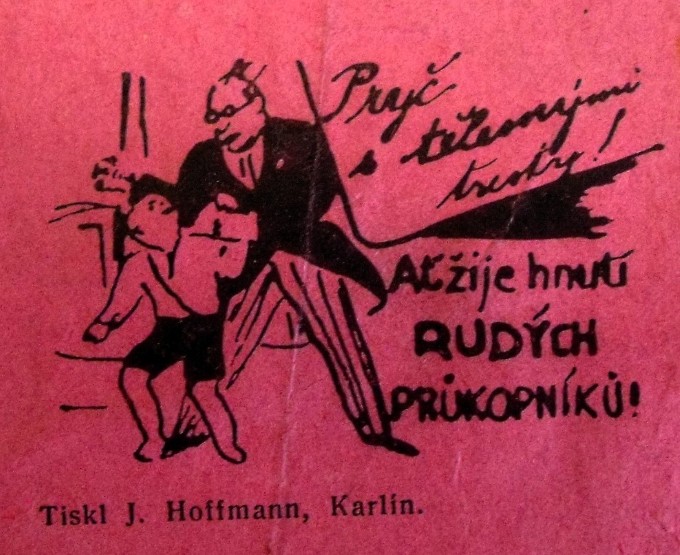
All campaigns, such as International Youth Day, May 1st, and others, show the great political influence of the League on the masses of young workers. For International Youth Day 250 meetings were organised, which were attended, in addition to many adult workers, by 40,000 young workers.
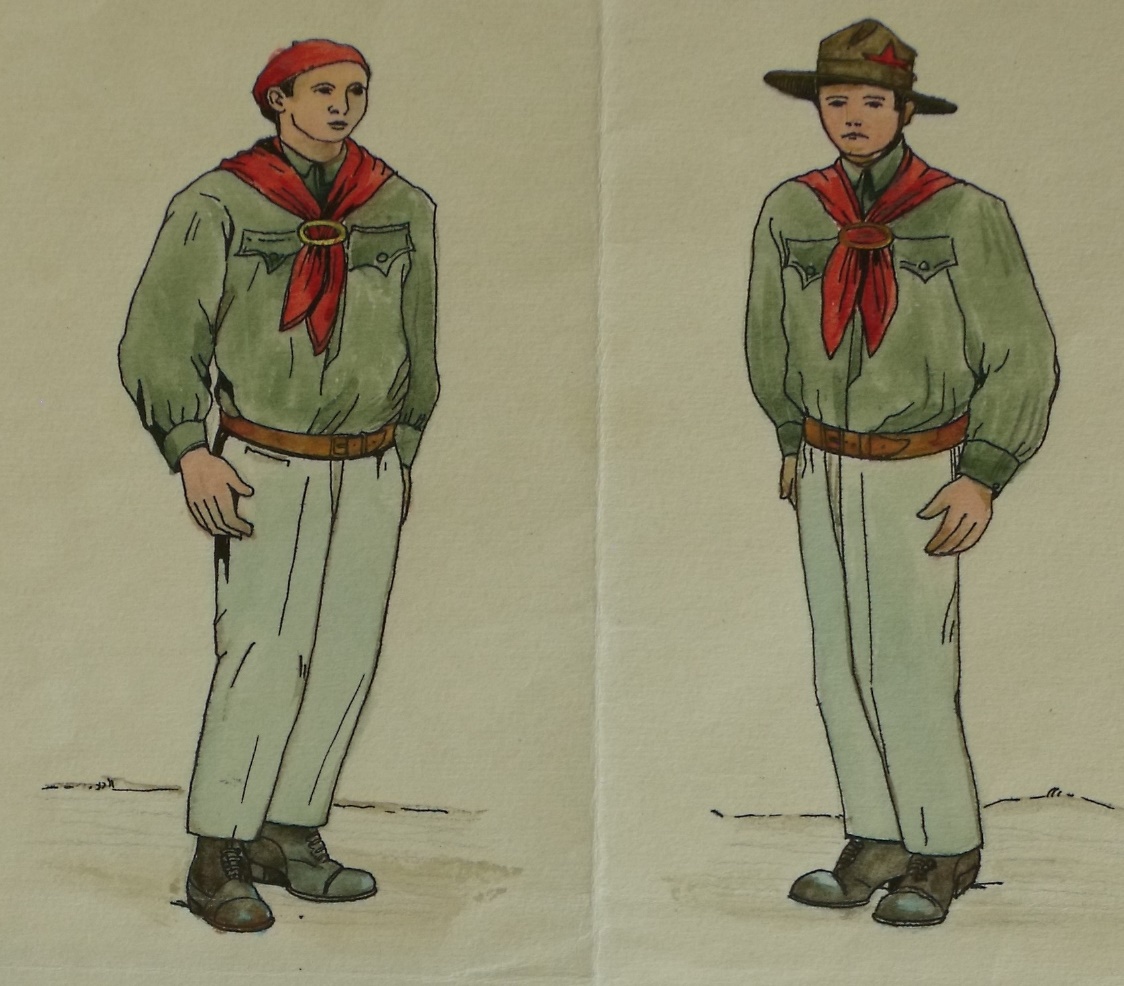
The League is now actively working to improve its methods of work and to brighten the inner life of the organisations. The “Blue Blouses,” which are modeled after the Russian, are very popular.
WORK IN THE COUNTRYSIDE.
So far no systematic work is being conducted among the young peasants and young agricultural labourers, although the League has many organisations in the villages. In 1926 a week of agitation was organised in the countryside; this, however, with the exception of the Slovak districts, did not meet with any particular good results. In May, 1928, a Conference of functionaries working in village organisations was held.
PIONEER ORGANISATIONS.
For a long time the Pioneer organisations were not under a central leadership. For this reason this movement developed very slowly. Only the Sixth National Congress decided to organise a Central Children’s Bureau, which safeguards the development of Pioneer organisation. At present 2,000 Pioneers are organised in 70 sections. The Pioneer organisation publishes a Children’s paper in Czech under the joint editorship of the Party and League, and a children’s paper in German has been issued since May of this year.
The work in the Proletarian Sport Movement has been badly neglected. Although in the Red Sport organisations alone 30,000 young workers are organised in the German workers’ gymnastic and sports movement a strong opposition movement has sprung up, and although a large percentage of the members work actively in the sport organisation, no fractions exist and no systematic work is being conducted.
PRESS.
In the period under report, the League has created papers (appearing fortnightly in German and Czech) were transformed into weeklies. The League now publishes five papers in German, Czech, Slovak, Hungarian and Ukrainian, with the total circulation of 14,500 copies. The German and Czech papers are weeklies, the others monthlies.
PERSPECTIVES.
Since its dissolution in 1922, the League has worked in a semi-legal state. The repression against the Y.C.L. is stronger than against the Party. The Government tries by all methods at its disposal, particularly through persecution of the League’s functionaries, to weaken and paralyse the work. In addition to this, there exists a strong employers’ terror. Nevertheless, the conditions for the development of the League are very favourable. The situation in Czecho-Slovakia becomes sharper every day, the masses are getting more and more active and the number of larger and smaller economic struggles grows steadily. If the League will understand how to utilise the favourable conditions to the fullest extent, how actively to lead all struggles, and how to strengthen its work in all spheres, only good results can accrue.
PDF of full book: https://www.marxists.org/history/international/young-communist-international/cyi-4th-to-5th.pdf

