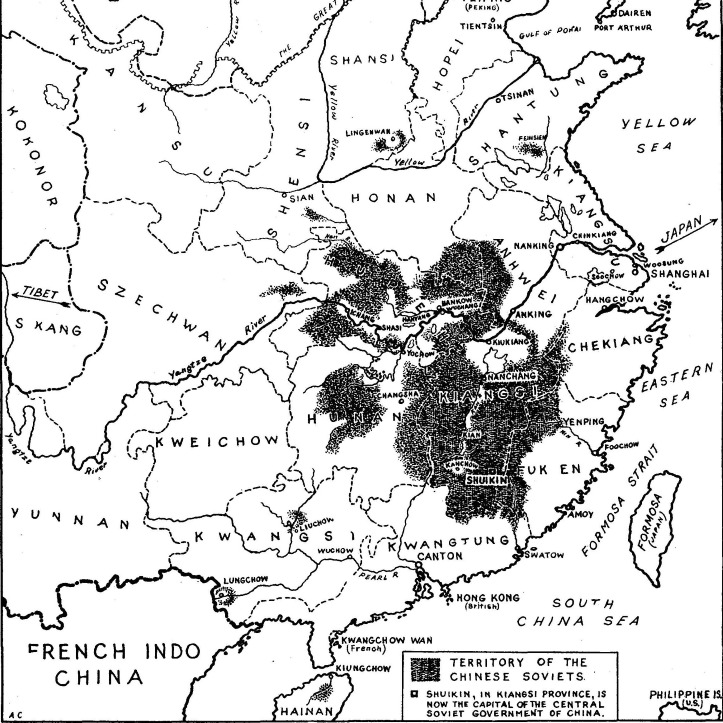
Before the People’s Republic was proclaimed in 1949 after the People’s Liberation Army victory in the Second Civil War, there was Soviet China proclaimed at the All-Chinese Soviet Congress on November 7, 1931 held in Ruijin, capital of the Jiangxi Soviet. The Soviets developed during the First Civil War and were made up of a number of non-contiguous, largely rural, locations under control of the Chinese Red Army after defeat and retreat from the major cities in 1927. The amount of authority exercised in these Communist-administered areas differed by leadership and location, with their territory shifting as they became targets of the Kuomintang’s ‘encirclement campaigns’ over the next years, which ultimately led to the retreat now known as the Long March in the autumn of 1934. Below are reports of two strongholds of the Chinese Soviets as they were in early 1932.
‘The Situation in the Hunan-Kiangsi and North-East Kiangsi Soviet Districts’ from International Press Correspondence. Vol. 12 Nos. 20 & 26. May 5 & June 9, 1932.
The Situation in the Hunan-Kiangsi Soviet District.
Like all other Soviet districts, the Soviet district situated on the borders of Hunan and Kiangsi has grown and increased in strength through constant struggles against the attacks and intrigues of the imperialists and the Kuomintang, on the one hand, and against various deviations and tendencies, on the other, many important and fundamental problems, such as the land distribution, economic policy etc. have lately found a correct solution.
The local Soviet Government has paid the greatest attention to the land problem because of its importance as the most fundamental task. Despite the fact that the distribution of the land was carried out long ago, the work was not regarded as complete and successful until towards the end of last year, when a campaign for redistribution was conducted. The work is now practically completed, with the exception of a few places in Pinghsiang and Yu-heuen where white troops are active and the masses have to concentrate all their attention and energies on fighting the enemy. The redistribution was carried out by allotting so much land to each village according to labour power and population. Agricultural implements, as well as draught animals confiscated from the landlords and gentry, were divided among the agricultural labourers and poor peasants who were in need of them. The plan to set up agricultural implement stations has not yet been realised. It is quite certain that the recent redistribution of the land has raised the agrarian revolution to a much higher level.
In regard to economic policy, there is no need to say that the Kuomintang’s taxation policy, under which frightfully heavy burdens were imposed on the toiling masses, has been done away with. For the purpose of defending the Soviet power and maintaining the public services, the Soviet government has introduced a progressive land tax and a progressive commercial tax. The burden of taxation is borne by the well-to-do peasants. The families of red soldiers, the poor peasants who do not receive more than 600 catties) of grain annually for each member of their families, and those families who after meeting their own requirements have left over less than 100 catties of grain annually, are exempted from the progressive land tax. (*A catty is the Chinese pound, usually amounting to 1 lb. avoirdupois.)
Trade in such articles of everyday use such as tea, oil, table-salt, matches and medicine is exempt from the progressive commercial tax. Traders whose capital does not exceed $50 are also exempted from the commercial tax. Traders with a capital between 50 to 100 dollars and dealing in petroleum, cotton cloth, stationery etc. are taxed 2 per cent, whilst those dealing in foreign goods, wine tobacco etc. are subjected to a tax of 3 percent, for traders with a capital exceeding $100 the tax is increased progressively by 0.5 per cent, and 1 per cent, respectively for each $100 of capital.
In order to combat the economic boycott imposed by the enemy and to develop the village economy, and thereby improve the standard of living of the poor people in general, the Soviet government has established a workers and peasants bank, which commenced operations on January 15. The Bank at present has a capital of $20,000 and is planning to increase it to $100,000. It has issued banknotes to the amount of $100,000.
The broad toiling masses of the Soviet districts realise that in order to consolidate and extend their economic achievements they must promote the sound growth of the Soviet regime, ruthlessly repel the attacks of the white troops, and combat the destructive activity of the gentry and landlords, This is the reason of their enthusiastic militant spirit. It is concretely expressed in the various activities they are now conducting on behalf of the Red Army, the local defence forces and to purge the district of reactionary elements.
The working population of Lienhua and Yenshien willingly and eagerly give congee, tea, vegetables, firewood, shoes, sandals etc. to the red soldiers and at the same time mend and wash their clothes. The families of the red soldiers have the best land allotted to them and are constantly helped by their neighbours in tilling it. Although the Red Army has suffered heavy losses in the course of a long period of bitter fights, it has had no difficulty in maintaining its strength thanks to the fact that the broad masses, particularly the Young vanguards, always promptly answer the call of the Red Army for new recruits. Of the new recruits about 20 per cent. come from the Young Vanguards.
The local defence forces in the various districts have been very active in harassing the enemy’s rear, in building defence works and assisting the Red Army generally. For instance, the armed forces of the working masses of Ki-an have attacked and seized many headquarters of the armed forces of local landlords and gentry and obtained possession of a large number of rifles. The armed forces of the workers of Yinhsien, numbering over 4000, are constantly harassing the rear of the enemy.
The masses have also displayed great activity in clearing out the reactionary elements. All families of the landlords, gentry and reactionary elements in the various districts have been deported. Many of them who actually took part in counter-revolutionary plots were executed.
The women are also playing their part. There are many women holding positions in the local Soviet governments. The women members of the Young Vanguards fight as bravely as the men. The struggles against the old usages and customs is now proceeding in various districts. The movement for holding women’s conferences is now being built up from below, and it has been decided to hold the provincial women’s congress on March 8, International Women’s Day. Every local Soviet government has attached to it a women’s committee which deals specially with questions relating to the improvement of the conditions of living of women and the women’s demands in general. These committees constantly submit their suggestions to the Soviet government for execution by the latter.
As large tracts of territory have now come under the control of the Soviets, and the Kuomintang has thereby lost considerable areas which it formerly was able to exploit, the burdens imposed upon the masses in the districts still under the Kuomintang have increased tenfold. Moreover, the white troops seize stocks of food, burn down houses, violate women everywhere and constantly compel the masses to serve as guards or “volunteers” to assist them in attacking the Soviet districts. The lot of the soldiers in the white armies is no better than that of the civilian population. Their pay is always several months in arear; they have to endure the rigours of winter clad in a uniform of thin cotton cloth; they are constantly bullied and flogged by their officers. This is why they are susceptible to the propaganda of the Soviet masses and why from time to time they desert or mutiny. The masses in the Soviet districts always cordially welcome mutineers and deserters. Most of them are quite ready to stay with the Red troops and help to fight the Kuomintang.
It is obvious that despite the savage white terror exercised by it, the Kuomintang is already very hard put to it to maintain its rule in the white districts and to prevent the Soviet government from extending its rule.
***
The Soviet District of North-East Kiangsi. (Soviet Correspondence from Ko-Yuän in North-East Kiangsi.)
The Soviet territory in North-East Kiangai, today comprises more than 20 districts.
After having defeated the third campaign of the Kuomintang against the Soviet districts last year, the Red Army also succeeded in recapturing the lost districts. In addition, new victories have been achieved in the Spring of this year. Thus at the end of February, three new Soviet districts were set up in the Kuang-Fung region (North-East of Kiangsi) and three further districts in the region between Djen-Yang and Pu-Zen. From here the Soviet Power has been extended in the direction of Djen-Ngau. The advance of the Red Army has been particularly successful in Fukien. The town of Chunganhs was captured and the Wuyi mountains, an extremely important strategical point, occupied, so that the Kuomintang troops have lost a strong basis. In the Te-Schin region (Kiangsi) the 6th Soviet district has been recaptured and a new Soviet district (the 10th) has been organised. In the course of a month the Soviet territory in North Kiangsi has increased by 200 square Li. (*A Li is about a third of an English mile.)
As a result of this extension of our Soviet district our aim, the uniting of the various Soviet districts into a cordinated Soviet territory, has been partly realised. Particularly important is the linking up of the Soviet district in North-East Kiangsi with the Soviet district in the North of Fukien, which was achieved by setting up a military guard to cover the connecting routes. The connection between the Soviet district in North-East Kiangsi and the Central Soviet district in Kiangsi was established by the partisan fights, so that a united Soviet district in Kiangsi is approaching realisation.
In spite of their repeated defeats, the troops of the Kuomintang reaction have not yet abandoned their hopes of annihilating the Soviet districts and are constantly carrying out fresh attacks. When the 9th, 79th and 53rd divisions of the Kuomintang army, after the defeat of the third campaign against the Central Soviet district, retreated to Anhwei and Chekiang, they attacked the centre of our Soviet district of Ko-Yuan, In other places they also attacked the agricultural population, set fire to the houses, seized the grain and killed civilians. In spite of this furious attack on our Soviet district, the Kuomintang army was repulsed by our heroic 10th Red Army supported by the Soviet population. Finally, the Red Army together with the local partisan troops inflicted an annihilating defeat on the Kuomintang army, which lost more than 1000 killed and wounded. The scattered remnants of the defeated Kuomintang army were driven over the frontiers of the province.
As a result of the constant defeats the Kuomintang troops were compelled to apply new methods in their fight. The 55th, 18th and 4th divisions of the Kuomintang army and the local “security detachments” of the Kuomintang are permanently stationed round our Soviet district. In addition to the numerous robber attacks upon the Soviet population, these troops are engaged in consolidating their position by erecting fortresses at distances of 30-40 Li from each other. The Kuomintang troops are now endeavouring to blockade the Soviet districts. In order to weaken the morale of the Soviet population they spread the rumour that the “fortresses mean the death of the “Communist bandits”. It is true, the fortresses mean a threat to the Red Army, which is still weak from the military-technical point of view, but in recent times it has succeeded in destroying not only some of the newly erected fortresses (near Wan Yian) but also some of the old ones (for instance in Yu-Kiang).
Under the former Le-Li-San leadership we made various mistakes in our agrarian policy. Thus for instance, the division of the land was not carried out in the interests of the poor peasants and land workers. The confidence of the middle peasants in the Soviets was also shaken by such mistakes. The correction of these mistakes consolidated and strengthened the confidence of the broad masses into the Soviet power.
As a result of the agrarian revolution a clear class differentiation is taking place in the village, and the class struggle is assuming sharper forms. The big peasants, who always liked to make themselves out to be middle or even poor peasants, were exposed by the toiling population. The result of this new correct agrarian policy was expressed in the fighting enthusiasm with which the poor peasant population repulsed the attacks of the enemy.
The Provisional Central Government of Soviet China has also proceeded to carry out the labour legislation adopted by the Soviet Congress. Wages have been considerably increased, the eight-hour day has been realised by the workers’ collectives and also the agricultural workers have partly won the eight-hour day.
The trade unions of our Soviet district now comprise 14,198 members, of whom 8764 are artisans, 4191 agricultural workers, 371 water transport workers, 505 unskilled workers, 303 miners and 64 commercial clerks. The trade unions are exerting all their forces in order to win a greater number of agricultural and industrial workers by a correct representation of the interests of their members.
Since the news of the Japanese attack on Manchuria reached our Soviet district the anti-imperialist and anti-Kuomintang mood of our Soviet population has greatly increased. In a very short time the membership of the League against Imperialism rose to 160,000. In February the League Against Imperialism held a delegate conference of the whole Soviet district. It was decided to fight, under the leadership of the Soviets, against imperialism, against the Kuomintang, and for the development of the agrarian revolution. In addition, the Congress adopted a programme of action of the anti-imperialist movement.
The news of the Japanese robber-attack on Shanghai greatly enhanced the fighting spirit of the Soviet population. Everywhere protest demonstrations of the workers and peasants took place. The toiling population of our Soviet district pledges itself to continue the fight with all its forces until final victory against the Japanese robber-attacks, against the partitioning of China by the imperialists, for the support of the heroic struggles of the Shanghai workers, for the defence of the Chinese Soviet districts and of the Soviet Union!
International Press Correspondence, widely known as”Inprecorr” was published by the Executive Committee of the Communist International (ECCI) regularly in German and English, occasionally in many other languages, beginning in 1921 and lasting in English until 1938. Inprecorr’s role was to supply translated articles to the English-speaking press of the International from the Comintern’s different sections, as well as news and statements from the ECCI. Many ‘Daily Worker’ and ‘Communist’ articles originated in Inprecorr, and it also published articles by American comrades for use in other countries. It was published at least weekly, and often thrice weekly.
PDF of full issue: https://www.marxists.org/history/international/comintern/inprecor/1932/v12n20-may-05-1932-Inprecor-op.pdf
PDF of issue 2: https://www.marxists.org/history/international/comintern/inprecor/1932/v12n26-jun-09-1932-Inprecor-op.pdf

