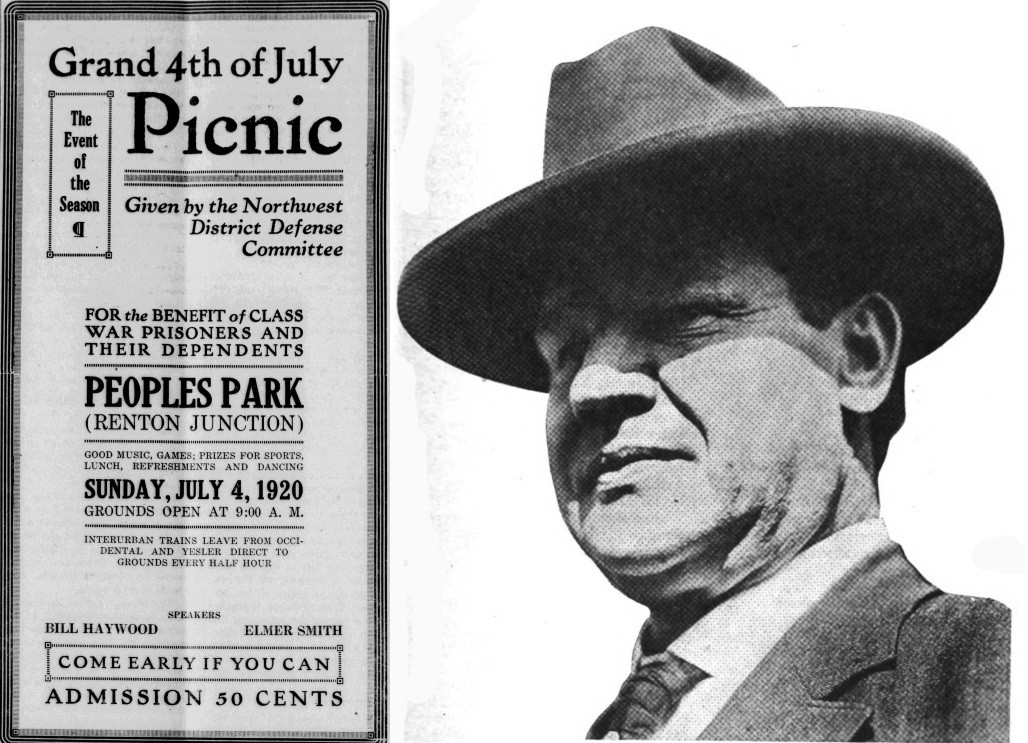
A speech from Haywood is the main event at a benefit picnic for class war prisoners held at Seattle’s Peoples Park on July 4, 1920 that saw thousands attend.
‘Seattle Picnic Scores Tremendous Success’ from Industrial Worker. Vol. (new) 1. No 64. July 10, 1920.
BIG PICNIC PREPARATIONS BEING RUSHED
The picnic committee in charge of the big picnic on July Fourth at People’s Park, Renton Junction, in anticipation of a record breaking crowd, have been making extensive improvements at the park during the past week. Sanitary accommodations have been made, adequate both for men and women. Many more tables, benches and refreshment stands have been built and placed at shady and advantageous spots. Everything possible is being done to complete the improvements necessary for the accommodation of a large crowd.
The program as announced by the committee for speaking, dancing and sports is as follows:
Refreshments on sale from 10 a.m. until 9 p.m.
Elmer Smith, first speaker, 11:30 a.m. Boys’ Race, up to 14 years old–First prize, bat, ball, glove; second prize, fielder’s glove.
Girls’ Race, up to 14 years–First prize, Brownie Camera; second prize, fancy box of candy.
Three Legged Race (open)–First prize, $8 a couple; second prize, $5 a couple. Ladies’ Race–First prize, fancy box of candy; second prize, lavelliere.
Sack Race (open)–First prize, $5; second prize, $2.50.
100-Yard Dash (open)–First prize, $5; second prize, $2.50.
REFRESHMENTS ARE ALWAYS ON SALE
Dancing from 2 p.m. to 4 p.m.
Wm. D. Haywood will speak at 4:30 p.m. Anticipating as it does a tremendous crowd, the picnic committee is not unmindful of the fact that various elements of the capitalistic underworld: pickpockets and the like, who attracted by the occasion and the size and nature of the gathering, will be on the grounds plying their trade. There will also perhaps be a disturbing element present; quarrelsome individuals who may seek to disrupt the holiday mood of those present. The picnic committee therefore wishes to get the support of all those workers who are present at the picnic to act as a committee of one and co-operate with the special committee appointed by those in charge of the picnic to maintain order.
IF YOU SEE PICKPOCKETS OR OTHER CROOKS OPERATING, NAIL THEM ON THE SPOT. GET THEM OFF THE GROUNDS.
DO NOT ENTER INTO ANY ARGU- MENTS WITH TROUBLESOME INDIVIDUALS, VERBAL OR PHYSICAL. NOTIFY THE COMMITTEE IN CHARGE AND IF NECESSARY LEND THEM YOUR ASSISTANCE.
LET US MAKE THIS THE MOST ORDERLY AS WELL AS THE LARGEST PICNIC IN THE HISTORY OF THE NORTHWEST.
***
Seattle Picnic Scores Tremendous Success
“It doesn’t look like the I.W.W. is dead!” said Bill Haywood as he looked over the vast crowd.
From every standpoint the big picnic at People’s Park on Sunday, July 4th, was a great success. The crowd was a record-breaker. The weather was perfect. There was not the slightest attempt at a disturbance on the grounds. The program went off without a hitch. The speeches were well delivered and well received. Considerable literature was sold and distributed, and delegates were busy signing up new members and stamping up old ones. A large amount of bail was raised, and a still larger amount pledged by many loggers who had deposited their money on coming to town. The Northwest District Defense picnic committee was literally “run ragged,” but they scored in making this picnic the largest and most successful one ever held by the organization.
The crowd was estimated to be nine thousand or more. The park was secured on a guarantee of five thousand admissions, so when that number of admission tickets had been counted at the gates the balance was estimated. The additional number of tickets was more than half as large as the pile of counted tickets. Children were admitted free and, judging from the looks of the grounds, they were all there with a pop bottle in one hand and ice cream cone in the other and their faces smeared with candy. The number of women present was quite large. For some reason there were not as many stool-pigeons and detectives on the grounds as at previous picnics.
J.T. Doran opened for the defense in the morning and then introduced Elmer Smith. Smith held the crowd in the grip of his eloquence, round after round of applause greeting his remarks. He was followed by a short program from the rebel children.
In the afternoon Ragnar Johanson acted as chairman in introducing William D. Haywood. Haywood’s appearance on the platform brought forth nearly five minutes of cheering and demonstration. He spoke on the extent of the work of the I.W.W., detailing its influence in other countries and putting a climax on his remarks along that line by stating that the sun never sets on I.W.W. agitation and organization. He then took up the structure and methods of the A. F. of L. as compared with the I.W.W. and showed that the loosely affiliated craft union body composed of 122 international unions of 27,000 local unions, each of which had or was trying to get a contract with their enemy not to fight that enemy, could not properly be called a labor union. He recited the fact that Negroes, Asiatics, and women were barred from many of the craft unions, and the existence of apprenticeship limitation rules, closed books, and enormous initiation fees, all showed that there was no desire on the part of the A. F. of L. to really organize the working class. Haywood estimated the number of members of the A. F. of L. as about two million, the larger apparent membership being due to the fact that many members had to carry car in several different unions in order to work steadily, thus supporting several sets of international officials and several headquarters. The further fact that the main headquarters of the loosely affiliated unions was in Washington, D.C., a non-industrial city where a labor lobby has been maintained for forty years without gaining a single law that even looked like it might benefit the workers, was proof that the A. F. of L was not a labor organization.
The universal transfer system of the I.W.W. by which a member has immediate entrance into the industrial union covering his or her line of work without the payment of any additional initiation fees, was given as one thing which alone made the I.W.W. a superior organization. A low initiation, modest dues, no apprenticeship rules, and the books never closed against any man, woman, or even child that is forced to work for wages, be those workers white, black, brown or yellow–these make the I.W.W. a real labor organization, said Haywood, who then asked all wage workers on the grounds to join the I.W.W. if they had not already done so.
Haywood also made a strong plea for bail to secure the release of the men still held in jail. The audience was greatly moved by his recital of the brutalities inflicted upon the men while incarcerated. The Bail and Bond Committee was active during the whole day and by their efforts secured $9,000 toward the joint bond of $50,000 that will release the men in Leavenworth on the Chicago indictment. There were many loggers who pledged themselves to make loans to the committee on returning to Seattle from the park.
Raffles conducted in the grounds brought in more than $250 to the Philadelphia longshore strikers of the I.W.W., and about the same amount for the Defense Committee. The receipts on refreshments were $4,350. The committee was busy all day on the 5th checking up on admissions and other items. This is simply a news account and the financial statement will come later.
The Industrial Union Bulletin, and the Industrial Worker were newspapers published by the Industrial Workers of the World (IWW) from 1907 until 1913. First printed in Joliet, Illinois, IUB incorporated The Voice of Labor, the newspaper of the American Labor Union which had joined the IWW, and another IWW affiliate, International Metal Worker.The Trautmann-DeLeon faction issued its weekly from March 1907. Soon after, De Leon would be expelled and Trautmann would continue IUB until March 1909. It was edited by A. S. Edwards. 1909, production moved to Spokane, Washington and became The Industrial Worker, “the voice of revolutionary industrial unionism.”
PDF of full issue: https://washingtondigitalnewspapers.org/?a=d&d=IWW19200710&e=——-en-20-IWW-21–txt-txIN-%22william+d+haywood%22——#

