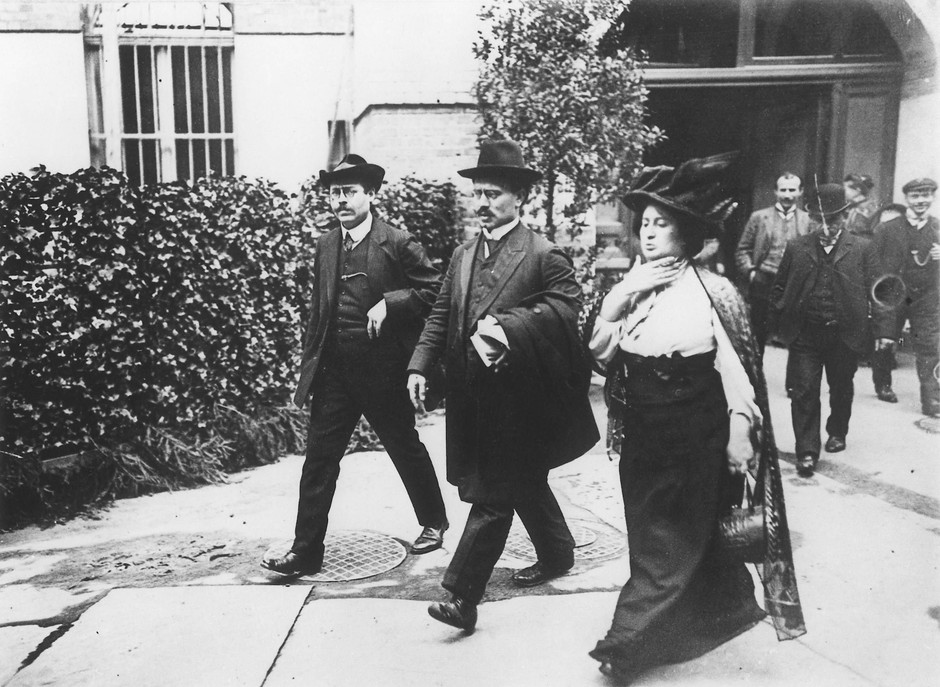
Unknown today, German-born Carl Wittman played a brief but important role as a conduit between German and U.S. Lefts around the First World War. Wittman came to the U.S. as a boy, arriving in Alaska in 1900 where he spent ten years gold mining. Unusually, he made some money and used it to travel the world in his 20s, including Hawaii, which made him an anti-imperialist. It was there in 1911 that he joined the Socialist Party, to which he would adhere to its Left and write for its press. Back in Europe between 1913-1916, Whittman would be a co-worker of Liebknecht and Otto Ruhle in the opposition to social-patriotism, occasionally sending reports to the International Socialist Review. He returned to the U.S. in 1916 with smuggled letters from Liebknecht and the German Left, writing this article warning the Socialist Party that it risked following the German party to disaster. Drifting from active politics, he ran a small chicken farm in rural New Jersey and published a local paper, the Clarion, as a community fixture until 1950.
‘The German Minority and the War’ by Carl Wittman from International Socialist Review. Vol. 17 No. 5. November, 1916.
MANY comrades left the Socialist movement because on August 4, 1914, all the 111 Socialist deputies in the Reichstag failed to do their duty. Among them are some of the best members in Germany and also here in America.
From Comrade Ruhle I received the following explanation of those critical days at the beginning of the war: The great majority of the members of the Socialist group took unconditionally the ground that the Fatherland must be defended; once war has begun, they said, everyone must fight for his country. Ten members held that everyone must fight in case the nation is attacked, in case it is not waging a war of conquest.
These ten are not fundamentally opposed to war of defense; their doubts are of purely opportunistic character. Only four were definitely, fundamentally, opposed to all war, even defensive war. These were Liebknecht, Ruhle, Herzfeld (from Rostock), and Henke (from Bremen). Their view is that during this imperialistic era all wars are carried on for the purpose of conquest; that no land is safe as long as there are capitalist armies; that for the proletariat of any nation the army of that nation is the greatest source of danger.
The fourteen members of the last two groups were prepared to vote against the war appropriation in the Reichstag. In order to prevent this the majority passed a resolution providing that every member was to be present and was to vote for the appropriation. The fourteen faced the alternative of voting in accordance with the resolution or splitting the group and the party. The voting of the appropriation thus became a subordinate issue. The division of the party was the great issue up for discussion. The fourteen had to decide for or against it on August 4, 1914. The ten opportunists were unwilling to see the thing through, to vote as they wished to do at the expense of a split in the party. They pleaded with the other four and threatened them. As their trump card they said that a movement begun by only four members would excite nothing but ridicule. To divide the tiny minority of fourteen would be to rob it of all influence with the majority. In order to prevent this the four yielded to the fourteen. That Liebknecht on December 2, 1914, in spite of the resolutions of the group, in spite of the pleadings and threatenings of the ten, voted against the war appropriation–this was his great deed. But he was the only Socialist in Germany who could defy the whole group, the whole party machine, the whole press. He could do it because he had an international name, a name which had international weight when he received it from his father. Had Rühle done, alone and unsupported, what Liebknecht did on December 2, he would have been disgraced before all Europe. It would have been thought that he imagined that he could, single-handed, bring about a division in the great Social Democratic party.
Thus vote for the war appropriation became on August 4 the great issue. This issue must be settled in every village, every city, every nation where there are Socialists. It is the question which faces the Socialism of our day. It will divide friend from friend and sever the false from the true. It will leave nothing as it was. Those who believe in defense must grant everything–appropriations, taxes, cannons, cannon-fodder, constitutional rights. Everything must be granted. On the crooked track of defensive warfare there is no halting place. In the hour of danger every sacrifice must be made. Necessity knows no fine distinctions. Once place the Fatherland above internationalism and you must sacrifice your party, your Socialism.
There is a sharp division between international Socialism and national defense. The opposition between these two is not new. At nearly every congress of the second International it was on the program. It was a nut that could not be cracked. We should not crack it now were we not forced to do it. The days of theory are past. The catastrophe has arrived.
After two years of experience with the misery which follows in the trail of this policy of national defense we, here in America, still stop our ears and close our eyes to the facts of the matter. Everywhere we have the poor courage to say to Liebknecht and Rühle that they also failed on August 4. If they, right at the start, had voted no, how much better it would have been, how great a disillusionment we should have been spared! But they could not do it without splitting the party and the group. They understood the state of the case perfectly and they did not for a moment betray our cause. Almost hand-to-hand they fought against the defense-Socialists in the party caucuses.
Sad to say, many Socialists are bewitched by their notions of bourgeois parliaments. To them the part they play in the parliamentary debates is everything. This, too, will be changed after the war. All European parliaments have resigned their prerogatives or had them wrested from them since the outbreak of the war. They have become maids-of-all-work to military dictators. We have to bear in mind that Liebknecht and his friends have definitely cut themselves off from the majority. They refuse to pay dues and call upon the comrades to refuse further support to the party officials.
The American Socialist party must take some position with regard to this division with the German party. What this attitude is to be is a question which is being carefully side-stepped at the present time. But it is a question which cannot forever be avoided. When the conditions demand an answer it will be fought out among our members. Any American who condemns Scheideman’s fight-to-a-finish policy and then allows some one to unload Berger’s Patent Preparedness upon him, resembles the Pharisee who wished to pull the mote out of his brother’s eye but was unconscious of the beam in his own.
The International Socialist Review (ISR) was published monthly in Chicago from 1900 until 1918 by Charles H. Kerr and critically loyal to the Socialist Party of America. It is one of the essential publications in U.S. left history. During the editorship of A.M. Simons it was largely theoretical and moderate. In 1908, Charles H. Kerr took over as editor with strong influence from Mary E Marcy. The magazine became the foremost proponent of the SP’s left wing growing to tens of thousands of subscribers. It remained revolutionary in outlook and anti-militarist during World War One. It liberally used photographs and images, with news, theory, arts and organizing in its pages. It articles, reports and essays are an invaluable record of the U.S. class struggle and the development of Marxism in the decades before the Soviet experience. It was closed down in government repression in 1918.
PDF of full issue: https://www.marxists.org/history/usa/pubs/isr/v17n05-nov-1916-ISR-riaz-ocr.pdf

