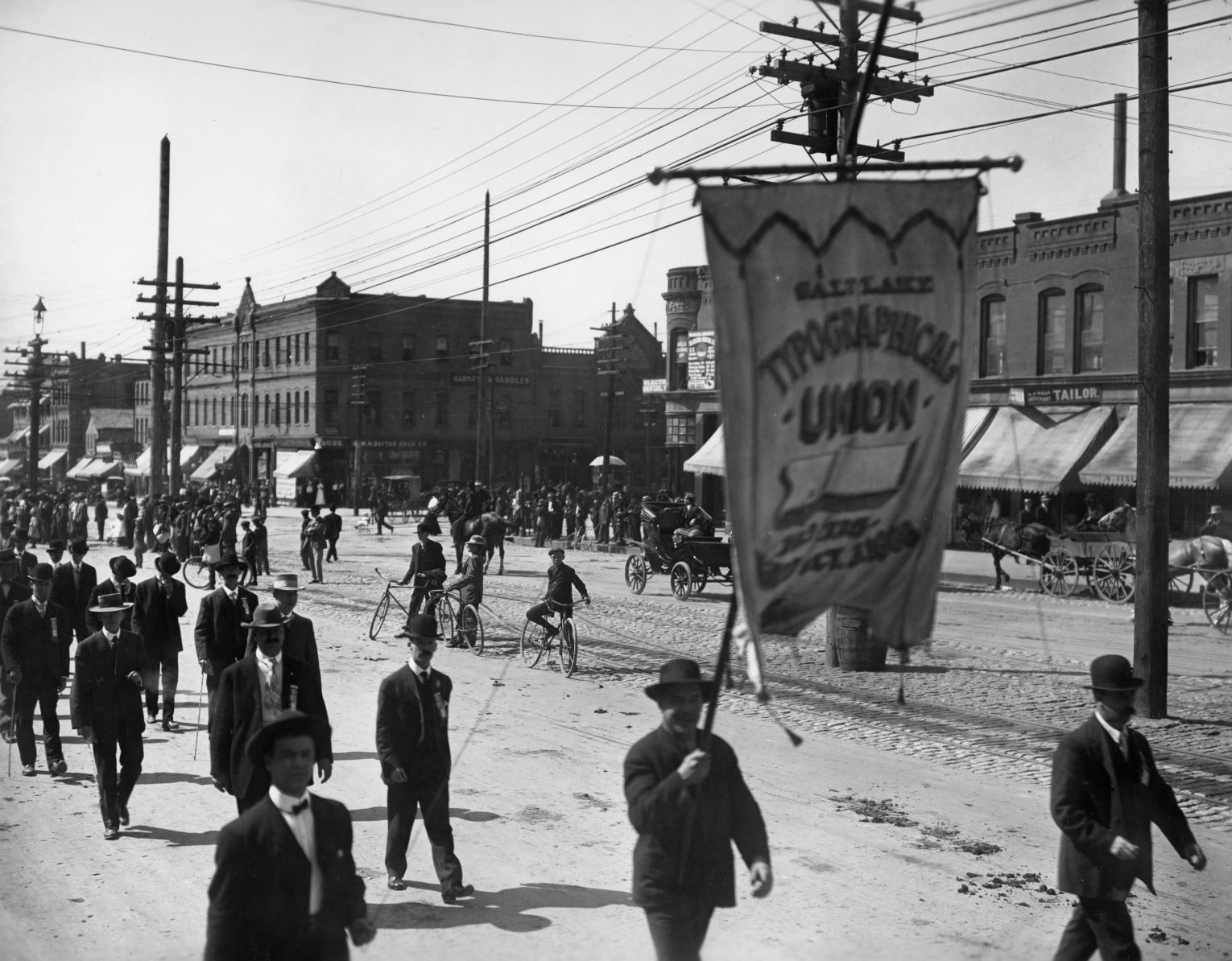
Elwood Brewster describes a dynamic in his International Typographical Union all union activists will be familiar with whereby different bureaucratic cliques coalesce into hardened ‘parties’ fighting for administrative power while not offering real alternatives to the rank-and-file.
‘Parties In the Printing Trades’ by Elwood Brewster from Labor Herald. Vol. 1 No. 6. August, 1922.
IN spite of our familiarity with the functions of political parties in Government, the development of definite “parties” in trade union matters of policy and administration has been very slow in the United States. That is to say, openly recognized political groupings on the basis of trade union issues have not been highly developed. More and more, however, the fight of the employers to crush the unions is bringing this matter to the fore. The future doubtless holds experience along this line for us, and it will be of value to study some of the past events of this kind. The outstanding example of party groupings in the trade unions, is doubtless to be found in the International Typographical Union. Originally there was but one “party” in the I.T.U., the same kind of party which exists in every union in the country. This was the grouping of active, administration elements, who took charge of the affairs of the organization and had more or less of an understanding about matters among themselves. Such germs of party organization exist everywhere, and out of them come the definite programs and party lines which develop under pressure of severe class struggle. In the I.T.U., these original “stalwarts” were the radicals or militants of their day. They were the men who never missed a union meeting, who made it their business to know about every member, how he stood on union issues, etc. They were rather exclusive socially, and only slowly took new members into their informal circles.
“The Wahneta,” a Union Party
In the loose grouping of the “administration” elements in the I.T.U. the idea grew that something more definite than common interest should bind them together. So a secret organization with a ritual and all the trimmings was formed, known as the “Wahneta.” Information of an authoritative nature about this organization, is hard to obtain on account of its nature. There has been a great deal said and written about it, particularly of late, in controversy. In this article we will confine ourselves largely to statements which appeared in The Industrialist, organ of a group of New York progressives in the printing trades (March, 1922), which was quoted approvingly by the organ of the Wahnetas, The Typo Blade of Chicago (April, 1922). As both camps agree that the article in question is a good one, it may be safely taken as somewhat correct.
The Wahneta was launched about 40 years ago, according to this authority. Its object is the control of the policies and offices of the union, local and international. It gathers together previous to each union meeting, to consider all business to come before the union; thus is obtained concerted and powerful action of all its members on each issue. The local secretaryship is always one of the main objectives, with a majority of all committees, and at least half of the delegates to international conventions. In each local of the I.T.U. where there is a Wahneta organization, one member is leader, having the ritual or “book.” Meetings are seldom held in the same place successively, and the keeper of the “book” notifies the members of the place of meeting. If this information is not given to a member he knows he has been dropped.
The policy of this “ruling class” within the I.T.U. was originally a militant one, within the narrow confines of strict craft-unionism. But with the development of the industry, and particularly with the growth of power of the Wahneta organization, they became more and more conservative and reactionary. Today they are completely “standpatters,” upholding the bosses against the claims advanced by the more militant membership. It is charged that they work in close cooperation with the employers. The charge is borne out by their attitude toward union policies, which has been stated as:
“The present social order, in which labor is a commodity worth what it will fetch in the labor market, always existed and always will. The employer is the “boss” and he should have unimpeded control of his composing-room in every particular other than in the matter of wages and hours, and, by the policy of arbitration, he is to have his say in what these shall be.”
The success of the Wahneta in attaining its object was almost complete for a long time. For many years it was a common jest that a convention of the I.T.U. was merely an outing for the Wahnetas. Nothing came before such gatherings without their prior knowledge. Having complete control of votes, they were able to be “generous” in allowing malcontents to state their grievances, but the Wahneta decided the issues. Only of late years, with the rise of a rival “party,” the Progressives, has their power been seriously challenged.
“The Progressive Party”
About 20 years ago the Progressive party became a distinct factor in the I.T.U. It crystalized out of a current of protest against the rulership of the Wahnetas, existing for some time without leaders or organization. Previous to the definite organization of the Progressives, it had been the practice of the Wahnetas, as resourceful politicians, to have one of their own number become a leader of the progressive faction whenever the opposition became threatening, in order to render it harmless to them. This was all the more easy to do, as the Wahnetas were a disciplined organization with a definite program, while the progressives were a heterogeneous collection of anti-administration elements.
The Progressive party has never entirely outgrown this indefiniteness of character. It comprises the most varied currents. The basis of unity is the common opposition to the domination of the “hard-boiled” machine, economy in administration, and more latitude in the official journal for opinion dissenting from the rigidly official. It might be called a “liberal” party, as opposed to the “tory” Wahnetas.
The Struggle for Dominance
The two parties have become commonly accepted factors in the life of the union. They are “respectable” institutions, in the sense that the leaders generally accept them as necessary instruments for determining the policy of the organization. So true is this that even Frank Morrison, for years secretary of the A. F. of L. and part and parcel of the Gompers machine, considers it in the natural course to be a candidate for I.T.U. delegate to the A. F. of L. on the Progressive party ticket.
The struggle against the Wahnetas first took the form of opposition to the existence of any definite grouping within the union. This move succeeded in writing into the laws of the I.T.U. an obligation intended to suppress such organizations. It reads: “that I will belong to no society or combination composed wholly or partly of printers, with the intent or purpose to interfere with the trade regulations or influence or control legislation of this union.” But this did not do away with the Wahnetas, and the progressives themselves, perforce, established their party organization to make their influence felt.
The Progressive party made the first big dent in the Wahneta machine in 1920, when they elected John McParland to the position of President of the I.T.U. After almost two decades they had at last become a power. But, in the language of the newspaper cartoonist, “then the fun began,” the real fight was on. The struggle between the Progressive party, holding the presidency and a minority of the Executive, inexperienced as a party whatever the qualifications of their officials and on the other hand, the old entrenced “Wahs” with a majority of the Executive, and a tradition of rulership extending back for generations. And it cannot be said that the Progressives have not made a very good showing in the scrap.
It is entirely outside the scope of this short article to give the details of the struggle for power. We may say, however, that the Progressive party made good before the membership in some degree. At the elections just closed they re-elected McParland president, and won a majority on the executive. The secretary-treasurer’s office still remains with Hays, the Wahneta representative, together with a minority of the executive officers. The voting showed a decided gain in the strength of the Progressive party. They now have the administration powers and responsibilities.
What of the Future?
The Wahnetas have lost. There does not appear any probability of them having the ability to come back. But the “party” history of the I.T.U. is not necessarily closed thereby. The Progressives are far from being a united body of common opinion. As they consolidate their gains, and as the menace of a Wahneta “come back” disappears, the germs of a new line-up which now lie dormant within the Progressive organization will sprout and grow. But it will be upon an entirely new plane. The future party struggles promise to be much healthier than the past. They will be more nearly struggles upon principles and policies.
The new Progressive administration frankly proclaims itself “conservative.” It is willing to tolerate the most far-reaching educational work, but wishes it clearly understood that while “they are progressive” they are “in no sense radical.” On the other hand we see such groups as those represented by The Industrialist proposing as at policy for the Progressive party
“Labor must have the right to determine its hours of work and compensation, to exercise authority over working conditions, to elect the managers of the industry–foremen, superintendents, etc. and to maintain shop rules by self-discipline.”
Without doubt the present “liberal-conservative” administration will receive the united support of all the elements which put it in power, so long as there is a Wahneta menace, and so long as the administration continues to give its best services to the union. But the present heterogeneous organization is sure to develop something new in the course of a few years or less–which should be an omen of progress to all in the printing trades.
The Labor Herald was the monthly publication of the Trade Union Educational League (TUEL), in immensely important link between the IWW of the 1910s and the CIO of the 1930s. It was begun by veteran labor organizer and Communist leader William Z. Foster in 1920 as an attempt to unite militants within various unions while continuing the industrial unionism tradition of the IWW, though it was opposed to “dual unionism” and favored the formation of a Labor Party. Although it would become financially supported by the Communist International and Communist Party of America, it remained autonomous, was a network and not a membership organization, and included many radicals outside the Communist Party. In 1924 Labor Herald was folded into Workers Monthly, an explicitly Party organ and in 1927 ‘Labor Unity’ became the organ of a now CP dominated TUEL. In 1929 and the turn towards Red Unions in the Third Period, TUEL was wound up and replaced by the Trade Union Unity League, a section of the Red International of Labor Unions (Profitern) and continued to publish Labor Unity until 1935. Labor Herald remains an important labor-orientated journal by revolutionaries in US left history and would be referenced by activists, along with TUEL, along after it’s heyday.
Link to PDF of full issue: https://www.marxists.org/history/usa/pubs/laborherald/v1n06-aug-1922.pdf

