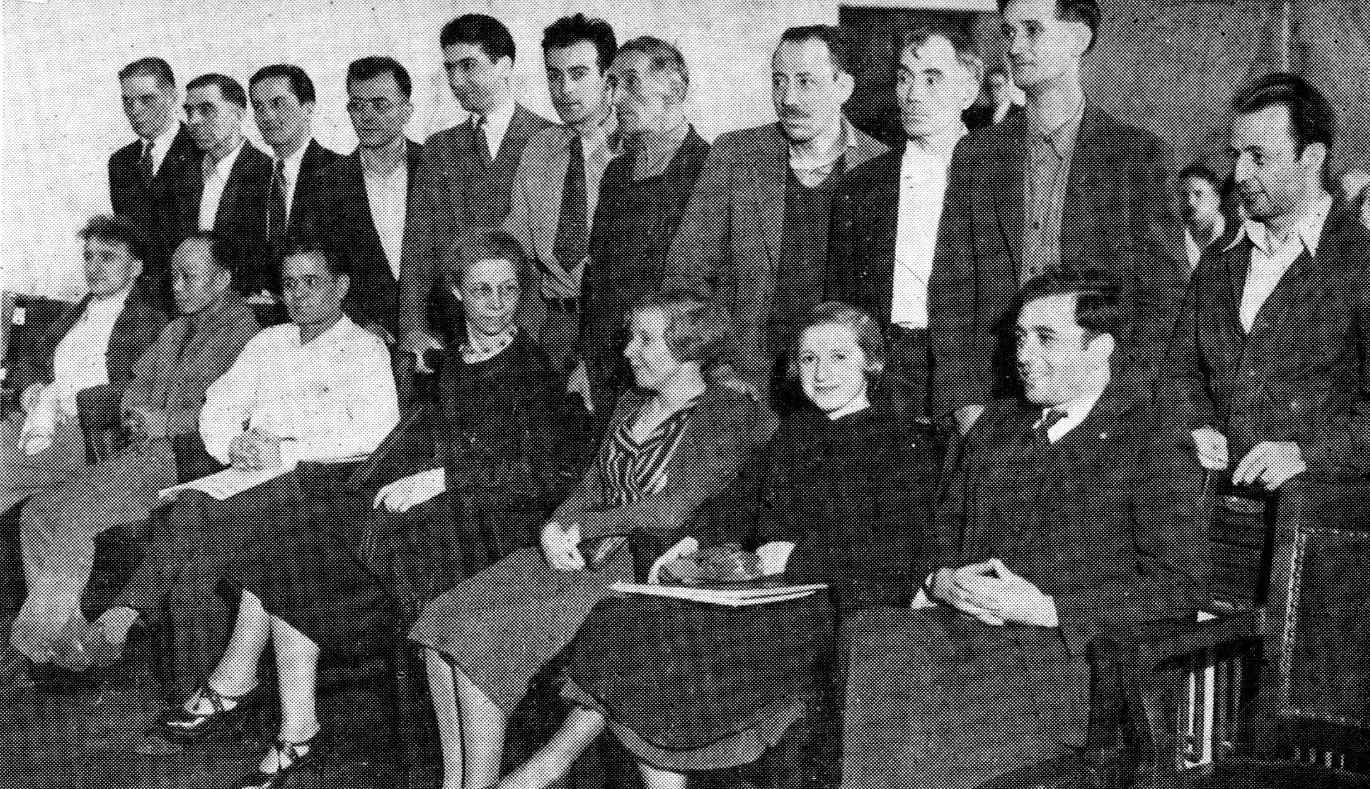
For decades California had the reputation of being, outside of the South, the most violently anti-labor state in the country with notorious frame-ups like the case of Tom Mooney and its Criminal Syndicalism law which made nearly all union organizing a possible offense. Most known for prosecutions of the I.W.W., it was a weapon the ruling class used frequently. Below another famous case is described by a defendant, that of eighteen workers facing the law as California’s capitalist farmers attempt to crush the Cannery and Agricultural Workers Industrial Union, a T.U.U.L. affiliate.
‘The Sacramento Criminal Syndicalism Trials’ by John Warnick from New Masses. Vol. 14 No. 4. January 22, 1935.
[The writer is one of the eighteen workers now on trial in Sacramento—THE Editors.]
County Jail, Sacramento, CAL. THE California Criminal Syndicalism Act, a pure example of class law, was passed in 1919, ostensibly to protect the commonwealth from sedition—”to protect American institutions from the destructive menace of alien agitators.” The real target was California’s 300,000 agricultural workers.
California’s army of ranch workers plays a peculiarly important role in the state’s industrial economy. Upon the primary base of fruits, vegetables, nuts, etc., which these workers produce, are built the secondary but important industries of processing, packing, canning, shipping and, to a large extent, power. And over all is a watchful and highly integrated financial oligarchy.
Upon the ranch hands in the field, and on their children, rest most of the great private fortunes of the state’s landed and industrial aristocracy. To protect its position the ruling class must preserve the status quo of its relations with the agricultural workers. Therefore—unalterable opposition to: any effort to better the condition of the exploited agricultural workers!
For decades the employers had defeated all attempts of the agricultural workers to organize, employing the usual methods of bribery, demagogy and intimidation. Appeals to loyalty, patriotism and chauvinism were effectively used to divide the workers along racial and color lines. When the I.W.W. entered the field before the World War, and these “reasonable” methods began to fail, the employers resorted to more direct means of suppression. Workers were driven, clubbed, jailed, shot, killed. The failure of even these methods to stop the growth of the “One Big Union” brought forth the Criminal Syndicalism Act. Immediately after the enactment of the law it was used extensively to prosecute the I.W.W. organizers, many of whom were sent to prison for long terms.
Although the Wobblies had serious organizational weaknesses, the mass prosecutions for criminal syndicalism at the beginning of the 1920’s played no small part in the liquidation of the militant syndicalist union. The act was then shelved for ten years until the first year of the capitalist crisis when the now famous Imperial Valley case occurred. As a direct result of strikes eight organizers of the newly created Cannery and Agricultural Workers Industrial Union (then called Agricultural Workers Industrial League) were convicted of criminal syndicalism and given long prison sentences ranging from two to fifty-six years.
The C.&A.W.I.U. for a time led a dormant existence. But in the 1933 upsurge it set the brilliant record of 50,000 workers led in strike struggles, 22,000 new members enlisted and many victories won. The series of strikes culminated in the fall in the cotton strike, an event that for three weeks monopolized headlines of California newspapers. The employers were amazed that the strike call should be answered by 18,000 determined workers—black, brown, and white—over a scattered area covering several thousand square miles. In an attempt to cripple the biggest and best organized strike of the year and at the same time behead the C.&A.W.I.U., an indictment charging criminal syndicalism was brought against Pat Chambers, the western district organizer of the union.
Chambers’ arrest and imprisonment under the prohibitive cash bail of $10,000 did not defeat the strike. His place at the head of the Central Strike Committee was immediately filled by the young district secretary of the union, Caroline Decker. Despite the killing of three strikers and several wounded, an increase of 25 percent, representing a half-million dollars more in wages, was won.
Pat Chambers’ trial resulted in a deadlocked jury. The case was finally dismissed—five months after the arrest. The growing radicalization of the masses under the impact of the crisis, the splendid support, organized principally by the Communist Party, plus the desire of the employers to pacify the angered workers over the acquittal of eight growers charged with the murder of the strikers, temporarily saved. Chambers from the fate of the Imperial Valley victims.
The tremendous success of the cotton strike gave the workers the needed courage again to assault that hitherto. impregnable preserve of grower-shipper profits, Imperial Valley. Two strikes at the beginning of 1934 shook the Valley. Although under constant terror, the workers succeeded in wringing concessions from the reluctant bosses. However, all known strike leaders—Chambers, Ray, Hancock, Cutler, Nieto, Saloranzo—were placed under arrest and a warrant was even issued for Caroline Decker, although she had not been within hundreds of miles of the Valley. Attorneys who came into the Valley to defend the prisoners were arrested for “vagrancy” and when released were kidnaped, clubbed into unconsciousness and threatened with lynching. Although the strike leaders were found guilty of “vagrancy,” “disturbing the peace,” etc., none this time was charged with criminal syndicalism. Too much public attention had been focused on this ruthless “law unto itself” Valley. The employers were holding their heavy artillery in reserve.
They held many secret meetings during the winter and spring months of 1933-34. As a result committees were established, new organizations formed with high-sounding but misleading patriotic names. One such organization called “Associated Farmers, Inc.” had a financial committee of such “farmers” as Earl G. Fisher of the Pacific Gas and Electric Co. (power trust), Leonard Wood, of the California Packing Corporation (Del Monte—a “farmer” who owns several hundred thousand acres of choice land) and Colbert Caldwell of the State Industrial Relations Board! “Associated Farmers” had offices in San Francisco which have become the employers’ publicity bureau. Speaking tours are arranged, systematic releases are given to the press. The theme is constant and unvarying—the people are faced with a “red menace”; the “subversive activities of alien agitators threatens the State’s industry and agriculture with destruction.”
Beginning with the outbreak of the West Coast Longshore and Marine Strike on May 9, the tension hovering over the agricultural hinterland was gradually eclipsed by the greater tension at the seaports. This tension was deliberately aggravated by the press until, when the San Francisco general strike was called in the middle of July, it seemed to have reached the proportions of an uncontrolled public hysteria. As a matter of fact, this hysteria was confined to the press, the employer groups, the officials and the “patriotic” organizations which they control. The vast majority of the people undoubtedly were sympathetic with the strikers. However, the smoke-screen, artificial as it was, gave the employers their opportunity for the counterattack against the agricultural workers.
Under cover of this hysteria there occurred almost simultaneously police and vigilante raids on C.&A.W.I.U. headquarters everywhere. Not one of the score of union headquarters in the state was allowed to remain open—all were smashed or forcibly closed. And the climax of the reaction came with the arrest of thirty-four men and women in Sacramento, the home of the district offices of the C.&A.W.I.U. All thirty-four were charged with vagrancy, but eighteen were picked out and these were charged with criminal syndicalism on six counts. Thus out of a thousand or more arrested during the California “July Days” only these eighteen were chosen to face this dreaded capitalist law. The full significance of this fact can be appreciated when one realizes that included among the eighteen are Pat Chambers and Caroline Decker and eight other functionaries of the Agricultural Union. The other eight prisoners are the local organizers of the Communist Party, the International Labor Defense and the Unemployment Council, organizations that have been the closest allies of the agricultural workers in their struggle for emancipation from their miserable conditions.
The smashing of the C.&A.W.I.U. apparatus and the jailing of the Union officials have not crushed the militancy of the workers. Since the “July Days” there have been innumerable spontaneous strikes led by unnamed worker-heroes in the class struggle. Many of these resulted in substantial gains. Moreover, there have been several large strikes—in the hop fields near Sacramento, in the vegetable fields of Southern California, not to mention the big strike of 6,000 lettuce workers in Salinas Valley in which, for the first time, the colored Filipino and Mexican workers fought together with the white A.F. of L, workers in the packing sheds.
The big growers have attempted to introduce the A.F. of L. into the field, as the lesser of two evils. Open overtures have been made to Paul Scharrenberg, state secretary of the A.F. of L., to deliver the workers over to the labor bureaucracy at $5 per head. So far this attempted deal has brought little results. The workers are too revolutionary to take to the A.F. of L. bureaucracy.
The militant fight of the workers and their repudiation of the A.F. of L., however, should not hide the necessity of freeing their chosen leaders—of smashing the vicious criminal syndicalism law. Not only is there real danger that eighteen innocent people will be sent to prison for six to eighty-four years, but also there is the equal danger of putting an end to a revolutionary task only half completed. Convictions would mean the virtual illegalizing of the C.&A.W.I.U. and all left-wing labor and political organizations in California.
Only the widest possible support of the workers can assure even the semblance of a fair trial. Upon the advanced workers and farmers, upon the liberal professionals and intellectuals everywhere hangs the fate of eighteen militant workers and the fate of the revolutionary movement in California.
Protests should be sent to District Attorney Otis D. Babcock and Judge Dal M. Lemmon, County Court House, Sacramento, California, and to Governor Frank F. Merriam, and United States Attorney General Webb, Capitol Building, Sacramento, California.
The New Masses was the continuation of Workers Monthly which began publishing in 1924 as a merger of the ‘Liberator’, the Trade Union Educational League magazine ‘Labor Herald’, and Friends of Soviet Russia’s monthly ‘Soviet Russia Pictorial’ as an explicitly Communist Party publication, but drawing in a wide range of contributors and sympathizers. In 1927 Workers Monthly ceased and The New Masses began. A major left cultural magazine of the late 1920s and early 1940s, the early editors of The New Masses included Hugo Gellert, John F. Sloan, Max Eastman, Mike Gold, and Joseph Freeman. Writers included William Carlos Williams, Theodore Dreiser, John Dos Passos, Upton Sinclair, Richard Wright, Ralph Ellison, Dorothy Parker, Dorothy Day, John Breecher, Langston Hughes, Eugene O’Neill, Rex Stout and Ernest Hemingway. Artists included Hugo Gellert, Stuart Davis, Boardman Robinson, Wanda Gag, William Gropper and Otto Soglow. Over time, the New Masses became narrower politically and the articles more commentary than comment. However, particularly in it first years, New Masses was the epitome of the era’s finest revolutionary cultural and artistic traditions.
PDF of full issue: https://www.marxists.org/history/usa/pubs/new-masses/1935/v14n04-jan-22-1935-NM.pdf

