
Possibly the first English-language history, from the beginning of the conflict in early 1918 to the start of 1920, of the Red Army’s 14,000,00-mile-front war against counter-revolution and imperialist intervention is this from the Soviet’s military attache in the U.S. Bek (Boris Tageyev) was a former, and exiled, Tsarist officer of Persian descent who had fought in the Russo-Japanese War and became became a military journalist and Social Revolutionary. Arrested and escaping, he wrote for European papers on defense matters, traveling widely before landing in the U.S. Here he became a supporter of the Bolsheviks, and made the Red Army’s representative in the Soviet’s U.S. mission and military editor of the quasi-official Soviet Russia. After the closing of the mission he return to Soviet Russia and continued to write well-regarded military histories until he was caught up in the Purges. Charged as a ‘Japanese, English, American, French and Italian spy’ and shot on January 4, 1938.
‘The Red War’ by B. Roustam Bek (Lt. Col.) from Truth (Duluth). Vol. 4 No. 12. March 19, 1920.
The theory of military art always had for its motto: “simplicity of decision”. The great strategists contend that strategy as an art cannot be superior to the originality of a military leader, for military art is the art or science of divining the real situation and intention of an enemy and so organizing means of opposing him as to check his advance or thwart his plans.
The “simplicity of decision” during the Russian civil war, now practically at an end, has been throughout on the side of the Soviet General Staff. Its main strategic aim was the annihilation of the invaders; and the original strategy was worked out by Trotzky, recognized even by his enemies as a man with strategic genius. This is a quality to which the anti-Bolshevist leaders and their supporters can lay no claim. Their problems and decisions, however, were far from simple. They had to attain their strategic objective, Moscow, by means of strictly limited forces, and they could not hope to annihilate their enemy. The invaders had to meet, not only the Red army, but an armed nation. Moreover, they had no determinate strategic plan of campaign worked out carefully by a single leader with a gift for strategy, but several plans prepared in different parts of the world by strategists of different nationalities and different schools of strategy, prompted by different political aims. While the strategists of the Soviets knew well the actual situation and clearly defined intention of their enemy, the invaders of Russia were unable even to guess what was happening in Moscow or Petrograd or in any way to foresee the future movement of the Soviet army. Consequently, while the plans of the military operations of the invaders were fully known to the Reds, the intention of the latter remained an enigma to the whole world until its realization in a most dramatic way.
The anti-Bolshevist leaders absolutely neglected this important factor: that the strategic unity of the whole front must always be preferred to the unity of the tactical bodies. The setback of the Red army as far as Orel, for example, was considered by the Allies as a final victory of Denikin over the Soviet army, while it was, in reality, but an incident on the road to his complete failure.
The anti-Bolshevist leadership, too, failed to recognize that, in a modern war, the most skillful maneuvering in the battlefield is secondary to the moral superiority of the army, the nation back of the army, and the equipment and number of troops. The preponderance of men is a most important factor, and here lay the real superiority of the Reds over their enemies.
The Allies fell short, too, in another respect: they failed to understand the real spirit of the population of Soviet Russia, just as they underestimated the strength of its armed forces with their unexhaustible strategic reserves. They started the invasion of Russia with powerful, well organized armies led by experienced generals, well equipped and fully supplied with ammunition and all modern technical weapons, but without reserves strong enough to support the administrative organization in the rear of the armies or in conquered regions, and without the moral support of the population. Certain classes in the various countries gave their moral support to Kolchak, Denikin and Yudenich, but the great bulk of the Russian people remained with the Soviet.
It was in the face of this unfavorable situation that the Allies began their undeclared war against Soviet Russia, a war which French strategists refer to as “la guerre a la banque” a gamble which had to end in a disaster.
The last offensive of the Russian army against the Germans took place during the first weeks of July, 1917. Forty thousand German prisoners were taken by the Russians within three weeks, and the Allies were prepared to believe that Kerensky, the organizer of this offensive, had saved the Russian army for the Allied cause. In reality this victory caused the downfall of the Kerensky government and led to the success of Lenin. In order to prove to the Allies the faithfulness of the Russian government, Kerensky sacrificed all the troops upon whose devotion he could reckon. Many thousands of his admirers volunteered for the offensive he had planned and bravely went to death. But there were no reserves behind them. The bulk of the Russian army, as well as the majority of the people, did not want the war. They were preoccupied with the Revolution and the Revolution could not be made to merge with a war started by the hated Czar’s government. The people wanted no more fighting. “Give us peace at any price!” was the cry of all Russia. Neither Kerensky not the Allies understood, apparently, that a new-born, revolutionary Russia would be unable to continue a war by means of an imperialistic army. The democratization of this army could be accomplished only by a radical reorganization of the whole military machine, an impossibility during the war.
The cry for peace did not mean that the Russian people had lost their fighting ability, for the civil war has since proved that. But Russia had suffered staggering losses in the war. Before further struggle was possible, she required a rest in order thoroughly to reorganize her political and military machinery on the new lines.
The Allies did not understand this condition of affairs and began a movement in defiance of elementary principles of strategy. They created their own front in Russia against the will of the Russian people. It was a strategic anomaly, an absurdity beyond any criticism. In a country ablaze with revolution such a front could not stand, constantly in peril as it was of being cut off from its own base by a hostile population. The Russian people saw in this movement of the Allies an attempt to prevent the conclusion of peace with the Central Powers, a peace which would put a stop to their further destructive penetration into Russia. Consequently, when Lenin appeared with his peace program, he was accepted by the majority, the Kerensky government was overthrown, and on January 18, 1918, the all-Russian Constituent Assembly was dissolved by the military force of a new power, the Soviet government, which came to be called Bolshevist.
The Russo-German peace treaty was signed by the Soviet plenipotentiaries on March 3, 1918, but this did not stop the further invasion of Russian territory by the Central Powers. Petrograd was seriously threatened by the Germans who occupied Finland and the Baltic States, Lithuania, White Russia, Poland and Ukraine. The transfer of the Russian capital from Petrograd to Moscow had its effect on the strategy of the enemy. The Germans suddenly arrested their advance on Petrograd and began to march on Moscow from the northwest and southwest, but halted within 150 miles of that city.

By the end of March the Austro-Germans were already in possession of the whole of Western Ukraine, west of the Dnieper, and practically they were the masters of the cities of Zhitomir, Kiev, Poltava, Ekaterinoslav and Kharkov as well as the Black Sea ports of Nikolaiev, Kherson and Odessa. Thanks to the friendly relations established by Ukrainians through Hetman Skoropadsky, the Kaiser’s favorite, the Germans successfully continued their invasion of Russia, and the middle of April they occupied Lyov, a small town situated 130 miles northwest of Kharkov. The further the invaders penetrated Into Russin, the more disorderly became their advance, and finally the invasion lost the military aspect. The vastness of Russia, the lack of communications, were appreciated by the invaders too late. They did not realize during their speedy advance that with the capturing of one town after another, always in the hope of finding rich booty, they were gradually losing their way. Lloyd George has referred to Russia as a country “very easy to go into and very difficult to get out of.”
The German army, dispersed throughout Ukraine, South Russia, and even in the Caucasus, was in a deplorable strategic situation. Suddenly the “friendly” Ukrainians deserted, and hostile guerilla bands threatened their communications. The separate detachments of the original Red militia began their unexpected attack from all sides. The only sympathy the German experienced came from the local landlords, the well-to-do people and reactionary officers who looked to the Germans, as to the Allies, to check the growing danger of Bolshevism.
The old Russian army was officially disbanded. It was a most extraordinary demobilization. Any soldier who did not want to join the Red Guard went home carrying his gun and as many rounds as he thought necessary. In some cases machine guns and even field cannon were brought to the villages by the dismissed men. The officers who had escaped made for the regions occupied by the Germans and it was under German protection that the first counter-revolutionary bands forced their way into the Don and Kuban districts. The Entente powers, instead of cooperating with the Red Guard in order to stop further German advance, withdrew their troops in order to concentrate them at points from which they planned an advance of their own into Russia.
Germany was much too seriously threatened in the west to succeed in any such gigantic campaign as a march on Moscow; That she was really powerless in Russia could be seen by the disorderly movement in different directions without a protected war and without any sign of reserves. Had the Allies listened to the appeals of Chicherin and the Soviet foreign commissaries, and had they supported the Red Guard in South Russia, the Germans would have been heavily beaten and would not have dared to penetrate so deep into Russian territory.
During these days the Soviet government was favorably disposed forward the Allies. Chicherin’s dispatches read, for instance: “Russia’s relations with the Entente are unchanged.” Trotzky approached the American military mission in Moscow, asking assistance in organizing a volunteer army and in improving the country’s transportation. On March twenty-seventh the Paris Petit Parisien published a statement to the effect that Trotzky had also asked the French to assist him in organizing military resistance to the Germans. All this was in vain, and the situation in Russia became more and more chaotic. Here and there, throughout the vast territory of the late Russian Empire, from the Baltic to the Pacific and from the Arctic to the Black Sea, as well as in Transcaspia and Turkestan, unorganized fighting between the Soviet armed forces and counter-revolutionists proceeded with activity.
The Red Army in those early days could not be considered as a properly organized tactical unit. The forces were of a purely revolutionary character, created in a hurry by peasants and workers, and the general aim was simply the destruction of the dispersed reactionary units, that they might be prevented from uniting into a single strong counter-revolutionary body. The forces often suffered reverses, but they struck, too, many heavy blows that were effective enough to give the Soviet government breathing space in which to organize properly its administrative and military center. The diplomatic relation with Germany after the Brest-Litovsk treaty was a new ordeal for the Soviet government. Joffe, the Soviet envoy, arrived in Berlin on April twentieth with his mission to stop further German advance into Russia. Meanwhile Count Mirbach in Moscow was trying to establish control over the Soviet. The situation became still more complicated when this German autocrat was assassinated in Moscow on April twenty-third.
The skirmishes between the invading Germans and the Red Guard became more and acute. Petrograd was considered to be under a serious menace. Finns and Germans drove into Murmansk territory, and the port of Ino, the key to Petrograd, was in great danger. The enemy continued its advance in Ukraine. Crimea was entirely invaded, and the town of Batoisk, opposite Rostov on the Don, was attacked. At last the Germans entered the southern Caucasus and the Finnish troops began their march in the direction of Baku. Only the Russo-Finnish agreement stopped the Finnish movement.
But these were not all the troubles which the Russian people had to meet. In northern Russia the Germans were still advancing and occupied the town of Tver, northwest of Moscow on the Moscow-Petrograd railway, and the very Important railway junction of Vologda, which was on the line of communication between Petrograd, Moscow, Archangel and the Ural district. At such a pass the Soviet began peace negotiations with the Ukrainians at Kiev. The Rada (parliament) was overpowered by Hetman Skoropadsky who, encouraged by the Kaiser, adopted a very aggressive attitude towards the Soviet representatives. The negotiations took place May twenty-second. Germany demanded that the Black Sea navy be returned from Novorossisk to Sebastopol; the Ukrainians claimed fourteen governments, Voronej included. To force the Bolsheviki to accede to these claims, Taganrog and Rostov were occupied by the Germans. Meanwhile the withdrawal of the Russian troops from Armenia had been followed by the invasion of the Turkish armies in the regions evacuated by the Russians. The Turks took Alexandropol and threatened Baku, and at the same time southern Transcaspia sent an army against the Bolsheviki. On June nineteenth, under German pressure, the Soviet government removed part of its navy from Novorossisk to Sebastopol, sinking another part of it. Four days later the whole of the surrendered navy was returned to Russia, under the armistice with Ukraine.
The Allies, heavily engaged on the western front and overestimating the German strength in Russia, did not risk an important stroke. Kolchak visited London and Paris and there were serious negotiations with Denikin and also with the leaders of newly recognized Czecho-Slovakia. On April fifth, Japan landed a detachment at Vladivostok simultaneously with fifty British regiments. With the landing of these troops came solemn assurance by the Allies that this step was not meant as an attempt to interfere in the internal affairs of Russia. Then the English fleet appeared at Murmansk. The Soviet government protested, and in answer to that protest, in June, 1100 British soldiers were landed in north Russia. In July the Czecho-Slovak movement against the Bolsheviki, which had developed in connection with the original plan of the Czechs to withdraw through Siberia and the port of Vladivostok, became general. This was the signal for a Red war waged by the Russian people against those same allies in whose cause they had already given 7,000,000 lives, the cream of their population.
In order to understand the seriousness of the position of the new-born Soviet Republic in 1918, it is sufficient to look at economic conditions in which Russia found herself after the forced treaty of Brest-Litovsk. She had lost 300,600 square mile of territory with 56,000,000 inhabitants; 13,000 miles of railways; 89 per cent of her coal output; 75 per cent of her ore; about 4,000 different factories: 268 sugar refineries and many other distilleries and workshops. The war and the revolution had entirely disintegrated her finances. In the face of such staggering blows they had now to meet a new invasion. More than 120,000,000 of the population were under Bolshevist administration, but in war the issue is not decided by the population, but by the number of men actually brought into the firing line was necessary to create a new army on new principles, well trained and high spirited. This difficult task was entrusted to Trotsky.
I have often been asked by my American friends how Trotzky, a civilian, a pacifist, succeeded not only in creating a huge and powerful army, but in becoming War Minister and more than that, a great strategist. This is the answer.
Trotzky is gifted with the strategic instinct. As a real revolutionist, he had foreseen his opportunity to appear in his country as a leader of the masses. During his exile abroad he seriously studied military art in France, in England and in Switzerland. The project of the French Socialist, Jaures, who tried to introduce into France a new army based on principles of organization similar to those of the army of Switzerland, was certainly known to Trotzky, as well as the works, taking the same position, of a captain of the French army, Gaston Foch, and those of General Percin, all of which were rejected by the conservative military element of the French General Staff.
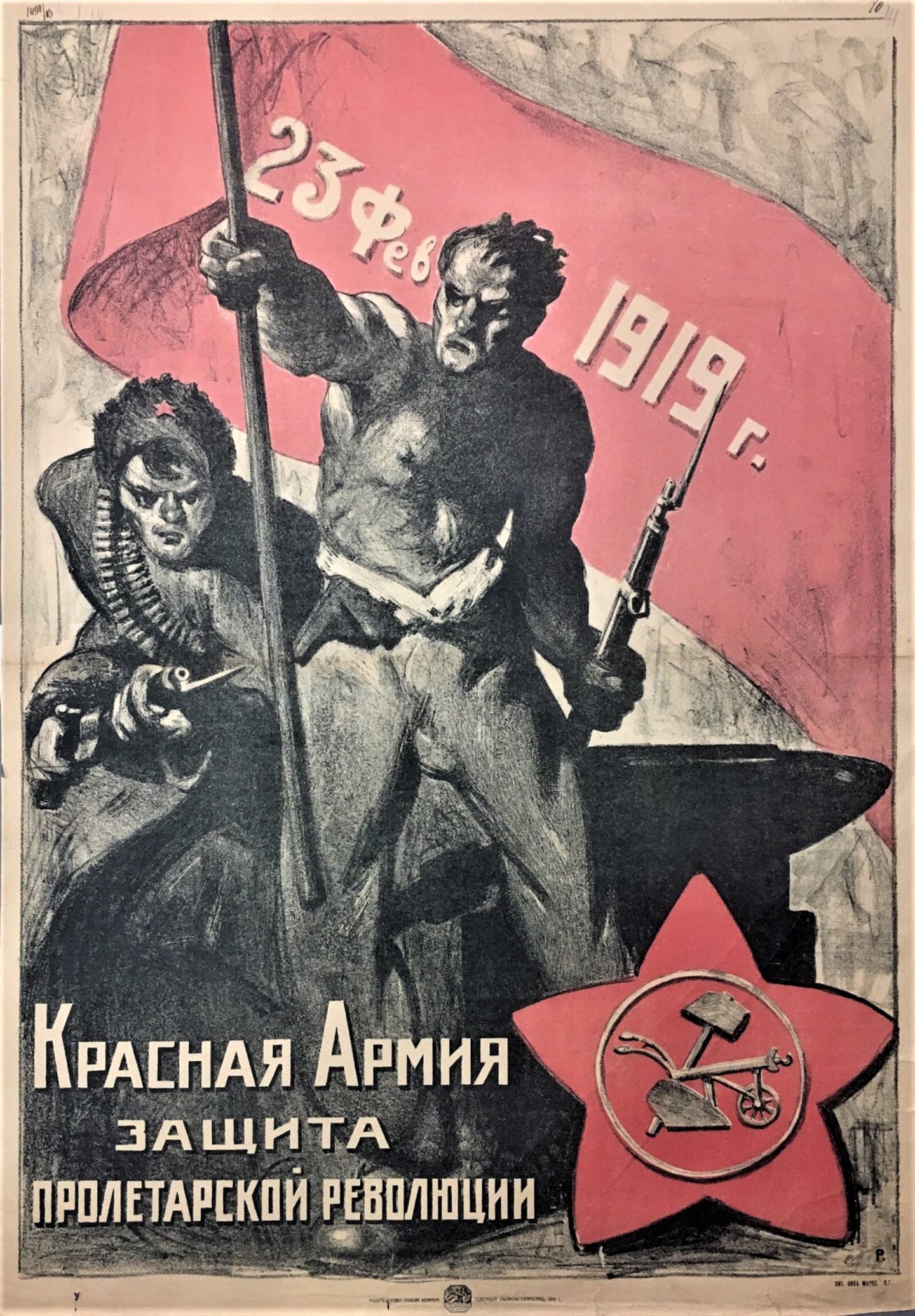
This significant factor, ignored by those who planned the invasion of Russia, was very seriously taken into account by Trotzky. He realized that the enemies of Soviet Russia would never be able to oppose him with an army superior in number to the forces which in a few months could be created in Soviet Russia. With a strategic situation, in addition, which allowed him to operate on inner lines, he assured the Soviet government that a victory for the Red army would be inevitable. He was right. While the original Bolshevist forces, known as the Red Guard, were still fighting in a disorderly way in different parts of Russia, Trotzky began the organization of the new Soviet army. The high military leaders of Europe and America nevertheless continued to hold to their firm opinion that Trotzky never would be able to raise a formidable army with which to resist the modern forces of the Allies.
As War Minister Trotzky had to create an army suitable to the new regime. It would have been an absurdity to build an army on the old imperialistic principles. A fighting force such as he planned must be formed gradually according to a plan thought out by trained specialists and developed by means of the general education of the youth of the land. The greatest difficulty lay in the fact that the Soviet Republic needed this army at once. The young government had neither methods of its own for such an organization nor any system for the efucation and administration of an army designed for regular operations against the modern armies of Europe. There was dire need for skillful instructors of every kind for every branch of the army. Trotzky knew well that if he acted in accordance with the principle included in the program of the Social Democracy, he would be unable to accomplish his great task in time to save the new government He realized that a temporary compromise was inevitable, and he decided to call the officers of the late Russian army to the Red colors.
It was a risky undertaking, because his compromise might easily, as was the case in France, produce a Russian “Bonapartism”. Trotzky took precautions. During the period occupied with the working out of the new method of recruitment, and while the arriving recruits were being drilled by the Revolutionary officers, mostly promoted from the ranks, Trotzky was busy educating the old regime officers. He realized that these officers of the old order could be trained only through a series of misfortunes, physical privations and suffering, and moral depression. He knew that in the struggle for existence, the weakest among them would perish, but that the strong-minded, in the moment of a life-and-death struggle for country and liberty, would rally to the support of their own people. And so it happened.
A hard time awaited those of the old Russian army who did not volunteer to serve in the Soviet militia. The aggressive reactionary element was annihilated. The remainder, unable to leave Russia, had to work as common laborers in order to keep from starving. Even senior officers and generals took to selling newspapers or odds and ends in the streets. They became the outcasts of the nation. There was a widely circulated fear that openly to help these unfortunates would bring dire punishment. Thousands perished: a very few succeeded in emigrating. After several months of this bitter experience, the survivors willingly enough passed out of the first stage of the Trotzky “training-school”, and entered the Red army, where they were put under the permanent supervision of the Military Commissaires of the Soviet. The strong, thorough discipline introduced by Trotzky enforced even to the point of capital punishment, was fully recognized as an important moral element of military organization, by these officers of another day. In accordance with their position, their economic condition became much better than in the days of their service under the old regime. Their wives and families were now protected by the state and their future insured against misery. They returned to their posts in the old well-organized machinery of the largest general staff in the world, and started to work with real Russian enthusiasm along entirely new lines, under the direction of a new military leader. It was a real miracle, one of the wonders of the war.
While the military machinery was being set in motion. Trotzky was busy reorganizing the whole system of military schools. His purpose was speedily to provide young officers drawn from the peasant and working classes. He succeeded. During the first two years of Bolshevist rule 40,000 young men were trained as officers and put into the field. Now almost every considerable village has a military school where special instructors are training young men, and even the girls who are fit for the army. Ten thousand women are serving in the Red army today. The General Staff of the Red army has been built around men of high military standing, experienced in the Great War. The names of Generals Parensov Brussiloff, Sitin, Klembovsky, Plustchik-Plustievsky, Kameneff, Pnievsky and many others are familiar to anyone who followed movements of the Russian army from 1914 to 1917. Other leaders in the Red forces who once held important commands in the armies of the Czar are: General Cherimissoff, professor in the War College and former commander of the Twelfth Imperial Army: General Zinkovitch, former chief of Staff of the Sixth Army: General Seliviathev, former commander of the Fourth division from Finland; General Badouss, formed commander of the Sixth division; General Sytine, former Adjutant General on the Rumanian front; General Egorieff, former army corps commander; General Velitchko, the famous military engineer who introduced concrete turrets in modern fortifications; General Belialeff, the artillery expert and perhaps the most reactionary of the generals of the old Russia; General Nessamoff, prominent as a professor of the Staff College. The Red commander who crushed Admiral Kolchak in the east is General Evert, the same Evert who won such high praise from the Allies for his skill in directing the successful Russian attacks on the center of the German front in 1914 and 1915. It was General Gouki who recently retook the city of Kieff from General Denikin.
In January, 1919, the first-line Soviet army, numbering 750,000 men, with an equal number of reserves, was already in the field. At the present moment the total Red forces number not less than 4,000,000 men, and sixteen field armies are being maneuvered.
While in 1918 the war office in Moscow was busy creating a new powerful army and its General Staff was preparing a plan of defense, gradually reinforcing and reorganizing the troops already engaged in different parts of Russia, the Allies were slowly concentrating their forces in North and South Russia as well as in East Siberia.
The Red military operations at the end of 1918 were of a reconnoitering character only, and could not yet develop into a decisive engagement. It was not until the spring of 1919 that the war area in Russia gradually took on a strategic look. The invaders appeared in separate groups, menacing Soviet Russia from the north, west, southwest, southeast and east. Their line extended about 14,000 kilometers, a front that was fifteen or sixteen times as long as was held by the Allies during the European war. The anti-Bolshevist forces and their supporters, of course, were unable to organize an unbroken line along such a front. They would have had to concentrate in Russia twelve or thirteen times more troops than they required in their war against Germany. That, clearly, was impossible.
The early spring of 1919 found the invaders preparing for a general offensive, with Moscow as their strategic objective. The anti-Bolshevist armies presented five main fronts, namely: (1) The Murmansk-Archangel front; (2) the Siberian front; (3) the Turkestan front, along the Persian border; (4) the South-Russian front of General Denikin (Ukraine included); (5) the Western front, which included Polish, as well as the battle-line of the Baltic States, up to the Gulf of Finland. Their strength in North Russia was estimated at 60,000 men; in Siberia, counting the forces under Kolchak and the Czecho-Slovaks who had succeeded in joining him, at about 300,000 men with a main base at Vladivostok, protected by Allied troops and naval forces. In addition, the Anglo-American-Japanese forces protected the Trans-Siberian railway and other lines of communication in the rear of the Kolchak army. In Turkestan there was no visible concentration of the invading forces until July, 1919. The Anglo-Persian army was not stronger than 50,000 men. Denikin was prepared to use more than 250,000 men, half of which would be Cossack cavalry. There was no accurate estimate of the strength of the Ukrainians under Petlura because the character of the operation of this army was purely “partisan” or “guerrilla”. According to several dispatches their strength was not less than 150,000 men. The Western front did not give the Red command any anxiety because of the unreadiness of the Polish army. For more than a year and a half the Soviets held the Poles with a very weak detachment. The one well-organized Polish military body is the First Polish Musketry army corps of the old Russian army, which is under the command of the former Russian General Dovdor-Musnitzky. The Lithuanians declared that they had 30,000 fighting men ready, but they remained only in project. They were never able to mobilize even a half of that number. The Letts, together with the German barons, formed a force of 10,000, and later on were reinforced by the English to meet the aggressive movement of the von der Goltz army under Avaloff-Bermondt. The only well-organized army in the west was that of the Esthonians, but it was too small (about 25,000 men) to undertake any offensive operation against the Soviet forces. It remained on the defensive, holding the strongly fortified positions along the lakes of Peipus and Pskoff. Unfortunately for Esthonia she became the victim of the famous adventure of General Yudenich. It was absolutely certain that the Finns in no case would operate against the Soviets, this certainly minimizing the strategic importance of the northeastern part of the Western front. There were, then, about 1,000,000 men to invade Russia.
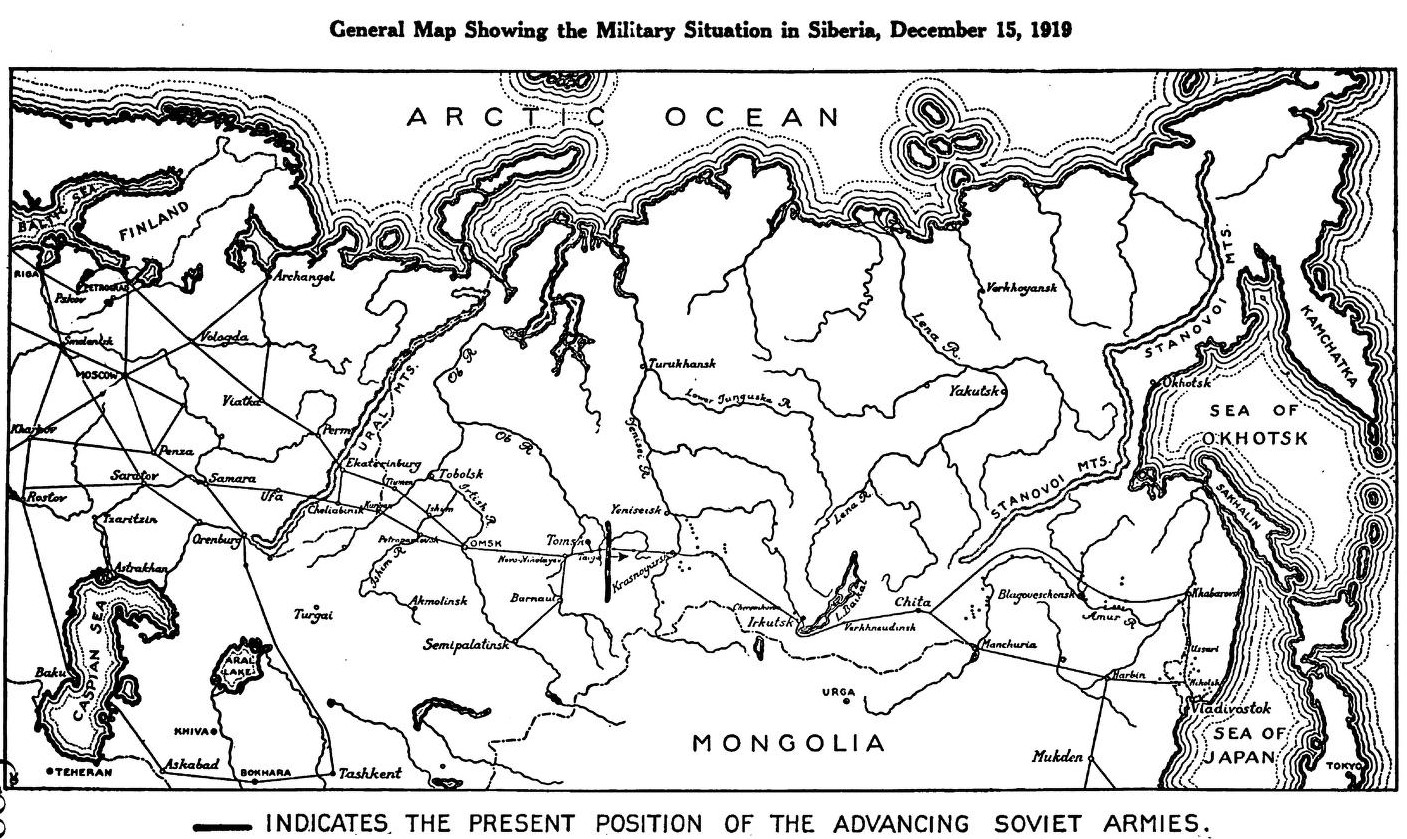
A glance at the map of Russia will reveal that Moscow lies in the center of the railway network of the country. Petrograd and Moscow are connected with Siberia by means of two railway lines, one through Samara-Ufa-Chèliabinsk and another through Vologda-Viatka-Perm-Ekaterinburg-Tiumen. Vologda is directly in rail communication with Archangel and Petrograd and there is a line running northward rom Petrograd to Murmansk in the Arctic, and another from Viatka northwest to Kotlas, on the North Dvina river. This river is navigable to Archangel.
It was essential, therefore, that the Allies reach. the northern Petrograd-Vologda-Viatka line, in order to establish a junction with the forces advancing from the Ural along the Tiumen-Ekaterinburg-Perm-Viatka-Vologda railway, and to cover the movement of the second army on Moscow along the Trans-Siberian railroad via Cheliabinsk-Ufa. It is essential to note that during his successful campaign of the previous year, Kolchak had captured both towns west of the Urals: Perm and Ufa.
The intention of the enemy was fully realized in Moscow. The Red high command decided to defeat it. On January 20, the City of Ufa fell before the Soviet army and the Russo-Czeho-Slovak forces were pursued by the Reds to Zlatoust, 140 miles to the northeast. The city of Orenburg was also threatened by the Reds and the Ataman Dutoff abandoned the town and fell back in a northerly direction. The speedy movement of all the Kolchak reserves inclusive of the Allied forces saved his army from early disaster in the Tobolsk district.
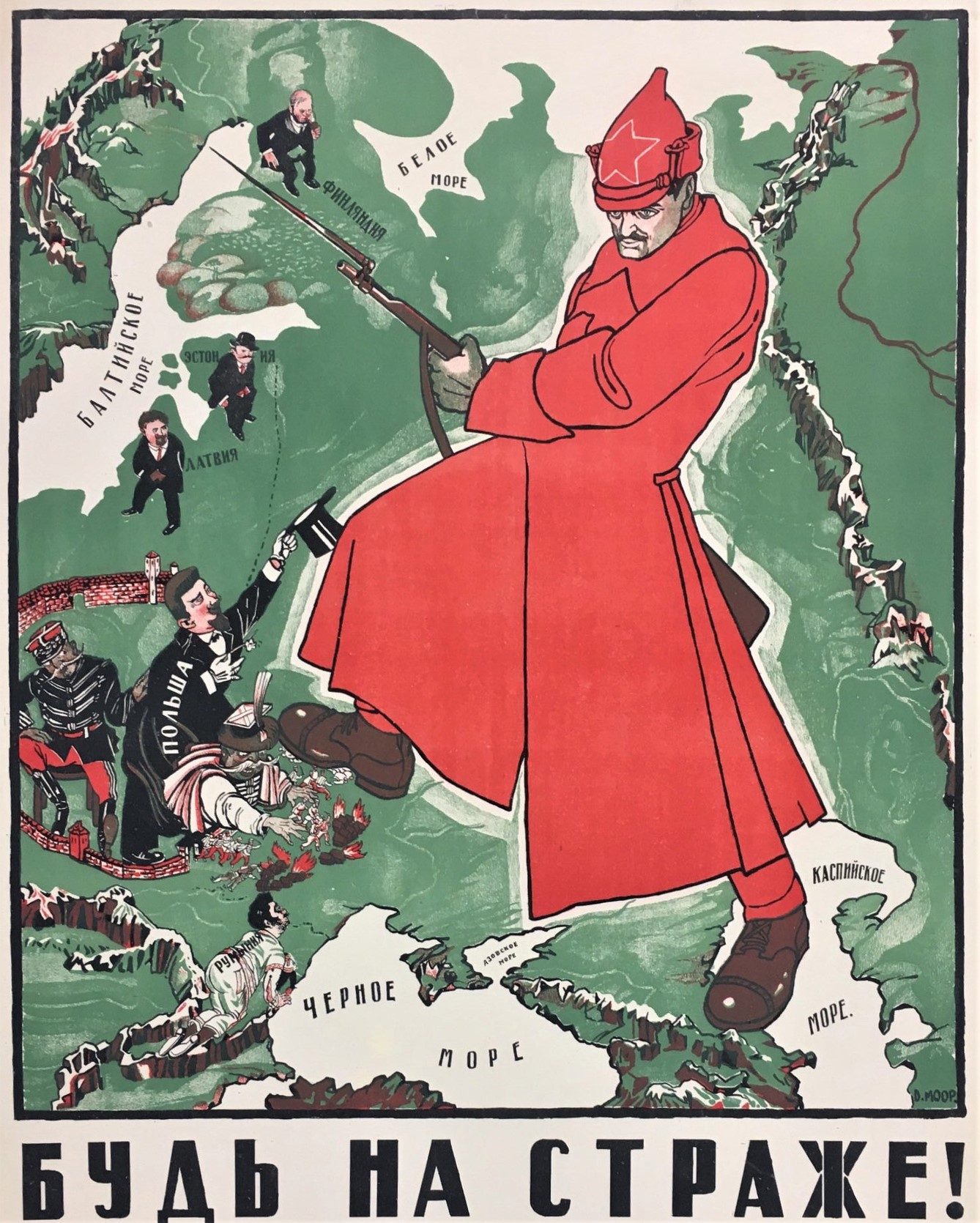
The renewed activity of the Allies on the Murmansk- Archangel front during March and April, 1919, forced the Soviet general staff to act quickly. While the new concentration against Kolchak was in progress, fresh reserves sent from Vologda reached the northern battle lines and defeated the invaders near Onega. The Allies were forced to withdraw completely.
Meanwhile Kolchak once more took the initiative. He started an offensive, advancing an average of seven miles a day, until, in the beginning of May, he had penetrated as far as Bugulma-Bogoroslan, in the Samara region. Had Denikin been ready at that moment for a new offensive following the series of defeats which he had suffered, and had the Caucasian population supported him instead of threatening his rear, Kolchak very probably would have reached Moscow. But such solidarity could not be expected.
During this period, in Ukraine and Crimea the separate units of the Reds were in constant struggle with the bands of Petlura and the Don-Kuban Cossacks of Krassnoff, and there was no serious movement of the Soviet armies against Denikin. The revolutionary movement which burst out in Odessa, and serious mutinies in the French fleet, forced the Allies to evacuate Odessa, which fell into the hands of the local Soviets. Denikin still remained inactive, planning a decisive move northward. Toward the end of May, Kolchak was suddenly attacked by the Soviet armies in the Kazan and Samara regions. The Reds started their offensive in Kolchak’s army, which fell back on Ufa, while the right massed formations, directing their main blow at the center of flank of the invaders still threatened Viatka. On June ninth, Ufa fell to the Reds after three days of fighting, and on July second the Soviet troops won a victory in the Viatka region, pushed eastward and captured Perm. The retreat of the beaten forces so swift and the pursuit so vigorous that on July sixteenth the Soviet troops captured Ekaterinburg, 100 miles to the east of Perm. As a direct result of these Red successes, the third Kolchak army, which was moving southward toward Orenburg, was obliged to retire, and was caught in a trap and annihilated. Simultaneously the activity of the Red guerrilla forces in eastern Siberia became more pronounced and constantly threatened the communications in the rear of the Kolchak army. There were more than four hundred local uprisings in Siberia. The goldfields on the Lena were captured by the Reds, 50,000 strong. The most important Ural industrial district had thus fallen into the hands of the Soviets, and Kolchak had been seriously defeated before he could be supported by the Denikin offensive.
While this was transpiring in Siberia Denikin was already on his way in his advance on Moscow. His army had without difficulty taken Kharkov, Tzaritzin, Bielgorod and Yeksterinoslav, and Petlura had captured Kiev. The famous Donetz Industrial district was now in the possession of the anti-Bolsheviki. The opinion in Europe and America among the military experts was that the surprising success of Denikin proved the weakness of the Soviet army, which, thanks to the lack of communication, and especially lack of rolling stock, had been unable to accomplish its strategic operation on inner lines by speedy transportation of troops from one front to another. In reality such a supposition was incorrect.
It is evident now that the Soviet General Staff considered the Siberian theater of war as an absolutely separate one from that of European Russia, and used for the Siberian front special reserves, having in view in the future, a period of severe fighting and later a long pursuit of the enemy in case of his failure. It was also probable that the Soviet forces after having penetrated in, Transbaikalia would meet the Allied and strong Japanese forces east of Lake Baikal. Therefore the Soviet strategists in no case would have sacrificed in the Siberian army the smallest part of their reserves. They sent against Kolchak about 600,000 men in the first line, and 600,000 men gradually followed them as their reserves. To oppose the Denikin advance it was necessary to send an army almost as strong as for the operation in Siberia, or 1,200,000 men. There were not more than 300,000 men at the disposal of the Reds for the operation in South Russia when Denikin started his offensive. The necessary balance was in formation. Therefore the Soviet General Staff expecting an attack on Petrograd by the northwestern Yudenich forces, was obliged to take the defensive in South Russia, trying to persuade Petlura to turn against the invaders. There is no question that the Reds were prepared to cede a great deal of territory, retiring with their center and holding in check both extreme flanks of the advancing enemy. At the same time the Reds successfully organized a most vigorous guerrilla war in the rear of the Denikin battle front using for that purpose the original Red Guards and local population. Ignoring this danger Denikin still continued the offensive, undertaking a so-called “concentrated” advance. For such a movement he had to divide his army into three separate groups: one, the western, in the Kiev direction; another, the central column, moving on Orel; and the third, the eastern, advancing along the Volga, on Kamishin. Such an operation is considered risky because, with the failure of one column, the remainder may be separately defeated.
So far as I can understand, Denikin was sure of the proposed Yudenich attack on Petrograd and probably thought that cooperation with the Baltic States and Finland would exhaust the Reds to such an extent that Kolchak again would be able to resume the offensive. It was supposed at this time in Allied headquarters that the total strength of the Soviet army could not be more than 2,000,000 men, only the half of which could be used.
The battle for Orel and the attack on Petrograd, as well as a new counter offensive of Kolchak, took place in the middle of October, after Denikin had succeeded in capturing Voronezh. His cavalry o 13,000 Cossacks under Mamontoff accomplished a most successful raid behind the Red lines about one hundred and fifty miles to the west of Tamboy. The towns Kiev, Kursky, Tchernigov, and at last Orel, fell before him and Denikin established his headquarters at Kharkov. The fall of Moscow seemed to be imminent. Denikin’s vanguards were already approaching Tula.
Suddenly the entire situation changed. On October eleventh Petlura betrayed Denikin and the Ukrainians and declared war on the anti-Bolsheviki, thus threatening the rear and the left wing of the invaders. But Denikin still advanced, though his strategic situation became desperate. Meantime the Reds had accomplished the concentration of their fresh reserves at the center, plunged forward in massed formations, defeated Denikin north of Orel, recaptured that town and developed the offensive along all the front from Kiev on the west and Tzaritzin on the east.
It now became clear that the Red army was superior in numbers over a technically stronger enemy, because by the end of October Yudenich in the northwest, Kolchak in Siberia and Denikin in South Russia had been seriously defeated. In the middle of November the Denikin front was broken through in its center over a front of 47 miles and a most vigorous pursuit of the beaten armies began almost simultaneously on all three battle fronts. Mid-December saw Kharnov captured by the Reds. In Siberia, after the fall of Omsk, the Kolchak army was completely annihilated, and in the northwest Yudenich was hopelessly beaten. In South Russia the enemy was partially annihilated by a strategic pursuit and partially put to light, seeking cover in Rumania, Poland and Caucasus. Denikin himself embarked on a British battleship, thus bringing to an end his importance in Russia. Kolchak, reported sick in Achinsk, a town between Tomsk and Krasnvyarsk, was captured by the Soviet army at the end of December. The Socialist-Revolutionaries had established their government at Irkutsk, thus preventing their 1st dangerous enemy, the head of the “All-Russian” government, from escaping. The year 1919 ended in complete victory for the Red armies. So there remains still only one counter-revolutionary leader, Ataman Semonof, who may cause some insignificant troubles in Eastern Siberia. The Japanese will do anything to avoid a direct shock with the Red army and it is possible that they may use Semonof to try to stop the Bolshevist advance east of Irkutsh. This may or may not be, but the development of further events in Siberia depends on the conduct of the Amur and Ussuri, Cossacks. In case they desert their chief, the task of the Japanese army is likely to be complicated. We must not forget that China anxiously watches Japanese movements in Siberia along the whole Mongolian border. Bands of Hunghuses (bandits) are raiding in a great number, and above all, the Chinese regular army presents a considerable force in that northern part of China. The distance from Irkutsk to Vladivostok is about 2,000 miles. From Karimskaya east of Chita the Trans-Siberian railway is divided into two branches: one runs along the northern bank of Amur to Khacarovsk and another south toward Harbin; both of them connect with Vladivostok. In the face of the most unfavorable political situation in that part of Siberia, thinly populated by about 1,000,000 men, mostly Cossacks and Russian colonists who undoubtedly will not share the feeling of Ataman Semonof toward the Japanese invasion of Siberia, an enormous number of troops will be required for the protection of these railway lines. The Japanese know that a war against Russia in Siberia, with China and Korea, friendly to Russia, in the rear of the Japanese army, will differ from the previous war with an imperialistic Russia in Manchura. They are, therefore, very careful. There is no doubt that Japan will link with the strangest influence. I doubt that the strongest will prove to be Ataman Semonof.
Any summing up of the military situation in Russia must be connected with the international political situation. The strategy of the Red army is purely defensive. The offensive tactics which the Bolshevist forces have pursued must be regarded as attacks whose chief design has been defense of Soviet Russia against the aggression of outside nations. The Red army is now being attacked by the Poles and Letts. It was not concentrated on this front to meet the new attack, which it had not anticipated. The Soviet government was thus forced to meet a new invasion and a new enemy, and may as a result occupy Poland in case of a Red victory.
Soviet Russia has never fought to increase its territory. Its purpose is to establish peace with its neighbors at the earliest possible moment. And in this it has partially succeeded in Asia as well as in Europe. Turkestan and Afghanistan have openly declared their friendly attitude, and there are many indications, in the Chinese press and in unofficial utterances, that China’s position is not hostile. The reason lies in the extreme liberality of the Soviet policy toward the States of Asia as contrasted with the continued imperialistic policy of force of the great European powers. More convincing and persuasive than even the most cleverly conceived propaganda has been the following announcement of policy by Foreign Minister Chicherin:
“Imperialism has created in the East a special kind of veiled annexations. This is the so-called Concessions and Capitulations, which citizens of imperialistic countries are administrative powers and not the right of European determines that subject to the local laws. The imperialistic governments have been relying upon armed power to coerce these Oriental countries, consisting partly of their own troops and partly of native elements ambitious for conquest…They have established settlements, within which the natives are slaves, and within which they are sometimes not even allowed to live…Socialist Russia cannot reconcile itself with such a situation, despite its existence for centuries. Socialist Russia, since, the November Revolution, has declared to the Oriental peoples that it is not only willing to abandon these “privileges”, but to endeavor with all means at its command, together with the peoples of the East, to demand the abolition of this crying injustice, and to give to the peoples of the East the opportunity to regain their lost liberty. We have abandoned all secret treaties, by which the ruling classes of the Oriental countries, either out of motives of aggrandizement or of fear, allied themselves with the Czarist government, and by so doing enslaved their peoples for dentures. We have recalled our troops from the conquered territory of Persia, and also recalled our military instructors, whose task it was to create an army of the natives to protect the interests of the Russian capitalists and support the Persian absolutism. We have notified China that we relinquish the conquests of the Czarist government in Manchuria, and that we recognize Chinese rights in this territory, where the principal trade-route runs, namely, the Eastern-Siberian Railroad.”
Turkestan has joined the Soviet Republic as a federal state. If Afghanistan remains hostile to the British, the cause is to be found in Great Britain, not in Russia. There are no Russian troops in Afghanistan. Russia has returned to the Afghans Kushk and Maerv, taken by Russia in 1885. If the Soviet diplomatic mission is successful in Kabul, it will be because the Afghans and the Soviet government have joined on the common ground of enmity to Great Britain. In Europe a very similar situation is presented. The Baltic States, Finland and Poland have long been disposed to establish peace with the Soviet government, which has guaranteed them self-determination and independence. Esthonia is today practically at peace with Soviet Russia, and this fact prevents any real possibility of a coalition of the Baltic States against Moscow. Had England and France not been opposed to peace between Russia and the border States, and had they lifted their blockade, the present acute problem would have disappeared long ago. The facts of the military situation leave little room for doubt that by backing such nations as Poland, Latvia, Persia and Caucasus in attacks on the Soviet republic, the Allies are condemning these States to conquest by the Red armies; for in the event of their defeat invasion must be the natural consequence of a lost war.
With a declaration of war a most remote possibility and with no prospect of any real unity of action in the Baltic States and Poland, the Allies must inevitably face the third alternative of peace as a solution of their Russian problem. They already see that a state of war creates the favorable opportunity for Bolshevist propaganda. Its spread and effect can be averted neither by force of arms nor the stringing of a barbed-wire fence made up of the border States; for such a barrier could be maintained only by means of a long and bloody war. I am sure today, as I was almost a year ago, that Allied intervention in Russian affairs will be a complete failure, and that should the blockade be lifted and commercial communication with Moscow established, directly with the Soviet government and not through intermediaries, peace will come much sooner than is popularly believed.
If France, England and America agree to a direct peace with the Bolsheviki, there cannot be a question but that demobilization of the Red armies will follow immediately. It seems to me to be just as certain that outside propaganda will stop as promptly. Such propaganda is primarily a new weapon of modern warfare like poison gas, tanks and other, destructive instruments of the military machine. It was a most important part of the war between Germany and the Allies and it was a weapon that was abandoned when peace came. The propaganda organizations employed in the Great War were disbanded with peace, and it is logical to suppose that the same will be true when peace is made with Russia. Moreover, the official statements of Lenin and other government leaders and such evidence as is to be found in the testimony of Martens before the Senate and in the documents which have found their way out of Russia, make strong emphasis of the assertion that the Bolshevist government has abandoned all hope of a world revolution and world-wide communism. One cannot read the various statements and official pronouncements Coming out of Moscow without gathering the definite impression that the Bolsheviki, disappointed at the failure of labor the world over to espouse the doctrines of Red Russia and align itself with the Bolsheviki, are intent now upon setting up a conception of a “perfect state” which shall serve as a model for all peoples; and that their one great purpose is to force a peace that will mean opportunity to devote themselves, without interruption and interference, to the building of the state of which they dream.
I believe this impression to be the fact. And this fact is at the bottom of “The Red War”,
Truth emerged from the The Duluth Labor Leader, a weekly English language publication of the Scandinavian local of the Socialist Party in Duluth, Minnesota and began on May Day, 1917 as a Left Wing alternative to the Duluth Labor World. The paper was aligned to both the SP and the I.W.W. leading to the paper being closed down in the first big anti-I.W.W. raids in September, 1917. The paper was reborn as Truth, with the Duluth Scandinavian Socialists joining the Communist Labor Party of America in 1919. Shortly after the editor, Jack Carney, was arrested and convicted of espionage in 1920. Truth continued to publish with a new editor J.O. Bentall until 1923 as an unofficial paper of the C.P.
Access to full issue: https://www.mnhs.org/newspapers/lccn/sn89081142/1920-03-19/ed-1/seq-3

