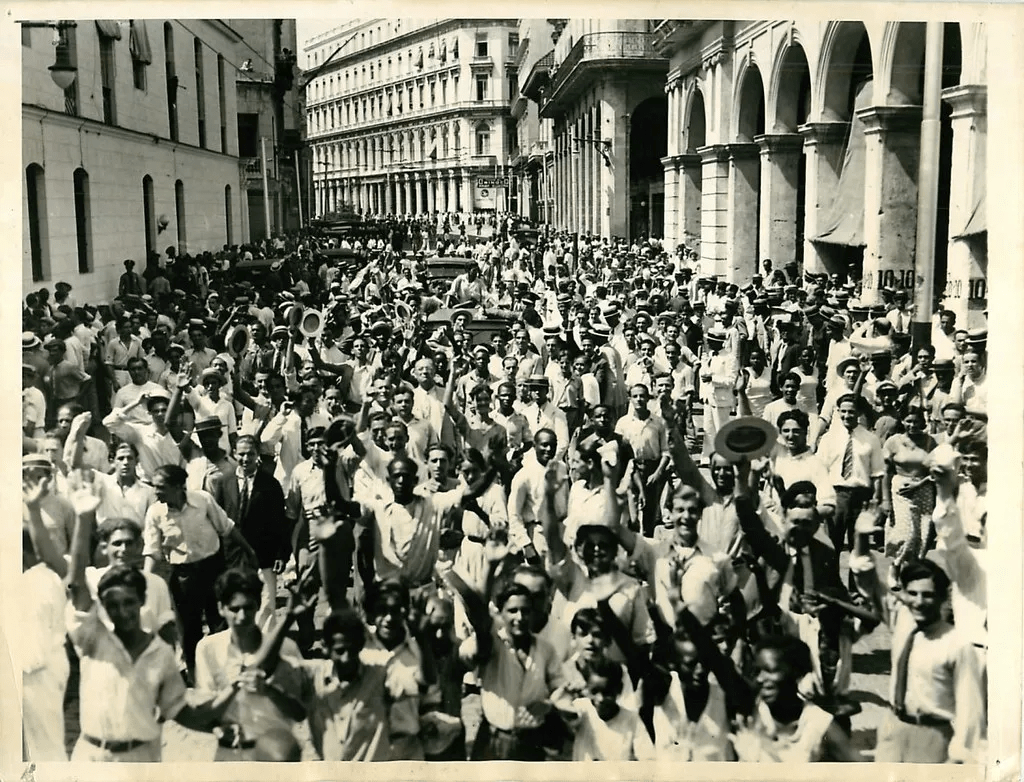
The Cuban Revolution of 1933 that overthrew U.S.-backed dictator Gerardo Machado was unfinished business as the island saw two more years of revolutionary struggles before Batista was able to consolidate power through the suppression of the popular movements. With 6000 members in late 1933 and a much larger periphery, the Cuban C.P. played an important role in those events.
‘The Revolutionary Battles in Cuba’ by D.R.D. from Communist International. Vol. 11 No. 2. January 15, 1934.
Big events are developing once more in Cuba. In the middle of January, the C.P. Cuba and the revolutionary Confederation of Labor (C.N.O.C.) called on the workers to prepare for a general strike against the new Mendieta government which has come to power with the direct support of American imperialism and which had united all the basic groups of Cuban counter-revolution with the aim of launching a decisive attack on the revolutionary movement and the gains of the working class. The world bourgeois press which, echoing American imperialism, enthusiastically welcomed the coming to power of a government “with no tendencies to the extreme left” (Times, Jan. 19) announced to the world the complete collapse of the general strike in Cuba. The bourgeois press was somewhat too hasty. The very first day of the existence of the new reactionary government was marked by a wave of strikes in Havana and other towns which paralyzed the railroads and street cars and left the towns without light. On January 24, the New York Times stated that the strike movement was spreading to the provinces, to the sugar refineries and plantations, (the so-called Centrales). On February 1, according to L’Humanite, about 100,000 workers were already on strike in Cuba, among them 26,000 women in the province of Pinar del Rio and in Havana. On February 5, Tass cabled from New York that the strike movement was spreading throughout the country and paralyzing the basic branches of Cuban industry—sugar and tobacco—as well as transport, electric power, etc., and that 150,000 workers took part in the movement. Finally, according to the latest information of Tass dated February 7 from New York, 5,000 harbor workers and chauffeurs and 8,000 miners had joined the strike. In various parts of Coba, the strikes and mass demonstrations were already accompanied by armed clashes between the demonstrators and the troops.
Now, what is this Mendieta government against which the present general strike is directed? It is a government which American imperialism and Cuban counter-revolution have put in power after the previous bourgeois-landlord government of Grau san Martin proved incapable of coping with the growing forces of revolution.
The attitude of American imperialism towards Grau was sufficiently clearly expressed in a private letter of the United States Ambassador to Cuba, Welles (who since then has been replaced by Roosevelt’s personal representative, Caffery). The following is a passage from Welles’ letter:
“Grau San Martin has not the confidence of anybody. Should he continue to rule, we have no hope that the present depression in foreign and Cuban business interests can be remedied for some time. He has entirely lost control of the requirements in the present situation. His idea of government is to issue decrees or laws, no matter how inapplicable or impossible the carrying out of these decrees might be.” (Daily Worker, New York, December 15, 1933.)
The attitude of the Cuban ruling classes towards Grau is no better. Cuba Importadora i Industria, the organ of the commercial circles, wrote as follows
in December, 1933:
“The affairs of our government are in the hands of an ‘authentic’ revolutionary regime represented by a small and hastily improvised group. Without any public support and relying only on violence this group is leading the country to disaster which is tantamount to social and economic catastrophe. From the very moment when this group took over control of government affairs by means of violence we have witnessed feverish thoughts, absence of any preparatory work and the obvious ineptitude of the members of this group coupled with passionate egoism that has become characteristic of every act of the new government.”
Even the correspondent of the American Nation, who on the whole was sympathetic to the Grau government, admits that “the present Grau Government is a romantic, nationalistic enterprise without a definite program.” (Nation, January 17, 1934).
These quotations show that although the Grau Government defended the interests of the bourgeoisie and landlords as well as their dictatorship against the developing revolution of the people it did not enjoy the support of either the ruling classes or the imperialists. Grau was put into the President’s chair by the petty-bourgeoisie, mainly by the students, by the workers who were under petty-bourgeois influence and by the army which got rid of its old officers who were in the service of Dictator Machado. The army, however, was not in the hands of Grau, but in the hands of Sergeant Batista who became commander-in-chief and temporarily supported Grau. Grau made desperate attempts to extend his petty-bourgeois support by means of petty concessions and anti-imperialist demagogy. Thus he issued a decree reducing gas and electric rates by 45 per cent and when the American electric company refused to comply he established government control over it.
He even refused to make payments to American banks in respect to certain loans made by Machado. He tried to win over the unemployed by his so-called “50 per cent law” according to which, 50 per cent of all jobs must be put at the disposal of native Cubans. Finally, in the very last days of his rule, Grau even issued a decree according to which the land belonging to the government was to be distributed among the peasants, each peasant household receiving 33 and one-third acres; by this decree he hoped to win the support of the peasantry.
However, the majority of these decrees together with many others issued by him remained on paper and failed to improve the situation of the petty-bourgeoisie, thus resulting in the growth of discontent among the petty-bourgeoisie. The chief force in Cuba in this period was not the petty-bourgeoisie, but the proletariat. The period of the Grau government coincided with the rapid development of strike struggles of the workers against the capitalists. Throughout the whole of Cuba the workers, among whom there are about half a million unemployed (according to Wirtschaftdienst, June 16, 1933) took the offensive against the employers in an attempt to utilize the favorable situation created after the Tall of Machado, first of all in order to improve their economic situation. It is precisely this powerful strike movement of the proletariat which gave such breadth and force to the August revolution, transforming it into a real mass revolution. The workers achieved important successes in their economic struggles: in several industries the capitalists were compelled to raise wages and introduce the eight-hour day. Of special importance is the success of the strike struggles of the sugar plantation workers which were accompanied by seizure of plantations and in certain cases even by the establishment of Soviets, which however lasted only a few days. The movement of the sugar plantation workers struck a blow against the chief interests of American capital in Cuba.
Simultaneously with the development of the strike struggles of the workers and in connection with these struggles the revolutionary trade unions as well as the influence of the Communist Party among the working masses gained strength. The Communist Party of Cuba succeeded in winning over from the reformists a number of trade unions among which there was the mass union of tobacco workers. The Party considerably extended its influence in and increased the membership of the revolutionary sugar plantation workers’ union, which was first organized in the beginning of 1933. On January 12, 1934, the fourth congress of the revolutionary Confederation of Labor was opened in Havana in the presence of 10,000 workers. Over 2,000 delegates were present at this congress and if our information is correct, these two thousand delegates represent 300,000 organized workers, which means that the Communist Party has come very near to winning over the majority of the Cuban proletariat.
The ruling classes of Cuba and American imperialism could not help noticing that the rapid revolutionization of the masses and particularly the growth of the influence and force of the Communist Party represented a threat to the very foundations of the bourgeois landlord regime and imperialist rule in Cuba. They requested the Grau Government to take decisive measures against the revolutionary movement. Grau tried to satisfy these demands; he shot down workers’ demonstrations; he raided trade unions; he sent troops to the “Centrales” (sugar refineries attached to the plantations); he arrested Communists. But he was powerless to crush the movement, and under the pressure of the masses he was forced on several occasions to retreat. Very characteristic of this helpless wavering policy is the raid on the headquarters of the Revolutionary Confederation of Labor. This raid was conducted under the personal supervision of one of Grau’s ministers. Besides the headquarters of the Confederation the house of the secretary, Comrade Sasara Villar, was also raided, and Comrade Villar, together with several others, was arrested. On the following day protests from working class organizations began to pour in. Grau denied all responsibility in connection with the raid and put all the blame on some unknown sergeant. The leaders of the Confederation were at once released with apologies and compensation for damages was offered to the Confederation.
American imperialism, which is the main factor in the counter-revolutionary camp, twice attempted to bring about the overthrow of Grau, first with the help of the reactionary terrorist A.B.C. organization. The revolt of the counter-revolutionary officers and students led by the A.B.C. and the United States Ambassador to Cuba took place on November 7-8, but found no response among the masses and was crushed by Battista without any great difficulty. The second time American imperialism undoubtedly placed its stake on Battista himself, as a would-be military dictator. In the letter quoted above, Ambassador Welles wrote:
“There is a solution to the situation, if Colonel Battista is ready to act. Decidedly he is opposed to Communism, and were he determined to maintain order, he would receive the support of the business and banking groups with a view to replacing the present regime by a government in which they could have more confidence.”
However, this attempt failed. First the petty officers refused to support Battista against Grau. Later, on the eve of Mendieta’s coming to power, when Battista was still attempting to establish his own dictatorship, the strike of the municipal workers and civil servants compelled him to give up his attempt. Finally, American imperialism was all the same successful in uniting the Cuban counterrevolutionary forces and in persuading Grau to resign. This was due first of all to the fact that Grau had completely lost the confidence of the petty bourgeoisie. Under the influence of the strike wave in the last days of November, and especially in December, there were waverings in the ranks of the petty-bourgeoisie. These waverings found their expression in the strikes of teachers and doctors, in the anti-government demonstrations of the students, etc. The situation became unfavorable in the army. The old army discipline was being destroyed. It had become more and more difficult to use the army for crushing revolutionary actions. It became necessary to resort to all sorts of slander against the Communists, and to cajole the soldiers. The army ceased to be the obedient tool of the ruling classes. The approach of the so-called “Zafra” (harvest season on the sugar plantations) upon which the profits of American capital in Cuba depend, compelled American imperialism to hasten the overthrow of the government, notwithstanding the fact that Gran, with all his zig-zags, was undoubtedly moving to the right. This found its expression not only in the attempts to crush the revolutionary movement, but also in the release of the counter-revolutionary officers arrested after the revolt.
In the middle of January the fall of the Grau government had become inevitable. The fact that this change of government took place by means of an agreement and not by means of armed rebellion and the fact that Evia, who came into power after Grau, could hold power only two days, shows the force of the revolutionary pleasure of the masses.
Thus, American imperialism has been successful in placing finally in power a government of united counter-revolution without resorting to open armed intervention which, for reasons of an international character, would be inconvenient. Of course it is not excluded that disagreement in the camp of the ruling classes still exists.
The immediate tasks of the Mendieta government are clear. It must launch a decisive offensive against the revolutionary movement, it must bring to naught the economic victories of the working class and ensure the carrying out of the Zafra in the interests of American capital.
While the Cuban counter-revolution—the bourgeoisie and landlords—are calling for full confidence in Mendieta, American imperialism is doing all in its power to help them carry their aim into effect. For four months American imperialism stubbornly refused to recognize the Grau government under the pretext that it did not represent the “will of the nation.” This same American imperialism hastens to recognize the Mendieta government a few days after its formation, evidently considering it to be definitely proved that it represents the “will of the nation,” though a considerable part if not the majority of the Cuban nation—the proletariat and the urban poor—by means of strikes demonstrate their will to overthrow this government of united reaction. With the same object of supporting Mendieta, American imperialism hastens to promise a big quota for Cuban sugar (according to the plan of Chadbourne, the export of sugar in the years of the crisis must be a little more than one-third of normal) and to finance its manufacture and export in the coming season. The latest statement in the New York Times speaks of the decision of Roosevelt to send two million dollars worth of food to Cuba on credit for the supply of the population whose purchases of food have fallen greatly during the years of the crisis, thus reducing wide sections of the population to a state of actual starvation.
Will the Mendieta government be able to carry out the tasks imposed on it and deprive the revolution of its “social character which fatally threatens to bring it to a crisis,” according to the expression of the most openly reactionary organ of the Cuban ruling classes, Diario dela Marina?
The first steps of the new government showed that it was trying to “step cautiously” at first. Mendieta’s government confirmed Grau’s “50 per cent law” against which the American sugar manufacturers who import cheap labor power into Cuba— Negroes from Haiti and Jamaica—had protested as well as the maintenance of government control over the plant of the American Electric Company. These measures show that Mendieta, not feeling himself strong enough to make a frontal attack on the proletariat, at any rate, at the given stage, tried to carry out the slogan proclaimed by reaction: “Not for sovietism, not for feudalism but for enlightened opportunism. We must all sacrifice something so as not to lose all.”( Diario dela Marina, Jan. 23, 1934) As can be seen, the Cuban landlords and capitalists understand perfectly well what the further development of the revolution may mean to them. However, the objective conditions and the growing indignation of the masses proved to be stronger than the cunning calculations of counter-revolution which wished to continue Grau’s policy of honied phrases and empty promises a little longer so as to utilize this time for rallying its forces and above all for strengthening the shattered discipline in the army and forming supplementary armed forces in the form of class military organizations. (According to the Daily Worker, the A.B.C. has already started to form counter-revolutionary detachments of “Green Shirts.”)
By the objective conditions to which we referred previously we mean the beginning of the season for harvesting and manufacturing the sugarcane and the so-called Zafra. The question of Zafra is a question of national importance for Cuba since sugarcane is practically the only crop of the country. Sugar and allied products comprise 85 per cent of Cuban exports and directly or indirectly affect the immediate interests of two-thirds of the population of the country. The chief profits of the American capitalists who operate in Cuba and appropriate 75 per cent of the entire national income of the country, are connected with the manufacture of sugar. (Wirtschaftdienst, June 16, 1933) As the result of some months of strikes, the workers in the plantations secured a rise in wages from 15-20 cents to $1 for an eight-hour day. At the present level of prices for sugar, the maintenance of these wages is incompatible with the colonial superprofits to which American capital is accustomed. The American sugar manufacturers refused to begin the Zafra until the Mendieta government took steps to “protect them from the discontented workers,” i.e., until wages were reduced to the level of Machado’s time. The Zafra season usually begins January 15. On January 20, 1934, only eight Centrales were at work, while a year ago about 200 were in operation at this period. But neither the American capitalists nor the Cuban government can limit themselves to a mere sabotaging of the Zafra on which the profits of the former and the income of the latter depend. However much the Mendieta government may wish to tarry a little before exposing its anti-worker face, its attack on the gains of the workers has become quite inevitable. During the last few days this attack has found expression among other things in the prohibition of strikes. Such are the objective conditions which have accelerated the new rise of the strike wave. Under the leadership of the C.P. and the C.N.O.C. (National Federation of Labor of Cuba) these mass strikes have grown into a counteroffensive of the workers against reaction, into a general political strike which at the present time is paralyzing almost all the economic life of Cuba.
The political significance of the present general strike differs in principle from the strike which overthrew Machado in August, 1933. In the overthrow of Machado, besides the working class which was the main driving force, there took part also various groups of the Cuban bourgeoisie and the landlords who felt offended by Machado and his clique which monopolized for itself all the spoils of office. In the August strike the proletariat was not yet opposed to the ruling classes, because in practice the working masses did not yet see that essentially in their class hatred for the toilers these bourgeois-landlord groups in no way differed from Machado although they opposed him. It is precisely for this reason that the liberal press in Cuba and outside it speaks so lovingly of the national character of the “glorious” revolution which overthrew Machado. The present general strike is developing after four months of revolution, after hundreds of thousands of workers had been drawn into the economic struggle against the capitalists, thousands of them, in all probability, having taken part in strikes several times (we have no exact data), when not only the workers but also the broad masses of the people have felt on their own shoulders the policy not only of the rights but also of the most “left” radical demagogic part of the Cuban bourgeoisie as represented by the Grau government. In the present strike it is not against the government of a part of the ruling classes that the workers are striking but against the government of “national concentration” which has the open support of all the political groups of the Cuban bourgeoisie and landlords. Therefore the present general strike is bound to be accompanied by a sharp division of the class forces on the political stage of Cuba and is bound to be directed objectively against the bourgeois-landlord semi-colonial regime as a whole. The full realization of this central point—the political significance of the present general strike by the working masses depends entirely on the successful work of the Communist Party. But the further development of events depends to a great extent on the correctness of its policy.
***
Having called on the workers to defend their gains from the attacks of reaction, the C.P. of Cuba, according to the casual information of the Daily Worker, launched two basic political slogans in the workers’ and peasants’ committees of action and the present general strike—the formation of united seizure of the power in the localities by the workers and peasants. Both slogans are correct but insufficient. The brief history of the Cuban revolution can already show cases when the workers, having seized the local power, did not know what to do with the power they had seized. There was such a case in Sienfuegos, where the workers kept the local municipality in their hands for several days marking time until they were driven out by the troops. The only measure undertaken by the workers’ power was the handing over of 40,000 pesos belonging to the local authorities for distribution among the unemployed. Likewise when the workers seized the centrales and formed Soviets in the centrale at Mabei, nothing was done for the immediate distribution of land to the peasants. These facts show that the slogan of the seizure of the local power is not sufficient. It is also necessary to indicate a series of concrete transitional demands for which the Party is now struggling and which can be carried out immediately either by direct action or as soon as the power in any district comes into the hands of the workers and peasants even if this power is of short duration. Among such transitional demands are: workers’ control over the factories with increased wages, introduction of the eight-hour day, etc., the annulment of the debts of the peasants and the division of the land of the landlords and the government, as well as the plantations among the peasants, the confiscation of the reserves of food and clothing for the benefit of the unemployed, the moving of the workers to the best houses, a considerable reduction of taxation, deter: mined measures for the struggle against speculation and high prices, a guarantee that the Zafra will be carried on in the interests of the toiling population, and, last but not least, the arming of the workers and peasants, the formation of defense detachments, red guards, etc.
A short and simply written platform of such intermediate demands will not only show the workers what to fight for at the present time but will also serve as a guide to immediate action for the workers and peasants; will rouse and direct the initiative even in places where the direct leadership of the Party is difficult or inexperienced. It is true that even on November 10th, the Party published quite a good program of the workers’ and peasants’ government, pointing out concretely what the Soviet power will give to the various strata of the toilers. This program is useful and necessary for general agitation for the Soviet power but cannot replace a short program of action for the present period which is transitional, passing into a direct struggle for the workers’ and peasants’ government. Incidentally, it may be mentioned that there are mistakes in this program. The demand for the collective cultivation of the land when the plantations came into the hands of the peasants and farm laborers is the most dangerous of these mistakes, because firstly, it deprives the Party of the support of considerable sections (if not the majority) of the peasants and of some of the farm laborers who depend on the plantations and who wish to cultivate their own farms and secondly, inasfar as the methods of large-scale cultivation used on the plantations are connected with the manufacture of cane sugar, it makes it difficult for Cuba to build up its own food basis, on the development of which the future fate of the workers’ and peasants’ revolution will depend to a great extent after the overthrow of the bourgeois-landlord government.
In the past the Party did not always show ability to maneuver with slogans so that they should be in accord with the various levels of the movement in the various districts, with the rapidly changing situation, with the turn and changes of particular phases in the development of the revolution. It is sufficient to look at the leaflets and manifestos of the Communist Party to see that all the slogans of the Party belong to one of the two basic groups—immediate economic demands or the agitational slogans of the Soviet power. However, even under the Grau government, it was necessary to put forward a number of intermediate demands which do not deny but presuppose (this applies also to the present stage) the preservation and extension of elementary economic demands in those districts of the country where the movement is only beginning, for those backward sections of the working class and especially of the peasants, which are rising to the struggle for the first time, etc.
A most important task faces the Party in the sphere of the political education and organization of the masses. We have already noted the great successes of the C.P. of Cuba in winning over the working masses. The fact that the Party secured these successes as a result of the successful leadership of mass economic struggles is a tremendous asset to the Party. But the trade unions won by the Party from the reformists have not yet been consolidated. The reformists still sit in the trade unions. They have quieted down for a time and are waiting for a convenient opportunity to come to the fore again. If the Party does not carry on mass work with the aim of politically isolating the reformists from the masses then there is still the danger that some sections of the proletariat will waver and some ex-reformist trade unions will withdraw from C.N.O.C. This actually happened in some district when Grau began his repressive measures against the revolutionary unions. The present general strike provides particularly favorable conditions for developing energetic work with the object of politically educating the masses on the experience of their own struggle, for the raising of the movement to a higher level, for plainly showing to the masses that all the reformists, however they may call themselves, are on the other side of the barricade, and that the only leader capable of carrying the working class and the peasants to the victorious completion of the revolution and the winning of power is the Communist Party.
In order to consolidate its influence in the trade unions, the Party must considerably strengthen the Party backbone in them, which presupposes the extensive recruiting of trade union members for the Party and the Y.C.L. It must bring about the correct functioning of the Communist fractions, get possession of the trade union apparatus and drive the reformists out of the leading organs, and without fail, introduce non-Party revolutionary workers into them as well as Communists. Finally, the organizational fusion of the ex-reformist unions with the revolutionary unions demands that they should be recognized on an industrial basis, and especially it demands the organization, widening and strengthening of the factory committees in the various enterprises. All this work can only be successfully carried on provided it is accompanied by a struggle against the influence of the reformists and by our mercilessly unmasking them before the broadest working masses, and provided that at the same time we carefully take into account the concrete situation in every trade union.
The Party theoretically understands the significance of the agrarian revolution. However, in practice the Party has so far done very little to organize peasant committees in the villages, to develop the struggle of the peasants for land.
The level of the peasant movement throughout the whole period since the fall of Machado has lagged greatly behind the powerful strike struggle of the proletariat and in general has not gone beyond the limits of the partial demands of the peasants. This is the basic weakness of the Cuban revolution. Only in two Eastern provinces (Oriente and Santa Clara) which, however, are extremely important from the point of view of the distribution of the population, the peasants in isolated cases began to seize the land of the landlords. The lagging of the peasant movement behind the development of the proletarian struggle is undoubtedly connected with the fact that the Party, having incorrectly understood the task of maneuvering in connection with the danger of intervention by American imperialism, withdrew the slogan of the confiscation of the plantations belonging to the imperialists and their division among the toilers of the villages. In the program of the workers’ and peasants’ government mentioned above, the peasants are left somewhere in the background, after the petty-bourgeoisie, after the office workers, handicraftsmen, students and traders.
The Party in general, it should be said, neglected work in the villages, not only forgetting the importance of this work from the point of view of ensuring support for the proletariat by its chief ally—the peasants—but forgetting also the connection between the attitude of the peasants to the proletariat and the attitude of the army to the revolution. The Party says nothing about the giving of land to soldiers. It formulates the slogan of soviets thus—soviets of workers’ and peasants’ deputies, supported by committees of soldiers and sailors, seemingly denying the soldiers and sailors direct participation in the soviets, which is absolutely impermissible. If we add to this that the Party pays little attention and devotes little effort to the work in the army, it will explain the comparatively small success of the Party among the masses of soldiers, especially in the matter of organizing soldiers’ committees. However, we must mention that the latest information of the Daily Worker speaks of improvement in this work. For example, it is mentioned that the sailors from two warships offered their support to the Party, in some districts the soldiers and junior officers send their delegates to the Party committees, expressing their readiness to act at the instructions of the Party. This shows that the Cuban comrades have realized that at the present stage of the movement the disintegration of the army and the winning of even part of it to the side of the revolutionary people is one of the most important conditions for the victory of the revolution.
In order to get the masses to join our organizations and to guarantee a Party backbone in the mass organizations, the C.P. of Cuba must become a mass organization. For this purpose 6,000 members and about the same number of Y.C.L.’ers is not sufficient although these figures signify that the membership of the Party and the Y.C.L. has more than doubled during the last four or five months. The Party must strengthen its illegal apparatus and improve its guidance of the provinces in order to ensure a united political line and unity of action in the various districts. Finally in every organization of the Party we must enforce iron discipline and inflict strict punishments including expulsion from the Party for any negotiations with class hostile groups without the preliminary decision of competent organs.
The C.P. of Cuba and the worker and peasant masses which follow it are entering a transition stage to decisive struggles for power, for the revolutionary democratic dictatorship of the working class and the peasants. The next few weeks will show whether American imperialism, through its puppet Mendieta, will once more fully establish a colonial regime in Cuba or whether the toiling masses of Cuba, led by the working class and its Communist Party, will obtain their freedom, will obtain firm gains which no reaction will be able to take away from them.
The ECCI published the magazine ‘Communist International’ edited by Zinoviev and Karl Radek from 1919 until 1926 irregularly in German, French, Russian, and English. Restarting in 1927 until 1934. Unlike, Inprecorr, CI contained long-form articles by the leading figures of the International as well as proceedings, statements, and notices of the Comintern. No complete run of Communist International is available in English. Both were largely published outside of Soviet territory, with Communist International printed in London, to facilitate distribution and both were major contributors to the Communist press in the U.S. Communist International and Inprecorr are an invaluable English-language source on the history of the Communist International and its sections.
PDF of full issue: https://www.marxists.org/history/international/comintern/ci/vol-11/v11-n02-jan-15-1934-CI-USA-riaz-orig.pdf

