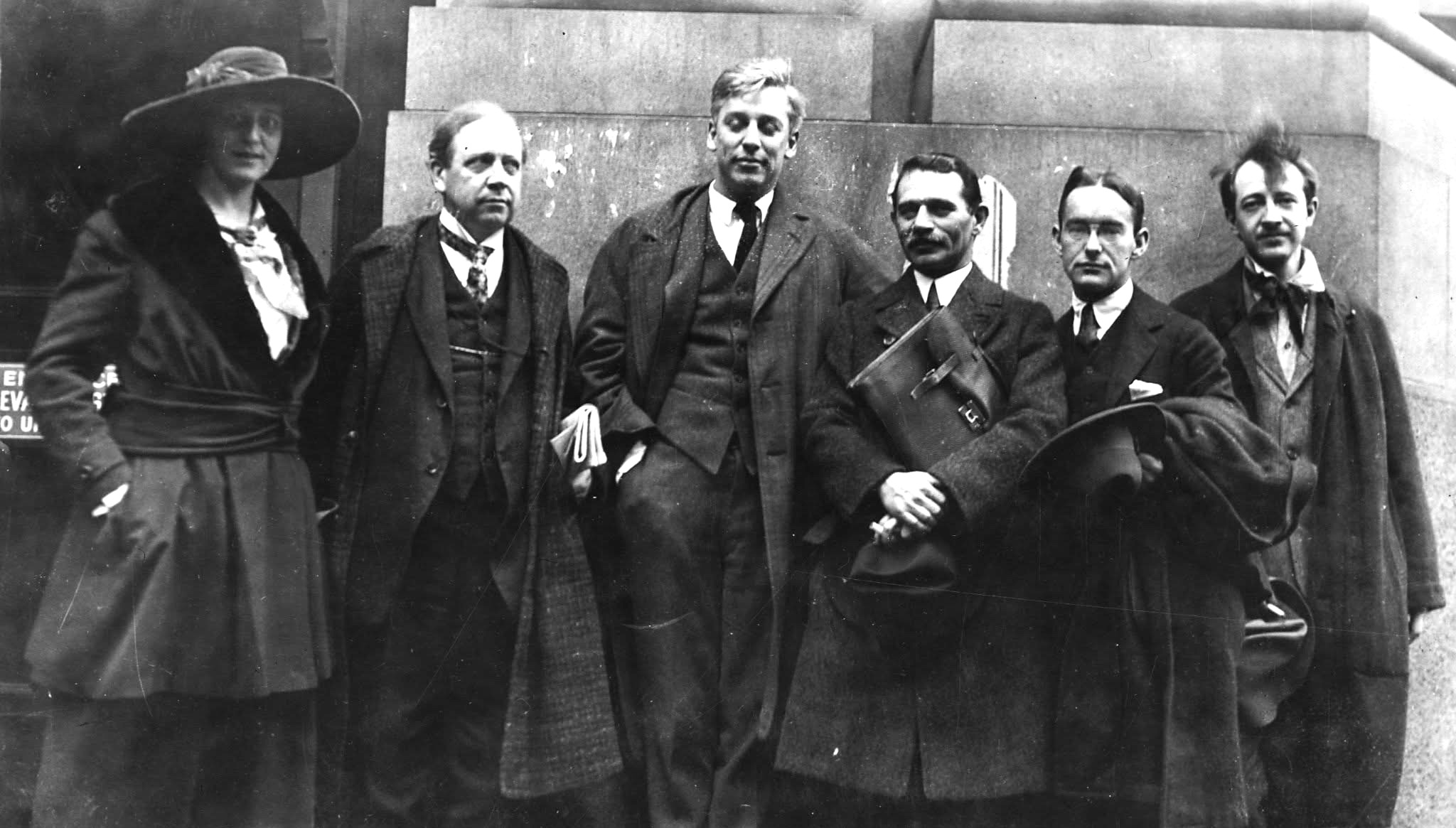
John Reed on trial. The second of two trials, both to end in hung juries, of The Masses for violating the Espionage Act by inspiring “insubordination, disloyalty, mutiny and refusal of duty in the military and naval forces of the United States.” Along with the magazine itself, seven were individually charged–Max Eastman, Floyd Dell, John Reed, Henry Glinterekamp, Art Young, Merrill Rogers, Jr., and Josephine Bell–as well. The Masses, like nearly every radical publication at the time, did not survive government repression.
‘The Second Masses Trial’ by John Reed from The Liberator. Vol. 1 No. 10. December, 1918.
IN the United States political offenses are dealt with more harshly than anywhere else in the world. In the amendment to the Espionage Act it is made a crime equivalent to manslaughter to “criticize the form of government.” The sentences in Espionage cases run anywhere from ten to twenty years at hard labor, with fines of thousands of dollars.
Nevertheless, in imposing sentences federal judges usually employ such words as these: “This is a free country. You enjoy here the rights of free speech and a free press. If you had committed this offense in any other country you would have been stood up against a wall and shot. This country protected you while you made a good living, and you were ungrateful. I am going to give you the limit, so that you may be an example to other malcontents and bad citizens.” All of which is, of course, quite untrue. The facts are the opposite of those stated.
The harsh punishment of political offenses breeds revolution, as other countries know. In this country Socialists are the chief political criminals, as they were in Germany before 1870. Bismarck could not suppress them there; Burleson and Gregory will not be able to do so here.
The second trial of the Masses case, although a political trial, differed in many respects from the conventional Espionage case. All the defendants were Americans, of old American lineage. The Judge, Martin Manton, allowed them a good deal of latitude in proving their intent. The jury was open to impressions. The case was tried in New York City, where the hysterical war spirit has never got the hold it has in the more provincial districts of the Middle West. And, finally, the tensity of patriotic feeling, kept at a stretch for more than a year, had begun to slacken.
This we felt immediately we entered the court-room. Outside, in City Hall Park, the Liberty Loan Band was playing the national anthem, as it had before. In the courtroom the Marshal and his satellites, as well as Department of Justice operatives, moved around with menacing looks. When the Judge took the bench he seemed to have made up his mind; he interrupted constantly our lawyers’ examination of talesmen. The jury panel looked hopeless; one man after another admitted prejudice against Socialists, and Socialism. A tall, pompous-looking gentleman, asked his business, replied self-consciously, “Wall Street.”
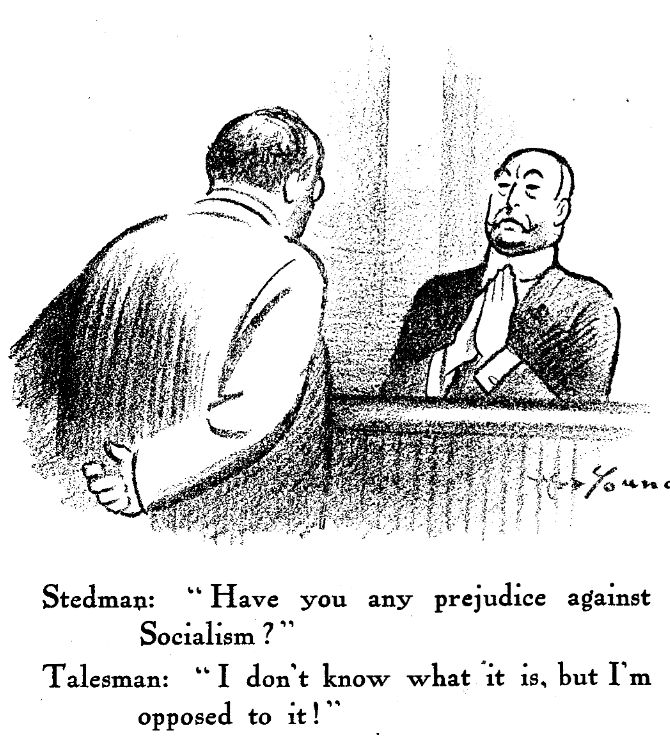
Stedman asked if he had any prejudice against Socialism. “I don’t know what it is,” he said, “but I’m opposed to it!”
How inevitably, how clearly in all these cases, the issue narrows down to the Class Struggle! District Attorney Barnes’ opening address to the jury implied one chief crime that of plotting the overthrow of the United States Government by revolution; in other words, the crime of being, in the words of Mr. Barnes, “Bolsheveeka,” addicted to what he called “Syndickalism.” An immortal definition of the Socialist conception which he made to the jury remains in my mind:
“These people believe that there are three classes–the capitalists, who own all the natural resources of the country; the bourgeoisie, who have got a little land or a little property under the system, and the proletariat, which consists of all those who want to take away the property of the capitalists and the bourgeoisie.”
We were described as men without a country, who wanted to break down all boundaries. The jury was asked what it thought of people who called respectable American business men “bourgeoisie.”
In no European country could a prosecuting attorney have displayed such ignorance of Socialism, or relied so confidently upon the ignorance of a jury…
I was not present at the first Masses trial. In prospect, it did not seem to me very serious; but when I sat in that gloomy, dark-paneled court-room, and the bailiff with the brown wig beat the table and cried harshly, “Stand up!” and the Judge climbed to his seat, and it was announced, in the same harsh, menacing tone, “The Federal Court for the Southern District of New York is now open…”–I felt as if we were in the clutches of a relentless machinery, which would go on and grind and grind…
The first trial had taken place amid the excitement and patriotic hysteria which accompanied the Third Liberty Loan; the second trial was set for the Fourth Liberty Loan campaign. Morris Hillquit, our counsel, was ill; Dudley Field Malone, associated in the case, had to leave it just before the trial; and Seymour Stedman, who came from Chicago to the rescue at the last moment, tried the case without the possibility of preparation, and almost in a state of physical collapse.
But the attitude of the defendants in the second trial was different from what it had been in the first. Last spring Germany was invading Russia; this fall the United States was invading Russia; and Socialists were in a different frame of mind. Moreover, the persecution of Socialists had grown more bitter, and it had become more and more clearly a class issue.
I think we all felt tranquil, and ready to go to prison if need be. At any rate, we were not going to dissemble what we believed. This had its effect on the jury, and on the Judge. When Max Eastman defended the St. Louis Declaration of the Socialist Party, when Floyd Dell defended the conscientious objectors, when Art Young made it clear that he disapproved of this war and all wars on social and economic grounds, when Seymour Stedman boldly claimed for us, and for all Socialists, the right of idealistic prophesy, and repudiated the capitalist system with its terrible inequalities, a new but perfectly logical and consistent point of view was presented. The jury was composed of a majority of honest, rather simple men, the background of whose consciousness must have contained memories of the Declaration of Independence, the Rights of Man, Magna Charta. They could not easily, even in war-time, repudiate these things; especially when all the defendants were so palpably members of the dominant race.
Two weeks later I saw in that same court the trial of some Russian boys and girls, on similar charges. They did not have a chance; they were foreigners. An official of the District Attorney’s office was explaining to me why the Judge had been so severe upon these Russians, while our Judge in the Masses case had been so lenient.
“You are Americans,” he said. “You looked like Americans. And then, too, you had a New York Judge. You can’t convict an American for sedition before a New York Judge. If you’d had Judge Clayton, for example, it would have been equivalent to being tried in the Middle West, or in any other Federal Court outside of New York. You would have been soaked…”
It has been said that the disagreement of the jury in this second Masses case is a victory for free speech, and for international Socialism. In a way this is true. International Socialism was argued in court, thanks to the curiosity and the fair-mindedness of Judge Manton; free speech was vindicated by the charge of Judge Manton, who ruled that anyone in this country could say that the war was not for democracy, that it was an imperialist war, that the Government of the United States was hypocritical–in fact, that any American had the right to criticize his government or its policies, so long as he did not intend to discourage recruiting and enlistment or cause mutiny and disobedience in the armed forces of the United States.
But the one great factor in our victory was Max Eastman’s three-hour summing up. Standing there, with the attitude and attributes of intellectual eminence, young, good- looking, he was the typical champion of ideals-ideals which he made to seem the ideals of every real American. I had attempted to bring in the case of the Russian Soviet Republic, to combat the insinuations of Mr. Barnes that the Bolsheviki were German agents and that we supported them in their corruption. With suspicious reluctance the Court ruled all that evidence out. But Max boldly took up the Russian question, and made it part of our defense. The jury was held tense by his eloquence; the Judge listened with all his energy. In the court-room there was utter silence. After it was all over the District Attorney himself congratulated Max, and it is rumored that Marshal McCarthy began to preach Socialism to his deputies.
Stedman: “Have you any prejudice against Socialism?”
Talesman: “I don’t know what it is, but I’m opposed to it!”
I do not deny that this constituted a great victory for free speech, for Socialism. But at the same time this man East- man, as the Judge himself is reported to have said, is a dangerous fellow; it did not make any difference what cause he was pleading he would have convinced them just the same…
A preparation for this climax was made by Seymour Stedman, both by his summing-up and by the effect of his personality throughout the case. Stedman is the kind of man that men listen to; he appears to be a shrewd, good-natured Yankee from the Middle West, who knows how to talk the language of the man on the street.
When he said, for example, “My ancestors were at Valley Forge when Americans at high prices were selling their goods to British soldiers in Philadelphia,” the jurymen were jolted; they began to think. When he described how a mere handful of rich men own the entire resources of America, when he coldly and clearly traced the economic causes of the great war, and showed why Socialists did not believe that America ought to enter it, he was convincing. It was the way the Middle West used to talk a year ago; it was common sense.
“This republic,” he said, “must not be threatened by any attacks upon Americans in expressing their views on any man and any law which may be adopted at any time.”
I heard the jury talking this over, outside, in the hall, during recess. It hit them hard.
Barnes had the last say. Both Stedman and Eastman, preceding him, outlined to the jury what Barnes would say in his summing-up. So well did they prognosticate his very language that when the District Attorney rose to speak he really had nothing new to say.
At the end of his speech he rung all the conventional changes on the patriotic motive, ending with the description of a young man, a lawyer of his acquaintance, who had died in the trenches abroad so that the world might be made free. “Somewhere in France,” said Mr. Barnes, “he lies dead, and he died for you and he died for me. He died for Max Eastman, he died for John Reed. died for Merrill Rogers. His voice is but one of a thousand silent voices that demand that these men be punished…”
Art Young, who had been quietly sleeping at the counsel table, awoke at this point. He listened for a moment, with growing perplexity. Then he leaned across the table.
“Who’s he talking about?” asked Art. “Didn’t he die for me, too?”
The jury filed out about three. They took one ballot–to determine the guilt or innocence of the corporation–the Masses Publishing Company. Not guilty. Then arose a hard-faced old man, one of the jurors, an ex-City employee.
“I voted ‘not guilty’ for the corporation,” he said, “on condition that you would all vote ‘guilty’ for the individuals on each indictment…I am a Catholic. My faith bids me never to let a Socialist go if I once get my hands on him.” There was only one more ballot. The jury disagreed–eight for acquittal, four against.
The second Masses trial was over, with equanimity…
We await the third.
The Liberator was published monthly from 1918, first established by Max Eastman and his sister Crystal Eastman continuing The Masses which was shut down by the US Government during World War One. Like The Masses, The Liberator contained some of the best radical journalism of its, or any, day. It combined political coverage with the arts, culture, and a commitment to revolutionary politics ay a pivotal time in Left history. The writings by John Reed from and about the Russian Revolution were hugely influential in popularizing and explaining that events to U.S. workers and activists. Increasingly, The Liberator oriented to the Communist movement and by late 1922 was a de facto publication of the Party and was sold to the Party by Eastman. In 1924, The Liberator merged with Labor Herald and Soviet Russia Pictorial into Workers Monthly. The Liberator is an essential magazine of the US left.
PDF of full issue: https://www.marxists.org/history/usa/culture/pubs/liberator/1918/10/v1n10-dec-1918-liberator-hr.pdf

