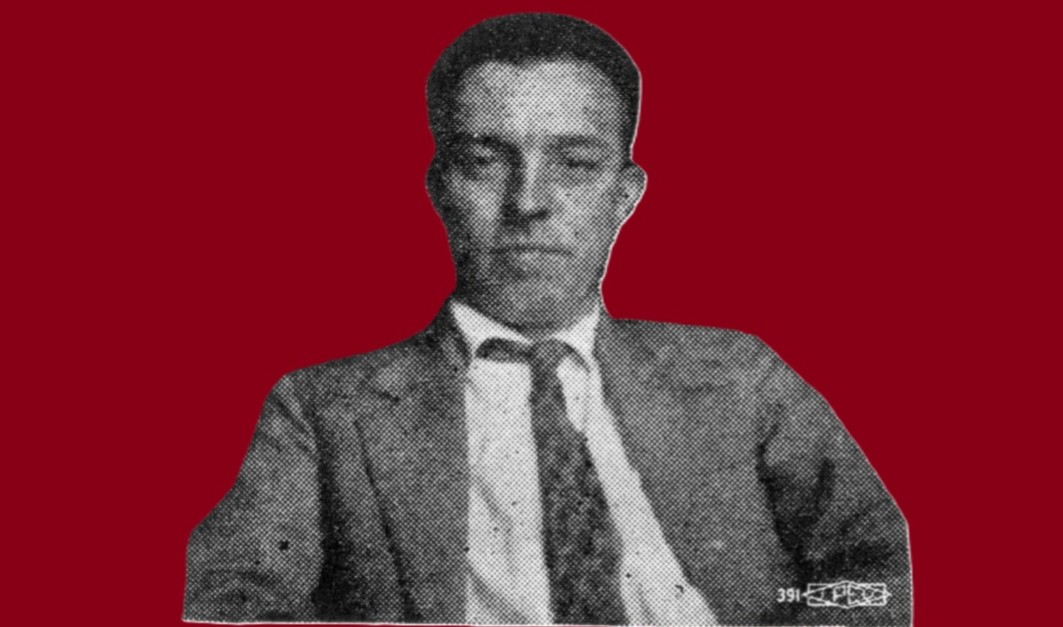
Written from the bowels of Chicago’s Cook County Jail where so many activists, from the Haymarket martyrs on, have been held. Arrested with dozens of others in the raids of September 5, 1917 that targeted I.W.W. and Socialist Party offices and activists, wobbly Harrison George–to later be editor of the Daily Worker–reacts violently to his first imprisonment. Harrison, who was among the last of the World War One-era political prisoners to be released in 1923, was profoundly affected by prison, spending most of his time in Leavenworth, he would try and make sense of the experience in many of his later writings.
‘A Grave of Liberty’ by Harrison George from Industrial Worker. Vol. 3. No. 8. March 23, 1918.
Is the Cook County Jail to again function as a sarcophagus of human rights? Behind its massive, grey stone walls are entombed one hundred or so of men who represent the I.W.W. Many have been taken in irons for thousands of miles to rot here far from their homes and kindred. For nearly six months they have been here held awaiting trial–not in a jail–but in a sewer; in the most hideous and health-wrecking institution conceivable to the imagination.
Into cold, dark and vermin-filled stone cells, whose full floor space is 6 feet by 8 feet–with a three-tier bunk on one side, an ancient type of open toilet and a small wash basin with a cold water tap–into cells supposed to hold only two prisoners, as many as five men have been crowded–some sleeping on the cold stone floor in the dead of a cruel winter; and in a jail where the filth and cobwebs of forty years clings to the crevices undisturbed; in a jail where ventilation does not exist, where the temperature is unregulated except by the whims of the changing guards who have no thermometer to guide them; in a jail where the only food given is a scanty ration of putrid meat and other things apparently rescued from the garbage can; in a jail where twenty hours of each twenty-four must be spent in the crowded cells; in a jail where sunlight, or even daylight, is a thing unknown–and where a poor artificial light ruins the best of eyes; in a jail, and under jailers, whose sole purpose seems to be to wreck human hopes and human health by putting men under such vile confinement and subject to such treatment as would kill hogs unused to such a sty.
Is it any wonder that we are becoming emaciated wrecks–even the strongest of us? Is it any wonder that the eyesight of many is failing–never to return? Is it any wonder that even such an athlete as Sam Scarlett–the former football star–whom all will remember as the picture of vigorous manhood, should now be a mere shadow of his former self–a pallid ghost–a walking skeleton? Is it any wonder that a lad of German birth, a fellow worker arrested at Chicago in the December raids, a boy whose artist mind exhibited itself in sculpturing, should in this unholy place turn into a screaming maniac his sensitive mind overthrown by the taunts of an American Torquemada who threatened him with hanging? Is it any wonder that Stanley Gancharik, a Russian boy, a fellow worker arrested as a “slacker” in June, coming in strong and healthy, should in December be discharged in the last stages of consumption? Even the flint-hearted Judge Landis being touched with his plight to the extent of giving the lad $3 to “see a doctor.” Fellow worker Gancharik “saw a doctor” too late, he died on February 25–murdered by those responsible for his incarceration in this cesspool–the Cook County jail.
It is a timely question that I ask of you who read these lines: Is this jail again to be the tomb of human liberty? We who are shut within its walls have not forgotten Parsons and his brave fellows, who here–in the same pen where we walk to and fro–gave up their lives for labor thirty years ago. We have not forgotten and–feverish and wakeful in the silent hours of the night–I hear a voice re-echoing from the cold, dark corners of our dungeon–an echoing voice of long ago–saying, “The day will come when our silence will be more eloquent than the voices you strangle today.” O, ye rulers! You should tremble for what is in our hearts!
Think not, you who exploit and impoverish the workers, that you can break our spirit. You cannot! Has imprisonment–the first I have ever known–tamed my soul? No! But it has fixed in me a remorseless anger–the sacred fire of rebellion against tyranny. I came here a creature tempered with mercy to all mankind; if I go from here–if I do go–a merciless enemy of those whose cruel violence opposes the liberation of my class.
A grand jury has suggested that the prisoners here should be compelled to witness the hangings of those men who are executed in this jail–“It would teach them a lesson.” Aye, it would! It would teach them the lesson of a barbarous and inverted civilization. It would impress upon these proletarians, housed here temporarily, the effectiveness of the gallows as a method of disposal of those who chance to be the underdogs. But will their class always be the underdog? Think of that–ye haughty masters of things! Think upon that and take us to the gallows if ye will–but history will speak–and you cannot strangle Time–can you?
The Industrial Union Bulletin, and the Industrial Worker were newspapers published by the Industrial Workers of the World (IWW) from 1907 until 1913. First printed in Joliet, Illinois, IUB incorporated The Voice of Labor, the newspaper of the American Labor Union which had joined the IWW, and another IWW affiliate, International Metal Worker.The Trautmann-DeLeon faction issued its weekly from March 1907. Soon after, De Leon would be expelled and Trautmann would continue IUB until March 1909. It was edited by A. S. Edwards. 1909, production moved to Spokane, Washington and became The Industrial Worker, “the voice of revolutionary industrial unionism.” A victim of finances and internal disputes, the IW ceased publication in 1913, only to be revived in 1916 and surviving as a weekly, sometimes more, until 1931. Easily among the most important working class newspapers in U.S. history and an essential resource on the wobbly, and larger radical labor experience.
PDF of full issue: https://washingtondigitalnewspapers.org/?a=d&d=IWW19180323

