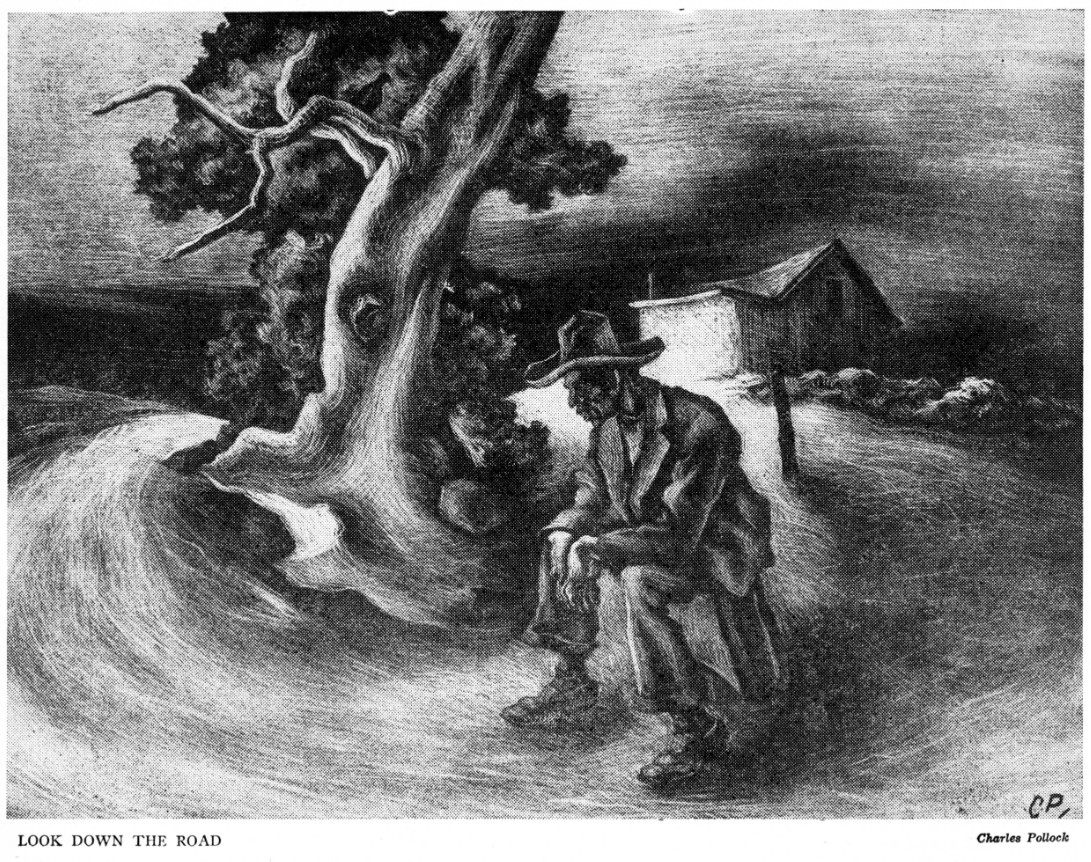
What was left of central Idaho’s small farmers, along with the region’s migratory workforce, are decimated in the Great Depression.
‘Starve, Peasant! The Crisis in the Idaho Hills’ by George Dixon from New Masses. Vol. 18 No. 4. January 21, 1936.
The following article on conditions among poor farmers and agricultural workers in the Far West was written before the Supreme Court invalidated the Agricultural Adjustment Administration. The A.A.A. proved to be of little help indeed to the small farmers, although some benefit accrued to the middle farmer. With the A.A.A. defeat, the poor and middle farmers are left without even the meager aid that occasionally filtered through to them–Editors.
YOU DON’T hear much about the land west of the Dakotas, but in the great dry-farming areas of the Far West men and women are in just as bad shape as the farm population of more publicized areas. The millions of acres of wheat land extending west through Montana and south into Idaho years ago were vast producers of marketable grains. Thousands of farmers went out, cleared the sage, plowed around the lava boulders and during the wartime boom made considerable money. But the picture rapidly changed; prices on every farm product and especially on wheat fell like plumets.
The impact of a glutted market was felt by the farmers years earlier than by other American workers. On Canyon Creek in eastern Idaho for example as early as 1920 a man considered himself lucky if he got from the land as much money as he put into it. Gibbons and Reed, who in that year owned between two and three thousand acres of the best dry land experienced a complete crop failure and in the long winter that followed lost most of their range stock. The next year, with the collapse of the American wheat market, they had to get crop loans and seed mortgages, and the harvest of that year broke them. This happened to a flourishing partnership of well-to-do men; what was the lot of the little farmer with maybe half a section in wheat? He had more difficulty in getting his loans—if he could get them at all—and when he was broke he was sold off his land.
The dry-farmer who has stuck it out until today is a hard-bitten, angry man with no love for the Roosevelt government. He sees the results of A.A.A. policy and he knows that the government has no care for his welfare. He knows that the big ranchers, the livestock companies, the big owners of hundreds of thousands of acres of land, the Woods and Hagenbarths are getting A.A.A. checks, but he has not seen any come his way. And his hatred of the trustified farming interests mounts daily.
The tactics employed by the Woods Livestock Company, several years ago taken over by Hugh Hagenbarth & Sons, have taught him what to expect of these American kulaks. During the War, Woods built the town of Spencer, Idaho, importing indigent school teachers on loans against their homesteads. This homestead land, as soon as it was cleared, was easy pickings for the company; and under the terms of the loans Woods was able to take the cleared land and throw his school teachers off. The nucleus for a powerful company was formed and in the drought years of the early ‘twenties Woods bought up large areas of farm and cattle land for $1 to $8 an acre. But with wheat prices at all-time lows, the company began to use this cleared land for range; the land of independent farmers that stood in the way of Woods’ herds was overrun, the fences cut and right-of-way disregarded. If the independent farmer had to move his herd through Woods’ land to get it to market, they closed him out, wouldn’t let him pass and there was nothing for him to do but sell out to the company at the company’s price. The little man was absorbed.
Legrand Smith of Rexburg can tell you what has happened to hundreds of his friends and what happened to him. In their desperate efforts to sell the products of their factories to a farming population with no purchasing power, the International Harvester Company sent an army of salesmen into the West with “attractive” propositions on their tractors—in a time when there was already an overproduction of farm goods. Farmers bought tractors because they were willing to take any chance to make a little money to pay back their mountainous debts. They signed long installment contracts, many of them doing what Legrand Smith did, auctioning off their team outfits to make the down payment. The end result of this. attempt to increase production by machinery was inevitably a further slump into debt and failure. When in the U.S.S.R. tractors and every kind of farm machinery cannot be supplied and utilized too rapidly, every attempt to use it in this country only plunges the farmer deeper into the crisis. Aside from being far too expensive for the farmer to operate, apart from the initial cost, these tractors and especially Farmalls were found to be too light and poorly constructed to work the heavy soil in the rolling lava hills of Idaho. Now they may be seen standing in sheds or on corner lots unused, rusted and abandoned—and not paid for.
THE last five years thousands of these small farmers have been sold out, expropriated. They have become migratory workers, moving with the seasons from wheat to peas to beets and to the lumber camps. They have joined with the thousands of transient Mexicans. And they are forced to exist at the lowest subsistence levels of any workers in the country.
The San Diego Fruit and Produce Company raises peas on a large scale in the Teton region of Idaho. Each year for several weeks in August and September thousands of Mexicans and American workers are recruited from over the intermountain states to work in the fields as pickers. A traveling agent solicits pickers, promising a wage he knows will not be paid. On arriving at the camps the workers have no choice but to accept the company’s terms, having spent their last cent bringing themselves and their families perhaps hundreds of miles in the expectation of a season’s work at fair wages. They sign contracts which the Mexicans in most cases do not understand. The single men are forced to board with the company, the family men to live in miserable mud-and-packing-case huts furnished by the company and to buy at the company’s store.
In 1935 the wage. paid was eighty-five cents per hundredweight of peas picked. An average picker can pick from two to three “hampers” in a fourteen-hour day. But the company has figured out a way to swindle the picker out of part of his wage, force him to spend all of the wages he does get and keep him in the fields until the last tailings of peas are picked, when he can’t pick more than forty cents worth of small thirdrun peas from the bad fields. The method is simple. The men are paid seventy cents “straight” with a bonus of fifteen cents per hundredweight to be paid at the end of the contract. If a picker quits or for any reason is absent for a day from the fields, he forfeits the entire bonus accumulation. If a picker does work out his contract he makes so little during the last weeks, since the peas grow scarcer—and smaller—that his earnings are eaten up by his living expenses. The company charges him $1 a day board and he’s lucky to make forty cents, bonus and all, in the last weeks of work.
On August 14, 1935, 2,000 pickers went on strike in the fields of the San Diego Fruit and Produce Company, demanding $1 straight per hamper. The sheriff of Teton county hurriedly deputized several dozen growers, entered the camp and at the point of guns arrested four of the strike leaders, blackjacked them and threw them into jail at Driggs, Idaho. But the next day the strikers parried by surrounding a group of deputies in the camp, backing them into an automobile and keeping them there until Sheriff H. Rex Smith released the strike leaders.
That afternoon hysterical growers gathered in the courthouse at Driggs, screaming for armed intervention against the striking pea pickers. Sheriff H. Rex Smith cowered in his office, saying the situation was entirely beyond his control and S.H. Atchley, prosecuting attorney of Teton county, frantically wired Governor Ross to send troops. When the National Guard arrived the troops marched into the camps and “captured” over 200 strikers. At the muzzle’s end work resumed.
IT IS a fact that the population of this Far Western farm area has fallen by almost a quarter in the last five or six years. West from the Teton mountains to the valleys of central Idaho thousands of dry-land acres lie uncultivated, untenanted, the huddle of abandoned shacks on a hillock overlooking the vacant land falling more completely to ruin. with every winter. Some of these farms were deserted ten years ago and these look now almost as if a plow had never been set in them and the land never cleared. Others were vacated only last fall, but increasingly as relief money filters more slowly through where it is not cut altogether, the land is being abandoned. Ghost towns–the sunbaked, unpainted frame post-office, dance hall and general store–stand at the junction of section roads as testimony to a dead system of agriculture. Those farmers who have stuck it out speak of the country as being all shot to hell and some even go so far as to blame the land itself for their str.
But it is becoming increasingly apparent to a growing number of these men living peasant existences on the bare stretches of the Idaho hills that hunger is the only thing they can expect of the farmer’s life under the present set-up. All the confident assertions and ballyhoo of their county agents does not delude them; the slight improvement in market prices has not caught up with the soaring prices of consumer’s goods. The great task is simply to reach these disillusioned and angry men and put in their hands the methods to fight for their rights, the knowledge of their historic role in the struggle for a human existence.
The New Masses was the continuation of Workers Monthly which began publishing in 1924 as a merger of the ‘Liberator’, the Trade Union Educational League magazine ‘Labor Herald’, and Friends of Soviet Russia’s monthly ‘Soviet Russia Pictorial’ as an explicitly Communist Party publication, but drawing in a wide range of contributors and sympathizers. In 1927 Workers Monthly ceased and The New Masses began. A major left cultural magazine of the late 1920s and early 1940s, the early editors of The New Masses included Hugo Gellert, John F. Sloan, Max Eastman, Mike Gold, and Joseph Freeman. Writers included William Carlos Williams, Theodore Dreiser, John Dos Passos, Upton Sinclair, Richard Wright, Ralph Ellison, Dorothy Parker, Dorothy Day, John Breecher, Langston Hughes, Eugene O’Neill, Rex Stout and Ernest Hemingway. Artists included Hugo Gellert, Stuart Davis, Boardman Robinson, Wanda Gag, William Gropper and Otto Soglow. Over time, the New Masses became narrower politically and the articles more commentary than comment. However, particularly in it first years, New Masses was the epitome of the era’s finest revolutionary cultural and artistic traditions.
PDF of full issue: https://www.marxists.org/history/usa/pubs/new-masses/1936/v18n04-jan-21-1936-NM.pdf

